
Exodus 12 · 1 Kings 6 · Debate · Featured Study
The Date of the Exodus
Scripture gives Israel 430 years in Egypt and counts 480 years from the exodus to the building of Solomon's temple.
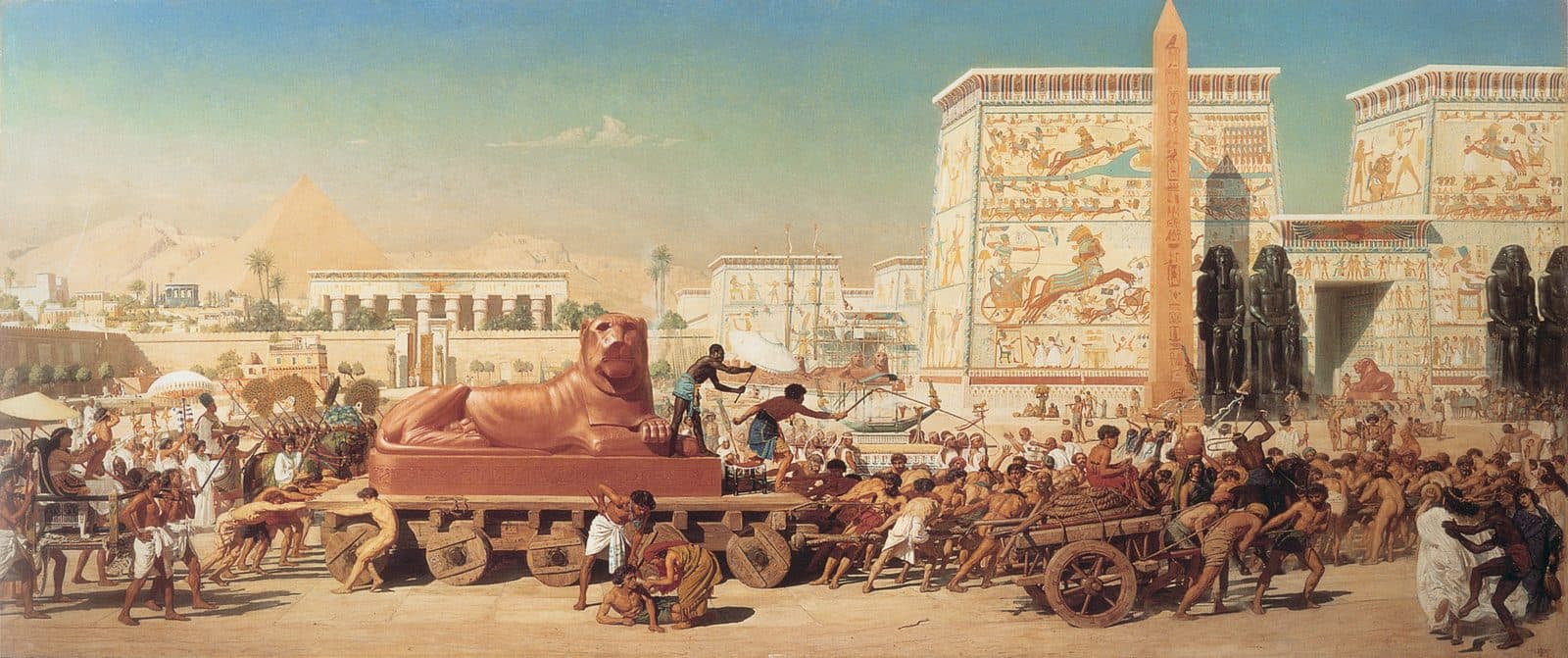
Edward Poynter, Israel in Egypt, 1867, oil on canvas, Guildhall Art Gallery, London. Public domain, via Wikimedia Commons.
THE ARTWORKPoynter painted the forced labour of Exodus 1:11, with the Israelites dragging a statue through a city of Pharaoh.
The Israelites built Pharaoh a store city named Rameses, and that name stands at the centre of the debate over their departure.
Summary
One reading dates the exodus about 1446 BC from the 480 years of 1 Kings 6:1, and the other dates it to the thirteenth century BC from the city of Exodus 1:11.
- The Septuagint and the Samaritan Pentateuch add the land of Canaan to the 430 years of Exodus 12:40.
- Rashi counts 210 of those years in Egypt, and Josephus 215.
- Seder Olam Rabbah and C. F. Keil read the 480 years as a plain total, and Petrie and Driver set the exodus after Rameses II.
- A stele of King Merenptah names Israel as a people in Canaan.
- Eugene Merrill holds the early date today and Kenneth Kitchen the late one.
The Texts Both Dates Read
the three verses every reckoning of the exodus has to answer
In the four hundred and eightieth year after the Israelites had come out of the land of Egypt, in the month of Ziv, the second month of the fourth year of Solomon’s reign over Israel, he began to build the house of the LORD.Albert Barnes notes that the earlier part of the received chronology depends on this verse, because the other dates of the Old Testament leave several periods unstated.
So the Egyptians appointed taskmasters over the Israelites to oppress them with forced labor. As a result, they built Pithom and Rameses as store cities for Pharaoh.The name of the second city is the late date's chief text, and every early reckoning has to account for it.
Now the duration of the Israelites’ stay in Egypt was 430 years. At the end of the 430 years, to the very day, all the LORD’s divisions went out of the land of Egypt.Where these years were spent decides how long Israel lived in Egypt, and the Hebrew, the Greek and the rabbis answer differently.
The Counts in the Text
nine counts of years and ages that the two dates have to fit
| Text | Count | What it measures | Reading it serves | Verse |
|---|---|---|---|---|
| Hebrew | 400 years | Abram's descendants enslaved in a land not their own | all three reckonings of the stay | Genesis 15:13 |
| Hebrew | 430 years | the stay in Egypt | the long stay of Keil | Exodus 12:40 |
| Septuagint and Samaritan | 430 years | the sojourn of the fathers and of Israel together | the short stay | Exodus 12:40 |
| Greek | 430 years | from the covenant with Abraham to the law | the short stay, as Keil reads Paul | Galatians 3:17 |
| Hebrew | 30 years | Joseph's age when he entered Pharaoh's service | both readings | Genesis 41:46 |
| Hebrew | 130 years | Jacob's age when he stood before Pharaoh | the years from Abram's call to the descent into Egypt | Genesis 47:9 |
| Hebrew | 480th year | from the exodus to the fourth year of Solomon | the early date | 1 Kings 6:1 |
| Septuagint | 440th year | the same span | neither date; Keil, after Preuss, traces it to a reckoning by genealogy | 1 Kings 6:1 |
| Hebrew | 300 years | Israel in Heshbon to the days of Jephthah | the early date, in Seder Olam Rabbah's sum | Judges 11:26 |
- Text
- Hebrew
- Count
- 400 years
- What it measures
- Abram's descendants enslaved in a land not their own
- Reading it serves
- all three reckonings of the stay
- Verse
- Genesis 15:13
- Text
- Hebrew
- Count
- 430 years
- What it measures
- the stay in Egypt
- Reading it serves
- the long stay of Keil
- Verse
- Exodus 12:40
- Count
- 430 years
- What it measures
- the sojourn of the fathers and of Israel together
- Reading it serves
- the short stay
- Verse
- Exodus 12:40
- Text
- Greek
- Count
- 430 years
- What it measures
- from the covenant with Abraham to the law
- Reading it serves
- the short stay, as Keil reads Paul
- Verse
- Galatians 3:17
- Text
- Hebrew
- Count
- 30 years
- What it measures
- Joseph's age when he entered Pharaoh's service
- Reading it serves
- both readings
- Verse
- Genesis 41:46
- Text
- Hebrew
- Count
- 130 years
- What it measures
- Jacob's age when he stood before Pharaoh
- Reading it serves
- the years from Abram's call to the descent into Egypt
- Verse
- Genesis 47:9
- Text
- Hebrew
- Count
- 480th year
- What it measures
- from the exodus to the fourth year of Solomon
- Reading it serves
- the early date
- Verse
- 1 Kings 6:1
- Text
- Septuagint
- Count
- 440th year
- What it measures
- the same span
- Reading it serves
- neither date; Keil, after Preuss, traces it to a reckoning by genealogy
- Verse
- 1 Kings 6:1
- Text
- Hebrew
- Count
- 300 years
- What it measures
- Israel in Heshbon to the days of Jephthah
- Reading it serves
- the early date, in Seder Olam Rabbah's sum
- Verse
- Judges 11:26
The Early Date and the Late Date
five reckonings of the date, each under its own holders
The 480 years read as yearsC. F. Keil, The Books of the Kings; Eugene Merrill, Fixed Dates in Patriarchal Chronology
C. F. Keil, in his commentary on 1 Kings 6:1, holds the number 480 correct against the 440th year of the Septuagint and the differing figures of Josephus.
Eugene Merrill, in Fixed Dates in Patriarchal Chronology (1980), reads the 480 years as a plain total and places the exodus in 1446 BC.
The objection is W. M. Flinders Petrie's, who held that later compilers reached the 480 years by adding the periods of Judges end to end.
Seder Olam Rabbah, the year 2448 from creationSeder Olam Rabbah, chapters 1, 3 and 15; Matthew Henry, Commentary on the Whole Bible
The rabbinic chronology Seder Olam Rabbah reaches 480 by adding three hundred years to Jephthah's second year, 140 years from then to the temple and the forty years in the wilderness.
It counts 1,656 years from Adam to the Flood and 392 from the Flood to the birth of Isaac. It spreads the four hundred years of Genesis 15:13 over the whole time Abraham's offspring were strangers in lands not their own. By its own figures the exodus falls in the year 2448 from creation.
Matthew Henry reads Jephthah's three hundred years as a title that time had settled.
“So that, supposing their title had not been clear at the first (which yet he had proved it was), yet, no claim having been made for so many generations, the entry of the children of Ammon, without doubt, was barred for ever.”
Matthew Henry · Commentary on the Whole Bible · on Judges 11:26Puritan
James Ussher, 1491 BCJames Ussher, The Annals of the World
James Ussher, in The Annals of the World (1658), placed the exodus in the year 2513 from creation, 1491 BC, and the foundation of the temple in 1012 BC.
Under Merenptah, 1234 to 1214 BCW. M. Flinders Petrie, Egypt and Israel; S. R. Driver, The Book of Exodus
Petrie, in Egypt and Israel (1911), held that the store city Rameses and the land of Rameses set the exodus after Rameses II, whom he dated 1300 to 1234 BC. He placed the exodus about 1220 BC.
He also held that Egypt raided Palestine down to 1194 BC while the book of Judges records no Egyptian action, so the entry into Canaan came after that year.
S. R. Driver, in The Book of Exodus (1911), named Rameses II the Pharaoh of the oppression, since Naville had shown that Rameses II founded Pithom. He set the exodus under the next king, Merenptah, whom he dated 1234 to 1214 BC after Petrie.
The objection is Keil's, who holds that the 480 years agree with the period of the Judges when that period is rightly estimated.
About 1260 BCKenneth Kitchen, On the Reliability of the Old Testament
Kenneth Kitchen, in On the Reliability of the Old Testament (2003), allows that the 480 years may count twelve generations of forty years, and he dates the exodus about 1260 BC.
The objection is Keil's, who quotes Thenius: where the king's year and the month are given, the main number rests on something more than mere computation.
What the Text Says of the Date
two things the verses state about the city of Rameses
RAMESES BEFORE MOSES
The Israelites built Rameses before the birth of Moses, which Exodus 2 tells next, so the oppression had begun before he was born.
RAMESES IN JOSEPH'S DAY
Genesis already calls the land where Joseph settled his father and brothers the district of Rameses.
Rameses and Pithom
the store cities of Exodus 1:11, and the stele that names Israel
The commentators placed the two cities by their Greek names.
“Pithom (Greek, Patumos), lay on the eastern Pelusiac branch of the Nile, about twelve Roman miles from Heliopolis; and Raamses, called by the Septuagint Heroopolis, lay between the same branch of the Nile and the Bitter Lakes.”
Jamieson, Fausset & Brown · Commentary Critical and Explanatory on the Whole Bible · on Exodus 1:11Reformed
Albert Barnes calls Rameses the principal city of Goshen and the place where Israel gathered to set out. John Gill reports that the Targum of Jonathan takes Rameses to be Pelusium.
Adam Clarke names the new king of Exodus 1:8 as probably Ramesses Miamun or his son Amenophis, and he places the son's accession about 1604 BC.
Driver gives the text of a stele of Merenptah's fifth year, found at Thebes in 1896. On it Israel is written with the sign for a people, while the other names carry the sign for a land, and the line says Israel is laid waste and its seed is no more.
Petrie dated the stele a few years before the exodus and took it to show that some Israelites were then living in Palestine.
How the Date Was Reckoned
two ancient reckonings, the Jewish historian's and the rabbis'
Josephus and the shepherds of ManethoFlavius Josephus, Antiquities of the Jews; Against Apion
Josephus, in Antiquities 8.3.1, counts 592 years from the exodus to the building of the temple.
In Against Apion 1.16 he takes the shepherds of the Egyptian priest Manetho to be Israel's forefathers. In Against Apion 1.26 he says Tethmosis was king when they went away.
The years of bondageSeder Olam Rabbah, chapter 3
Seder Olam Rabbah dates the start of the bondage to the death of Levi, 116 years before the exodus. It holds that the bondage lasted no fewer than 87 years, the age of Miriam, whose name it ties to the bitterness of those years.
What the Text Leaves Unsaid
two things the text leaves open
The Temple Dated from the Exodus
why Kings measures Solomon's house from the going out of Egypt
Keil observes that Kings dates the temple by the exodus as well as by Solomon's reign, because the house marked an epoch in the kingdom of God. It was to be the pledge that Israel would keep the land the LORD had promised.
And there I have provided a place for the ark, which contains the covenant of the LORD that He made with our fathers when He brought them out of the land of Egypt.”At the dedication Solomon joins the ark's place in the house to the covenant the LORD made when He brought Israel out of Egypt.
John Wesley on the Long Years
the promise that waited 430 years, and the house that waited 480
Wesley reads the exodus as the day the promise to Abraham began to be kept.
“So long the promise God made to Abraham lay dormant and unfulfilled, but now, it revived, and things began to work towards the accomplishment of it. The first day of the march of Abraham's seed towards Canaan was four hundred and thirty years (it should seem, to a day) from the promise made to Abraham, Gen. xii, 2.”
John Wesley · Explanatory Notes upon the Old Testament · on Exodus 12:40Evangelical
On 1 Kings 6:1 he gives two reasons the house was so long in coming.
“So long it was before that holy house was built, which in less than four hundred and thirty years was burnt by Nebuchadnezzar. It was thus deferred, because Israel had by their sins, made themselves unworthy of this honour: and because God would shew how little he values external pomp and splendour in his service.”
John Wesley · Explanatory Notes upon the Old Testament · on 1 Kings 6:1Evangelical
Where the 430 Years Begin
three reckonings of the stay in Egypt, from the Hebrew text, the Greek and the rabbis
These were the names of the sons of Levi according to their records: Gershon, Kohath, and Merari. Levi lived 137 years. The sons of Gershon were Libni and Shimei, by their clans. The sons of Kohath were Amram, Izhar, Hebron, and Uzziel. Kohath lived 133 years. The sons of Merari were Mahli and Mushi. These were the clans of the Levites according to their records. And Amram married his father’s sister Jochebed, and she bore him Aaron and Moses. Amram lived 137 years.The ages given here, from Levi to Amram, are the numbers the three reckonings below argue over.
In Egypt aloneC. F. Keil, The Pentateuch, volume 2
Against a short stay he sets the nine or ten generations from Joseph to Joshua in 1 Chronicles 7:20 to 27, which fit 430 years and do not fit 215.
The objection is the genealogy of Moses, since Rashi adds the lives of Kohath and Amram to the eighty years of Moses and finds that they fall short of 430.
From Abraham's coming into Canaanthe Septuagint and the Samaritan Pentateuch, as John Gill reports them; Flavius Josephus, Antiquities 2.15.2; James Ussher; Adam Clarke
John Gill reports that the Septuagint adds the land of Canaan to Exodus 12:40, and that the Samaritan reads the stay of the Israelites and their fathers in Canaan and in Egypt.
Josephus puts the exodus 430 years after Abraham came into Canaan and 215 years after Jacob went down to Egypt. Ussher counts the 430 years from the day Abram set out at God's call, so that the exodus fell on their last day.
Adam Clarke quotes Kennicott that the Israelites did not dwell 430 years in Egypt.
Keil's objection is that the Alexandrian translators altered the text to suit the genealogy of Moses in Exodus 6. He adds that Paul followed their reckoning in Galatians 3:17 because exact chronology had no bearing on his point.
From the covenant between the piecesSeder Olam Rabbah, chapter 1; Rashi on Exodus 12:40
Seder Olam Rabbah sets the covenant between the pieces in Abraham's seventieth year and counts the 430 years of Exodus 12:41 from it.
Rashi counts the four hundred years of Genesis 15:13 from the birth of Isaac, thirty years after the covenant, and finds 210 years from Israel's coming into Egypt to the exodus. He adds that this verse was one of the passages altered in the translation made for King Ptolemy.
Keil's objection is the witness of Onkelos, the Syriac and the Vulgate to the Hebrew reading.
Books on the Date
six works on the counts and the cities, each free to read
Biblical Commentary on the Old Testament: The Pentateuch, volume 2
C. F. Keil and F. Delitzsch, translated by James Martin · 1871 to 1878
This volume is where Keil answers the Septuagint on Exodus 12:40 to 41.
Read at the Internet ArchiveThe Books of the Kings
C. F. Keil, translated by James Martin · 1872
Keil defends the 480 years of 1 Kings 6:1 on page 67 and in its footnote.
Read at the Internet ArchiveEgypt and Israel
W. M. Flinders Petrie · 1911
Petrie's third chapter gives his case for an exodus about 1220 BC.
Read at the Internet ArchiveThe Book of Exodus
S. R. Driver · 1911
Driver's introduction surveys Egypt under Rameses II and Merenptah and gives the stele in English.
Read at the Internet ArchiveAntiquities of the Jews
Flavius Josephus, translated by William Whiston · 1737
Josephus gives his counts of the exodus in Book 2, chapter 15, and Book 8, chapter 3.
Read at Project GutenbergThe Annals of the World
James Ussher · 1658
Ussher's fourth age begins in the year of the exodus and gives its events by month and day.
Read at the Internet ArchiveA Night to Be Observed
the command of Exodus 12:42 and the Passover Paul names in Christ
Readers who differ over the century of the exodus read the same command to keep its night, and the New Testament reads that night in Christ.
Because the LORD kept a vigil that night to bring them out of the land of Egypt, this same night is to be a vigil to the LORD, to be observed by all the Israelites for the generations to come.This verse makes the night of the going out a vigil Israel keeps for the generations to come, and Paul reads that vigil next.
Get rid of the old leaven, that you may be a new unleavened batch, as you really are. For Christ, our Passover lamb, has been sacrificed. Therefore let us keep the feast, not with the old bread, leavened with malice and wickedness, but with the unleavened bread of sincerity and of truth.Paul turns the night of Exodus 12 into the daily life of the church, and the reader is asked to live it out.
Keep studying
Read it4
Studies6