
Leviticus 10 · A Story
Nadab and Abihu: the unauthorized fire
The account of Leviticus 10, read with the climb of Exodus 24, the record of Numbers 3 and the warning that opens Leviticus 16.
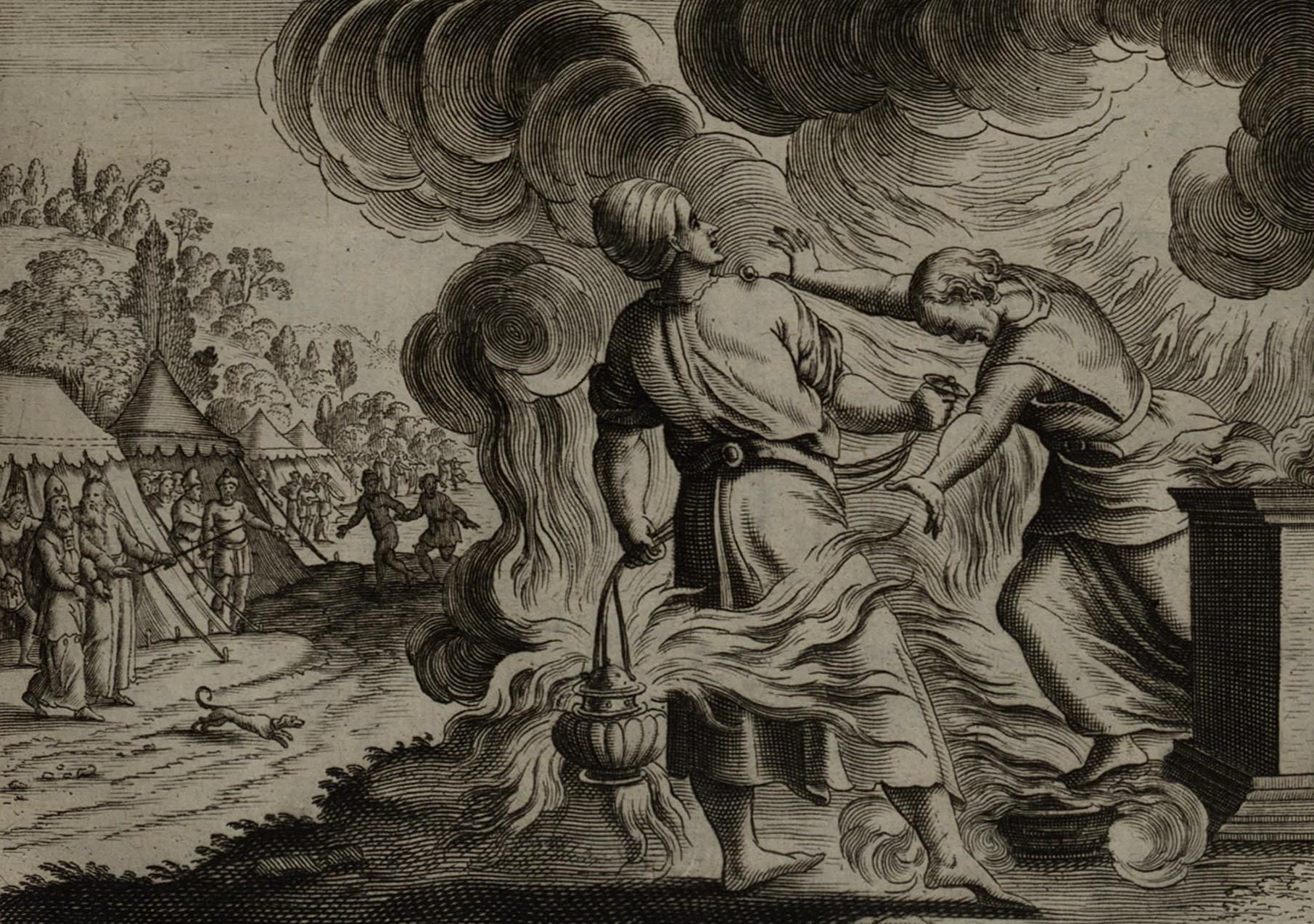
Gérard Jollain, The Death of Nadab and Abihu, engraving published in La Saincte Bible (Paris, 1670). Public domain by date. Wikimedia Commons, File:Jollain Death of Nadab and Abihu.jpg.
THE ARTWORKJollain engraved Leviticus 10:2 for a French illustrated Bible of 1670. He sets the two sons in the flame beside the altar, with the elders watching from the tents.
The fire that had just accepted Israel's first sacrifice broke out the same day against two of Aaron's sons.
Summary
Nadab and Abihu, newly ordained priests, offered incense with fire the LORD had not commanded, and they died at the tabernacle (Leviticus 10:1 to 2).
- Moses gave the LORD's own reason, “To those who come near Me I will show My holiness” (Leviticus 10:3).
- Aaron and his two remaining sons were forbidden to mourn, while the whole house of Israel mourned (Leviticus 10:6).
- Eleazar and Ithamar carried on the priesthood, and every later priest descends from them (1 Chronicles 24:2).
The Eighth Day and the Fire
Leviticus 9:1 to 10:20, from Aaron's first offering to his answer to Moses
For seven days Aaron and his four sons stayed at the entrance of the Tent of Meeting while Moses ordained them. On the eighth day Aaron offered the first sacrifices of his priesthood and blessed the people. He went into the tent with Moses, and when they came out the glory of the LORD appeared to everyone.
Then the two eldest sons came before the altar with fire God had not asked for, and they were struck dead where they stood.
Two cousins carried the bodies out of the camp. The LORD then gave Aaron a law against wine in the sanctuary. Later that day Moses and Aaron disagreed over one of the offerings, and Moses accepted Aaron's reason.
The two fires, in the versesLeviticus 9:24 and 10:1 to 2
Fire came out from the presence of the LORD and consumed the burnt offering and the fat portions on the altar. And when all the people saw it, they shouted for joy and fell facedown.This verse shows the LORD accepting the worship He had commanded, the measure by which Leviticus 10:1 is judged.
Now Aaron’s sons Nadab and Abihu took their censers, put fire in them and added incense, and offered unauthorized fire before the LORD, contrary to His command. So fire came out from the presence of the LORD and consumed them, and they died in the presence of the LORD.These two verses hold the whole event, the fault and the judgment, and the rest of the chapter answers them.
Moses' word and Aaron's silenceLeviticus 10:3
Then Moses said to Aaron, “This is what the LORD meant when He said: ‘To those who come near Me I will show My holiness, and in the sight of all the people I will reveal My glory.’” But Aaron remained silent.Moses speaks this verse over the bodies, before anyone moves them.
“Rather, I will sanctify myself in them that come near to me (i. e. the priests), and I will glorify myself before all the people. The words used by Moses on this occasion are not found elsewhere in the Pentateuch. But the sense is implied in such passages as Exo 19:22; Exo 28:41; Exo 29:1, Exo 29:44. Aaron’s silence (compare Psa 39:9) on this occasion may be compared with his reasonable and natural expostulation with Moses when his surviving sons were rebuked for not having eaten the flesh of the sin-offering Lev 10:19.”
Albert Barnes · Notes, Explanatory and Practical, on the Old and New Testaments (1832-1869) · on Leviticus 10:3Evangelical
The Day in Order and the Court in Cubits
The day's events in order, and the court drawn to the cubits of Exodus 27
Every event of Leviticus 9:1 to 10:20 falls on the eighth day of the ordination.
- Days 1 to 7The ordination of Aaron and his four sonsLeviticus 8:33 to 35
- Day 8Moses summons Aaron, his sons and the elders of IsraelLeviticus 9:1
- Day 8Aaron makes the sin, burnt and peace offerings and blesses the peopleLeviticus 9:22
- Day 8Fire from the presence of the LORD consumes the offering on the altarLeviticus 9:24
- Day 8Nadab and Abihu offer unauthorized fire and die before the LORDLeviticus 10:1 to 2
- Day 8Mishael and Elzaphan remove the dead from before the sanctuaryLeviticus 10:4 to 5
- Day 8The LORD forbids wine and strong drink to priests entering the tentLeviticus 10:8 to 9
- Day 8Moses questions Eleazar and Ithamar, and Aaron repliesLeviticus 10:16 to 20
A timeline of eight stops, Leviticus 8:33 to 10:20, each with its verse.
Aaron and his sons served between the bronze altar and the veil, and only Aaron could go behind it.
10 cubits, about 4.5 m (15 feet)
- The court100 cubits by 50, with linen curtains 5 cubits highExodus 27:18
- The Most Holy Placebehind the veilLeviticus 16:2
- The altar of incensea cubit square, in front of the veilExodus 30:6
- The tent's entrancethe door of the Holy Place, with the altar in front of itExodus 40:6
- The basinbetween the tent and the altarExodus 30:18
- The bronze altar5 cubits square, where the fire consumed the offeringLeviticus 9:24
- The gate20 cubits wide, on the eastExodus 27:16
- Outside the campbeyond the gate, at a distance the text does not giveLeviticus 10:5
10 cubits, about 4.5 m (15 feet)
The text gives the court, the gate and both altars in cubits. The tent's 30 by 10 cubits and its two rooms follow the usual reckoning from its frames, the places of the tent, the basin and the altar follow the order of Exodus 40:6 to 7, and the distance to the edge of the camp is not given. A cubit is about 18 inches.
Drawn to scale in cubits, east to the right. The deeper the shade, the nearer a place stands to the Most Holy Place.
What the Text Says and What Is Said of It
Four retellings set beside the verses, and five Hebrew words of the account
“THEY WERE DRUNK”
The account names no wine at the deaths, and the law against wine follows in Leviticus 10:9.
“THE FIRE BURNED THEIR BODIES”
The cousins carried them out still in their tunics, so the bodies and the garments were whole.
“AARON PROTESTED”
His only recorded words that day come in Leviticus 10:19, and they concern the sin offering.
“THE FAULT WAS THE INCENSE”
The verse faults the fire, offered contrary to His command. The incense is named only as what they added to it.
| Word | Sense in this account | Where |
|---|---|---|
| esh zarah (h784, h2114) | Fire that is zarah, from a verb meaning to be a stranger. Numbers 3:4 and 26:61 repeat the same two words. | Leviticus 10:1 |
| qetoret zarah (h7004, h2114) | The same adjective set on incense, which the law forbids on the altar of incense. | Exodus 30:9 |
| machtah (h4289) | A pan for live coals, the censer each son took. | Leviticus 10:1 |
| qarab and qarob (h7126, h7138) | The verb for presenting the fire means to approach or bring near, and Moses' word for those who come near means near. Both are spelled with the same three letters. | Leviticus 10:1 and 3 |
| damam (h1826) | To be still or quiet, the verb of the last clause of Leviticus 10:3. | Leviticus 10:3 |
Aaron's House and the Mountain
The four sons by name, the climb of Exodus 24, and the record kept after the deaths
Aaron married Elisheba, and she bore four sons: Nadab the firstborn, Abihu, Eleazar and Ithamar (Exodus 6:23; Numbers 3:2). All four were called to serve as priests with their father (Exodus 28:1).
At Sinai, before the tabernacle stood, the LORD had told the two sons to worship at a distance (Exodus 24:1).
Mishael and Elzaphan, whom Moses summoned for the task, were sons of Uzziel, the brother of Aaron's father Amram (Exodus 6:18 and 22). Albert Barnes, in his Notes on the Old Testament, holds that Moses chose them as the nearest kin who were not priests.
The record returns to the deaths three times. Numbers 3:4 places them in the Wilderness of Sinai and adds that the two left no sons. Numbers 26:61 repeats the cause, and 1 Chronicles 24:1 to 2 names the two again before the courses of the priests.
The two sons on the mountainExodus 24:9 to 11
Then Moses went up with Aaron, Nadab and Abihu, and seventy of the elders of Israel, and they saw the God of Israel. Under His feet was a work like a pavement made of sapphire, as clear as the sky itself. But God did not lay His hand on the nobles of Israel; they saw Him, and they ate and drank.The same two sons had been in the company that met God on the mountain and lived.
“They feasted upon the sacrifice, before God, in token of their cheerful consent to the covenant now made, their grateful acceptance of the benefits of it, and their communion with God, in pursuance of that covenant. Thus believers eat and drink with Christ at his table, Luke xxii.”
Matthew Henry · Commentary on the Whole Bible · on Exodus 24:11Puritan
The record after the deathsNumbers 3:4 and 1 Chronicles 24:2
Nadab and Abihu, however, died in the presence of the LORD when they offered unauthorized fire before the LORD in the Wilderness of Sinai. And since they had no sons, only Eleazar and Ithamar served as priests during the lifetime of their father Aaron.Moses' census of the Levites keeps the deaths in the family record.
But Nadab and Abihu died before their father did, and they had no sons; so Eleazar and Ithamar served as priests.David's priestly courses descend from the two younger brothers alone.
What the Text Leaves Unsaid
The chapter tells the deaths in two verses and leaves four questions open.
Where did their fire come from?Leviticus 10:1 and 16:12
The text calls the fire unauthorized and never says where it was taken from. Leviticus 16:12, given after the deaths, directs the high priest to take his coals from the altar before the LORD.
How old were they?Exodus 6:23
No age is given for either son, and no wife is named. The record says only that they had no sons.
Where were they buried?Leviticus 10:4 to 5
The text names no grave beyond the camp.
Did they speak?Leviticus 10:1 to 2
Neither son says a word in the account, and no reason of theirs is given.
To Those Who Come Near Me
What Leviticus 10:3 states, how Leviticus 16 answers it, and where the New Testament takes the warning
The priests stood nearest to the LORD's presence, and the fire showed that nearness carried a charge with its privilege.
Now the LORD spoke to Moses after the death of two of Aaron’s sons when they approached the presence of the LORD. And the LORD said to Moses: “Tell your brother Aaron not to enter freely into the Most Holy Place behind the veil in front of the mercy seat on the ark, or else he will die, because I appear in the cloud above the mercy seat.Moses is to give this warning to Aaron himself, the father of the two men.
Leviticus 16 then gives the one way into the Most Holy Place, once a year, with blood and with coals from the altar; the Day of Atonement sets out the full rite.
Hebrews on drawing nearHebrews 10:22 and 12:28 to 29
let us draw near with a sincere heart in full assurance of faith, having our hearts sprinkled to cleanse us from a guilty conscience and our bodies washed with pure water.The letter urges an approach with a cleansed heart, by the way Christ opened.
Therefore, since we are receiving an unshakable kingdom, let us be filled with gratitude, and so worship God acceptably with reverence and awe. “For our God is a consuming fire.”The letter ends its warnings by calling God a consuming fire and asking for worship with reverence.
Barnes on Leviticus 16:1
“The reference to the death of Nadab and Abihu is a notice of the occasion on which the instructions were given, well calculated to add point and emphasis to the solemn admonition to the high priest in the second verse. The death of his sons Lev 10:2, for drawing near to Yahweh in an unauthorized manner, was to serve as a warning to Aaron himself never to transgress in this respect.”
Albert Barnes · Notes, Explanatory and Practical, on the Old and New Testaments (1832-1869) · on Leviticus 16:1Evangelical
Two later deaths at holy things2 Samuel 6:7 and Acts 5:5
And the anger of the LORD burned against Uzzah, and God struck him down on the spot for his irreverence, and he died there beside the ark of God.Uzzah dies beside the ark for his irreverence, the same judgment at a holy thing.
On hearing these words, Ananias fell down and died. And great fear came over all who heard what had happened.Ananias falls dead at the start of the church, which Jamieson, Fausset and Brown set beside Leviticus 10:2 in their Commentary Critical and Explanatory (1871).
How the Teachers Read the Fire
Teachers from the third century to the nineteenth on the deaths and on Aaron's answer
Cyprian on worship by human authority
“The sons of Aaron also, who set upon the altar a strange fire not commanded by the Lord, were at once blotted out in the sight of the avenging Lord. These examples, you will see, are being followed wherever the tradition which comes from God is despised by lovers of strange doctrine and replaced by teaching of merely human authority.”
Cyprian · Treatise I. On the Unity of the Church 18-19 · on Leviticus 10:1Patristic
Rashi on the fire within and the two physiciansRashi on Leviticus 10:5 and 16:1 (11th century)
Rashi takes Leviticus 10:5 to mean that the fire entered the two men and killed them from within, leaving no outward burning. On Leviticus 16:1 he gives Rabbi Elazar ben Azariah's parable of two physicians. The one who adds that a man died of the same fault warns the patient more than the one who gives only the rule (the Rosenbaum and Silbermann translation).
Barnes on the fire that sanctified and destroyed
“The fire which had just before sanctified the ministry of Aaron as well pleasing to God, now brought to destruction his two eldest sons because they did not sanctify Yahweh in their hearts, but dared to perform a self-willed act of worship; just as the same Gospel is to one a savor of life unto life, and to another a savor of death unto death 2Co 2:16.”
Albert Barnes · Notes, Explanatory and Practical, on the Old and New Testaments (1832-1869) · on Leviticus 10:2Evangelical
Barnes on Aaron's answer
“That is: ‘Behold this very day, in which we have done our part in sacrificing sin-offerings and burnt-offerings to the Lord, this great calamity has befallen me. Could it have been well-pleasing to the Lord if those who have been so humbled as I and my sons have been by the sin of our relations and the divine judgment, had feasted on the most holy flesh of the sin-offering?’”
Albert Barnes · Notes, Explanatory and Practical, on the Old and New Testaments (1832-1869) · on Leviticus 10:19Evangelical
Where the Readers Divide
Readers divide on two questions: what made the fire unauthorized, and why Moses accepted Aaron's answer over the burned goat.
What made the fire unauthorizedLeviticus 10:1 and 10:8 to 9
Leviticus 10:1 states one cause, and readers have proposed others. Rashi on Leviticus 10:2 reports two rabbis. Rabbi Ishmael held that the sons entered the sanctuary drunk with wine, reading verses 8 to 9 as the cause. Rabbi Eliezer held that they gave rulings in the presence of Moses their teacher. On Leviticus 10:9, Jamieson, Fausset and Brown, in their Commentary Critical and Explanatory (1871), record the opinion that the two priests were drunk. Albert Barnes, in his Notes on the Old Testament, holds that the incense was probably lit at an unauthorized time. John Wesley, in his Explanatory Notes upon the Old Testament (1765), argues from Leviticus 6:12 that fire from any other source was forbidden.
“Now as this was forbidden implicitly; chap. vi, 12, especially when God himself made a comment upon that text, and by sending fire from heaven declared of what fire he there spake; so it is more than probable it was forbidden expressly, though that be not here mentioned, nor was it necessary it should be.”
John Wesley · Explanatory Notes upon the Old Testament · on Leviticus 10:1Evangelical
Why Moses was satisfiedLeviticus 10:16 to 20
But Aaron replied to Moses, “Behold, this very day they presented their sin offering and their burnt offering before the LORD. Since these things have happened to me, if I had eaten the sin offering today, would it have been acceptable in the sight of the LORD?” And when Moses heard this explanation, he was satisfied.Aaron ties the burned goat to what had happened to him that very day.
Rashi counts three goats of the sin offering that day and reports two views of why the third was burned: something unclean had touched it, or the priests' mourning barred them from eating it. He reads Leviticus 10:20 as Moses admitting that he had heard the rule and forgotten it. Adam Clarke, in his Commentary on the Bible (1832), reads the same verse as Moses yielding to the good sense of Aaron's argument, since God showed no displeasure.
The Great Books on This Story
Commentary on the Whole Bible
Matthew Henry · 1710
Henry preaches Leviticus 8 to 10 verse by verse and reads the priests' rites as figures of Christ.
Read it free at CCELExplanatory Notes upon the Old Testament
John Wesley · 1765
Wesley weighs where the fire came from and why Moses spared Aaron his rebuke, in short and exact notes.
Read it free at CCELPentateuch with Rashi's Commentary
Rashi, translated by M. Rosenbaum and A. M. Silbermann · 1929 to 1934
Rashi gathers the rabbis' readings of the deaths, the three goats and Moses' admission in one running commentary.
Read it free at SefariaThe Charge of Those Who Come Near
“You and your sons are not to drink wine or strong drink when you enter the Tent of Meeting, or else you will die; this is a permanent statute for the generations to come. You must distinguish between the holy and the common, between the clean and the unclean, so that you may teach the Israelites all the statutes that the LORD has given them through Moses.”On the day of the deaths the LORD gives the priests their charge, kept sober to tell the holy from the common and to teach it.
Therefore, brothers, since we have confidence to enter the Most Holy Place by the blood of Jesus, by the new and living way opened for us through the curtain of His body, and since we have a great priest over the house of God,Hebrews answers the warning of Leviticus 16:2 with access for every believer.
The text asks the reader to come near God as He commands, through the priest He has given.