

Genesis 3 · Symbol · Featured Study
The Serpent
A symbol study of the serpent from the garden to the bronze serpent and the dragon of Revelation, with the Hebrew and Greek words and one reading in dispute.
The serpent is the first voice in the Bible to question what God said.
- The word
- נָחָשׁ (nachash), H5175
- First appears
- Genesis 3:1 “Now the serpent was more…”
Hugo van der Goes, The Fall, about 1467. Public domain.
Summary
The serpent is a creature of the field in Genesis 3. Scripture follows it through the law, the prophets and the Gospels.
- Genesis calls the serpent more crafty than any beast of the field. The word is arum, close in sound to arummim, naked, in Genesis 2:25.
- God curses it to go on its belly and eat dust, and Isaiah 65:25 keeps that curse in the new creation.
- In Numbers 21 a bronze serpent on a pole heals the bitten. Jesus names it as a picture of His own lifting up.
- Revelation calls the dragon that ancient serpent, the devil and Satan, in chapters 12 and 20.
The Crafty Beast of the Field
Two verses give the serpent's first words and the curse that answers them.
Genesis 2 ends with the man and his wife naked and unashamed, arummim in Hebrew, and Genesis 3 opens with the serpent called arum, crafty. Strong's concordance lists the two words side by side, arom, naked, at H6174 and arum, crafty, at H6175. Each is spelled with the same four Hebrew letters, so the chapter turns on a play of sound before it turns on the fruit.
Now the serpent was more crafty than any beast of the field that the LORD God had made. And he said to the woman, “Did God really say, ‘You must not eat from any tree in the garden?’”The serpent speaks to the woman, and Genesis names her husband with her only in verse 6.
So the LORD God said to the serpent: “Because you have done this, cursed are you above all livestock and every beast of the field! On your belly will you go, and dust you will eat, all the days of your life.The sentence on the serpent comes before the sentences on the woman and the man.
The Serpent at the Tree
The Fall of the Vienna Diptych, read part by part against Genesis 3.
The painter set the serpent on its feet beside the woman, before the curse sends it onto its belly.
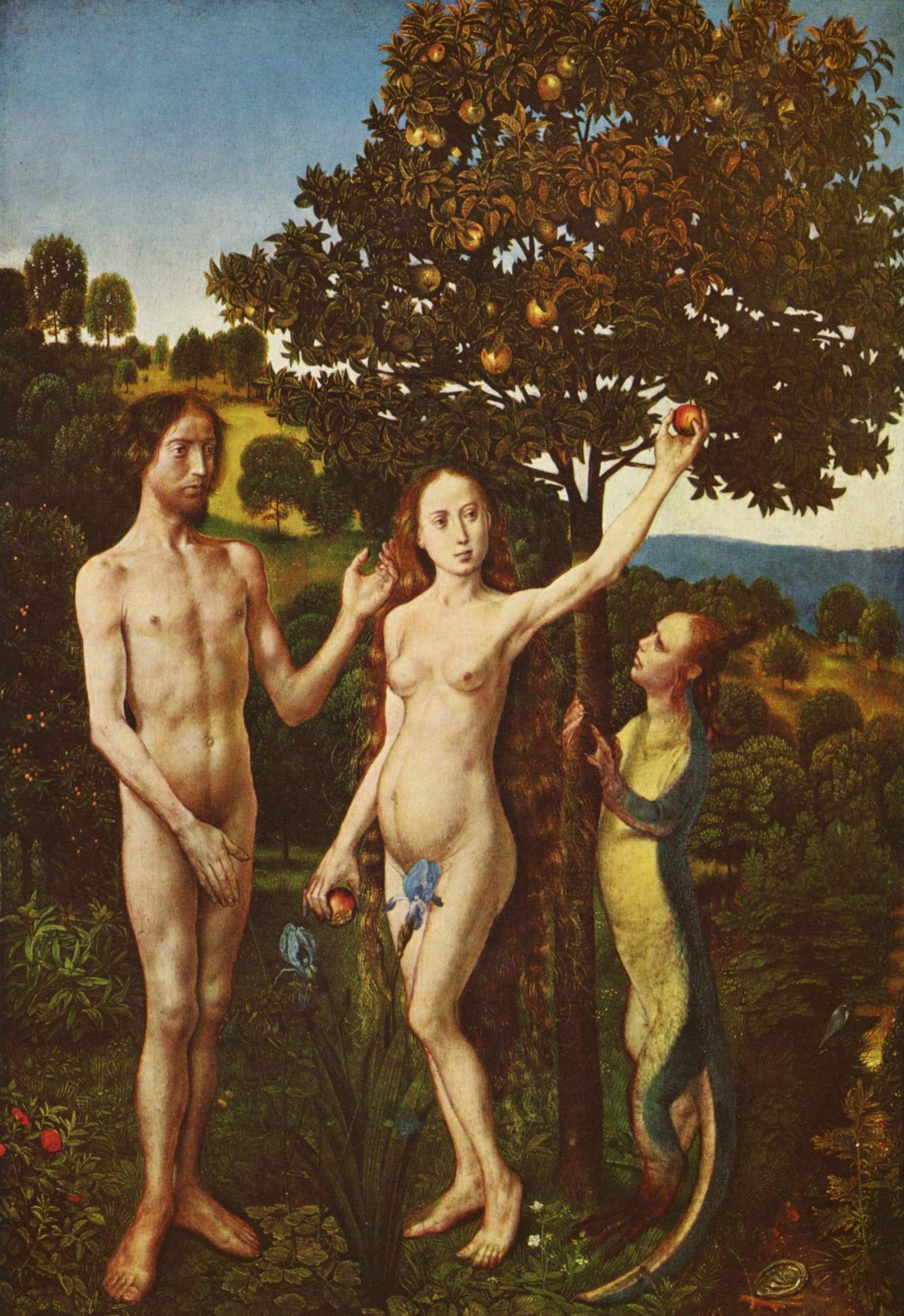
- The treeFruit hangs among the leaves over the three figures.Genesis 3:3
- The womanEve holds one fruit and reaches up for another.Genesis 3:6
- The manAdam stands beside her with his hand raised toward her.Genesis 3:6
- The serpentIts head turns toward the woman's raised hand.Genesis 3:1
- The tailA long tail runs down to the grass at the trunk's foot.Genesis 3:14
Hugo van der Goes, The Fall, about 1467. Public domain.
Five parts of the panel, each numbered where it stands, with the verse the part answers to.
The Serpent Through Scripture
Sixteen places in canon order, from the garden to the binding of the dragon.
The serpent runs from the garden of Genesis 3 to the dragon bound in Revelation 20.
- Genesis 3The crafty beast of the field, Genesis 3:1
- Genesis 49Dan a snake by the road, Genesis 49:17
- Exodus 4The staff becomes a snake, Exodus 4:3
- Exodus 7Aaron's staff swallows the staffs, Exodus 7:12
- Numbers 21The bronze snake on a pole, Numbers 21:9
- 2 Kings 18Hezekiah breaks Nehushtan, 2 Kings 18:4
- Psalm 58Venom like a cobra's, Psalm 58:4
- Isaiah 27Leviathan the coiling serpent, Isaiah 27:1
- Isaiah 65Dust the serpent's food, Isaiah 65:25
- Matthew 10Shrewd as snakes, Matthew 10:16
- Luke 10Authority to tread on snakes, Luke 10:19
- John 3As Moses lifted up the snake, John 3:14
- Acts 28Shaken off into the fire, Acts 28:5
- 2 Corinthians 11The serpent's cunning, 2 Corinthians 11:3
- Revelation 12That ancient serpent, Revelation 12:9
- Revelation 20A thousand years, Revelation 20:2
One stop for each passage in canon order; each stop opens its verse in the reader.
The staff that became a snake before PharaohExodus 4:3 and Exodus 7:12, with Albert Barnes
Albert Barnes, in his Notes on Exodus 4:3, identifies the snake as the cobra that stood on the crown of every Pharaoh, so the sign told Moses he would master the king. In Exodus 7 Pharaoh's magicians copy the sign by their magic arts.
Each one threw down his staff, and it became a serpent. But Aaron’s staff swallowed up the other staffs.The sign ends with one staff left where many were thrown down.
Hezekiah breaks the bronze snake2 Kings 18:4, with Matthew Henry and John Wesley
The snake Moses made was kept until the reign of Hezekiah, and by then Israel burned incense to it. John Wesley, in his Explanatory Notes, calls it a memorial of mercy that had become an object of superstition.
“But in process of time, when they began to worship the creature more than the Creator, those that would not worship images borrowed from the heathen, as some of their neighbours did, were drawn in by the tempter to burn incense to the brazen serpent, because that was made by order from God himself and had been an instrument of good to them.”
Matthew Henry · Commentary on the Whole Bible · on 2 Kings 18:4Puritan
What Scripture Says of the Serpent
Four verses that name what the serpent stands for, and one reading its teachers add.
THE DEVIL AND SATAN
John names the dragon as the serpent of old.
CUNNING THAT MISLEADS
Paul fears that the church will be led astray as Eve was.
THE SON OF MAN LIFTED UP
Jesus takes the bronze snake as the pattern of His death.
SATAN UNDER FOOT
Paul promises that God will crush Satan under the church's feet.
The Son of Man lifted up, Satan under foot
A real animal with Satan behind itJamieson, Fausset and Brown, on Genesis 3:1
Jamieson, Fausset and Brown note that Moses names no spirit in Genesis 3 and tells only what was seen. They hold that the Gospel reveals Satan as the author of the plot, and cite John 8:44 and Revelation 20:2.
Nachash, Arum and Ophis
The words for the snake, its cunning and the bronze it was cast in.
Nachash, the serpent, sounds like nechoshet, bronze, and Numbers 21 uses both.
| Word | Strong's number | Strong's definition | Uses |
|---|---|---|---|
| נָחָשׁ nachash | H5175 | “a snake, from its hiss” | 31 |
| עָרוּם arum | H6175 | “cunning, usually in a bad sense” | 11 |
| נְחֹשֶׁת nechoshet | H5178 | “copper, and a thing made of it” | 140 |
| נְחֻשְׁתָּן Nehushtan | H5180 | “the copper serpent of the desert” | 1 |
| שָׂרָף saraph | H8314 | “burning, so poisonous, of a serpent” | 7 |
| ὄφις ophis | G3789 | “a snake, and figuratively Satan” | 13 |
What the Text Does Not Say
Three questions about the serpent that Scripture leaves open.
The serpent passages leave the creature's shape and speech unexplained.
| What is not said | What the verse does say |
|---|---|
| How did the serpent move before the curse? | After the curse it goes on its belly. |
| How did an animal come to speak? | The serpent speaks, and the woman answers it. |
| Did Satan speak in Genesis 3? | Genesis names only the serpent the LORD God had made. |
The Serpent Lifted Up
The bronze snake of Numbers and the words of Jesus to Nicodemus stand side by side.
So Moses made a bronze snake and mounted it on a pole. If anyone who was bitten looked at the bronze snake, he would live.The cure for the snake's bite is a snake made of bronze.
Just as Moses lifted up the snake in the wilderness, so the Son of Man must be lifted up, that everyone who believes in Him may have eternal life.Jesus gives Nicodemus the same pattern for His own death.
The bitten Israelite did nothing but look, and Jesus sets believing in the place of looking.
The head and the heelGenesis 3:15
And I will put enmity between you and the woman, and between your seed and her seed. He will crush your head, and you will strike his heel.”The sentence on the serpent reaches past it to its seed.
Dust in the new creationIsaiah 65:25
In Isaiah 65 the beasts that kill are changed, and the sentence of Genesis 3:14 stands.
The wolf and the lamb will feed together, and the lion will eat straw like the ox, but the food of the serpent will be dust. They will neither harm nor destroy on all My holy mountain,” says the LORD.The verse ends the chapter that announces new heavens and a new earth in verse 17.
Voices on the Serpent
Five teachers from the second century to the nineteenth, each with the work named.
died 202 · Irenaeus
Irenaeus, in Against Heresies, reads the seed of the woman in Genesis 3:15 as Christ, who crushed the enemy that led humanity captive in Adam.
died 379 · Basil of Caesarea
Basil of Caesarea, in his Homilies on the Hexaemeron, cites the viper that fastened on Paul's hand and did him no harm as a witness that faith has power to walk upon serpents.
died 420 · Jerome
Jerome, in his Commentary on Isaiah, reports that the Hebrews read Leviathan of Isaiah 27:1 as the devil, the adversary.
1662 to 1714 · Matthew Henry
Matthew Henry, in his Commentary on John 3:14, calls the bronze serpent the last miracle that passed through the hand of Moses before his death.
1762 to 1832 · Adam Clarke
Adam Clarke, in his Commentary on the Bible, on Genesis 3:14, observes that God does not ask the tempter why he deceived the woman, since he cannot roll the blame on any other.
Jerome, Matthew Henry, Adam Clarke
Type or Contrast
Two readings of the bronze serpent, each with its holder and the strongest objection.
The bronze serpent is a type of the crossAmbrose of Milan, On the Holy Spirit 3.8.50
Ambrose of Milan holds this reading in On the Holy Spirit, and John Wesley holds it in his Explanatory Notes upon the Old Testament.
“It was good that the Lord ordained that, by the lifting up of the brazen serpent, the wounds of those who were bitten should be healed; for the brazen serpent is a type of the cross.… In the same way, the world was crucified in its allurements. Therefore not a real but a brazen serpent was hung. This is so because the Lord took on himself the likeness of a sinner in his body but, in actuality, was without sin.”
Ambrose of Milan · On the Holy Spirit 3.8.50 · on John 3:14Patristic
The objection: Scripture uses the serpent for the enemy from Genesis 3 to Revelation 12, which makes it a strange figure for the Savior.
The bronze serpent is the enemy put to deathGregory of Nazianzus, Oration 45.22
Gregory of Nazianzus, in Oration 45, reads Numbers 21:9 against the cross.
“That brazen serpent was hung up as a remedy for the biting serpents, not as a type of him that suffered for us but as a contrast. It saved those that looked upon it, not because they believed it to live but because it was killed, and killed with it were the powers that were subject to it, being destroyed as it deserved. And what is the fitting epitaph for it from us? ‘O death, where is your sting? O grave, where is your victory?’ You are overthrown by the cross.”
Gregory of Nazianzus · ORATION 45.22 · on Numbers 21:9Patristic
The objection: Jesus compares the serpent's lifting up to His own lifting up in John 3:14, which reads as a likeness.
Books to Read Next
Three public domain works, each free to read.
Against Heresies
Irenaeus · second century
Book 5, chapter 21, reads Genesis 3:15 as Christ's victory over the serpent.
Read at New AdventThe Second Oration on Easter
Gregory of Nazianzus · fourth century
Section 22 of this Easter oration reads Numbers 21:9.
Read at New AdventCommentary on the Whole Bible
Matthew Henry · 1708 to 1710
His notes follow the serpent from Genesis 3 through Numbers 21 to John 3.
Read at CCELThe Ancient Serpent Bound
The serpent that spoke first in the garden is seized and bound in Revelation 20.
Between the two stands the Son of Man lifted up, and everyone who believes in Him has eternal life.
Sources
Scripture is the Berean Standard Bible.
- James Strong, Exhaustive Concordance of the Bible, 1890, entries H5175, H6174, H6175, H5178, H5180, H8314 and G3789, with each word's count of uses.
- Jamieson, Fausset and Brown, Commentary Critical and Explanatory, 1871, on Genesis 3:1.
- Albert Barnes, Notes, Explanatory and Practical, on Exodus 4:3.
- Matthew Henry, Commentary on the Whole Bible, 1710, on 2 Kings 18:4.
- John Wesley, Explanatory Notes upon the Old Testament, 1765, on 2 Kings 18:4.
- John Wesley, Explanatory Notes upon the Old Testament, 1765, on Numbers 21:8.
- Matthew Henry, Commentary on the Whole Bible, 1710, on John 3:14.
- Ambrose of Milan, On the Holy Spirit 3.8.50.
- Gregory of Nazianzus, Oration 45.22, the Second Oration on Easter.
- Irenaeus, Against Heresies 5.21.1.
- Adam Clarke, Commentary on the Bible, 1832, on Genesis 3:14.
- Basil of Caesarea, Homilies on the Hexaemeron 9.6.
- Jerome, Commentary on Isaiah, on Isaiah 27:1.
Keep Studying
Places1