
John 18:28
in John 18Then they led Jesus away from Caiaphas into the Praetorium. By now it was early morning, and the Jews did not enter the Praetorium, to avoid being defiled and unable to eat the Passover.
BSB
The same verse in ASV and KJV ▾
ASV
They lead Jesus therefore from Caiaphas into the Prætorium: and it was early; and they themselves entered not into the Prætorium, that they might not be defiled, but might eat the passover.
KJV
Then led they Jesus from Caiaphas unto the hall of judgment: and it was early; and they themselves went not into the judgment hall, lest they should be defiled; but that they might eat the passover.
⋯
This verse in John 18
Commentary
23 notes on this verseThey lead Jesus therefore from Caiaphas into the palace: and it was early; and they themselves entered not into the palace, that they might not be defiled, but that they might eat the passover. Judge righteous judgment, and Thou shalt not slay the innocent and just man, were the express injunctions of the Law and the Word of God.
This site's exposition
to avoid being defiled
The leaders who brought Him stayed outside the Praetorium to avoid being defiled before the Passover. A Gentile house would make them unclean for the meal. The wording has been read of the festival meals of Passover week and of a different calendar reckoning from the Synoptics' account.
The record, by era
The Church Fathers5 voices
Here we might suppose either that there had been something imperative requiring Caiaphas's presence in the hall of judgment and that he was absent on the occasion when the other chief priests held an inquiry on the Lord, or else that the hall of judgment was in his house. So then, from the beginning of this scene they had only been leading Jesus away to the personage in whose presence he was at last actually conducted. But since they brought the accused person in the character of one already convicted, and since it had previously approved itself to Caiaphas's judgment that Jesus should die, there was no further delay in delivering him over to Pilate with a view to his being put to death. And so it is that Matthew here relates what took place between Pilate and the Lord.
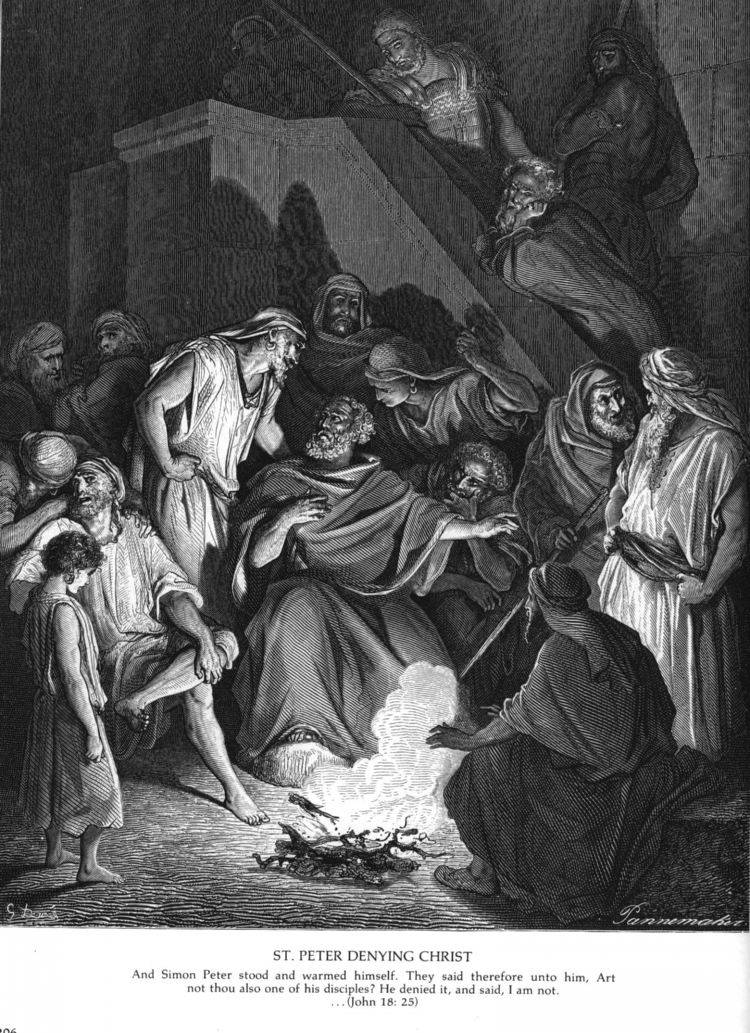
Let us now consider, so far as indicated by the evangelist John, what was done with, or in regard to, our Lord Jesus Christ, when brought before Pontius Pilate the governor. For he returns to the place of his narrative where he had left it, to explain the denial of Peter. He had already, you know, said, "And Annas sent Him bound unto Caiaphas the high priest:" and having returned from where he had dismissed Peter as he was warming himself at the fire in the hall, after completing the whole of his denial, which was thrice repeated, he says, "Then they bring Jesus unto Caiaphas into the hall of judgment (pretorium);" for he had said that He was sent to Caiaphas by his colleague and father-in-law Annas. But if to Caiaphas, why into the hall of judgment? Nothing else is thereby meant to be understood than the place where Pilate the governor dwelt. And therefore, either for some urgent reason Caiaphas had proceeded from the house of Annas, where both had met to give Jesus a hearing, to the governor's pretorium, and had left the hearing of Jesus to his father-in-law; or Pilate had made his pretorium in the house of Caiaphas, which was so large as to contain separate apartments for its own master, and the like for the judge.
"And it was morning; and they themselves," that is, those who brought Jesus, "went not into the judgment hall," to wit, into that part of the house which Pilate occupied, supposing it to be Caiaphas' house. And then in explanation of the reason why they went not into the judgment hall, he says, "lest they should be defiled; but that they might eat the passover." For it was the commencement of the days of unleavened bread: on which they accounted it defilement to enter the abode of one of another nation. Impious blindness! Would they, forsooth, be defiled by a stranger's abode, and not be defiled by their own wickedness? They were afraid of being defiled by the pretorium of a foreign judge, and had no fear of defilement from the blood of an innocent brother: not to say more than this meanwhile, which was enough to fix guilt on the conscience of the wicked. For the additional fact, that it was the Lord who was led to death by their impiety, and the giver of life that was on the way to be slain, may be charged, not to their conscience, but to their ignorance.
(Tr. cxiv) The Evangelist returns to the part where he had left off, in order to relate Peter's denial: Then led they Jesus to Caiaphas (a Caiapha Vulg.) unto the hall of judgment: to Caiaphas from his colleague and father in law Annas, as has been said. But if to Caiaphas, how to the prætorium, which was the place where the governor Pilate resided? (Tr. cxiv) Either then for some urgent reason Caiaphas proceeded from the house of Annas, where both had been sitting, to the prætorium of the governor, and left Jesus to the hearing of his father in law: or Pilate had established the prætorium in the house of Caiaphas, which was large enough to afford a separate lodging to its owner, and the governor at the same time. (de Con. Evang. l. iii. c. vii) According to Matthew, When the morning came, they led Him away, and delivered Him to Pontius Pilate. (Mat. 27:1, 2) But He was to have been led to Caiaphas at first. How is it then that He was brought to him so late? The truth is, now He was going as it were a committed criminal, Caiaphas having already determined on His death. And He was to be given up to Pilate immediately. And it was early. (Tr. xiv) And they themselves entered not into the judgment hall: i. e. into that part of the house which Pilate occupied, supposing it to be the house of Caiaphas. Why they did not enter is next explained: Lest they should be defiled, but that they might eat the Passover. (Tr. cxiv) The days of unleavened bread were beginning; during which time it was defilement to enter the house of a stranger. (Tr. cxiv) O impious blindness! They feared to be defiled by the judgment hall of a foreign prefect, to shed the blood of an innocent brother they feared not. For that He Whom they killed was the Lord and Giver of life, their blindness saved them from knowing.
We will prove that it may suffice that the death of the Christ had been prophesied, in order that, from the fact that the nature of the death had not been specified, it may be understood to have been affected by means of the cross and that the passion of the cross is not to be ascribed to any but him whose death was constantly being predicted.… For that you would do such a thing at the beginning of the first month of your new [years] even Moses prophesied when he was foretelling that all the community of the children of Israel were to sacrifice a lamb when evening came and were to eat this solemn sacrifice of this day [that is, of the Passover of unleavened bread] with bitterness." And then he added that "it was the Passover of the Lord," that is, the passion of Christ. This prediction was in this way also fulfilled that "on the first day of unleavened bread" you killed the Christ.
16 more voices on this verse
The Church Fathers4 voices
For that you would do thus at the beginning of the first month of your new (years) even Moses prophesied, when he was foretelling that all the community of the sons of lsrµl was to immolate at eventide a lamb, and were to eat this solemn sacrifice of this day (that is, of the passover of unleavened bread) with bitterness; "and added that "it was the passover of the Lord," that is, the passion of Christ. Which prediction was thus also fulfilled, that "on the first day of unleavened bread" you slew Christ; and (that the prophecies might be fulfilled) the day hasted to make an "eventide,"-that is, to cause darkness, which was made at mid-day; and thus "your festive days God converted into grief, and your canticles into lamentation.
"They lead Him therefore from Caiaphas to Pilate." This was done, in order that the number of His judges might show, even against their will, how fully tested was His truth. "And it was early." Before cock crow He was brought to Caiaphas, early in the morning to Pilate; whence the Evangelist shows, that being questioned by Caiaphas during an entire half of the night, He was in nothing proved guilty; wherefore Caiaphas sent Him on to Pilate. But leaving these things for the others to relate, John speaks of what follows next. And observe the ridiculous conduct of the Jews. They who had seized the innocent, and taken up arms, do not enter into the hall of judgment, "lest they should be polluted." And tell me, what kind of pollution was it to set foot in a judgment-hall, where wrong-doers suffer justice? They who paid tithes of mint and anise, did not think they were polluted when bent on killing unjustly, but thought that they polluted themselves by even treading in a court of justice.
"But what is, 'That they might eat the Passover?' For He had done this on the first day of unleavened bread." Either he calls the whole feast "the Passover," or means, that they were then keeping the Passover, while He delivered it to His followers one day sooner, reserving His own Sacrifice for the Preparation-day, when also of old the Passover was celebrated. But they, though they had taken up arms, which was unlawful, and were shedding blood, are scrupulous about the place, and bring forth Pilate to them.
A commentator
Clement of AlexandriaFragments Found in Greek Only in the Oxford Edition · Written before 215.
proposed
Accordingly therefore, on the fourteenth day, when also Jesus suffered, the chief priests and scribes, bringing him early in the morning to Pilate, did not enter the Praetorium so that they might not be defiled but instead might without hindrance eat the Passover in the evening. By this precise reckoning of the days all the Scriptures agree, and the Gospels are harmonious. The resurrection also bears further witness. He rose on the third day, which is the first day of the weeks of harvest on which it was ordained that the priest should offer the sheaf.
The Medieval Church5 voices
The Lord is led through many tribunals, with the thought that they would disgrace Him; but the truth, on the contrary, was revealed all the more, through the examination of the case by many tribunals. For the Lord came out of all of them uncondemned, …
"They lead Jesus therefore," etc. Here is treated the third examination of Christ, which took place under Pilate. And in this the malice of the Jews is shown: first, because they lead the unwilling Pilate to judge; second in this, that they lead him who …
The passover was strictly the fourteenth day of the month, the day on which the lamb was killed in the evening: the seven days following were called the days of unleavened bread, in which nothing leavened ought to be found in their houses. Yet we find the day of the passover reckoned among the days of unleavened bread: Now the first day of the feast of unleavened bread the disciples came to Jesus, saying unto Him, Where wilt Thou that we prepare for Thee to eat the passover? (Mat. 26:17) And here also in like manner: That they might eat the passover; the passover here signifying not the sacrifice of the lamb, which took place the fourteenth day at evening, but the great festival which was celebrated on the fifteenth day, after the sacrifice of the lamb. Our Lord, like the rest of the Jews, kept the passover on the fourteenth day: on the fifteenth day, when the great festival was held, He was crucified. His immolation however began on the fourteenth day, from the time that He was taken in the garden.
The praetorium is the place where the praetor sat. Praetors were called prefects and preceptors, because they issue decrees. It was the custom of the Jews when they condemned any one to death, to notify it to the governor, by delivering the man bound.
2328 Now the Evangelist tells about Christ's being handed over to the Gentiles: first, we see him delivered to the governor; secondly, Christ is examined by him (v 29); thirdly, the governor declares that Christ is innocent (v 38b). He does three things about the …
The Puritans and the Awakening2 voices
The servant's name was Malchus. 11 Then said Jesus unto Peter, Put up thy sword into the sheath: the cup which my Father hath given me, shall I not drink it? 12 Then the band and the captain and officers of the Jews took Jesus, and bound him, The hour was now come that the captain of our salvation, who was to be made perfect by sufferings, should engage the enemy.
quarantine:scripture (2026-07-29) — verbatim-run:47w-of-70
Then led they Jesus from Caiaphas,....
The Nineteenth Century5 voices
The hall of judgment - Εις το πραιτωριον, To the praetorium. This was the house where Pilate lodged; hence called in our margin, Pilate’s house. The praetorium is so called from being the dwelling-place of the praetor, or chief of the province. It was also the place where he held his court, and tried causes. St. John has omitted all that passed in the house of Caiaphas - the accusations brought against Christ - the false witnesses - the insults which he received in the house of the high priest - and the assembling of the grand council, or Sanhedrin.
A commentator
Jamieson, Fausset & Brown1802–1910
Commentary Critical and Explanatory on the Whole Bible (1871)
proposed
These are questions which have occasioned immense research and learned treatises. But as the usages of the Jews appear to have somewhat varied at different times, and our present knowledge of them is not sufficient to clear up all difficulties, they are among the not very important questions which probably will never be entirely solved.
A commentator
J.C. Ryle1816–1900
Expository Thoughts on the Gospels: John (lightly modernized text, Grace Gems edition) (1869)
proposed
Pilate told them, "Take him yourselves and pass judgment on him according to your own law!" The Jewish religious leaders replied, "We cannot legally put anyone to death." (This happened to fulfill the word Jesus had spoken when he indicated what kind of death he was going to die.) So Pilate went back into the governor’s residence, summoned Jesus, and asked him, "Are you the king of the Jews?" Jesus replied, "Are you saying this on your own initiative, or have others told you about me?" Pilate answered, "I am not a Jew, am I?
A commentator
J.C. Ryle1816–1900
Expository Thoughts on the Gospels: John (lightly modernized text, Grace Gems edition) (1869)
proposed
Pilate told them, "Take him yourselves and pass judgment on him according to your own law!" The Jewish religious leaders replied, "We cannot legally put anyone to death." (This happened to fulfill the word Jesus had spoken when he indicated what kind of death he was going to die.) So Pilate went back into the governor’s residence, summoned Jesus, and asked him, "Are you the king of the Jews?" Jesus replied, "Are you saying this on your own initiative, or have others told you about me?" Pilate answered, "I am not a Jew, am I? Your own people and your chief priests handed you over to me. What have you done?" Jesus replied, "My kingdom is not from this world. If my kingdom were from this world, my servants would be fighting to keep me from being handed over to the Jewish authorities. But as it is, my kingdom is not from here." Then Pilate said, "So you are a king!" Jesus replied, "You say that I am a king. For this reason I was born, and for this reason I came into the world—to testify to the truth. Everyone who belongs to the truth listens to my voice." Pilate asked, "What is truth?" When he had said this he went back outside to the Jewish religious leaders and announced, "I find no basis for an accusation against him. But it is your custom that I release one prisoner for you at the Passover. So do you want me to release for you the king of the Jews?" Then they shouted back, "Not this man, but Barabbas!" (Now Barabbas was a revolutionary.) The verses we have now read contain four striking points, which are only found in John's narrative of Christ's passion. We need not doubt that there were good reasons why Matthew, Mark, and Luke were not inspired to record them. But they are points of such deep interest, that we should feel thankful that they have been brought forward by John.
A commentator
Albert Barnes1798–1870
Notes, Explanatory and Practical, on the Old and New Testaments (1832-1869)
proposed
See Mat 27:1-2. Hall of judgment - The praetorium - the same word that in Mat 27:27, is translated “common hall.” See the notes on that place. It was the place where the Roman proctor, or governor, heard and decided cases brought before him. Jesus had been condemned by the Sanhedrin, and pronounced guilty of death Mat 26:66; but they had not power to carry their sentence into execution Joh 18:31, and they therefore sought that he might be condemned and executed by Pilate. Lest they should be defiled - They considered the touch of a Gentile to be a defilement, and on this occasion, at least, seemed to regard it as a pollution to enter the house of a Gentile. They took care, therefore, to guard themselves against what they considered ceremonial pollution, while they were wholly unconcerned at the enormous crime of putting the innocent Saviour to death, and imbruing their hands in their Messiah’s blood. Probably there is not anywhere to be found among men another such instance of petty regard to the mere ceremonies of the law and attempting to keep from pollution, at the same time that their hearts were filled with malice, and they were meditating the most enormous of all crimes. But it shows us how much more concerned men will be at the violation of the mere forms and ceremonies of religion than at real crime, and how they endeavor to keep their consciences at ease amid their deeds of wickedness by the observance of some of the outward ceremonies of religion by mere sanctimoniousness. That they might eat the passover - See the notes at Mat 26:2, Mat 26:17. This defilement, produced by contact with a Gentile, they considered as equivalent to that of the contact of a dead body Lev 22:4-6; Num 5:2, and as disqualifying them to partake of the passover in a proper manner. […]
The words behind it
27 Greek wordsEvery Greek word of this verse in the order it stands, with what it means and the door to its own study. The last column counts the times a word stands in the whole Bible: the rarer the word, the more the places it appears belong together.
| Greek | Sound | Meaning | Word study | In the Bible |
|---|---|---|---|---|
| Ἄγουσιν | agousin | They are leading | G71 → | 68 times |
| οὖν | oun | then | G3767 → | 497 times |
| τὸν | ton | <the> | G3588 → | 19766 times |
| Ἰησοῦν | iesoun | Jesus | G2424 → | 908 times |
| ἀπὸ | apo | from | G575 → | 640 times |
| τοῦ | tou | <the> | G3588 → | 19766 times |
| Καϊάφα | kaiapha | Caiaphas | G2533 → | 9 times |
| εἰς | eis | into | G1519 → | 1755 times |
| τὸ | to | the | G3588 → | 19766 times |
| πραιτώριον· | praitorion | Praetorium; | G4232 → | 8 times |
| ἦν | en | It was | G1510 → | 2333 times |
| δὲ | de | now | G1161 → | 2765 times |
| πρωΐ. | proi | early. | G4404 → | |
| καὶ | kai | and | G2532 → | 9120 times |
| αὐτοὶ | autoi | they themselves | G846 → | 5565 times |
| οὐκ | ouk | not | G3756 → | 1664 times |
| εἰσῆλθον | eiselthon | entered | G1525 → | 194 times |
| εἰς | eis | into | G1519 → | 1755 times |
| τὸ | to | the | G3588 → | 19766 times |
| πραιτώριον, | praitorion | Praetorium | G4232 → | 8 times |
| ἵνα | ina | so that | G2443 → | 668 times |
| μὴ | me | not | G3361 → | 1066 times |
| μιανθῶσιν | mianthosin | they may be defiled | G3392 → | |
| ἀλλὰ | alla | but | G235 → | 635 times |
| φάγωσιν | phagosin | may eat | G5315 → | 93 times |
| τὸ | to | the | G3588 → | 19766 times |
| πάσχα. | pascha | Passover. | G3957 → | 29 times |
ἌγουσινThey are leading
agousinG71 →68 times
οὖνthen
ounG3767 →497 times
τὸν<the>
tonG3588 →19766 times
ἸησοῦνJesus
iesounG2424 →908 times
ἀπὸfrom
apoG575 →640 times
τοῦ<the>
touG3588 →19766 times
ΚαϊάφαCaiaphas
kaiaphaG2533 →9 times
εἰςinto
eisG1519 →1755 times
τὸthe
toG3588 →19766 times
πραιτώριον·Praetorium;
praitorionG4232 →8 times
ἦνIt was
enG1510 →2333 times
δὲnow
deG1161 →2765 times
πρωΐ.early.
proiG4404 →
καὶand
kaiG2532 →9120 times
αὐτοὶthey themselves
autoiG846 →5565 times
οὐκnot
oukG3756 →1664 times
εἰσῆλθονentered
eiselthonG1525 →194 times
εἰςinto
eisG1519 →1755 times
τὸthe
toG3588 →19766 times
πραιτώριον,Praetorium
praitorionG4232 →8 times
ἵναso that
inaG2443 →668 times
μὴnot
meG3361 →1066 times
μιανθῶσινthey may be defiled
mianthosinG3392 →
ἀλλὰbut
allaG235 →635 times
φάγωσινmay eat
phagosinG5315 →93 times
τὸthe
toG3588 →19766 times
πάσχα.Passover.
paschaG3957 →29 times
A shaded row is a word that stands 400 times or fewer in the Bible.
The walk
8 stopsEach card is a verse this one points to, and under it the verses that one points to in turn. Where several paths arrive at the same place, that place is listed first: the text keeps returning to it.
Through
Matthew 27:27Then the governor’s soldiers took Jesus into the Praetorium and gathered the whole company around Him.
it leads to
- John 18:33
Pilate went back into the Praetorium, summoned Jesus, and asked Him, “Are You the King of the Jews?”
Reached by 2 separate paths from here.
- John 18:33
Through
John 19:14It was the day of Preparation for the Passover, about the sixth hour. And Pilate said to the Jews, “Here is your King!”
it leads to
- Matthew 27:62
The next day, the one after Preparation Day, the chief priests and Pharisees assembled before Pilate.
- John 19:5
When Jesus came out wearing the crown of thorns and the purple robe, Pilate said to them, “Here is the man!”
- Matthew 27:62
Through
John 18:33Pilate went back into the Praetorium, summoned Jesus, and asked Him, “Are You the King of the Jews?”
it leads to
- Luke 23:3–4
So Pilate asked Him, “Are You the King of the Jews?” “You have said so,” Jesus replied.
- Luke 19:38–40
“Blessed is the King who comes in the name of the Lord!” “Peace in heaven and glory in the highest!”
- John 19:12
From then on, Pilate tried to release Him, but the Jews kept shouting, “If you release this man, you are no friend of Caesar. Anyone who declares himself a king is defying Caesar.”
- Matthew 27:11
Meanwhile Jesus stood before the governor, who questioned Him: “Are You the King of the Jews?” “You have said so,” Jesus replied.
- John 19:3
And they went up to Him again and again, saying, “Hail, King of the Jews!” and slapping Him in the face.
- Luke 23:3–4
Where this verse is studied
On this page
Studies13
On this chapter
About John
Who and where
1 name in this verse with a page on the site.
This page draws on 20 works. Open the list of works
This page draws on Adam Clarke, Commentary on the Bible; Albert Barnes, Notes, Explanatory and Practical, on the Old and New Testaments (1832-1869); Alcuin of York, Catena Aurea by Aquinas; Augustine of Hippo, HARMONY OF THE GOSPELS 3.7.27; Augustine of Hippo, Tractates on John 114; Augustine of Hippo, Catena Aurea by Aquinas; B. F. Westcott, The Gospel according to St. John; Bede, Catena Aurea by Aquinas; Bonaventure, Commentary on John, Chapter 18; Clement of Alexandria, Fragments Found in Greek Only in the Oxford Edition; Cyril of Alexandria, Commentary on the Gospel of John, Book 12; J.C. Ryle, Expository Thoughts on the Gospels: John (lightly modernized text, Grace Gems edition); Jamieson, Fausset & Brown, Commentary Critical and Explanatory on the Whole Bible; John Chrysostom, Homily on the Gospel of John 83; John Gill, Exposition of the New Testament (1746-1748); Matthew Henry, Commentary on the Whole Bible; Tertullian, AN ANSWER TO THE JEWS 10; Tertullian, An Answer to the Jews; Theophylact of Ohrid, Commentary on John and Thomas Aquinas, Commentary on John.