
John 6:4
in John 6Now the Jewish Feast of the Passover was near.
BSB
The same verse in ASV and KJV ▾
ASV
Now the passover, the feast of the Jews, was at hand.
KJV
And the passover, a feast of the Jews, was nigh.
⋯
This verse in John 6
Commentary
15 notes on this verseThe persecutions of the Jews gave Him reason for retiring, and thus setting aside the Law. The truth being now revealed, types were at an end, and He was under no obligation to keep the Jewish feasts. Observe the expression, a feast of the Jews, (Mat. 14:13) not a feast of Christ.
This site's exposition
the Sea of Tiberias
on John 6:1-4
John gives the lake both of its names, the Sea of Galilee and the Sea of Tiberias, the second from the city Herod Antipas built on its shore. A large crowd follows Him after the signs He worked on the sick, and He goes up the mountain and sits with His disciples. The Passover was near.
The record, by era
The Church Fathers1 voice
"And the Passover, a feast of the Jews, was nigh." "How then," saith some one, "doth He not go up unto the feast, but, when all are pressing to Jerusalem, goeth Himself into Galilee, and not Himself alone, but taketh His disciples with Him, and proceedeth thence to Capernaum?" Because henceforth He was quietly annulling the Law, taking occasion from the wickedness of the Jews.
The Medieval Church4 voices
The time is mentioned when he says, Now the Passover was near. This time was also well suited for their refreshment, for "Passover" means "passage": "It is the Passover of the Lord, that is, his passage" (Ex 12:11). We understand from this that anyone who …
His refreshing the people shortly before the Passover signifies our refreshment by the bread of the divine word; and the body and blood, i. e. our spiritual passover, by which we pass over from vice to virtue.
Matthew and Mark make mention of the murder of John [the Baptist] in connection with the miracle of the bread while John here mentions it was near the day of the festival of Pascha of the Jews. It is evident that the festival of the …
There was also a suitability of time, because it was the Passover: whence He says: "Now the Passover, the feast day of the Jews, was near": on this feast the Lord had performed miracles, and he now had to renew them, because he had to …
8 more voices on this verse
The Medieval Church1 voice
"The Passover, the feast of the Jews, was near," he says. And yet He does not go to it, but withdraws into Galilee, because He was no longer subject to the ordinances of the law, so as to observe the legal feasts. And in another …
The Puritans and the Awakening2 voices
And the passover, a feast of the Jews, was nigh. This was the third passover, since our Lord's baptism, and entrance on his public ministry; see Joh 2:13. Whether Christ went up to this feast is not certain; some think he did not; but from what is said in Joh 7:1, it looks as if he did: how nigh it was to the feast, cannot well be said.
Note, The prospect of losing our opportunities should quicken us to improve them with double diligence; and, when solemn ordinances are approaching, it is good to prepare for them by conversing with the word of Christ. The notice Christ took of the crowd that attended him (
quarantine:debris (2026-07-29) — unbalanced-parens
The Nineteenth Century5 voices
And the passover - was nigh - This happened about ten or twelve days before the third passover which Christ celebrated after his baptism. Calmet. For a particular account of our Lord’s four passovers see the note on Joh 2:13. For thirty days before the Passover there were great preparations made by the Jews, but especially in the last nineteen days, in order to celebrate the feast with due solemnity. Lightfoot supposes that what is here related happened within the last fifteen days. See Calmet’s opinion above.
A commentator
J.C. Ryle1816–1900
Expository Thoughts on the Gospels: John (lightly modernized text, Grace Gems edition) (1869)
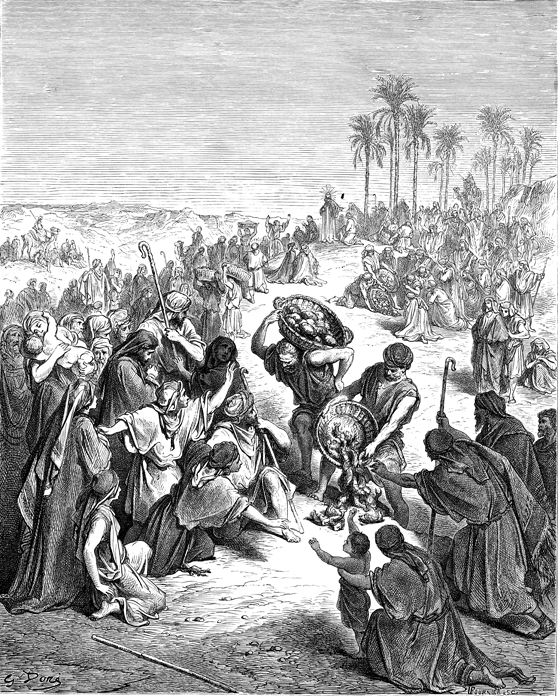
These verses describe one of our Lord's most remarkable miracles. Of all the great works that He did, none was done so publicly as this, and before so many witnesses. Of all the miracles related in the Gospels, this is the only one which all the four Gospel-writers alike record. This fact alone (like the four times repeated account of the crucifixion and resurrection) is enough to show that it is a miracle demanding special attention. We have, for one thing, in this miracle, a lesson about Christ's almighty power.
A commentator
Jamieson, Fausset & Brown1802–1910
Commentary Critical and Explanatory on the Whole Bible (1871)
proposed
passover . . . was nigh--but for the reason mentioned (Joh 7:1), Jesus kept away from it, remaining in Galilee. (Also see on Mr 6:45-56). 14, 15. that prophet--(See on Joh 1:21).
quarantine:debris (2026-07-29) — starts-lowercase
A commentator
J.C. Ryle1816–1900
Expository Thoughts on the Gospels: John (lightly modernized text, Grace Gems edition) (1869)
proposed
These verses describe one of our Lord's most remarkable miracles. Of all the great works that He did, none was done so publicly as this, and before so many witnesses. Of all the miracles related in the Gospels, this is the only one which all the four Gospel-writers alike record. This fact alone (like the four times repeated account of the crucifixion and resurrection) is enough to show that it is a miracle demanding special attention. We have, for one thing, in this miracle, a lesson about Christ's almighty power. We see our Lord feeding five thousand men with "five barley loaves and two small fish." We see clear proof that a miraculous event took place in the "twelve baskets of fragments" that remained after all had eaten. Creative power was manifestly exercised. Food was called into existence that did not exist before. In healing the sick, and raising the dead, something was amended or restored that had already existed. In feeding five thousand men with five loaves, something must have been created which before had no existence. Such a history as this ought to be specially instructive and encouraging to all who endeavor to do good to souls. It shows us the Lord Jesus "able to save to the uttermost." He is One who has all power over dead hearts. Not only can He mend that which is broken—build up that which is ruined—heal that which is sick—strengthen that which is weak. He can do even greater things than these. He can call into being that which was not before, and call it out of nothing. We must never despair of any one being saved. So long as there is life there is hope. Reason and sense may say that some poor sinner is too hardened, or too old to be converted. Faith will reply—"Our Master can create as well as renew . With a Savior who, by His Spirit, can create a new heart, nothing is impossible."
A commentator
Albert Barnes1798–1870
Notes, Explanatory and Practical, on the Old and New Testaments (1832-1869)
proposed
The passover - See the notes at Mat 26:2, Mat 26:17. A feast of the Jews - This is one of the circumstances of explanation thrown in by John which show that he wrote for those who were unacquainted with Jewish customs.
The words behind it
9 Greek wordsEvery Greek word of this verse in the order it stands, with what it means and the door to its own study. The last column counts the times a word stands in the whole Bible: the rarer the word, the more the places it appears belong together.
| Greek | Sound | Meaning | Word study | In the Bible |
|---|---|---|---|---|
| ἦν | en | Was | G1510 → | 2333 times |
| δὲ | de | now | G1161 → | 2765 times |
| ἐγγὺς | engus | near | G1451 → | 30 times |
| τὸ | to | the | G3588 → | 19766 times |
| πάσχα | pascha | Passover | G3957 → | 29 times |
| ἡ | he | the | G3588 → | 19766 times |
| ἑορτὴ | he'orte | feast | G1859 → | 25 times |
| τῶν | ton | of the | G3588 → | 19766 times |
| Ἰουδαίων.¶ | ioudaion | Jews. | G2453 → | 192 times |
ἦνWas
enG1510 →2333 times
δὲnow
deG1161 →2765 times
ἐγγὺςnear
engusG1451 →30 times
τὸthe
toG3588 →19766 times
πάσχαPassover
paschaG3957 →29 times
ἡthe
heG3588 →19766 times
ἑορτὴfeast
he'orteG1859 →25 times
τῶνof the
tonG3588 →19766 times
Ἰουδαίων.¶Jews.
ioudaionG2453 →192 times
A shaded row is a word that stands 400 times or fewer in the Bible.
The walk
8 stopsEach card is a verse this one points to, and under it the verses that one points to in turn. Where several paths arrive at the same place, that place is listed first: the text keeps returning to it.
Through
John 5:1Some time later there was a feast of the Jews, and Jesus went up to Jerusalem.
it leads to
- Deuteronomy 16:16
Three times a year all your men are to appear before the LORD your God in the place He will choose: at the Feast of Unleavened Bread, the Feast of Weeks, and the Feast…
- Exodus 23:14–17
Three times a year you are to celebrate a feast to Me.
- Leviticus 23:2–4
“Speak to the Israelites and say to them, ‘These are My appointed feasts, the feasts of the LORD that you are to proclaim as sacred assemblies.
- Exodus 34:23
Three times a year all your males are to appear before the Lord GOD, the God of Israel.
- Deuteronomy 16:16
Through
John 2:13When the Jewish Passover was near, Jesus went up to Jerusalem.
it leads to
- Luke 2:41
Every year His parents went to Jerusalem for the Feast of the Passover.
- John 11:55
Now the Jewish Passover was near, and many people went up from the country to Jerusalem to purify themselves before the Passover.
- Luke 2:41
Through
Deuteronomy 16:1Observe the month of Abib and celebrate the Passover to the LORD your God, because in the month of Abib the LORD your God brought you out of Egypt by night.
it leads to
- Exodus 34:18
You are to keep the Feast of Unleavened Bread. For seven days at the appointed time in the month of Abib, you are to eat unleavened bread as I commanded you. For in the…
- Exodus 12:2–20
“This month is the beginning of months for you; it shall be the first month of your year.
- Exodus 34:18
Where this verse is studied
On this page
Studies15
On this verse
On this chapter
About John
This page draws on 15 works. Open the list of works
This page draws on Adam Clarke, Commentary on the Bible; Albert Barnes, Notes, Explanatory and Practical, on the Gospels; Albert Barnes, Notes, Explanatory and Practical, on the Old and New Testaments (1832-1869); Alcuin of York, Catena Aurea by Aquinas; Bede, On the Gospel of Mark 2.6; Bonaventure, Commentary on John, Chapter 6; Brooke Foss Westcott, The Gospel according to St. John; J.C. Ryle, Expository Thoughts on the Gospels: John (lightly modernized text, Grace Gems edition); Jamieson, Fausset & Brown, Commentary Critical and Explanatory on the Whole Bible; John Chrysostom, Homily on the Gospel of John 42; John Gill, Exposition of the New Testament (1746-1748); Matthew Henry, Commentary on the Whole Bible; Theophylact of Ohrid, Catena Aurea by Aquinas; Theophylact of Ohrid, Commentary on John and Thomas Aquinas, Commentary on John.