

Jesus Christ · On Himself
The Way, the Truth, and the Life
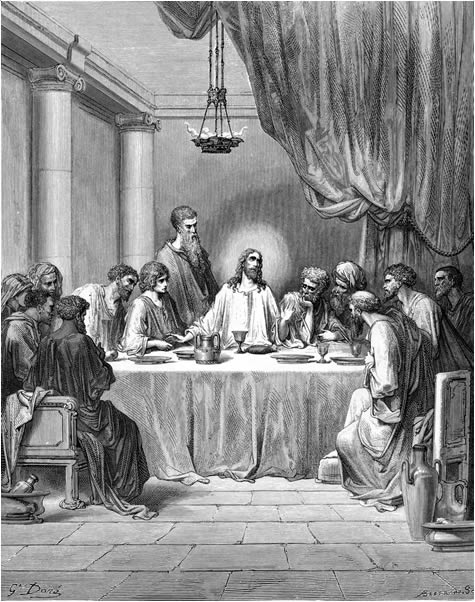
Hours before His arrest, Jesus tells His disciples not to let their hearts be troubled. Thomas answers with the most honest question in the room: we don’t know where You’re going, so how can we possibly know the way? Jesus doesn’t hand him directions. He hands him a Person, Himself, and says that no one comes to the Father except through Him.
Jan Luyken, Christ Crucified, c. 1700. CC BY-SA 3.0.
Summary
This page carries two exchanges from the upper room: Thomas asking the way and Philip asking to see the Father, each with the Greek behind the text and four public-domain commentators. The exclusivity of John 14:6b is named plainly, with the separate pastoral question about the unevangelized set apart and not adjudicated.
- The Greek article before way, truth, and life is unpacked: the way, not a way among several
- Four public-domain commentators, Wesley, Clarke, Henry, and Barnes, are quoted in full on Thomas's question
- John 14:6b's exclusivity is stated as this site's own confession, with the narrower question of the unevangelized named but not settled
- Philip's request in John 14:8-11 gets its own section, with Ambrose of Milan, Clarke, and Henry quoted on it
- Doorway cards carry the reader onward to Knowing the Father, the Deity of Christ, the I AM Sayings, and the Upper Room discourse
The Text
John 14:1-6: the night before the cross
“Do not let your hearts be troubled. You believe in God; believe in Me as well.Not spoken in a classroom. Spoken hours before Gethsemane, to men who have just heard Peter will deny Him.
“Lord,” said Thomas, “we do not know where You are going, so how can we know the way?”Thomas doesn't pretend to understand. He says plainly: we don't know, so how can we know?
Jesus answered, “I am the way and the truth and the life. No one comes to the Father except through Me.The answer to a destination-and-access question is not a map. It is a Person.
This is the same room, the same night, as the “Abba, Father” prayer Jesus will pray a few hours later in the garden. The disciples have just heard that one of their own number will deny Him and that He is leaving them. Thomas’s question is not a philosopher’s puzzle: it is a frightened friend asking “where” and “how,” and Jesus answers him pastorally, not abstractly.
Three Words, One Person
what each noun answers
ἡ ὁδός
hē hodós
The Way
ANSWERS
Thomas's own question: how do we get where You're going?
Not a route pointed to from a distance. A road walked by following a Person: Thomas already has it, because he already has Jesus in the room with him.
ἡ ἀλήθεια
hē alḗtheia
The Truth
ANSWERS
What every shadow and picture in the Law was reaching for
Not one fact weighed against others. The reality the Old Testament's own patterns and types pointed toward: the substance, not one more figure.
ἡ ζωή
hē zōḗ
The Life
ANSWERS
What outlasts the grave
Not a philosophy for living well. The very life that raises the dead: the same claim He will make again, plainly, at Lazarus's tomb.
What He Is Saying
a Person, not directions
Every other teacher who has ever pointed to a way, a truth, or a life has pointed away from himself: to a law, a method, a set of ideas someone else could adopt without him. Jesus points to Himself. Not “I know the way” or “I teach the truth,” but I am each one. The disciples already have what Thomas is asking for, because they already have Jesus in the room with them.
The Greek behind the Englishἡ ὁδός, ἡ ἀλήθεια, ἡ ζωή
Each of the three nouns carries the definite article in the Greek text: the way, not a way among several ways. The word for “way” (hodos) means a road or a journey, not merely a direction pointed out from a distance. Jesus is not showing Thomas the way. He is telling him he is already walking it, because he is already walking with Him.
A destination-and-access questionnot an abstract one
Thomas has just asked “where” and “how”: the two most practical questions a person facing an unknown road can ask. Jesus’s answer is equally practical: He is Himself the way believers already have, since they already know and have seen the Father in Him. The disciples don’t need a set of directions handed down later. They need to keep following the Person in front of them.
The Voices on Thomas's Question
the church hears John 14:5-7
To the question concerning knowledge, he answers, I am the truth. To the question whither, I am the life. The first is treated of in this verse; the second, ver. 7-17; the third, xiv, 18, &c.
John Wesley · Explanatory Notes upon the New Testament (1755), John 14:6
I am the Way - That leads so the Father: - the Truth that teaches the knowledge of God, and directs in the way: - the Life that animates all those who seek and serve him, and which is to be enjoyed eternally at the end of the way. Christ is the Way: 1. By his doctrine, Joh 6:68. 2. By his example, 1Pe 2:21. 3. By his sacrifice, Heb 9:8, Heb 9:9. 4. By his Spirit, Joh 16:13. He is the Truth: 1. In opposition to all false religions.
Adam Clarke · Commentary on the Bible (1832), John 14:6
Thomas had enquired both whither he went and what was the way, and Christ answers both these enquiries and makes good what he had said, that they would have needed no answer if they had understood themselves aright; for they knew him, and he was the way; they knew the Father, and he was the end; and therefore, whither I go you know, and the way you know.
Matthew Henry · Commentary on the Whole Bible (1710), John 14:6-7
If ye had known me - By this Jesus does not intend to say that they were not truly his disciples, but that they had not a full and accurate knowledge of his character and designs. They still retained, to a large extent, the Jewish notions respecting a temporal Messiah, and did not fully understand that he was to die and be raised from the dead. Ye should have known my Father also - You would have known the counsels and designs of my Father respecting my death and resurrection.
Albert Barnes · Notes, Explanatory and Practical (1832-1869), John 14:7
No Man Cometh Unto the Father, But By Me
John 14:6b, handled plainly
Jesus does not soften the second half of His answer. The way, the truth, and the life are not three options among many ways to reach God: access to the Father runs through Him alone. This is not a house verdict MannaFest stamps on a disputed question; it is the plain grammar of the verse, and it is this site’s own confession, held throughout: all come to the Father through Christ.
A separate, narrower question, named honestlythe unevangelized
The exclusivity of the verse’s grammar is not seriously disputed among interpreters. What genuinely is debated (as an ongoing pastoral question among Christians who all affirm John 14:6) is how this verse relates to those who never hear the gospel at all. Exclusivist, inclusivist, and “wider hope” positions all have holders within the church. This page names the question rather than adjudicating it; the traditional (exclusivist) reading leads here, as the plain sense of the text, with the wider pastoral debate named rather than erased.
Philip's Request
John 14:8-11
Philip said to Him, “Lord, show us the Father, and that will be enough for us.”Philip asks for exactly what every disciple longs for: a direct sight of the Father.
Jesus replied, “Philip, I have been with you all this time, and still you do not know Me? Anyone who has seen Me has seen the Father. How can you say, ‘Show us the Father’? Do you not believe that I am in the Father and the Father is in Me? The words I say to you, I do not speak on My own. Instead, it is the Father dwelling in Me, performing His works. Believe Me that I am in the Father and the Father is in Me—or at least believe on account of the works themselves.The distance between seeing Jesus and seeing the Father collapses entirely.
Philip’s request, “shew us the Father, and it sufficeth us,” is not an unreasonable one. He is asking for the very thing that would end every doubt. Jesus’s answer is the single clearest identity-claim of this discourse: to have seen Him is to have seen the Father. This passage carries enough weight on its own to earn a page of its own.
The Voices on Philip's Question
the church hears John 14:9-11
In the church, I know of only one image, that is, the image of the unseen God. God has said about this image, "Let us make man [humankind] in our image." Of this image it is written that Christ is the "effulgence of the glory and impress of his hypostasis." In that image, I perceive the Father as the Lord Jesus himself has said, "The one who has seen me has seen the Father."
Ambrose of Milan · Sermon Against Auxentius 32 (397), John 14:9
I am in the Father, and the Father in me? - We are essentially one; and those who have seen me have seen him who sent me. He doeth the works - We are not only one in nature, but one also in operation. The works which I have done bear witness of the infinite perfection of my nature. Such miracles as I have wrought could only be performed by unlimited power.
Adam Clarke · Commentary on the Bible (1832), John 14:10
Seek ye the Lord, seek him in Christ, and he will be found, for in him he dwells. Many words of power, and works of mercy, Christ did, and the Father did them in him; and the work of redemption in general was God's own work. We are bound to believe this, for the very works' sake.
Matthew Henry · Commentary on the Whole Bible (1710), John 14:10-11
Where It Points
the way that leads all the way home
Thomas asked how to find the way. Philip asked to see the Father. Jesus answers both men with the same word: Himself. Not a philosophy to master or a set of directions to memorize, but a Person to keep following: the same Person who, a few hours later in this very night, will pray “Abba, Father” on His way to the cross that opens this road for everyone who walks it.
Closing
A troubled room, an honest question, and an answer that refuses to be a map. Jesus does not tell Thomas which road to take. He tells him he is already on it, because the road is a Person, and that Person is standing in front of him. The same claim stands in front of every reader of this page.
Keep studying
Read it1