
Luke 22:15
in Luke 22And He said to them, “I have eagerly desired to eat this Passover with you before My suffering.
BSB
The same verse in ASV and KJV ▾
ASV
And he said unto them, With desire I have desired to eat this passover with you before I suffer:
KJV
And he said unto them, With desire I have desired to eat this passover with you before I suffer:
⋯
This verse in Luke 22
Commentary
22 notes on this verseHe says, "I will no longer come near to such a Pascha as this," one that consisted in the typical eating. A lamb of the flock was killed to be the type of the true Lamb until it is fulfilled in the kingdom of God, that is, until the time has appeared in which the kingdom of heaven is preached. This is fulfilled in us, who honor the worship that is superior to the law, even the true Pascha. A lamb of the flock does not sanctify those who are in Christ. Christ sanctifies us.
This site's exposition
When the hour had come
on Luke 22:14-16
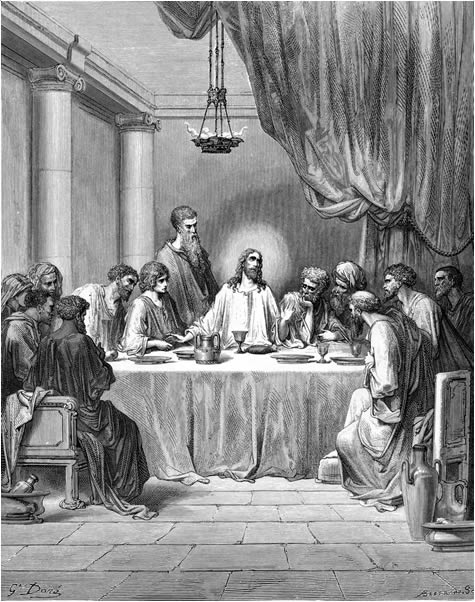
Jesus tells His apostles, I have eagerly desired to eat this Passover with you before My suffering. The Greek doubles the verb, a Hebrew idiom that raises the longing to its greatest strength. He will not eat it again until it is fulfilled in the kingdom of God.
This site's exposition
I have eagerly desired
Albert Barnes reads the doubled Greek as Hebrew for great desire. Jamieson, Fausset and Brown link the suffering named here to 1 Corinthians 5:7, which names Christ the Passover lamb. Cyril of Alexandria reads this as the last Passover of the type, the lamb of the flock giving way to the true Lamb.
The record, by era
The Church Fathers5 voices
(adv. Hær. 30. 22.) Hereby we may refute the folly of the Ebionites concerning the eating of flesh, seeing that our Lord eats the Passover of the Jews. Therefore He pointedly said, "This Passover," that no one might transfer it to mean another.
Or else; When our Lord was celebrating the new Passover, He fitly said, With desire have I desired this Passover, that is, the new mystery of the New Testament which He gave to His disciples, and which many prophets and righteous men desired before Him. He then also Himself thirsting for the common salvation, delivered this mystery, to suffice for the whole world. But the Passover was ordained by Moses to be celebrated in one place, that is, in Jerusalem. Therefore it was not adapted for the whole world, and so was not desired.
There was the rational element, by which He taught, by which He discoursed, by which He prepared the way of salvation; there was moreover indignation in Him, by which He inveighed against the scribes and the Pharisees; and there was the principle of desire, by which He so earnestly desired to eat the pass over with His disciples. In our own cases, accordingly, the irascible and the concupiscible elements of our soul must not invariably be put to the account of the irrational (nature), since we are sure that in our Lord these elements operated in entire accordance with reason.
How earnestly, therefore, does He manifest the bent of His soul: "With desire I have desired to eat this passover with you before I suffer." What a destroyer of the law was this, who actually longed to keep its passover! Could it be that He was so fond of Jewish lamb? But was it not because He had to be "led like a lamb to the slaughter; and because, as a sheep before her shearers is dumb, so was He not to open His mouth," that He so profoundly wished to accomplish the symbol of His own redeeming blood? He might also have been betrayed by any stranger, did I not find that even here too He fulfilled a Psalm: "He who did eat bread with me hath lifted up his heel against me.
In like manner, when treating of the gospel, we have proved from the sacrament of the bread and the cup the verity of the Lord's body and blood in opposition to Marcion's phantom; whilst throughout almost the whole of my work it has been contended that all mention of judicial attributes points conclusively to the Creator as to a God who judges.
14 more voices on this verse
The Church Fathers2 voices
For we must comply with fitting intimations and admonitions, that the sheep may not be deserted in danger by the shepherds, but that the whole flock may be gathered together into one place, and the Lord's army may be arrived for the contest of the heavenly warfare. For the repentance of the mourners was reasonably prolonged for a more protracted time, help only being afforded to the sick in their departure, so long as peace and tranquillity prevailed, which permitted the long postponement of the tears of the mourners, and late assistance in sickness to the dying. But now indeed peace is necessary, not for the sick, but for the strong; nor is communion to he granted by us to the dying, but to the living, that we may not leave those whom we stir up and exhort to the battle unarmed and naked, but may fortify them with the protection of Christ's body and blood. And, as the Eucharist is appointed for this very purpose that it may be a safeguard to the receivers, it is needful that we may arm those whom we wish to be safe against the adversary with the protection of the Lord's abundance. For how do we teach or provoke them to shed their blood in confession of His name. if we deny to those who are about to enter on the warfare the blood of Christ? Or how do we make them fit for the cup of martyrdom, if we do not first admit them to drink, in the Church, the cup of the Lord by the right of communion?
Again, in another place Christ said, "I have greatly desired to eat this Pasch with you." Why then did he say "this Pasch" even though at other times he had observed this feast with them? Why then? Because the cross would follow this Pasch. And again he said, "Father, glorify your Son so that your Son may glorify you." To be sure, in many places we find him foretelling the Passion, desiring that it come to pass and saying that this was the reason he had come into the world.
The Medieval Church5 voices
Whence he adds: And he said to them: With desire I have desired to eat this passover with you, before I suffer. This eating designates the incorporation and unity of the members into the unity of the body, which comes about through the enkindling of …
And he said to them: With desire I have desired to eat this Passover with you before I suffer. First, he desires to eat the typical Passover with the disciples, and thus reveal the mysteries of his passion to the world, so that he may …
He first then desires to eat the typical Passover, and so to declare the mysteries of His Passion to the world.
Or He says, With desire have I desired; as if to say, This is My last supper with you, therefore it is most precious and welcome to Me; just as those who are going away to a distance, utter the last words to their friends most affectionately.
The Lord says to the disciples: "I have earnestly desired to eat this Passover with you before My suffering." He speaks as if to say: this is My last supper with you, therefore it is dear and longed for by Me, for in the time …
The Puritans and the Awakening2 voices
): " With desire I have desired, I have most earnestly desired, to eat this passover with you before I suffer. " He knew it was to be the prologue to his sufferings, and therefore he desired it, because it was in order to his Father's glory and man's redemption. He delighted to do even this part of the will of God concerning him as Mediator.
quarantine:debris (2026-07-29) — leading-punctuation+unbalanced-parens
And he said unto them,.... The twelve apostles, as they were eating the passover, it being usual to talk and converse much at such a time; See Gill on Mat 26:
The Nineteenth Century5 voices
A commentator
Albert Barnes1798–1870
Notes, Explanatory and Practical, on the Old and New Testaments (1832-1869)
With desire I have desired - This is a Hebrew form of expression, and means “I have greatly desired.” The reasons why he desired this we may suppose to have been: 1. That, as he was about to leave them, he was desirous once of seeing them together, and of partaking with them of one of the religious privileges of the Jewish dispensation.
A commentator
Jamieson, Fausset & Brown1802–1910
Commentary Critical and Explanatory on the Whole Bible (1871)
With desire . . . desired--"earnestly have I longed" (as Ge 31:30, "sore longedst"). It was to be His last "before He suffered"--and so became "Christ our Passover sacrificed for us" (1Co 5:7), when it was "fulfilled in the Kingdom of God," the typical ordinance thenceforth disappearing.
A commentator
J.C. Ryle1816–1900
Expository Thoughts on the Gospels: Luke (lightly modernized text, Grace Gems edition) (1858)
proposed
These verses contain Luke's account of the institution of the Lord's supper. It is a passage which every true Christian will always read with deep interest. How astonishing it seems that an ordinance, so beautifully simple at its first appointment, should have been obscured and mystified by man's inventions! What a painful proof it is of human corruption — that some of the bitterest controversies which have disturbed the Church, have been concerning the table of the Lord. Great indeed is the ingenuity of man, in perverting God's gifts!
A commentator
J.C. Ryle1816–1900
Expository Thoughts on the Gospels: Luke (lightly modernized text, Grace Gems edition) (1858)
proposed
These verses contain Luke's account of the institution of the Lord's supper. It is a passage which every true Christian will always read with deep interest. How astonishing it seems that an ordinance, so beautifully simple at its first appointment, should have been obscured and mystified by man's inventions! What a painful proof it is of human corruption — that some of the bitterest controversies which have disturbed the Church, have been concerning the table of the Lord. Great indeed is the ingenuity of man, in perverting God's gifts! The ordinance that should have been for his wealth — is too often made an occasion of stumbling. We should notice, for one thing in these verses — that the principal object of the Lord's supper was to remind Christians of Christ's death for sinners. In appointing the Lord's supper, Jesus distinctly tells His disciples that they were to do what they did, "in remembrance of Me." In one word, the Lord's supper is not a sacrifice. It is eminently a commemorative ordinance. The bread that the believer eats at the Lord's table, is intended to remind him of Christ's body given to death on the cross for his sins. The wine that he drinks, is intended to remind him of Christ's blood shed to make atonement for his transgressions. The whole ordinance was meant to keep fresh in his memory — the sacrifice of Christ on the cross, and the satisfaction which that sacrifice made for the sin of the world. The two elements of bread and wine were intended to preach Christ crucified as our substitute under lively emblems. They were to be a visible sermon, appealing to the believer's senses, and teaching the old foundation-truth of the Gospel — that Christ's death on the cross, is the life of man's soul. We shall do well to keep this simple view of the Lord's supper steadily in view.
With desire I have desired - A Hebraism for, I have desired most earnestly. Our Lord’s meaning seems to be, that, having purposed to redeem a lost world by his blood, he ardently longed for the time in which he was to offer himself up. Such love did the holy Jesus bear to the human race. This eucharistic passover was celebrated once, by way of anticipation, before the bloody sacrifice of the victim of salvation, and before the deliverance it was appointed to commemorate; as the figurative passover had been likewise once celebrated before the going out of Egypt, and the deliverance of God’s chosen people. Quesnel.
How the passage was read
On Luke 22:1-23On Luke 22:1-23
The cups on the table
Luke alone records TWO cups (22:17, 22:20), and the detail is at home in the feast: the Passover meal was ordered around four cups of wine, a structure already fixed in the Mishnah, the first written code of Jewish oral law (Pesachim 10:1). Passover (Pesach) is the spring feast remembering the exodus; its meal, the seder (“order”), moved through blessing, story, and psalm with a cup at each station. Jesus takes the feast's own furniture, and at the cup after supper says the words that made it new: “this cup... is the new covenant in my blood.”
The seder as Jewish families keep it today descends from the same order, reshaped after the Temple fell in AD 70; the lamb on the table then is matzah and remembrance now.
This section is reception history: how the passage was read and kept in the Jewish tradition. Where a reading parts from an essential of the Christian faith, the section says so at that point.
Sources: Mishnah Pesachim 10:1 (the four cups) · The Lord's Supper (this site's study)
The words behind it
16 Greek wordsEvery Greek word of this verse in the order it stands, with what it means and the door to its own study. The last column counts the times a word stands in the whole Bible: the rarer the word, the more the places it appears belong together.
| Greek | Sound | Meaning | Word study | In the Bible |
|---|---|---|---|---|
| καὶ | kai | And | G2532 → | 9120 times |
| εἶπεν | eipen | He said | G2036 → | 925 times |
| πρὸς | pros | to | G4314 → | 700 times |
| αὐτούς· | autous | them; | G846 → | 5565 times |
| ἐπιθυμίᾳ | epithumia | With desire | G1939 → | |
| ἐπεθύμησα | epethumesa | I have desired | G1937 → | 16 times |
| τοῦτο | touto | this | G3778 → | 1381 times |
| τὸ | to | <the> | G3588 → | 19766 times |
| πάσχα | pascha | Passover | G3957 → | 29 times |
| φαγεῖν | phagein | to eat | G5315 → | 93 times |
| μεθ᾽ | meth᾽ | with | G3326 → | 461 times |
| ὑμῶν | humon | you | G4771 → | 2973 times |
| πρὸ | pro | before | G4253 → | 47 times |
| τοῦ | tou | <the> | G3588 → | 19766 times |
| με | me | I | G3165 → | 1936 times |
| παθεῖν· | pathein | to suffe; | G3958 → | 42 times |
καὶAnd
kaiG2532 →9120 times
εἶπενHe said
eipenG2036 →925 times
πρὸςto
prosG4314 →700 times
αὐτούς·them;
autousG846 →5565 times
ἐπιθυμίᾳWith desire
epithumiaG1939 →
ἐπεθύμησαI have desired
epethumesaG1937 →16 times
τοῦτοthis
toutoG3778 →1381 times
τὸ<the>
toG3588 →19766 times
πάσχαPassover
paschaG3957 →29 times
φαγεῖνto eat
phageinG5315 →93 times
μεθ᾽with
meth᾽G3326 →461 times
ὑμῶνyou
humonG4771 →2973 times
πρὸbefore
proG4253 →47 times
τοῦ<the>
touG3588 →19766 times
μεI
meG3165 →1936 times
παθεῖν·to suffe;
patheinG3958 →42 times
A shaded row is a word that stands 400 times or fewer in the Bible.
The walk
8 stopsEach card is a verse this one points to, and under it the verses that one points to in turn. Where several paths arrive at the same place, that place is listed first: the text keeps returning to it.
Through
John 4:34Jesus explained, “My food is to do the will of Him who sent Me and to finish His work.
it leads to
- John 6:38
For I have come down from heaven, not to do My own will, but to do the will of Him who sent Me.
- John 5:30
I can do nothing by Myself; I judge only as I hear. And My judgment is just, because I do not seek My own will, but the will of Him who sent Me.
- Job 23:12
I have not departed from the command of His lips; I have treasured the words of His mouth more than my daily bread.
- John 6:38
Through
John 17:1When Jesus had spoken these things, He lifted up His eyes to heaven and said, “Father, the hour has come. Glorify Your Son, that Your Son may glorify You.
it leads to
- Philippians 2:9–11
Therefore God exalted Him to the highest place and gave Him the name above all names,
- John 13:31–32
When Judas had gone out, Jesus said, “Now the Son of Man is glorified, and God is glorified in Him.
- John 17:4–5
I have glorified You on earth by accomplishing the work You gave Me to do.
- John 12:23
But Jesus replied, “The hour has come for the Son of Man to be glorified.
Reached by 2 separate paths from here.
- John 12:27–28
Now My soul is troubled, and what shall I say? ‘Father, save Me from this hour’? No, it is for this purpose that I have come to this hour.
Reached by 2 separate paths from here.
- Philippians 2:9–11
Where this verse is studied
On this page
Studies12
On this verse
About Luke
This page draws on 21 works. Open the list of works
This page draws on Adam Clarke, Commentary on the Bible; Albert Barnes, Notes, Explanatory and Practical, on the Old and New Testaments (1832-1869); Bede, On the Gospel of Luke; Bede, Catena Aurea by Aquinas; Bonaventure, Commentary on Luke, Chapter 22; Cyprian, Epistle LIII.; Cyril of Alexandria, COMMENTARY ON LUKE, HOMILY 141; Cyril of Alexandria, Commentary on Luke, Homily 141; Epiphanius of Salamis, Catena Aurea by Aquinas; Eusebius of Caesarea, Catena Aurea by Aquinas; J. C. Ryle, Expository Thoughts on the Gospels, Luke; J.C. Ryle, Expository Thoughts on the Gospels: Luke (lightly modernized text, Grace Gems edition); Jamieson, Fausset & Brown, Commentary Critical and Explanatory on the Whole Bible; John Chrysostom, AGAINST THE ANOMOEANS 7.46; John Gill, Exposition of the New Testament (1746-1748); Matthew Henry, Commentary on the Whole Bible; Tertullian, A Treatise on the Soul; Tertullian, Against Marcion Book IV; Tertullian, Against Marcion Book V; Theophylact of Ohrid, Catena Aurea by Aquinas and Theophylact of Ohrid, Commentary on Luke.