
Matthew 21:7
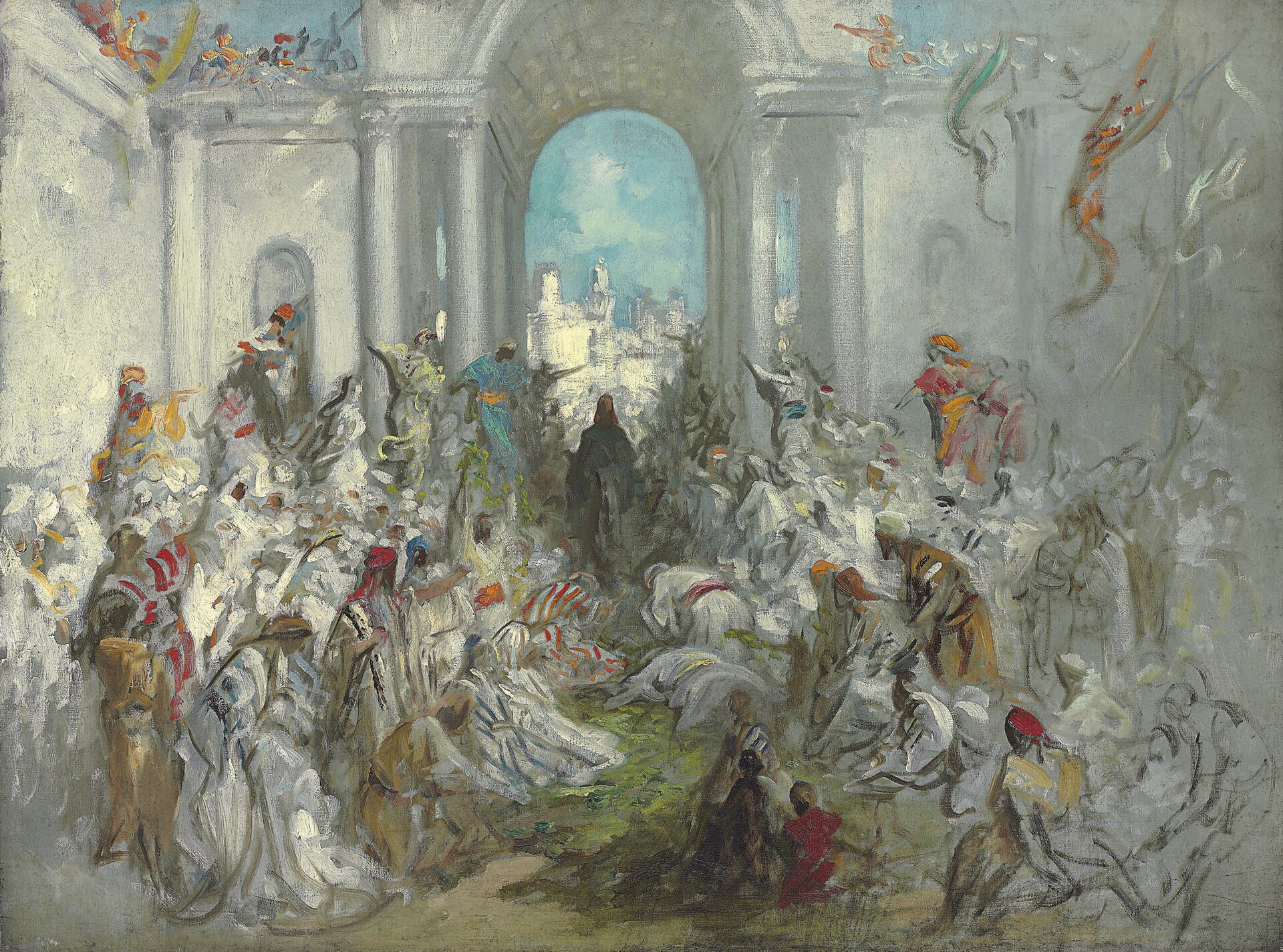
in Matthew 21They brought the donkey and the colt and laid their cloaks on them, and Jesus sat on them.
BSB
The same verse in ASV and KJV ▾
ASV
and brought the ass, and the colt, and put on them their garments; and he sat thereon.
KJV
And brought the ass, and the colt, and put on them their clothes, and they set him thereon.
⋯
This verse in Matthew 21
Commentary
20 notes on this verseNever before had the Lord employed the services of beasts, nor surrounded Himself with the ornaments of green boughs, till now when He is going up to Jerusalem to suffer. He moved them that beheld to do that which they had before desired to do; so it was opportunity that was now given them, not their purpose that was changed.
This site's exposition
did as Jesus commanded them
on Matthew 21:6-7
The disciples did as Jesus commanded them, and the simplicity of the obedience matches the simplicity of the charge; they fetch two animals on a stranger's word and a king's errand. They put on them their clothes, cloaks thrown as saddle and as covering both, and set him thereon, the pronoun most naturally read against the garments rather than forcing the Lord onto two beasts at once. Matthew Henry notes the poverty of the whole procession next to its meaning, a borrowed colt and borrowed cloaks bearing the Son of David into his own city.
The record, by era
The Church Fathers5 voices
(de Cons. Ev. ii. 66.) In this quotation from the Prophet, there is some variety in the different Gospels. Matthew quotes it as if the Prophet had expressly mentioned the she-ass; but it is not so quoted by John, nor in the Church-copies of the translation in common use. (John 12:15) This seems to me to be accounted for by the account, that Matthew wrote his Gospel in the Hebrew language. And it is clear that the translation called the LXX, has some things different from what are found in the Hebrew, by those who know that tongue, and who have rendered the same books out of the Hebrew. If the reason of this discrepancy be asked, I consider nothing more likely than that the LXX interpreted with the selfsame spirit with which the original was written, which is confirmed by that wonderful agreement among them of which we are told. By thus varying the expression, while they did not depart from the meaning of that God whose words they were, they convey to us the very same thing as we gather from this agreement, with slight variety, among the Evangelists. This shows us that it is no lie, when one relates any thing with such diversities in detail, as that he does not depart from his intention with whom he ought to agree. To know this is useful in morals in avoiding lies; and for faith itself, that we should not suppose that the truth is secured in sacred sounds, as though God imparted to us not the matter only, but the words in which the matter is conveyed. Rather the matter is in such sort conveyed in words, that we ought not to want words at all, if it were possible that the matter could be known by us without words, as God and His Angels know it. It follows, But the disciples went and did as Jesus commanded them, and brought the ass, and the colt. The other Evangelists say nothing of the ass. […]
All of these circumstances surrounding his appearance point to the shape of the future. By means of parabolic signs and by the conditions of present things, the form of the future is here suggested. The Lord is taking possession of the nations! His brightness is approaching! He is occupying the minds of the nations—just as the rider of a beast. He is proclaimed by the entire army of his retinue of patriarchs, prophets and apostles. The patriarchs are spreading their garments, which signify their glory, under the Lord. By their generations, names and struggles, the Lord was prophesied. Going to him with all the ornaments of their own worthiness and scattering themselves under his seat, they will show that all their glory had been laid beneath him in preparation for his coming. The prophets are spreading their own garments under the route of the one who is coming. They predicted this path long ago. They knew that the nations would uphold God. Many had died and offered themselves to stoning. They, in a certain sense, stripped their very bodies and offered their garments upon this path. The apostles are scattering the branches from the cut trees after casting their garments. This is not simply an act of human piety. It might at first seem that the branches might impede the one who is proceeding and might make the journey of the one who is hastening more difficult and entangled. Yet even in this the reasoning of the prophets is preserved and the form of the future announced. These branches are the fruitless nations, or the fruits of the oftentimes faithless nations. These branches are scattered under the route of the Lord by the apostles. They are preparing for the entry of the Savior.
Notwithstanding, it was possible that the Lord might have sate upon both animals. The Lord sitting upon the ass goes towards Jerusalem, because presiding over the Holy Church, or the faithful soul, He both guides it in this life, and after this life leads it to the view of the heavenly country. But the Apostles and other teachers set their garments upon the ass, when they gave to the Gentiles the glory which they had received from Christ.
But it seems that the Lord could not in so short a distance have sate upon both animals; seeing then that the history has either an impossibility or a meanness, we are sent to higher things, that is, to the figurative sense. The Apostles clothes which are laid upon the beasts may be understood either as the teaching of virtues, or discernment of Scriptures, or verities of ecclesiastical dogmas, with which, unless the soul be furnished and instructed, it deserves not to have the Lord take His seat there.
(Verse 6, 7) However, the disciples went and did as Jesus had ordered them. They brought the donkey and the colt, and put their cloaks on them, and Jesus sat on them. This colt and donkey, on which the apostles spread their cloaks so that Jesus might sit more comfortably, were naked before the coming of the Savior, and they shivered without cover, with many claiming dominion over them. But after they received the apostolic garments, they became more beautiful and had the Lord as their rider.
13 more voices on this verse
The Church Fathers5 voices
A commentator
John ChrysostomHomily on the Gospel of Matthew 66 · Written in the 5th century.
proposed
And yet He had often entered Jerusalem before, but never with so much circumstance. What then is the cause? It was the beginning then of the dispensation; and neither was He very well known, nor the time of His passion near; wherefore He mixed with them with less distinction, and more disguising Himself. For He would not have been held in admiration, had He so appeared, and He would have excited them to greater anger. But when He had both given them sufficient proof of His power, and the cross was at the doors, He makes Himself then more conspicuous, and doeth with greater circumstance all the things that were likely to inflame them. For it was indeed possible for this to have been done at the beginning also; but it was not profitable nor expedient it should be so. But do thou observe, I pray thee, how many miracles are done, and how many prophecies are fulfilled. He said, "Ye shall find an ass;" He foretold that no man should hinder them, but that all, when they heard, should hold their peace. But this is no small condemnation of the Jews, if them that were never known to Him, neither had appeared before Him, He persuades to give up their own property, and to say nothing against it, and that by His disciples, while these, being present with Him at the working of His miracles, were not persuaded.
A commentator
John ChrysostomHomily on the Gospel of Matthew 66 · Written in the 5th century.
proposed
And do not account what was done to be a small thing. For who persuaded them, when their own property was taken from them, and that, when they were perhaps poor men and husbandmen, not to forbid it? Why say I not to forbid it? not to ask, or even if they asked, to hold their peace, and give it up. For indeed both things were alike marvellous, as well, if they said nothing, when their beasts were dragged away, or if having spoken, and heard, "The Lord hath need of them," they yielded and withstood not, and this when they see not Him, but His disciples. By these things He teaches them, that it was in His power to have entirely hindered the Jews also, even against their will, when they were proceeding to attack Him, and to have made them speechless, but He would not. And another thing again together with these doth He teach the disciples, to give whatever He should ask; and, though he should require them to yield up their very life, to give even this, and not to gainsay. For if even strangers gave up to Him, much more ought they to strip themselves of all things. And besides what we have said, He was fulfilling also another prophecy, one which was twofold, one part in words, and another in deeds. And that in deeds was, by the sitting on the ass; and that by words, the prediction of Zacharias; because he had said, that the King should sit on an ass. And He, having sat and having fulfilled it, gave to the prophecy another beginning again, by what He was doing typifying beforehand the things to come. How and in what manner? He proclaimed beforehand the calling of the unclean Gentiles, and that He should rest upon them, and that they should yield to Him and follow Him, and prophecy succeeded to prophecy. But to me He seemeth not for this object only to sit on the ass, but also as affording us a standard of self-denial. […]
A commentator
John ChrysostomHomily on the Gospel of Matthew 66 · Written in the 5th century.
proposed
But He did these things, as I said, signifying beforehand the things to come. For here the church is signified by the colt, and the new people, which was once unclean, but which, after Jesus sat on them, became clean. And see the image preserved throughout. I mean that the disciples loose the asses. For by the apostles, both they and we were called; by the apostles were we brought near. But because our acceptance provoked them also to emulation, therefore the ass appears following the colt. For after Christ hath sat on the Gentiles, then shall they also come moving us to emulation. And Paul declaring this, said, "That blindness in part is happened to Israel, until the fullness of the Gentiles be come in; and so all Israel shall be saved." For that it was a prophecy is evident from what is said. For neither would the prophet have cared to express with such great exactness the age of the ass, unless this had been so. But not these things only are signified by what is said, but also that the apostles should bring them with ease. For as here, no man gainsaid them so as to keep the asses, so neither with regard to the Gentiles was any one able to prevent them, of those who were before masters of them. But He doth not sit on the bare colt, but on the apostles' garments. For after they had taken the colt, they then gave up all, even as Paul also said, "I will very gladly spend and be spent for your souls." But mark how tractable the colt, how being unbroken, and having never known the rein, he was not restive, but went on orderly; which thing itself was a prophecy of the future, signifying the submissiveness of the Gentiles, and their sudden conversion to good order. For all things did that word work, which said, "Loose him, and bring him to me:" so that the unmanageable became orderly, and the unclean thenceforth clean.
A commentator
John ChrysostomHomily on the Gospel of Matthew 66 · Written in the 5th century.
proposed
But these things He did, not as displaying any pomp, but at once, as I have said, both fulfilling a prophecy, and teaching self-denial, and at the same time also comforting His disciples, who were grieving for His death, and showing them that He suffers all these things willingly. And mark thou, I pray thee, the accuracy of the prophet, how he foretold all things. And some things David, some things Zechariah, had proclaimed beforehand. Let us also do likewise, and let us sing hymns, and give up our garments to them that bear Him. For what should we deserve, when some clothe the ass on which He was set, and others strew the garments even under her feet; but we, seeing him naked, and not being even commanded to strip ourselves, but to spend of what is laid by, not even so are liberal? And when they indeed attend upon Him before and behind, but we, when He cometh unto us, send Him away, and thrust Him off and insult Him.
A commentator
John ChrysostomHomily on the Gospel of Matthew 66 · Written in the 5th century.
proposed
Again, setting measures of sorrow, when He had need to mourn, He weeps moderately, everywhere setting us rules, as I have said, and limits how far one ought to proceed, and not any further. So for this intent now also, since it happens that some are weak and have need of beasts to carry them, in this too He fixes a measure, showing that one ought not to yoke horses or mules to be borne by them, but to use an ass, and not to proceed further, and everywhere to be limited by the want. But let us look also at the prophecy, that by words, that by acts. What then is the prophecy? "Behold, thy King cometh to thee, meek, and riding on an ass, and a young colt;" not driving chariots, like the rest of the kings, not demanding tributes, not thrusting men off, and leading about guards, but displaying His great meekness even hereby. Ask then the Jew, what King came to Jerusalem borne on an ass? Nay, he could not mention, but this alone.
The Medieval Church3 voices
Whence Matthew, who wrote his Gospel to the Jews, is the only one who mentions that the ass was brought to the Lord, to show that this same Hebrew nation, if it repent, need not despair of salvation,
Then in particular: "and they brought the ass and the colt." By this is signified that they converted both Jews and Gentiles, as it says (Rom 1:14): "To the Greeks and to the barbarians, to the wise and to the unwise, I am a debtor." …
Luke and Mark mention only one beast of burden, but Matthew mentions both ass and foal; yet they do not contradict. The mother followed the foal which was led. "He sat thereon," not on the two beasts, but on the clothes. Or, first He sat …
The Puritans and the Awakening1 voice
And brought the ass and the colt,....
The Nineteenth Century4 voices
And put on them their clothes - Thus acknowledging him to be their king, for this was a custom observed by the people when they found that God had appointed a man to the kingdom.
These verses contain a very remarkable passage in our Lord Jesus Christ’s life. They describe his public entry into Jerusalem when he came there for the last time, before he was crucified. There is something peculiarly striking in this incident in our Lord’s history. The narrative reads like the account of some royal conqueror’s return to his own city: “A very great multitude” accompanies him in a kind of triumphal procession. Loud cries and expressions of praise are heard around him: “All the city was moved.” The whole transaction is singularly at variance with the past tenor of our Lord’s life; it is curiously unlike the ways of him who did not “cry nor strive ” nor let his voice be heard “in the streets”—who withdrew himself from the multitude on other occasions, and sometimes said to those he healed, “See thou say nothing to any man.” ( Mark 1:44 ). And yet the whole transaction admits of explanation. The reasons of this public entry are not hard to find out. Let us see what they were. The plain truth is that our Lord knew well that the time of his earthly ministry was drawing to a close; he knew that the hour was approaching when he must finish the mighty work he came to do, by dying for our sins upon the cross. He knew that his last journey had been accomplished, and that there remained nothing now in his earthly ministry but to be offered as a sacrifice on Calvary. Knowing all this, he no longer, as in times past, sought secrecy; knowing all this, he thought it good to enter the place where he was to be delivered to death, with peculiar solemnity and publicity. It was not fitting that the Lamb of God should come to be slain on Calvary privately and silently. Before the great sacrifice for the sin of the world was offered up, it was right that every eye should be fixed on the victim.
These verses contain a very remarkable passage in our Lord Jesus Christ’s life. They describe his public entry into Jerusalem when he came there for the last time, before he was crucified. There is something peculiarly striking in this incident in our Lord’s history. The narrative reads like the account of some royal conqueror’s return to his own city: “A very great multitude” accompanies him in a kind of triumphal procession. Loud cries and expressions of praise are heard around him: “All the city was moved.”
A commentator
Albert Barnes1798–1870
Notes, Explanatory and Practical, on the Old and New Testaments (1832-1869)
proposed
And put on them their clothes - This was done as a token of respect, 2Ki 9:13.
The words behind it
16 Greek wordsEvery Greek word of this verse in the order it stands, with what it means and the door to its own study. The last column counts the times a word stands in the whole Bible: the rarer the word, the more the places it appears belong together.
| Greek | Sound | Meaning | Word study | In the Bible |
|---|---|---|---|---|
| ἤγαγον | egagon | they brought | G71 → | 68 times |
| τὴν | ten | the | G3588 → | 19766 times |
| ὄνον | onon | donkey | G3688 → | 5 times |
| καὶ | kai | and | G2532 → | 9120 times |
| τὸν | ton | the | G3588 → | 19766 times |
| πῶλον | polon | colt | G4454 → | 12 times |
| καὶ | kai | and | G2532 → | 9120 times |
| ἐπέθηκαν | epethekan | put | G2007 → | 38 times |
| ἐπ᾽ | ep᾽ | upon | G1909 → | 883 times |
| αὐτῶν | auton | them | G846 → | 5565 times |
| τὰ | ta | the | G3588 → | 19766 times |
| ἱμάτια | himatia | cloaks | G2440 → | 60 times |
| καὶ | kai | and | G2532 → | 9120 times |
| ἐπεκάθισεν | epekathisen | He sat | G1940 → | |
| ἐπάνω | epano | on | G1883 → | 19 times |
| αὐτῶν. | auton | them. | G846 → | 5565 times |
ἤγαγονthey brought
egagonG71 →68 times
τὴνthe
tenG3588 →19766 times
ὄνονdonkey
ononG3688 →5 times
καὶand
kaiG2532 →9120 times
τὸνthe
tonG3588 →19766 times
πῶλονcolt
polonG4454 →12 times
καὶand
kaiG2532 →9120 times
ἐπέθηκανput
epethekanG2007 →38 times
ἐπ᾽upon
ep᾽G1909 →883 times
αὐτῶνthem
autonG846 →5565 times
τὰthe
taG3588 →19766 times
ἱμάτιαcloaks
himatiaG2440 →60 times
καὶand
kaiG2532 →9120 times
ἐπεκάθισενHe sat
epekathisenG1940 →
ἐπάνωon
epanoG1883 →19 times
αὐτῶν.them.
autonG846 →5565 times
A shaded row is a word that stands 400 times or fewer in the Bible.
The walk
5 stopsEach card is a verse this one points to, and under it the verses that one points to in turn. Where several paths arrive at the same place, that place is listed first: the text keeps returning to it.
Through
2 Kings 9:13Quickly, each man took his garment and put it under Jehu on the bare steps. Then they blew the ram’s horn and proclaimed, “Jehu is king!”
it leads to
- 1 Kings 1:39
Zadok the priest took the horn of oil from the tabernacle and anointed Solomon. Then they blew the ram’s horn, and all the people proclaimed, “Long live King Solomon!”
- Mark 11:7–8
Then they led the colt to Jesus and threw their cloaks over it, and He sat on it.
- 1 Kings 1:34
There Zadok the priest and Nathan the prophet are to anoint him king over Israel. You are to blow the ram’s horn and declare, ‘Long live King Solomon!’
- Psalms 47:5–7
God has ascended amid shouts of joy, the LORD with the sound of the horn.
- Psalms 98:6
With trumpets and the blast of the ram’s horn shout for joy before the LORD, the King.
- 1 Kings 1:39
Where this verse is studied
On this page
Studies4
About Matthew
This page draws on 16 works. Open the list of works
This page draws on Adam Clarke, Commentary on the Bible; Albert Barnes, Notes, Explanatory and Practical, on the Old and New Testaments (1832-1869); Augustine of Hippo, Catena Aurea by Aquinas; Hilary of Poitiers, Commentary on Matthew 21.2; J.C. Ryle, Expository Thoughts on the Gospels: Matthew; Jerome, Catena Aurea by Aquinas; Jerome, Commentary on Matthew; John Chrysostom, Homily on the Gospel of Matthew 66; John Gill, Exposition of the New Testament (1746-1748); John Wesley, Explanatory Notes upon the New Testament; Matthew Henry, Commentary on the Whole Bible; Pseudo-Chrysostom, Catena Aurea by Aquinas; Rabanus Maurus, Catena Aurea by Aquinas; Remigius of Rheims, Catena Aurea by Aquinas; Theophylact of Ohrid, Commentary on Matthew and Thomas Aquinas, Commentary on Matthew.