
Place
Bethlehem
Also known as Beit Lehem · Ephrath · Ephrathah · City of David
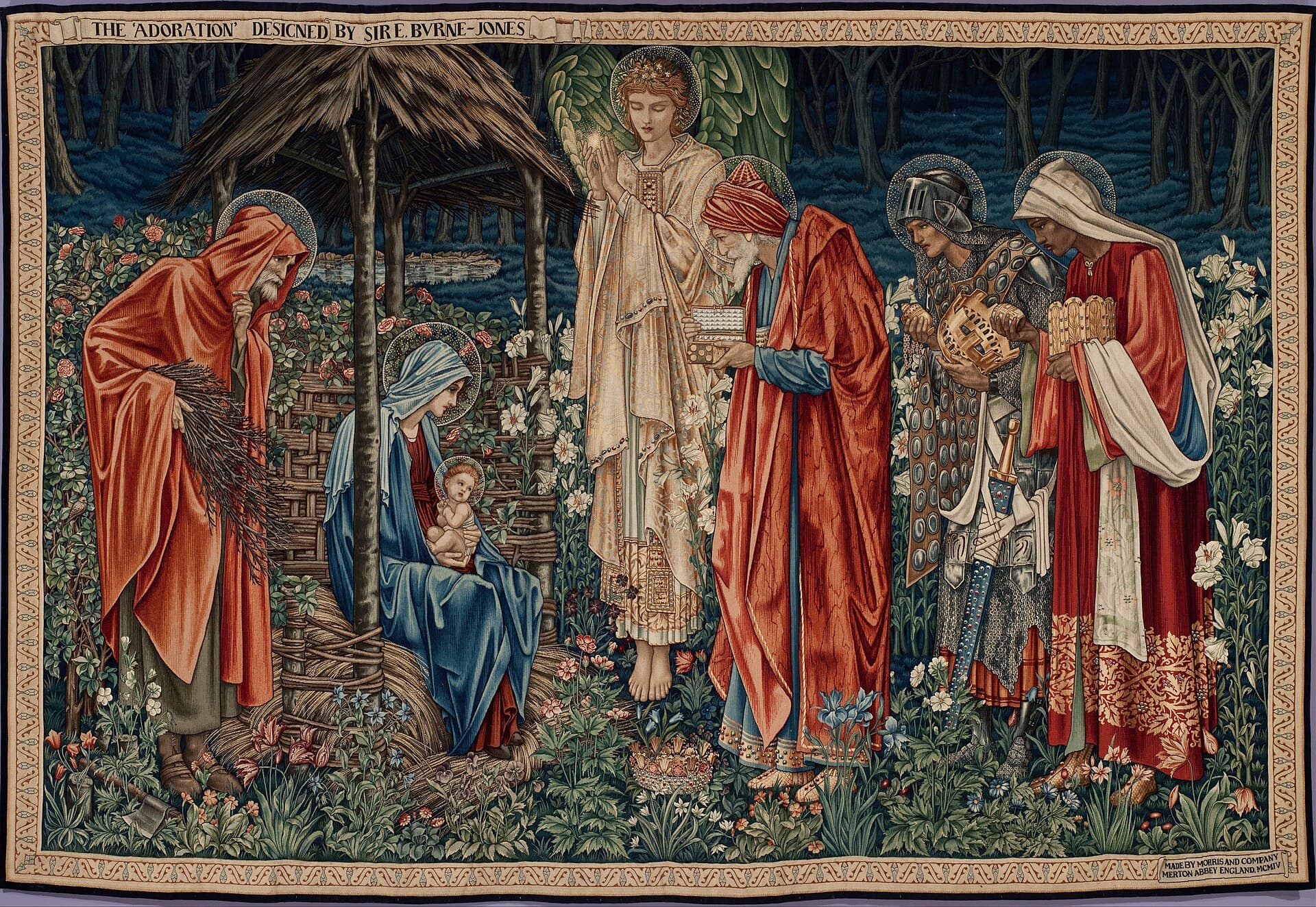
Edward Burne-Jones, The Adoration of the Magi. Public domain, via Wikimedia Commons.
Summary
David’s town, six miles south of Jerusalem, where Ruth gleaned, where Samuel anointed a shepherd boy, and where Jesus was born as Micah had said.
- Rachel was buried on the road to it, Ruth gleaned in its fields, and Samuel anointed David inside it.
- The name means house of bread, and the man born there said he was the bread of life.
- Micah named the town seven centuries early, and Herod's own scholars quoted that verse back to him.
- Three men broke a Philistine line for a drink from its well, and David poured the water out to the LORD.
- A cave under the Church of the Nativity has been shown as the birthplace since Justin Martyr described it around AD 155.
On this page
In Scripture
- Verses
- 55
- Books
- 16
Near Bethlehem
- Jerusalem7.1 km · 4.4 mi N
- Tekoa7.8 km · 4.8 mi S
- Zion8.2 km · 5.1 mi N
- Moriah8.6 km · 5.3 mi N
- Mount of Olives9.1 km · 5.7 mi NE
- Bethany9.3 km · 5.8 mi NE
Straight-line distances, computed from the gazetteer coordinates.
Where it is
the country around it
- Country
- Palestinian Territories (West Bank)
- Coordinates
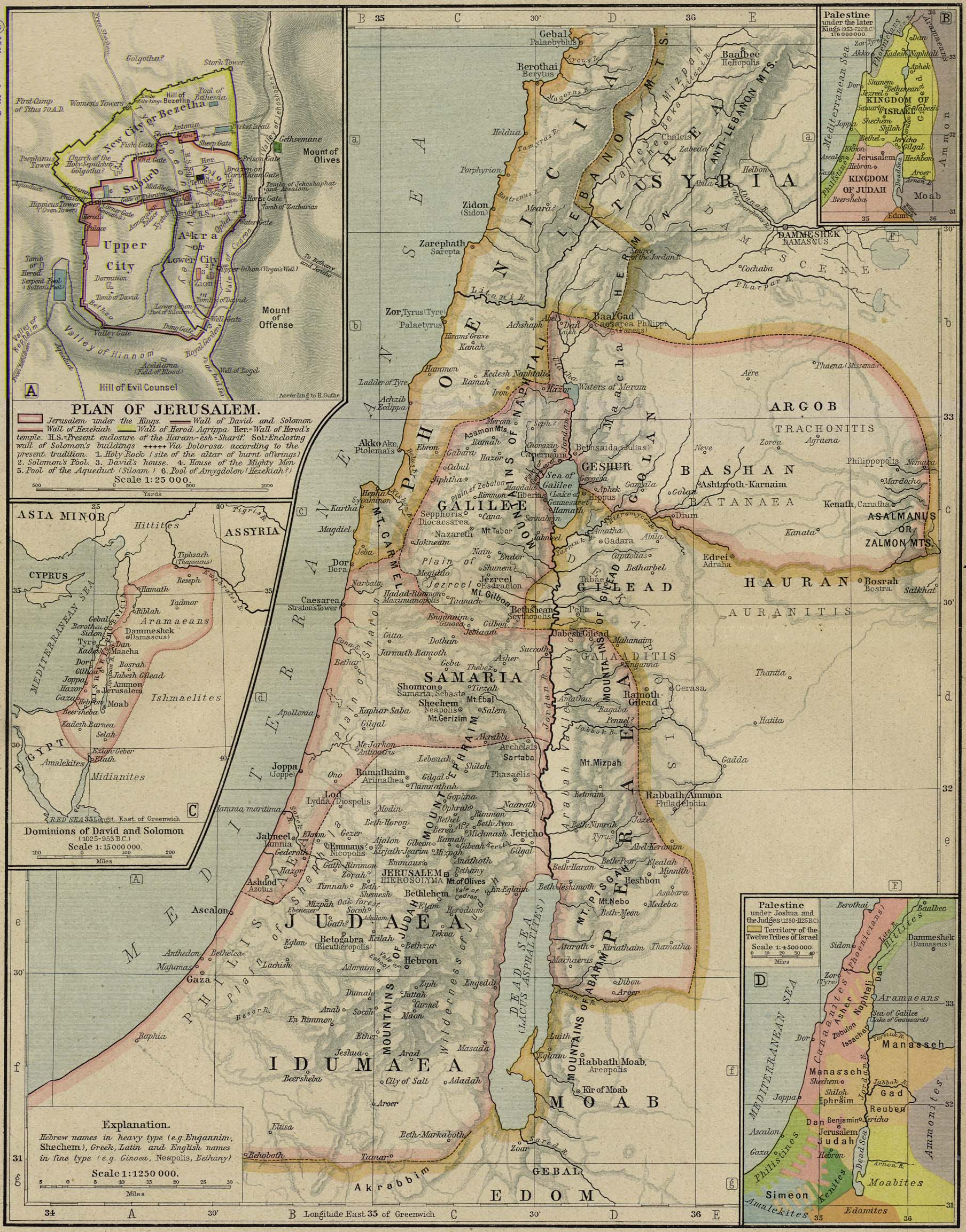
- 31.7054° N, 35.2024° Efind it on the Atlas →
- Region
- Judean Hill Country
- Kind of place
- Town
- Era
- Ancient and modern
2 places the record names with Bethlehem, the farthest 21 km away
- 1David anointed in front of his brothers1 Samuel 16:13 · 21 kmSo Samuel took the horn of oil and anointed him in the presence of his brothers, and the Spirit of the LORD rushed upon David from that day forward. Then Samuel set out and went to Ramah.
- 2A Jerusalem crowd quotes the Bethlehem expectation from memoryJohn 7:42 · 7.1 kmDoesn’t the Scripture say that the Christ will come from the line of David and from Bethlehem, the village where David lived?”
- Located: the gazetteer fixes one site
- Placed: the point stands for an area, or is rounded
- A dashed line ends at a place the gazetteer does not fix
Not located: Moab. The gazetteer records no location for it, so it is not marked.
Why Bethlehem matters
What has been found
the evidence, and where it is disputed
The birth of Christ at Bethlehem
Luke 2:1 to 2:20, with Matthew 2:1 to 2:12
Read Luke 2:1 to 2:20, with Matthew 2:1 to 2:12
- A registration is ordered across the empireLuke 2:1Now in those days a decree went out from Caesar Augustus that a census should be taken of the whole empire.
- Joseph goes up to the city of DavidLuke 2:4So Joseph also went up from Nazareth in Galilee to Judea, to the city of David called Bethlehem, since he was from the house and line of David.
- No room, and a feeding trough for a cradleLuke 2:7And she gave birth to her firstborn, a Son. She wrapped Him in swaddling cloths and laid Him in a manger, because there was no room for them in the inn.
- Shepherds keeping night watch in the fields nearbyLuke 2:8And there were shepherds residing in the fields nearby, keeping watch over their flocks by night.
- Today in the city of DavidLuke 2:11Today in the city of David a Savior has been born to you. He is Christ the Lord!
- Let us go to BethlehemLuke 2:15When the angels had left them and gone into heaven, the shepherds said to one another, “Let us go to Bethlehem and see this thing that has happened, which the Lord has made known to us.”
- They find the Baby lying in the mangerLuke 2:16So they hurried off and found Mary and Joseph and the Baby, who was lying in the manger.
- Magi arrive in Jerusalem asking for the King of the JewsMatthew 2:2asking, “Where is the One who has been born King of the Jews? We saw His star in the east and have come to worship Him.”
- Herod's scholars answer him out of MicahMatthew 2:6‘But you, Bethlehem, in the land of Judah, are by no means least among the rulers of Judah, for out of you will come a ruler who will be the shepherd of My people Israel.’”
- The magi come to the house and worshipMatthew 2:11On coming to the house, they saw the Child with His mother Mary, and they fell down and worshiped Him. Then they opened their treasures and presented Him with gifts of gold and frankincense and myrrh.
The crib scene compresses months. Matthew says the magi came to the house, and Herod's order covers boys up to two years old, reckoned from the time the star first appeared. Luke never numbers the shepherds and Matthew never numbers the magi.
The Incarnation: the full studyWhat happened here, in order
in the order the canon tells it
- Rachel buried on the road to EphrathGenesis 35:19So Rachel died and was buried on the way to Ephrath (that is, Bethlehem).
- Jacob sets a pillar over her graveGenesis 35:20Jacob set up a pillar on her grave; it marks Rachel’s tomb to this day.
- A young Levite of Bethlehem in Judah looks for workJudges 17:7And there was a young Levite from Bethlehem in Judah who had been residing within the clan of Judah.
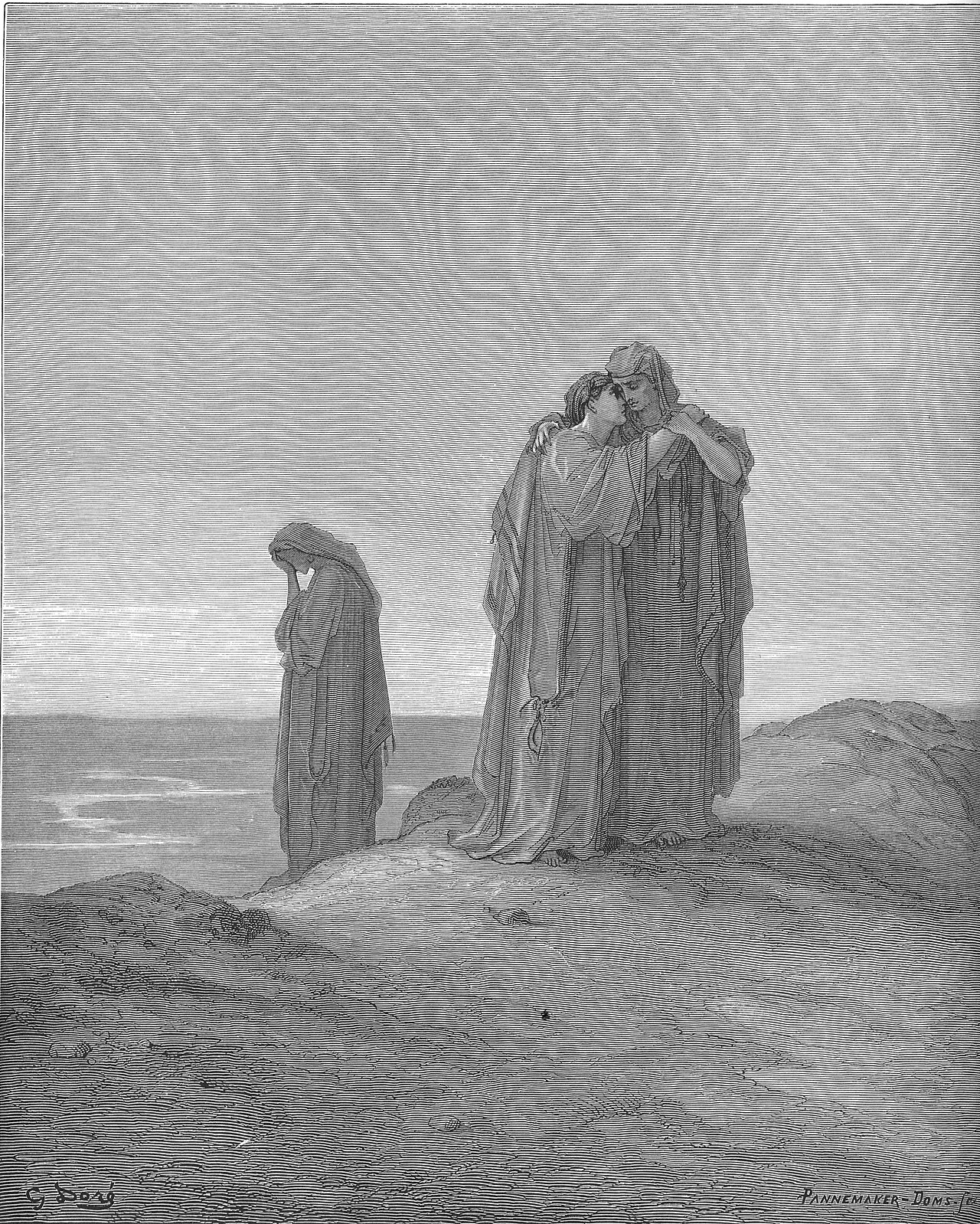
- Famine in the house of bread drives a family to MoabRuth 1:1In the days when the judges ruled, there was a famine in the land. And a certain man from Bethlehem in Judah, with his wife and two sons, went to reside in the land of Moab.
- Naomi and Ruth arrive at the start of barley harvestRuth 1:22So Naomi returned from the land of Moab with her daughter-in-law Ruth the Moabitess. And they arrived in Bethlehem at the beginning of the barley harvest.
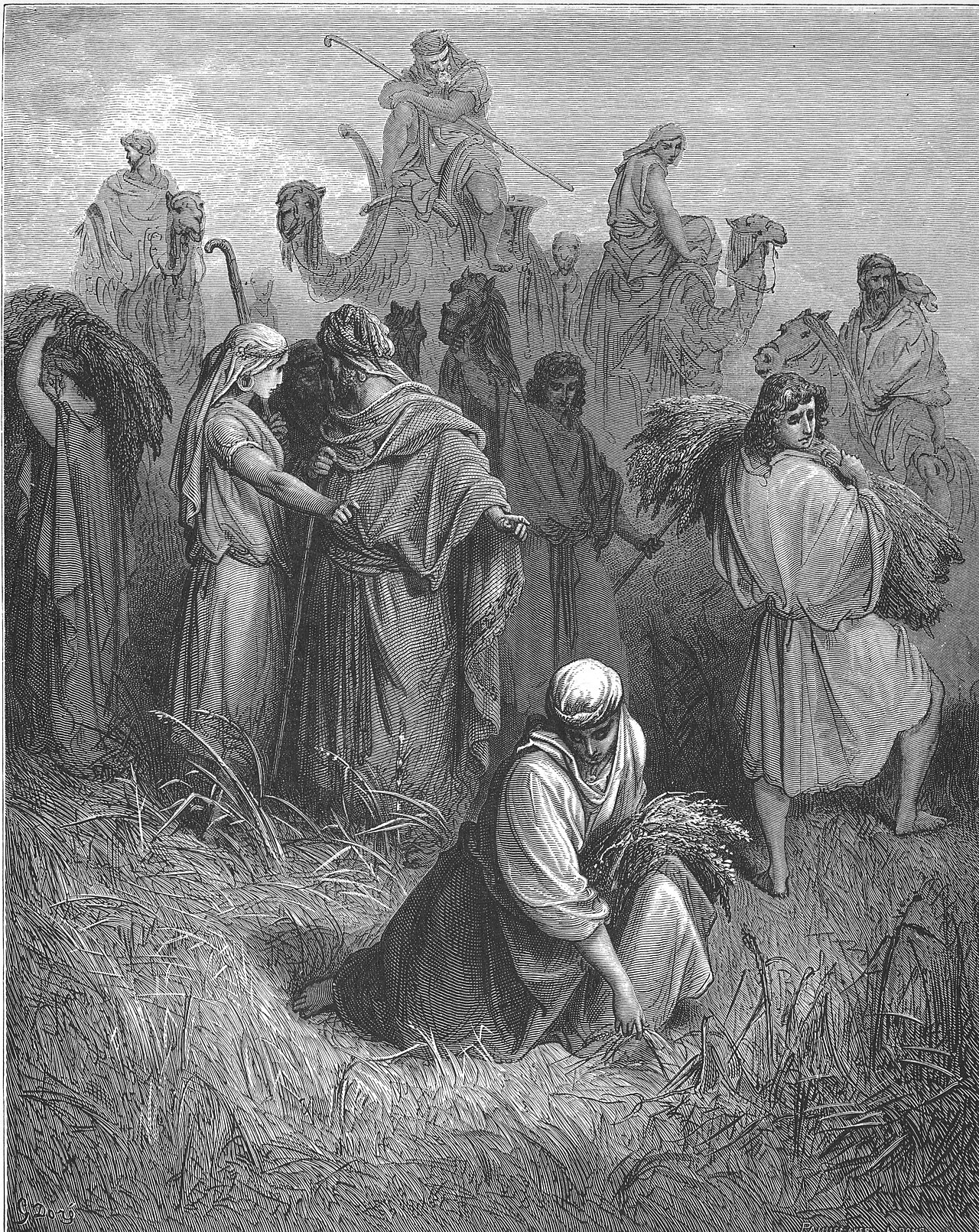
- Ruth gleans in a field belonging to BoazRuth 2:3So Ruth departed and went out into the field and gleaned after the harvesters. And she happened to come to the part of the field belonging to Boaz, who was from the clan of Elimelech.
- The elders bless the marriage at the town gateRuth 4:11“We are witnesses,” said the elders and all the people at the gate. “May the LORD make the woman entering your home like Rachel and Leah, who together built up the house of Israel. May you be prosperous in Ephrathah and famous in Bethlehem.
- Obed is born, the father of Jesse, the father of DavidRuth 4:17The neighbor women said, “A son has been born to Naomi,” and they named him Obed. He became the father of Jesse, the father of David.
- Samuel is sent to Jesse of Bethlehem with a horn of oil1 Samuel 16:1Now the LORD said to Samuel, “How long are you going to mourn for Saul, since I have rejected him as king over Israel? Fill your horn with oil and go. I am sending you to Jesse of Bethlehem, for I have selected from his sons a king for Myself.”
- David anointed in front of his brothers1 Samuel 16:13So Samuel took the horn of oil and anointed him in the presence of his brothers, and the Spirit of the LORD rushed upon David from that day forward. Then Samuel set out and went to Ramah.
- David named an Ephrathite from Bethlehem of Judah1 Samuel 17:12Now David was the son of a man named Jesse, an Ephrathite from Bethlehem of Judah who had eight sons in the days of Saul. And Jesse was old and well along in years.
- David longs for water from the well at the gate2 Samuel 23:15David longed for water and said, “Oh, that someone would get me a drink of water from the well near the gate of Bethlehem!”
- Three men break the Philistine line and bring it back2 Samuel 23:16So the three mighty men broke through the Philistine camp, drew water from the well near the gate of Bethlehem, and brought it back to David. But he refused to drink it; instead, he poured it out to the LORD,
- David pours the water out rather than drink it2 Samuel 23:17saying, “Far be it from me, O LORD, to do this! Is this not the blood of the men who risked their lives?” So he refused to drink it. Such were the exploits of the three mighty men.
- Rachel weeping for her childrenJeremiah 31:15This is what the LORD says: “A voice is heard in Ramah, mourning and great weeping, Rachel weeping for her children, and refusing to be comforted, because they are no more.”
- The ruler of Israel will come out of Bethlehem EphrathahMicah 5:2But you, Bethlehem Ephrathah, who are small among the clans of Judah, out of you will come forth for Me One to be ruler over Israel— One whose origins are of old, from the days of eternity.
- That ruler will stand and shepherd his flockMicah 5:4He will stand and shepherd His flock in the strength of the LORD, in the majestic name of the LORD His God. And they will dwell securely, for then His greatness will extend to the ends of the earth.
- Herod kills the boys of Bethlehem and its districtMatthew 2:16When Herod saw that he had been outwitted by the Magi, he was filled with rage. Sending orders, he put to death all the boys in Bethlehem and its vicinity who were two years old and under, according to the time he had learned from the Magi.
- A Jerusalem crowd quotes the Bethlehem expectation from memoryJohn 7:42Doesn’t the Scripture say that the Christ will come from the line of David and from Bethlehem, the village where David lived?”
Where it points
The voices
each quoted from the work named
(in Mich. v. 2.) The following is the sense of the prophecy. Thou, Bethlehem, of the land of Judah, or Ephrata, (which is added to distinguish it from another Bethlehem in Galilee,) though thou art a small village among the thousand cities of Judah, yet out of thee shall be born Christ, who shall be the Ruler of Israel, who according to the flesh is of the seed of David, but was born of Me before the worlds; and therefore it is written, His goings forth are of old. In the beginning was the Word.
In the beginning of barley harvest - This was in the beginning of spring, for the barley harvest began immediately after the passover, and that feast was held on the 15th of the month Nisan, which corresponds nearly with our March.
Our Lord Jesus is our Goel, our Redeemer, our everlasting Redeemer. He looked, like Boaz, with compassion on the deplorable state of fallen mankind. At a vast expense he redeemed the heavenly inheritance for us, which by sin was mortgaged, and forfeited into the hands of divine justice, and which we should never have been able to redeem.
4 more teachers on these versesMatthew Henry · Charles Spurgeon · Origen of Alexandria · J. C. Ryle
Fifthly, Thus he would honour God and give glory to him. The water purchased at this rate he thought too precious for his own drinking and fit only to be poured out to God as a drink-offering. If it was the blood of these men, it was God's due, for the blood was always his.
IT WAS NEEDFUL that it should be distinctly proven, beyond all dispute, that our Lord sprang out of Judah. It was necessary, also, that he should be born in Bethlehem-Ephratah, according to the word of the Lord which he spake by his servant Micah. But how could a public recognition of the lineage of an obscure carpenter and an unknown maiden be procured? What interest could the keepers of registers be supposed to take in two such humble persons?
Why then did the angel not go to Jerusalem, why did he not seek out the scribes and Pharisees, why did he not enter the synagogue of the Jews, but found "shepherds living out in the fields and keeping watch over their flock by night" and announced it to them? Does the word not hint at anything but truly the presenting matter, that the angel came to such ignorant shepherds, and does it signify nothing other than that? But the angel announces Christ to the shepherds of the churches.
It is not known who these wise men were. Their names and dwelling-place are alike kept back from us. We are only told that they came “from the east.” Whether they were Chaldeans or Arabians we cannot say. Whether they learned to expect Christ from the ten tribes who went into captivity, or from the prophecies of Daniel, we do not know. It matters little who they were. The point which concerns us most is the rich instruction which their history conveys.
Bethlehem in Scripture
55 verses name it, or one of its other names (Beit Lehem, Ephrath, Ephrathah), in 16 books
Open a book to read its mentions here. Text: Berean Standard Bible.
Old TestamentNew Testamentsegment width = share of mentions
Old Testament13 books · 47 mentions
Genesis3 mentions
- Genesis 35:16Later, they set out from Bethel, and while they were still some distance from Ephrath, Rachel began to give birth, and her labor was difficult.
- Genesis 35:19So Rachel died and was buried on the way to Ephrath (that is, Bethlehem).
- Genesis 48:7Now as for me, when I was returning from Paddan, to my sorrow Rachel died along the way in the land of Canaan, some distance from Ephrath. So I buried her there beside the road to Ephrath” (that is, Bethlehem).
Joshua1 mention
Judges8 mentions
- Judges 12:8After Jephthah, Ibzan of Bethlehem judged Israel.
- Judges 12:10Then Ibzan died, and he was buried in Bethlehem.
- Judges 17:7And there was a young Levite from Bethlehem in Judah who had been residing within the clan of Judah.
- Judges 17:8This man left the city of Bethlehem in Judah to settle where he could find a place. And as he traveled, he came to Micah’s house in the hill country of Ephraim.
- Judges 17:9“Where are you from?” Micah asked him. “I am a Levite from Bethlehem in Judah,” he replied, “and I am on my way to settle wherever I can find a place.”
- Judges 19:1Now in those days, when there was no king in Israel, a Levite who lived in the remote hill country of Ephraim took for himself a concubine from Bethlehem in Judah.
- Judges 19:2But she was unfaithful to him and left him to return to her father’s house in Bethlehem in Judah. After she had been there four months,
- Judges 19:18The Levite replied, “We are traveling from Bethlehem in Judah to the remote hill country of Ephraim, where I am from. I went to Bethlehem in Judah, and now I am going to the house of the LORD; but no one has taken me into his home,
Ruth6 mentions
- Ruth 1:1In the days when the judges ruled, there was a famine in the land. And a certain man from Bethlehem in Judah, with his wife and two sons, went to reside in the land of Moab.
- Ruth 1:2The man’s name was Elimelech, his wife’s name was Naomi, and the names of his two sons were Mahlon and Chilion. They were Ephrathites from Bethlehem in Judah, and they entered the land of Moab and settled there.
- Ruth 1:19So Naomi and Ruth traveled until they came to Bethlehem. When they entered Bethlehem, the whole city was stirred because of them, and the women of the city exclaimed, “Can this be Naomi?”
- Ruth 1:22So Naomi returned from the land of Moab with her daughter-in-law Ruth the Moabitess. And they arrived in Bethlehem at the beginning of the barley harvest.
- Ruth 2:4Just then Boaz arrived from Bethlehem and said to the harvesters, “The LORD be with you.” “The LORD bless you,” they replied.
- Ruth 4:11“We are witnesses,” said the elders and all the people at the gate. “May the LORD make the woman entering your home like Rachel and Leah, who together built up the house of Israel. May you be prosperous in Ephrathah and famous in Bethlehem.
1 Samuel8 mentions
- 1 Samuel 16:1Now the LORD said to Samuel, “How long are you going to mourn for Saul, since I have rejected him as king over Israel? Fill your horn with oil and go. I am sending you to Jesse of Bethlehem, for I have selected from his sons a king for Myself.”
- 1 Samuel 16:4So Samuel did what the LORD had said and went to Bethlehem. When the elders of the town met him, they trembled and asked, “Do you come in peace?”
- 1 Samuel 16:18One of the servants answered, “I have seen a son of Jesse of Bethlehem who knows how to play the harp. He is a mighty man of valor, a warrior, eloquent and handsome, and the LORD is with him.”
- 1 Samuel 17:12Now David was the son of a man named Jesse, an Ephrathite from Bethlehem of Judah who had eight sons in the days of Saul. And Jesse was old and well along in years.
- 1 Samuel 17:15but David went back and forth from Saul to tend his father’s sheep in Bethlehem.
- 1 Samuel 17:58“Whose son are you, young man?” asked Saul. “I am the son of your servant Jesse of Bethlehem,” David replied.
- 1 Samuel 20:6If your father misses me at all, tell him, ‘David urgently requested my permission to hurry to Bethlehem, his hometown, because there is an annual sacrifice for his whole clan.’
- 1 Samuel 20:28Jonathan answered, “David urgently requested my permission to go to Bethlehem,
2 Samuel5 mentions
- 2 Samuel 2:32Later, they took Asahel and buried him in his father’s tomb in Bethlehem. Then Joab and his men marched all night and reached Hebron at daybreak.
- 2 Samuel 23:14At that time David was in the stronghold, and the garrison of the Philistines was at Bethlehem.
- 2 Samuel 23:15David longed for water and said, “Oh, that someone would get me a drink of water from the well near the gate of Bethlehem!”
- 2 Samuel 23:16So the three mighty men broke through the Philistine camp, drew water from the well near the gate of Bethlehem, and brought it back to David. But he refused to drink it; instead, he poured it out to the LORD,
- 2 Samuel 23:24Now these were members of the Thirty: Asahel the brother of Joab, Elhanan son of Dodo of Bethlehem,
1 Chronicles10 mentions
- 1 Chronicles 2:19When Azubah died, Caleb married Ephrath, who bore to him Hur.
- 1 Chronicles 2:24After Hezron died in Caleb-ephrathah, his wife Abijah bore to him Ashhur the father of Tekoa.
- 1 Chronicles 2:50These were the descendants of Caleb. The sons of Hur the firstborn of Ephrathah:
- 1 Chronicles 2:51Shobal the father of Kiriath-jearim, Salma the father of Bethlehem, and Hareph the father of Beth-gader.
- 1 Chronicles 2:55Bethlehem, the Netophathites, Atroth-beth-joab, half the Manahathites, the Zorites, and the clans of the scribes who lived at Jabez—the Tirathites, Shimeathites, and Sucathites. These are the Kenites who came from Hammath, the father of the house of Rechab.
- 1 Chronicles 4:4Penuel was the father of Gedor, and Ezer was the father of Hushah. These were the descendants of Hur, the firstborn of Ephrathah and the father of Bethlehem.
- 1 Chronicles 11:16At that time David was in the stronghold, and the garrison of the Philistines was at Bethlehem.
- 1 Chronicles 11:17David longed for water and said, “Oh, that someone would get me a drink of water from the well near the gate of Bethlehem!”
2 further mentions in 1 Chronicles, read them in the book.
2 Chronicles1 mention
Ezra1 mention
Nehemiah1 mention
Psalms1 mention
Jeremiah1 mention
New Testament3 books · 8 mentions
Matthew5 mentions
- Matthew 2:1After Jesus was born in Bethlehem in Judea, during the time of King Herod, Magi from the east arrived in Jerusalem,
- Matthew 2:5“In Bethlehem in Judea,” they replied, “for this is what the prophet has written:
- Matthew 2:6‘But you, Bethlehem, in the land of Judah, are by no means least among the rulers of Judah, for out of you will come a ruler who will be the shepherd of My people Israel.’”
- Matthew 2:8And sending them to Bethlehem, he said: “Go and search carefully for the Child, and when you find Him, report to me, so that I too may go and worship Him.”
- Matthew 2:16When Herod saw that he had been outwitted by the Magi, he was filled with rage. Sending orders, he put to death all the boys in Bethlehem and its vicinity who were two years old and under, according to the time he had learned from the Magi.
Luke2 mentions
- Luke 2:4So Joseph also went up from Nazareth in Galilee to Judea, to the city of David called Bethlehem, since he was from the house and line of David.
- Luke 2:15When the angels had left them and gone into heaven, the shepherds said to one another, “Let us go to Bethlehem and see this thing that has happened, which the Lord has made known to us.”
The account
Read the account as one telling
The town sits on a limestone ridge about 2,500 feet above sea level, six miles south of Jerusalem on the road running down the spine of Judah. Its older name is Ephrath, or Ephrathah, and the Bible glosses that name for the reader twice so no one confuses the two.
Bethlehem first appears as the place Jacob buried Rachel. She died in labor on the road, some distance short of the town, and Jacob set a pillar over her grave. Immediately after, he pitched his tent beyond the Tower of Eder, the tower of the flock, which stands in the same stretch of country.
In the days of the judges the town shows up twice as an ordinary place people came from. A young Levite of Bethlehem in Judah went looking for work, and another Levite took a concubine from Bethlehem in Judah. Both accounts add the words in Judah, because there was a second Bethlehem in the tribe of Zebulun, listed once in Joshua 19:15, about seven miles from Nazareth.
The book of Ruth is set in the same period. Famine emptied the house of Elimelech, and when Naomi came home with Ruth the Moabitess the barley harvest was just beginning. Ruth gleaned behind the harvesters under the poverty law, Boaz redeemed the family holding at the town gate before the elders, and the child born to them was Obed, the father of Jesse, the father of David.
David grew up here keeping his father's sheep, and Samuel anointed him here in front of his brothers. First Samuel calls him an Ephrathite from Bethlehem of Judah. Later, when David was hiding at the cave of Adullam, a Philistine garrison held Bethlehem, which is how the town's well came to stand behind enemy lines in the story of the three mighty men.
- eighth century BC
Micah prophesied in the eighth century BC, while Assyria was pressing down on the land, and named this town as the birthplace of Israel's coming ruler. He puts that word four verses after addressing Migdal Eder, the tower of the flock, and follows it with a promise that the ruler will shepherd his flock.
Jesus was born in Bethlehem during the reign of Herod the Great. Luke traces it to a registration ordered by Caesar Augustus that sent Joseph, of the house and line of David, from Nazareth back to David's town. Shepherds keeping night watch in the fields nearby were told first. Matthew adds the magi, who came from the east and found the child in a house, and Herod, who answered by killing the boys of Bethlehem and its vicinity who were two years old and under.
After that the town leaves the biblical record, though the expectation it carried does not. John 7:42 catches a Jerusalem crowd repeating the Bethlehem prophecy in an argument about Jesus, which shows how widely the verse was known before the church existed to teach it.
Common questions
Was Jesus born in a stable or a cave?
Readers differ; the positions are named
Luke uses neither word. He says there was no room in the kataluma and that Mary laid the child in a manger. The oldest surviving outside witness is Justin Martyr, writing around AD 155 to 160 from about thirty-five miles away, who says the family lodged in a cave near the village; Origen reports the same cave being shown to visitors around AD 248.
Houses in the Judean hills regularly kept animals in a rock-cut lower room or an adjoining cave, so a cave and a stall describe the same building from two sides. Scripture leaves the detail open and this page leaves it there.
What was the manger, and what was the inn?
A manger is a feeding trough for animals, cut from stone or built up from it. Luke mentions it three times, and it is the sign the angel gives the shepherds so they will know which child they have found.
The Greek word behind inn is kataluma, the same word Luke uses in 22:11 for the upper room where the Last Supper was held. It means a guest space, not a commercial hotel. John Wesley thought the phrase might rather be translated in the stall, and no innkeeper appears anywhere in the text.
When was Jesus born, and why is December 25 disputed?
Readers differ; the positions are named
Scripture gives no date, no month and no season. December 25 first appears in a Roman list dated AD 354, and two explanations for it compete: one traces the date by calculation from a March 25 date for the conception, and the other sees a Christian claim planted on an existing Roman solar festival. Eastern churches keep January 6 or 7 on a different calendar reckoning.
Charles Spurgeon put the plain point in 1876, that there is no reason on earth beyond church custom why December 25 rather than any other day should be kept as the birthday. The date is not in the text, and nothing in the account depends on it.
Who were the magi, and how many were there?
Matthew never numbers them. He names three gifts, gold, frankincense and myrrh, and the count of three men came later, along with the names Melchior, Caspar and Balthazar that belong to tradition rather than to the text. J. C. Ryle was blunt about it in 1856: their names and home are kept back from us, and it matters little who they were.
They also did not arrive at the manger. Matthew says they came to the house, and Herod's order covers boys up to two years old, reckoned from the time the star first appeared. Months, and possibly more than a year, separate the shepherds from the magi.
What was the star of Bethlehem?
Readers differ; the positions are named
Three kinds of answer are on offer and this page names them without choosing. Johannes Kepler proposed a conjunction of Jupiter and Saturn in Pisces in 7 BC. Colin Humphreys has argued for a comet, and Michael Molnar for an astrological configuration in Aries involving Jupiter. Against all of these stands the reading that the star was not a natural body at all, held from Chrysostom onward and argued from the star's described behaviour, since nothing in the sky goes ahead of travellers on a short road and then stands still over one house.
Matthew tells us what the star did and does not tell us what it was. The full case for each reading is set out on the study page.
Was there really a census that sent Joseph to Bethlehem?
Readers differ; the positions are named
Luke says the registration happened while Quirinius was governor of Syria, and Josephus records a census under Quirinius in AD 6, about ten years after Herod died. That is a real gap and this page does not settle it.
Some read Luke's first as marking an earlier registration distinct from the AD 6 one. Sir William Ramsay argued that Quirinius held an earlier command in Syria, in Was Christ Born at Bethlehem? (1898). N. T. Wright reads the Greek as before Quirinius was governor, in Who Was Jesus? (1992). Much of critical scholarship follows Emil Schürer in holding that Luke was mistaken. What is not disputed is that Augustus ran registrations across the empire and that provincial registration by ancestral district is documented practice.
Does Micah 5:2 really name Bethlehem, and why does Matthew word it differently?
Micah names the town and its older name together, Bethlehem Ephrathah, and says the ruler who comes out of it has origins from the days of eternity. That the expectation was public long before the church is visible twice over: Herod's own scholars answer him from that verse, and an ordinary Jerusalem crowd quotes it from memory in John 7.
Matthew's Greek matches neither the Hebrew nor the Septuagint exactly. John Wesley explained why: the apostles did not always transcribe a passage word for word, but gave the general sense with some diversity of language.
Why does Matthew quote Jeremiah about Ramah when the children died in Bethlehem?
Jeremiah pictures Rachel weeping at Ramah for children who are no more, and Matthew applies the line to the boys killed at Bethlehem. Rachel's grave is on the Bethlehem road, so Matthew hears a mother of Israel weeping over the same ground a second time.
Jerome named the difficulty rather than hiding it. He observed that Matthew followed neither the Hebrew nor the Greek exactly, and that Ramah can be read as aloft, a cry carried far and wide. The chapter Matthew quotes turns almost at once to the children coming back to their own border, and reaches the new covenant sixteen verses later.
There are two towns called Bethlehem. Which one is this?
The other Bethlehem sat in the territory of Zebulun, about seven miles from Nazareth, and Scripture mentions it once, in a town list. Every passage about David's town and the birth of Christ specifies the southern one: Bethlehem in Judah, Bethlehem of Judah, Bethlehem Ephrathah, Bethlehem in Judea.
Jerome said that Micah adds Ephrathah for exactly that reason, to distinguish it from the other Bethlehem. The two are never confused inside the Bible because the text keeps labelling them.
Notable art
3 verified pieces depicting Bethlehem
Sources cited
- Easton's Bible Dictionary (1897): Bethlehemread 2026-04-17Public domain.
- ISBE (1915): Bethlehemread 2026-04-17Public domain.
- UNESCO World Heritage Site: Birthplace of Jesus: Church of the Nativityread 2026-04-17The reference behind the Church of the Nativity paragraph.
- Wikipedia: Bethlehemread 2026-04-17Background reading, credited under CC-BY-SA. No claim on this page rests on it.
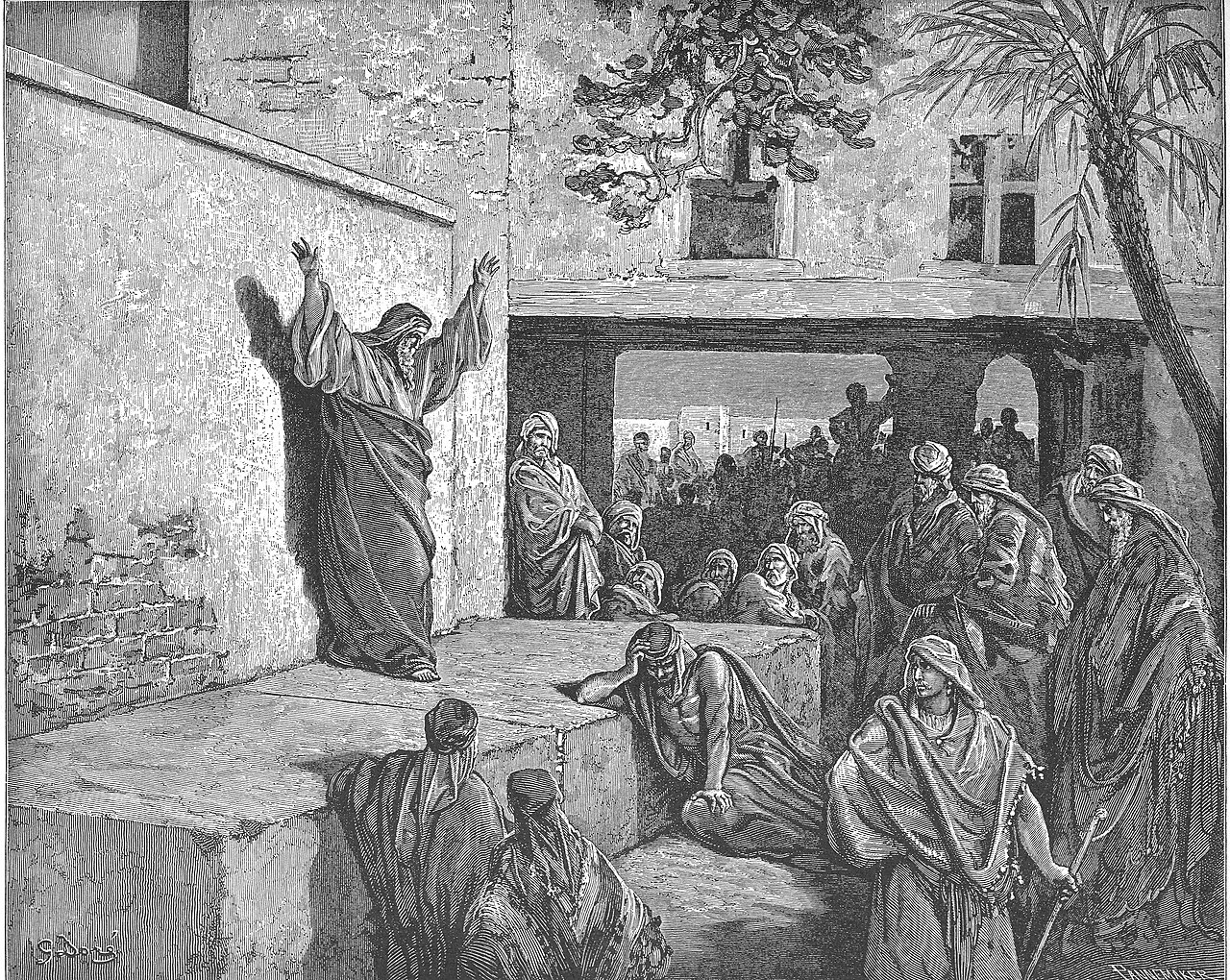
- Gustave Doré, La Sainte Bible (Tours: Alfred Mame et fils, 1866)The Ruth and Micah engravings on this page. Public domain.
- Edward Burne-Jones, The Adoration of the MagiThe hero image. Public domain, license-verified via the Commons imageinfo API.
- Justin Martyr, Dialogue with Trypho 78, c. AD 155 to 160The earliest surviving witness to the cave at Bethlehem. Public domain.
- Origen, Against Celsus 1.51, c. AD 248Reports the cave and the manger being shown at Bethlehem. Public domain.
- Origen, Homilies on Luke (253)Quoted on the page for the angel going to shepherds. Public domain.
- Jerome, Epistle 58.3, to Paulinus, AD 395The grove of Tammuz and Adonis over the site from Hadrian to Constantine. Public domain.
- Thomas Aquinas, Catena Aurea, on Matthew 2, carrying JeromeThe Jerome quotation on this page. Public domain.
- Eusebius of Caesarea, Life of Constantine 3.41 to 3.43Cited for the church built over the cave under Helena's patronage. Public domain.
- J. C. Ryle, Expository Thoughts on the Gospels: Matthew (1856)Quoted on the magi. Public domain.
- Charles H. Spurgeon, The Metropolitan Tabernacle Pulpit, Sermon No. 485Public domain, CCEL edition, lightly modernized text.
- Charles H. Spurgeon, The Metropolitan Tabernacle Pulpit, Sermon No. 1330Referred to on the December 25 question. Public domain, CCEL edition.
- Matthew Henry, Commentary on the Whole Bible (1710)Quoted on Ruth 4 and on 2 Samuel 23. Public domain.
- John Wesley, Explanatory Notes upon the Old Testament (1765) and upon the New Testament (1755)Cited on Ruth 4:11, Luke 2:7 and Matthew 2:6. Public domain.
- Adam Clarke, Commentary on the Bible (1832)Quoted on the barley harvest at Bethlehem. Public domain.
- Flavius Josephus, Antiquities of the Jews 17.8 and 18.1 to 18.2Cited at book level for Herod's death and for the census under Quirinius. Public domain.
- Sir William M. Ramsay, Was Christ Born at Bethlehem? (1898)Cited for the earlier command reading of the census question. Public domain.
- Emil Schürer, A History of the Jewish People in the Time of Jesus ChristCited for the reading that Luke was mistaken about the census. Public domain.
- N. T. Wright, Who Was Jesus? (1992)Modern, referenced not quoted, for the adverbial reading of Luke 2:2.
- Aviram Oshri, "Where Was Jesus Born?", Archaeology (2005)Referenced not quoted, for the Bethlehem of Galilee proposal.
Keep studying
On this page
Studies39
- The birth of Christ at Bethlehem
- 1 Samuel: the Study Guide
- 2 Samuel: the Study Guide
- Bethlehem
- David
- Luke, the Study Guide
Show the next 6 titles
Show the next 6 titles
- Matthew, the Study Guide
- Micah, the Study Guide
- Micah's idol and the migration of Dan
- No king in Israel: the refrain that closes Judges
- Rachel's Tomb on the Bethlehem Road
- Ruth: the Study Guide
Show the next 6 titles
Every page that names it1
Books that name it3
Lives that run through it5
Doorway2
Keep this page