
Place
Mount of Olives
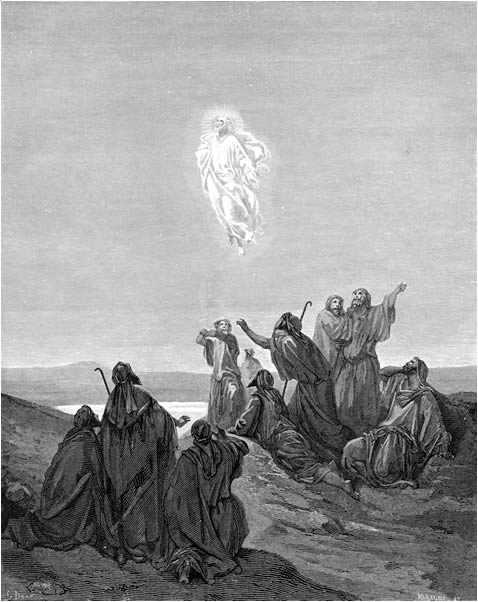
Gustave Doré, La Sainte Bible (Tours: Alfred Mame et fils, 1866). Public domain.
Summary
The ridge east of Jerusalem across the Kidron, where David went up weeping, where the glory departed in Ezekiel’s vision, where Jesus taught, wept over the city and was taken up, and where Zechariah says His feet will stand.
- The Mount of Olives is the limestone ridge immediately east of Jerusalem, separated from the temple platform by the Kidron valley and running about three and a half kilometres from north to south.
- Scripture names it first in 2 Samuel 15:30, where David walks up it barefoot and weeping, driven out of his own city by his own son, and stops at a summit where he used to worship.
- Ezekiel watches the glory of God leave the temple and stop over the mountain east of the city, and twenty-two chapters later he sees the same glory return from the east and fill the house.
- Zechariah 14:4 is the only place in the Old Testament prophets that uses the mountain's name, and it says the feet of the LORD will stand on it and split it east to west.
- Jesus rode down its western slope to the shouting of the crowd, wept over the city from that slope, taught about the end of the age sitting on it, prayed at its foot on the night He was betrayed, and ascended from it while angels said He would come back in the same way.
On this page
In Scripture
- Verses
- 14
- Books
- 7
Near Mount of Olives
- Moriah1.1 km · 0.7 mi W
- Zion1.2 km · 0.8 mi SW
- Bethany1.6 km · 1.0 mi SE
- Nob2.7 km · 1.7 mi NW
- Jerusalem3.3 km · 2.1 mi W
- Gibeah5.3 km · 3.3 mi N
Straight-line distances, computed from the gazetteer coordinates.
Where it is
the country around it
- Coordinates
- 31.7781° N, 35.2472° Efind it on the Atlas →
- Region
- East of Jerusalem
- Kind of place
- Mountain
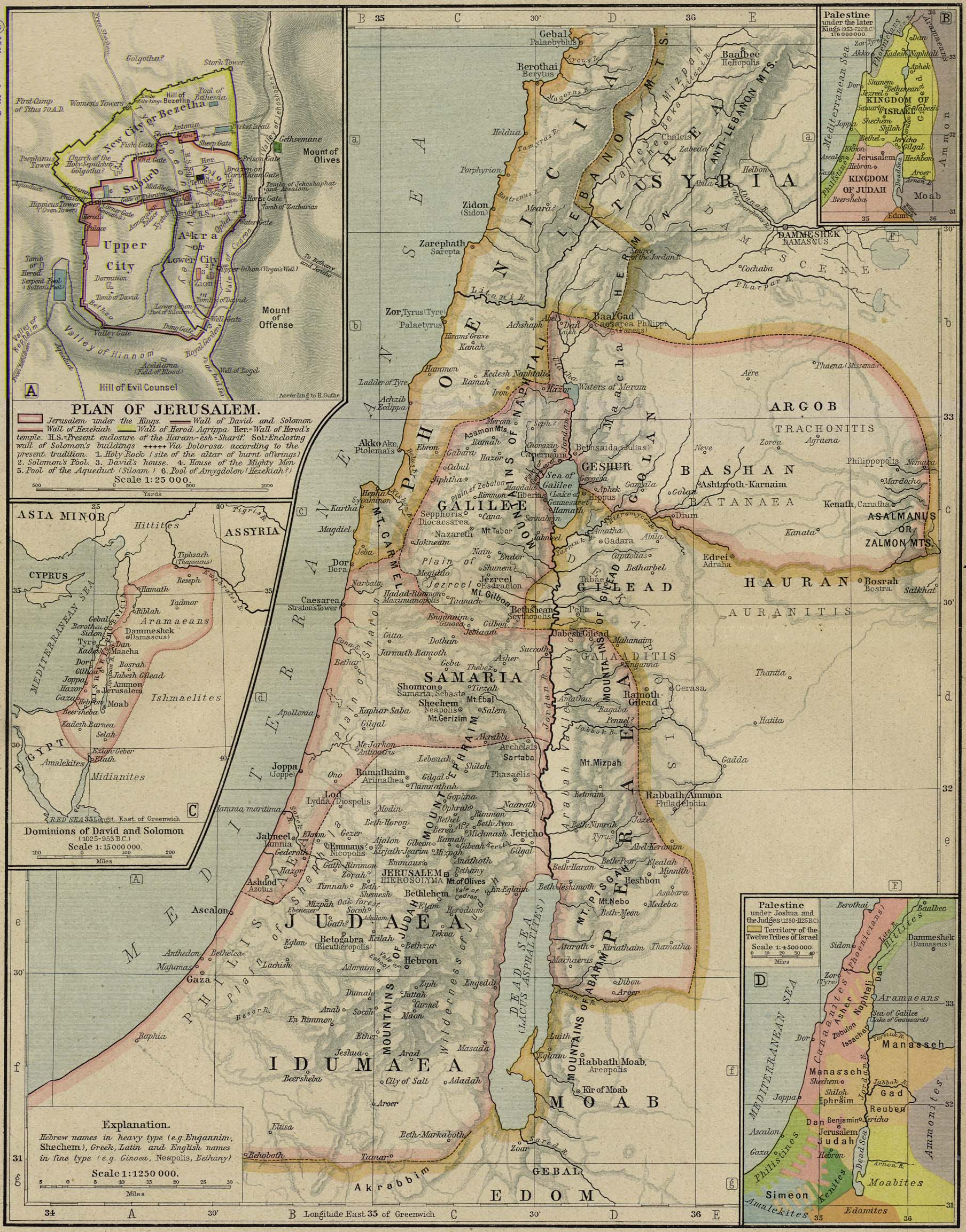
2 places the record names with Mount of Olives, the farthest 3.3 km away
- 1Solomon builds high places on the hill east of Jerusalem1 Kings 11:7 · 3.3 kmAt that time on a hill east of Jerusalem, Solomon built a high place for Chemosh the abomination of Moab and for Molech the abomination of the Ammonites.
- 2Led out as far as Bethany, and blessedLuke 24:50 · 1.6 kmWhen Jesus had led them out as far as Bethany, He lifted up His hands and blessed them.
- Located: the gazetteer fixes one site
- ? Proposed: one candidate among several
- A dashed line ends at a place the gazetteer does not fix
Not located: Gethsemane, The Temple, Moab. The gazetteer records no location for them, so they are not marked.
Why Mount of Olives matters
What has been found
the evidence, and where it is disputed
The ascension
Luke 24:50 to 53 and Acts 1:3 to 12, from the eastern slope of the ridge, forty days after the resurrection
Read Luke 24:50 to 53 and Acts 1:3 to 12, from the eastern slope of the ridge, forty days after the resurrection
- Led out as far as Bethany, and blessedLuke 24:50When Jesus had led them out as far as Bethany, He lifted up His hands and blessed them.
- Carried up while He was still blessing themLuke 24:51While He was blessing them, He left them and was carried up into heaven.
- Forty days of proofs and of the kingdomActs 1:3After His suffering, He presented Himself to them with many convincing proofs that He was alive. He appeared to them over a span of forty days and spoke about the kingdom of God.
- The last question they asked HimActs 1:6So when they came together, they asked Him, “Lord, will You at this time restore the kingdom to Israel?”
- The timetable refusedActs 1:7Jesus replied, “It is not for you to know times or seasons that the Father has fixed by His own authority.
- What they were given insteadActs 1:8But you will receive power when the Holy Spirit comes upon you, and you will be My witnesses in Jerusalem, and in all Judea and Samaria, and to the ends of the earth.”
- Taken up, and a cloud hid HimActs 1:9After He had said this, they watched as He was taken up, and a cloud hid Him from their sight.
- Two men in white beside themActs 1:10They were looking intently into the sky as He was going, when suddenly two men dressed in white stood beside them.
- He will come back in the same wayActs 1:11“Men of Galilee,” they said, “why do you stand here looking into the sky? This same Jesus, who has been taken from you into heaven, will come back in the same way you have seen Him go into heaven.”
- Back to the city from this mountainActs 1:12Then they returned to Jerusalem from the Mount of Olives, which is near the city, a Sabbath day’s journey away.
Luke tells this twice and the two accounts give the page its one honest geographical question. Luke 24:50 says He led them out as far as Bethany; Acts 1:12 says they returned from the Mount of Olives. Those are a village district and a ridge, not two rival points on a map, and Bethany's district reached the eastern slope. The buildings on the summit are later traditions with dates, and the text itself gives a district rather than a spot.
The Ascension: the full studyWhat happened here, in order
in the order the canon tells it
- David goes up the mountain barefoot and weeping, and the name appears for the first time2 Samuel 15:30But David continued up the Mount of Olives, weeping as he went up. His head was covered, and he was walking barefoot. And all the people with him covered their heads and went up, weeping as they went.
- There was already a place of worship on the summit2 Samuel 15:32When David came to the summit, where he used to worship God, Hushai the Archite was there to meet him with his robe torn and dust on his head.
- Solomon builds high places on the hill east of Jerusalem1 Kings 11:7At that time on a hill east of Jerusalem, Solomon built a high place for Chemosh the abomination of Moab and for Molech the abomination of the Ammonites.
- Josiah desecrates them, and the ridge is called the Mount of Corruption2 Kings 23:13The king also desecrated the high places east of Jerusalem, to the south of the Mount of Corruption, which King Solomon of Israel had built for Ashtoreth the abomination of the Sidonians, for Chemosh the abomination of the Moabites, and for Milcom the abomination of the Ammonites.
- The returned community goes up into the hill country for olive branchesNehemiah 8:15So they proclaimed this message and spread it throughout their towns and in Jerusalem, saying, “Go out to the hill country and bring back branches of olive, wild olive, myrtle, palm, and other leafy trees, to make booths, as it is written.”
- The glory of the LORD leaves the threshold of the templeEzekiel 10:18Then the glory of the LORD moved away from the threshold of the temple and stood above the cherubim.
- The glory stops over the mountain east of the cityEzekiel 11:23And the glory of the LORD rose up from within the city and stood over the mountain east of the city.
- The same glory comes back from the eastEzekiel 43:2and I saw the glory of the God of Israel coming from the east. His voice was like the roar of many waters, and the earth shone with His glory.
- The east gate is shut behind itEzekiel 44:2And the LORD said to me, “This gate is to remain shut. It shall not be opened, and no man shall enter through it, because the LORD, the God of Israel, has entered through it. Therefore it will remain shut.
- The one place in the prophets that names the mountainZechariah 14:4On that day His feet will stand on the Mount of Olives, east of Jerusalem, and the Mount of Olives will be split in two from east to west, forming a great valley, with half the mountain moving to the north and half to the south.
- The last week begins at Bethphage on this mountainMatthew 21:1As they approached Jerusalem and came to Bethphage on the Mount of Olives, Jesus sent out two disciples,
- A limit set on the desolation, spoken before He walks out to the ridgeMatthew 23:39For I tell you that you will not see Me again until you say, ‘Blessed is He who comes in the name of the Lord.’”
- After the hymn, out to the Mount of OlivesMatthew 26:30And when they had sung a hymn, they went out to the Mount of Olives.
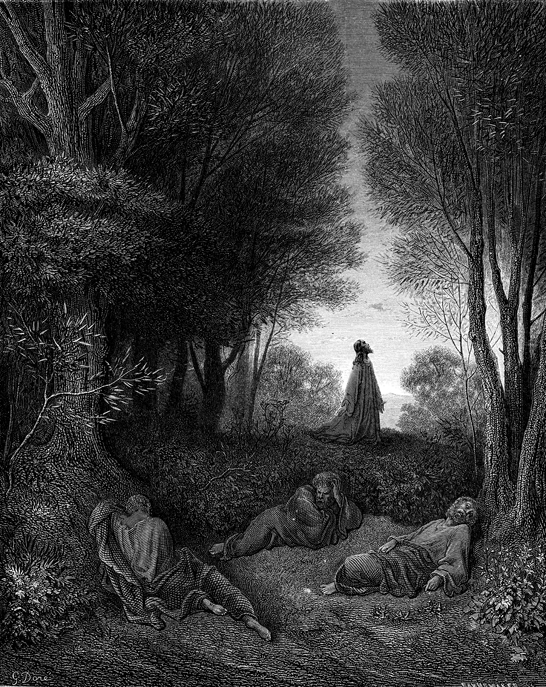
- Gethsemane, the garden at the foot of the ridgeMatthew 26:36At that time Jesus went with His disciples to a place called Gethsemane, and He told them, “Sit here while I go over there and pray.”
- The teaching about the end of the age is given sitting on this hillMark 13:3While Jesus was sitting on the Mount of Olives opposite the temple, Peter, James, John, and Andrew asked Him privately,
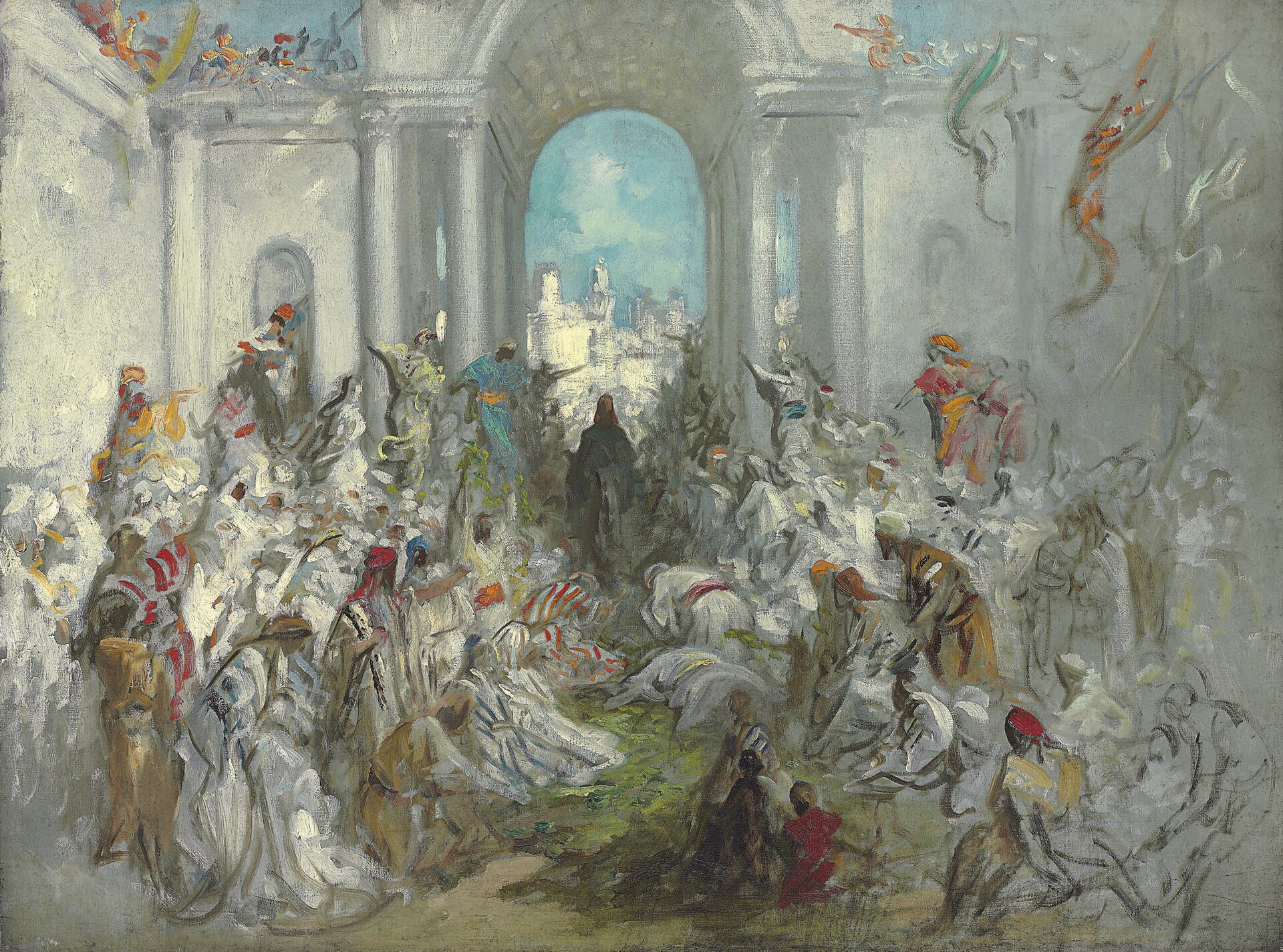
- The shouting starts at the descent from the mountainLuke 19:37And as He approached the descent from the Mount of Olives, the whole multitude of disciples began to praise God joyfully in a loud voice for all the miracles they had seen:
- He weeps over the city from that slope, before He enters itLuke 19:41As Jesus approached Jerusalem and saw the city, He wept over it
- Every night of that week was spent out on this mountainLuke 21:37Every day Jesus taught at the temple, but every evening He went out to spend the night on the Mount of Olives.
- Led out as far as Bethany, and blessedLuke 24:50When Jesus had led them out as far as Bethany, He lifted up His hands and blessed them.
- The disciples come back to the city from this mountainActs 1:12Then they returned to Jerusalem from the Mount of Olives, which is near the city, a Sabbath day’s journey away.
Where it points
The voices
each quoted from the work named
Mount of Olives - The mountain about a mile directly east of Jerusalem. See the notes at Mat 21:1. This was the place in which he probably often passed the night when attending the feasts at Jerusalem. The Garden of Gethsemane, to which he was accustomed to resort Joh 18:2, was on the western side of that mountain, and Bethany, the abode of Martha and Mary, on its east side, Joh 11:1.
Again, after Absalom's rebellion, when David was in flight, with many possible routes before him, he chose to make his escape by the Mount of Olives, as good as invoking in his own mind the Deliverer who should from there ascend into the heavens. And when Shimei cursed him bitterly he said, "Let him be."
I linger long in the land of the midday sun, for it was there and then that the spouse found her bridegroom at rest and Joseph drank wine with his brothers once more. I will return to Jerusalem and, passing through Tekoa the home of Amos, I will look on the glistening cross of Mount Olive from which the Savior made his ascension to the Father. Here year by year a red heifer was burned as an offering to the Lord, and its ashes were used to purify the children of Israel. Here also according to Ezekiel the cherubim after leaving the temple founded the church of the Lord.
4 more teachers on these versesEusebius of Caesarea · Charles Spurgeon · Albert Barnes · Adam Clarke
It is possible for us to see this literally fulfilled in another way even today, since believers in Christ all congregate from all parts of the world, not as of old time because of the glory of Jerusalem or that they may worship in the ancient temple at Jerusalem; but they rest there that they may learn both about the city being taken and devastated as the prophets foretold and that they may worship at the Mount of Olives opposite to the city, whither the glory of the Lord migrated when it left the former city.
May not our Lord also have thought of David, when on that memorable occasion he fled out of the city from his rebellions son, and it is written, "The king also, himself, passed over the brook Kidron," and he and his people went up barefoot and bareheaded, weeping as they went?
And His feet shall stand in that day upon the mount of Olives - “Over against Jerusalem to the east, wherein riseth the Sun of Righteousness.” The Mount of Olives is the central eminence of a line of hills, of rather more than a mile in length, overhanging the city, from which it is separated only by the narrow bed of the valley of the brook Cedron. It rises 187 feet above Mount Zion, 295 feet above Mount Moriah, 443 feet above Gethsemane, and lies between the city and the wilderness toward the dead sea: around its northern side, wound the road to Bethany and the Jordan . There, probably, David worshiped 2Sa 15:32; his son, in his decay, profaned it 1Ki 11:7; Josiah desecrated his desecrations 2Ki 23:13; there “upon the mountain, which is on the east side of the city, the glory of the Lord stood,” when it had “gone up from the midst of the city” Eze 11:23; it united the greatest glory of the Lord on earth, His Ascension, with its deepest sorrow, in Gethsemane. Since the Angel said, “This same Jesus, which is taken up from you into heaven, shall so come in like manner as ye have seen Him go into heaven” Act 1:11, the old traditional opinion is not improbable, that our Lord shall come again to judge the earth, where He left the earth, near the place of His Agony and Crucifixion for us.
This same Jesus - Clothed in human nature, shall so come in like manner - with the same body, descending from heaven by his sovereign and all-controlling power, as ye have seen him go into heaven. Thus shall he come again to judge the quick and the dead. It was a very ancient opinion among Christians, that when Christ should come again to judge the world he would make his appearance on Mount Olivet. Some think that his coming again to destroy the Jewish nation is what the angels refer to. See a connected account of the different appearances of Christ at the end of this chapter.
Mount of Olives in Scripture
14 verses name it, in 7 books
Open a book to read its mentions here. Text: Berean Standard Bible.
Old TestamentNew Testamentsegment width = share of mentions
Old Testament2 books · 2 mentions
2 Samuel1 mention
New Testament5 books · 12 mentions
Matthew3 mentions
- Matthew 21:1As they approached Jerusalem and came to Bethphage on the Mount of Olives, Jesus sent out two disciples,
- Matthew 24:3While Jesus was sitting on the Mount of Olives, the disciples came to Him privately. “Tell us,” they said, “when will these things happen, and what will be the sign of Your coming and of the end of the age?”
- Matthew 26:30And when they had sung a hymn, they went out to the Mount of Olives.
Mark3 mentions
- Mark 11:1As they approached Jerusalem and came to Bethphage and Bethany at the Mount of Olives, Jesus sent out two of His disciples
- Mark 13:3While Jesus was sitting on the Mount of Olives opposite the temple, Peter, James, John, and Andrew asked Him privately,
- Mark 14:26And when they had sung a hymn, they went out to the Mount of Olives.
Luke4 mentions
- Luke 19:29As He approached Bethphage and Bethany at the Mount of Olives, He sent out two of His disciples,
- Luke 19:37And as He approached the descent from the Mount of Olives, the whole multitude of disciples began to praise God joyfully in a loud voice for all the miracles they had seen:
- Luke 21:37Every day Jesus taught at the temple, but every evening He went out to spend the night on the Mount of Olives.
- Luke 22:39Jesus went out as usual to the Mount of Olives, and the disciples followed Him.
The account
Read the account as one telling
The Mount of Olives is the limestone ridge running north to south along the eastern side of Jerusalem, separated from the city and from the temple platform by the Kidron valley. It carries three named summits. From north to south they are Mount Scopus, the central summit that holds the village of et-Tur and the ascension traditions, and the southern summit, which 2 Kings 23:13 calls the Mount of Corruption and which older English works call the Mount of Offence. The ridge runs roughly three and a half kilometres. Published elevations differ by several metres between sources, so every figure here carries the word about: about 826 m for Mount Scopus, about 808 m for the central summit, about 747 m for the southern summit, with the temple platform at about 740 m and the Kidron floor beside the city at roughly 610 to 640 m. On those figures the central summit stands about 70 m above the temple platform. The valley between is dry for most of the year and runs only in the rains. The old road from Jericho and the Jordan came up the eastern side of the ridge, through Bethany, over the shoulder by Bethphage, and down the western slope to the city.
The first time Scripture names the mountain, a king is walking up it in flight. 2 Samuel 15 has David crossing the Kidron with the people weeping around him, going up the Mount of Olives with his head covered and his feet bare, praying that the counsel of Ahithophel would be turned into foolishness, and meeting Hushai the Archite at the top. Verse 32 says the summit was a place where he used to worship God, which means a holy place already stood on this ridge in the tenth century BC.
Solomon built on the same hill and Josiah tore it down. 1 Kings 11:7 says Solomon built a high place for Chemosh and for Molech on a hill east of Jerusalem. The text does not use the mountain's name there. The identification with this ridge is the traditional one, held from the Targum and Rashi onward, and it rests on 2 Kings 23:13, which places Josiah's demolition east of Jerusalem and south of the Mount of Corruption. Adam Clarke, following the Targum and Rashi, records the old observation behind that second name: the Hebrew for corruption, hammashchith, differs by one consonant from hammishchah, anointing, which is the word in the Mishnah's own name for the ridge. After the exile the mountain returns to ordinary use. Nehemiah 8:15 sends the returned community out into the hill country for branches of olive, wild olive, myrtle and palm to build booths for the feast of the seventh month.
Ezekiel gives the ridge its heaviest place in the prophets. He watches the glory of the LORD leave the temple by stages, first from the threshold, then at the entrance of the east gate, and finally rising up from within the city to stand over the mountain east of the city (Ezekiel 10:18 to 19; 11:22 to 23). Twenty-two chapters later the same glory comes back from the east, enters through the east gate, and fills the house, and the gate is then shut and stays shut (Ezekiel 43:1 to 5; 44:1 to 2). Zechariah, later still, names the mountain outright. On the day of the LORD, he writes, the feet of the LORD will stand on the Mount of Olives east of Jerusalem, and the mountain will split east to west into a great valley, half of it moving north and half south (Zechariah 14:4). That verse is the only use of the name in the Old Testament prophets.
Between the Testaments the mountain became a working part of Jerusalem's religious life, and the Jewish sources that record it are named, dated and placed here rather than assumed. The Mishnah, compiled about AD 200 and recording Second Temple practice, puts the burning of the red heifer of Numbers 19 on this mountain. Mishnah Parah 3:6 to 3:7 describes a causeway of arch upon arch built from the Temple Mount across to the mountain so that the priest and the heifer could cross without contracting impurity from a grave below, and Parah 3:9 has the priest sprinkling the blood seven times toward the entrance of the sanctuary. Mishnah Middot 2:4 gives the architectural consequence: every wall of the temple enclosure was high except the eastern wall, which was kept low so that the priest burning the heifer on the Mount of Olives could see the sanctuary entrance through it at the moment of sprinkling. Mishnah Rosh Hashanah 2:2 to 2:4 names this mountain as the first station in the chain of beacon fires by which the new moon was announced across the country, from here to Sartaba, Grofina, Hauran and Beth Biltin, and from there to the exiles in Babylonia. Two later aggadic sources, Lamentations Rabbah proem 25 and Avot de Rabbi Nathan 34, list ten stages by which the divine presence withdrew from the temple, and Lamentations Rabbah says the presence rested three and a half years on the Mount of Olives, calling Israel to repent, before it left. Those two are reading Ezekiel 10 and 11 rather than reporting independently, and this page presents them that way. The western slope also holds a Jewish burial ground generally described as the oldest in continuous use anywhere, with First Temple period graves in the Silwan necropolis at its southern foot. The reason the tradition gives for burying here is Zechariah 14:4 and the belief that the resurrection will begin from this slope. That is a tradition, and it is stated as one. One negative belongs here as plainly as the positives: 1 Enoch does not mention the Mount of Olives. There is no passage that names it. What the Enochic literature holds is a related interest in the mountains around Jerusalem, in its account of seven mountains and a throne-mountain and a blessed place with a deep valley beside it.
- first century
Josephus puts two episodes on the ridge in the first century. He reports twice a man from Egypt who gathered a crowd in the wilderness and brought it to the Mount of Olives, promising that at his command the walls of Jerusalem would fall so that they could go in. The procurator Felix attacked with cavalry and infantry, the crowd broke, and the Egyptian escaped. Josephus gives the figure of thirty thousand followers. Acts 21:38 has a Roman tribune ask Paul whether he is that same Egyptian and give the number as four thousand men of the sicarii. The numbers do not agree and this page does not resolve them. What both reports agree on is that a messianic crowd movement formed on this mountain within a generation of the ascension, which is what Zechariah 14:4 would lead a first-century Jerusalemite to expect of the place. Josephus also records that during the siege of AD 70 Titus brought legions up to Mount Scopus and placed the Tenth legion, which had come up from Jericho, on the Mount of Olives, opposite the city and separated from it by the Kidron. The book and section numbers for both passages were taken from the standard divisions and have not been checked against a printed edition, so this page names the works and leaves the numbers to the sources list.
The last week of Jesus's life runs across the ridge from one end to the other. Matthew 21:1 and Mark 11:1 place the sending for the colt at Bethphage on the Mount of Olives. Luke puts the praise at the descent from the mountain and the weeping in the same stretch of road, before He entered the city at all (Luke 19:37 to 44). Mark 13:3 and Matthew 24:3 place the teaching about the temple and the end of the age on this mountain, opposite the temple, with the disciples asking privately, and the full study of that teaching lives on its own page. Luke 21:37 says He taught in the temple by day and went out to spend every night on the Mount of Olives, and John 8:1 records the same habit. That verse sits inside the account of the woman taken in adultery, John 7:53 to 8:11, which is absent from the earliest Greek manuscripts, and this page says so where it uses it. On the last night the pattern held: they sang a hymn and went out to the Mount of Olives, and Luke 22:39 says He went out as usual. John 18:2 says Judas knew the place because Jesus had often met there with His disciples.
Luke tells the ascension twice. At the end of his Gospel he says Jesus led them out as far as Bethany, lifted His hands, blessed them, and was carried up into heaven. At the start of Acts he says they watched Him taken up, a cloud hid Him, two men in white asked why they stood looking into the sky, and told them that this same Jesus would come back in the same way. Acts 1:12 then says they returned to Jerusalem from the Mount of Olives. Luke 24:50 gives a village and Acts 1:12 gives the mountain, and both are districts rather than points. Bethany's district reached the eastern slope of the ridge, and John 11:18 puts the village fifteen stadia from the city. Adam Clarke worked the arithmetic in the eighteenth-century way, five stadia from the city to the mountain and fifteen to the village, with a tract on the eastern slope carrying the name Bethany.
Common questions
Where exactly is the Mount of Olives, and how far is it from Jerusalem?
It is the limestone ridge immediately east of Jerusalem, separated from the city and the temple platform by the Kidron valley, running about three and a half kilometres north to south with three summits. Acts 1:12 measures it from the city by the rabbinic Sabbath limit of 2,000 cubits, a little over a kilometre, and Josephus gives five stadia, about 900 m.
The central summit stands about 70 m above the temple platform. That is why the teaching of Mark 13 could be given sitting on this ridge, looking straight at the building it was about.
Why is it called the Mount of Olives, and why does 2 Kings call it the Mount of Corruption?
It was an olive-growing hill, and Nehemiah 8:15 sends people up into that hill country for branches of olive and wild olive to build booths. The second name comes from what was built on it: Solomon set up high places for Chemosh and Molech on the hill east of Jerusalem (1 Kings 11:7), and 2 Kings 23:13 names the southern end of the ridge the Mount of Corruption when Josiah pulled those shrines down.
Jewish sources call the ridge Har haMishchah, the Mount of Anointing. Adam Clarke, following the Targum and Rashi, reports the old observation that the Hebrew word for corruption differs from the word for anointing by one consonant.
Did the Mount of Olives really carry the burning of the red heifer?
The Mishnah says so, and says it in a way that leaves an architectural trace. Parah 3:6 to 3:7 describes a raised causeway from the Temple Mount to the mountain so the priest would not contract impurity on the way, and Middot 2:4 says the eastern wall of the temple enclosure was kept lower than the others so the priest burning the heifer on the mountain could see the sanctuary entrance while he sprinkled the blood.
The rite itself is commanded in Numbers 19 and is to be done outside the camp. The Mishnah was compiled about AD 200 and records Second Temple practice. Jerome, writing about 404, names the same rite as a memory of the place in the same sentence in which he names the ascension.
Is the Mount of Olives the same thing as Gethsemane?
No. Gethsemane is a garden at the foot of the ridge on the Kidron side. The mountain is the whole ridge, with Bethphage on it, Bethany over its shoulder, and a summit where David worshipped.
Luke 22:39 says Jesus went out as usual to the Mount of Olives, and Matthew 26:36 names the garden as the particular place on that hill where He went to pray. Gethsemane has its own study on this site.
Where did the ascension happen, and does the church on the summit mark the spot?
Readers differ; the positions are named
Luke 24:50 says Jesus led them out as far as Bethany, and Acts 1:12 says they returned from the Mount of Olives at the Sabbath distance from the city. Those are a district and a distance, not a point. Adam Clarke worked the difficulty in stadia: five from the city to the mountain, fifteen to the village of Bethany, and a tract on the eastern slope that carried the name Bethany at about the Sabbath distance out.
The buildings on the summit are traditions with dates. A church stood there under Constantine, witnessed by Eusebius and by the Bordeaux Pilgrim in 333. A rotunda at the traditional ascension spot was added later in the fourth century by a Roman noblewoman named Poemenia. The small octagonal chapel standing today is Crusader work of about the twelfth century. None of them can be shown to stand on a spot the text identifies.
What does Zechariah 14:4 say will happen there, and how do Christians read it?
Readers differ; the positions are named
Zechariah says that on the day of the LORD His feet will stand on the Mount of Olives, east of Jerusalem, that the mountain will split east to west into a great valley with half moving north and half south, and that the LORD will come with all the holy ones. This site's tradition reads it as it stands, as a bodily return of the Lord to this ridge at a time only the Father knows (Acts 1:7). It is read that way because Acts 1:11 says He will come back in the same way He went, and He went from this mountain. Cyril of Jerusalem was already teaching the verse that way about 350, and Albert Barnes calls it the old traditional opinion.
Two other readings are held and are named here with their holders. One refers the chapter to the Roman destruction of AD 70, and its supporters point to the Tenth legion camped on this mountain during the siege; Adam Clarke reports that reading and names Josephus for the fact. The other reads the splitting mountain figuratively, of the church age rather than of a future day. That reading has to treat a named mountain, a named direction and a named earthquake as figures while treating the surrounding verses as history, and it costs the chapter its plainest sense, which is why this site teaches the first reading.
No date is set here and none can be. Jesus refused a timetable in Acts 1:7 and this page does not supply one.
Why did Jesus spend His nights on this mountain during the last week?
Luke says plainly that it was His habit. He taught in the temple by day and went out to spend the night on the Mount of Olives, and the people came back early in the morning to hear Him (Luke 21:37 to 38). John records the same pattern (John 8:1 to 2), on a verse that sits inside the account of the woman taken in adultery, which is absent from the earliest Greek manuscripts.
It is also why Judas knew where to find Him. Luke 22:39 says He went out as usual, and John 18:2 says the place was known because He had often met there with His disciples. Theophylact of Ohrid adds the practical reason the arrest happened on the hill rather than in the city: there He could be taken without a crowd.
What is the connection between Ezekiel's departing glory and this mountain?
Ezekiel watches the glory of the LORD leave the temple by stages and stop over the mountain east of the city (Ezekiel 10:18 to 19; 11:22 to 23), and later sees it return from the east and fill the house (Ezekiel 43:2 to 5). Jewish tradition preserved in Lamentations Rabbah, proem 25, and Avot de Rabbi Nathan 34 lists ten stages of that withdrawal and says the presence waited three and a half years on this mountain, calling Israel to repent. Albert Barnes reports the same tradition second hand and gives the figure as three years.
Christian readers from Eusebius in the fourth century onward set that beside the fact that Jesus left the temple saying the house was left desolate, went out to this mountain, and ascended from it (Matthew 23:38; 24:3; Acts 1:12). Both are readings of Ezekiel and both are named with their dates. Matthew 23:39 sets a term to the desolation rather than an end to it.
Does 1 Enoch say anything about the Mount of Olives?
No. 1 Enoch does not name this mountain anywhere, and no passage in it can be read as naming this mountain without importing the identification from somewhere else.
What the Enochic literature does hold is a related interest in the country around Jerusalem, in its account of seven mountains, a throne-mountain of the great King, a fragrant tree kept for the righteous, and a blessed place with a deep valley beside it. Readers have identified that place with Jerusalem and the valleys around it. The honest line is that the book is interested in the mountains around Jerusalem and never names this one.
Notable art
3 verified pieces depicting Mount of Olives
Sources cited
- OpenBible.info Bible Geocoding: Mount of Olivesread 2026-08-20The coordinates on this page. Used under CC-BY with attribution to OpenBible.info.
- Berean Standard BibleAll Scripture text on this page. Public domain since 2023, translation_id 3 in the site's own verse store.
- Mishnah Parah 3:6 to 3:9 and Mishnah Middot 2:4The red heifer burned on the Mount of Olives, the causeway from the Temple Mount, and the low eastern wall of the enclosure. Compiled about AD 200, recording Second Temple practice.
- Mishnah Rosh Hashanah 2:2 to 2:4The beacon fires for the new moon, with this mountain as the first station in the chain to the exiles in Babylonia.
- Lamentations Rabbah, proem 25, and Avot de Rabbi Nathan 34The ten stages of the withdrawal of the divine presence and the three and a half years on the Mount of Olives. Aggadic sources later than the temple, reading Ezekiel 10 and 11.
- Flavius Josephus, Antiquities of the Jews and The Jewish WarThe Egyptian prophet who brought a crowd to the Mount of Olives, and the Tenth legion camped on the mountain in AD 70. Whiston translation, public domain. Book and section numbers were taken from the standard divisions and have not been checked against a printed edition, so this page names the works without them.
- Eusebius of Caesarea, Life of Constantine and Proof of the GospelHelena's foundation on the mountain and fourth-century Christian worship on the ridge opposite the city. Public domain, and the Proof of the Gospel passage is a row in the site's own quote pool.
- The Bordeaux Pilgrim, Itinerarium Burdigalense, 333The independent witness to a Constantinian basilica on the Mount of Olives within a decade of its foundation. Public domain.
- Egeria, Itinerarium, early 380sThe Holy Week and Ascension liturgies moving between the Eleona and the higher place. Public domain. To be checked against a current edition before publish.
- Jerome, Letter 108 and Commentary on EzekielThe red heifer, the ascension and Ezekiel's departing glory named together on one hill, about 420. Public domain, and both are rows in the site's own quote pool.
- Bellarmino Bagatti and J. T. Milik, Gli scavi del "Dominus Flevit" (Jerusalem: Franciscan Printing Press, 1958)The excavation of 1953 to 1955 on the western slope, the necropolis, and the ossuaries whose Christian identification is disputed.
- Nahman Avigad, Ancient Monuments in the Kidron Valley (Jerusalem, 1954, in Hebrew)The standard study of the Tomb of Benei Hezir, the Tomb of Zechariah and Absalom's Pillar.
- Joe Zias and Émile Puech, the proposed Byzantine inscription on Absalom's Pillar (2003)The reading of the worn Greek inscription as a Byzantine text naming Simeon. Presented on this page as a proposal with its authors named, and questioned by other epigraphers.
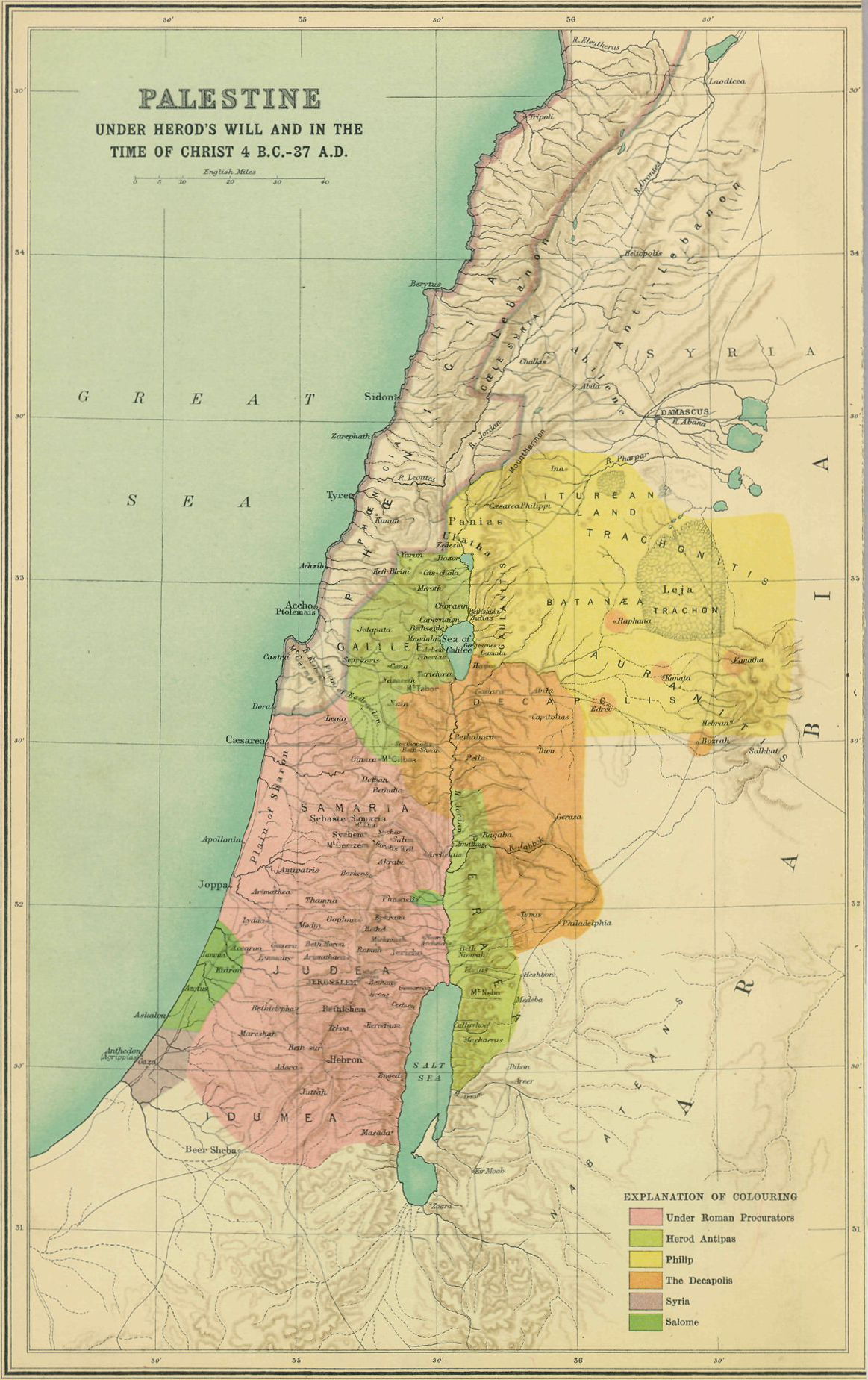
- George Adam Smith, The Historical Geography of the Holy Land (1894) and Atlas of the Historical Geography of the Holy Land (1915)The topography of the ridge and the map plate used on this page. Public domain.
- Albert Barnes, Notes, Explanatory and Practical, on the Old and New Testaments (1832 to 1869)The geography of the mountain at John 8:1, the rabbinic tradition reported at Ezekiel 11:23, the branches at Nehemiah 8:15, and the whole biblical chain walked in one paragraph at Zechariah 14:4. Public domain.
- Adam Clarke, Commentary on the Bible (1832)The Mount of Corruption and the play on the Hebrew, the two readings of Zechariah 14:4 with Titus and the Tenth legion, the ancient opinion about Acts 1:11, and the stadia that answer the Luke 24:50 question. Public domain.
- John Gill, Exposition of the Old Testament (1748 to 1763) and Exposition of the New Testament (1746 to 1748)Solomon's high place placed on this ridge following Rashi, and the low eastern wall of Middot 2:4 carried into the note on Matthew 24:3. Public domain.
- Cyril of Jerusalem, Catechetical Lectures 2 and 12 (about 350)David's route read as chosen, and Zechariah 14:4 taught as the one landmark of the return that a person in the city cannot miss. Public domain.
- Ambrose of Milan, Commentary on Luke (about 386); Augustine of Hippo, Tractates on John 33 (about 416); Remigius of Rheims and Theophylact of Ohrid via the Catena AureaThe olive and anointing readings of the mountain's name, Bethphage as a priestly village on its slope, the reason the arrest happened on the hill. All public domain and all rows in the site's own quote pool.
- Charles H. Spurgeon, The Metropolitan Tabernacle Pulpit, sermons 1199 and 3431The crossing of the Kidron read from David to Christ, and the David parallel behind the choice of Gethsemane. CCEL, public domain.
- J.C. Ryle, Expository Thoughts on the Gospels: Luke (1858), and Matthew Henry, Commentary on the Whole Bible (1710)The tenderness of Christ over the city and the descent of the hill from which He saw it, both on Luke 19:41. Public domain.
- Gustave Doré, La Sainte Bible (Tours: Alfred Mame et fils, 1866)The three engravings on this page. Public domain.
Keep studying
On this page
Studies14
- The ascension
- Gethsemane (The Garden Called the Oil Press)
- The Glory Departed: Ezekiel 8-11
- The Tabernacle
- The Feast of Tabernacles
- Rome
- The Stone
- The Bride & the Jewish Wedding
- David and Bathsheba: 2 Samuel 11-12
- The King
- The High-Priestly Line
- The Cleansing of the Temple: John 2 · Matthew 21
- The Vine & the Vineyard
- The Sects of Second Temple Judaism
Doorway2
Keep this page