
Jesus Christ · The Sermon on the Mount
The Narrow Gate
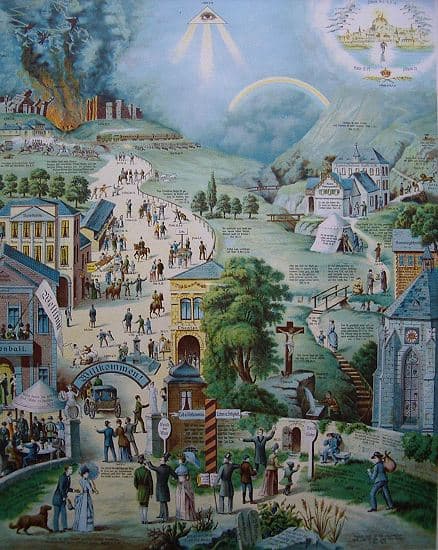
The Broad and the Narrow Way, Charlotte Reihlen and Paul Beckmann, 1866. Public domain.
THE ARTWORKConceived in 1866 by Charlotte Reihlen, a Stuttgart businesswoman and deaconess-house founder, and painted by Paul Beckmann, this lithograph sets Matthew 7:13–14 as one landscape: the broad road of taverns and theaters descending toward fire on the left, the narrow way rising past the cross to the heavenly city on the right, Scripture references lettered beside each scene. It hung in homes and mission halls across Europe; generations learned this verse by this picture.
Summary
Summary
The page walks Matthew 7:13-14 through the artwork history, the word 'strait' versus 'straight,' and two readings of the gate held together rather than opposed. It closes with two great books that took the image and ran with it: Bunyan's Pilgrim's Progress and Bonhoeffer's Cost of Discipleship.
- A three-to-one visual panel matches the wide and narrow roads to the verse's own proportions, not equal boxes for unequal things.
- "Strait" means narrow and pinched, not "straight" meaning not crooked, an easy word to misread today.
- Two readings, salvation itself and the cost of real obedience, are held together rather than treated as rivals.
- Church voices on the gate and the way include Augustine, Jerome, Matthew Henry, and John Wesley.
- The Pilgrim's Progress and The Cost of Discipleship carry the image forward as full books.
The Text
Matthew 7:13–14
Enter through the narrow gate. For wide is the gate and broad is the way that leads to destruction, and many enter through it.The wide gate, easily entered, and thronged.
But small is the gate and narrow the way that leads to life, and only a few find it.The narrow way, few find it, and it leads to life.
These two verses stand at the hinge point of the whole sermon's ending, the last plain teaching before Jesus closes with the parable of the wise and foolish builders (7:24–27). Everything He has taught since chapter 5 now comes down to a decision at a gate.
What He Is Saying
a gate, a road, and a choice
THE MAIN POINT
- Two gates: one wide, one narrow
- The broad road is crowded, and ends in destruction
- The narrow road is hard to find, and ends in life
- It is a command, not a suggestion: enter
- Jesus later names the gate: Himself
Jesus pictures two city gates and the roads that lead from them. One gate is wide and its road is broad, easy to find, easy to walk, and crowded with people. The other gate is narrow and its road is hard, easy to miss, and walked by few. The wide road ends in destruction. The narrow road ends in life. Jesus does not soften this into a suggestion; He commands: “Enter ye in at the strait gate.”
The Two Roads
the verse's own contrast, drawn at the verse's own proportions
THE WIDE GATE · THE BROAD WAY
MANY
“wide is the gate, and broad is the way… and many there be which go in thereat”
→ DESTRUCTION
THE STRAIT GATE
FEW
“narrow is the way… few there be that find it”
→ LIFE
The proportions are the sermon's own: the broad way takes most of the picture, and the way to life is the narrow strip beside it.
Go Deeper
the word, the readings, and the church's voices, each opens in place
“Strait,” not “straight”
The King James word is strait, not straight: two different English words that now sound and look almost alike. “Straight” means not crooked. “Strait” is the older word (it survives in “straitjacket” and the Strait of Gibraltar) and means pinched, narrow, constricted. Jesus is not describing a gate that goes in a straight line: He is describing one so narrow it is hard to squeeze through. Modern translations simply render it “narrow” throughout, which is exactly right and removes the confusion.
Two readings, held together
Most of the church has read the two gates as a picture of salvation itself, the way into Christ versus the way to destruction apart from Him, echoing His own words “I am the door” and “I am the way.” Others, noting that this verse caps a sermon entirely about how disciples live, hear an added emphasis: the narrow way is also the hard, Sermon-shaped path of real obedience, against the broad road of nominal religion that never costs anything. These are not rival readings, most who hold the second hold the first underneath it. The gate is entered by grace; the road, once entered, is still narrow to walk.
Christ deals faithfully with us, and tells us, First, That the gate is strait. Conversion and regeneration are the gate, by which we enter into this way, in which we begin a life of faith and serious godliness; out of a state of sin into a state of grace we must pass, by the new birth, John iii.
Matthew Henry · Commentary on the Whole Bible (1710), Matt 7:13–14
The strait gate - The holiness described in the foregoing chapters. And this is the narrow way. Wide is the gate, and many there are that go in through it - They need not seek for this; they come to it of course.
John Wesley · Explanatory Notes upon the New Testament (1755), Matt 7:13–14
The church on the gate
Hence the still stronger expression in Luke (Lu 13:24), "Strive to enter in at the strait gate." for wide is the gate--easily entered. and broad is the way--easily trodden. that leadeth to destruction, and--thus lured "many there be which go in thereat."
Jamieson, Fausset & Brown · Commentary Critical and Explanatory on the Whole Bible (1871), Matt 7:13
Enter ye in at the strait gate - Christ here compares the way to life to an entrance through a gate. The words straight and strait have very different meanings. The former means not crooked; the latter, pent up, narrow, difficult to be entered. This is the word used here, and it means that the way to heaven is pent up, narrow, close, and not obviously entered. The way to death is open, broad, and thronged. The Saviour here referred probably to ancient cities. They were surrounded with walls and entered through gates.
Albert Barnes · Notes, Explanatory and Practical, Matt 7:13
But because this belongs to few, He now begins to speak of searching for and possessing wisdom, which is a tree of life; and certainly, in searching for and possessing, i.e. contemplating this wisdom, such an eye is led through all that precedes to a point where there may now be seen the narrow way and the strait gate. When, therefore, He says in continuation, Enter ye in at the strait gate: for wide is the gate, and broad is the way, that leads to destruction, and many there be which go in thereat: because strait is the gate, and narrow is the way, which leads unto life, and few there be that find it; He does not say so for this reason, that the Lord's yoke is rough, or His burden heavy; but because few are willing to bring their labours to an end, giving too little credit to Him who cries, Come unto me, all you that labour, and I will give you rest. Take my yoke upon you, and learn of me; for I am meek and lowly in heart: for my yoke is easy, and my burden is light (hence, moreover, the sermon before us took as its starting-point the lowly and meek in heart): and this easy yoke and light burden which many spurn, few submit to; and on that account the way becomes narrow which leads unto life, and the gate strait by which it is entered.
Augustine of Hippo · Our Lord's Sermon on the Mount 2.23.77 (430), Matt 7:13
The church on the way
Attend to the words, for they have an especial force, many walk in the broad way—few find the narrow way. For the broad way needs no search, and is not found, but presents itself readily; it is the way of all who go astray. Whereas the narrow way neither do all find, nor when they have found, do they straightway walk therein. Many, after they have found the way of truth, caught by the pleasures of the world, desert midway.
Jerome · Catena Aurea by Aquinas (1264), Matt 7:13–14
As to the other way, the disadvantage of it lies in its narrowness and solicitude. Its very first step involves a revolution in all our purposes and plans for life, and a surrender of all that is dear to natural inclination, while all that follows is but a repetition of the first great act of self-sacrifice. No wonder, then, that few find and few are found in it.
Jamieson, Fausset & Brown · Commentary Critical and Explanatory on the Whole Bible (1871), Matt 7:14
Because strait is the gate, and narrow is the way,.... And so, difficult to enter in at; and when entered, the way is unpleasant to the flesh to walk in, being hedged up on each side with afflictions and tribulations; and moreover, is like the "narrow place", or στενος τοπος, "the strait place", as the Septuagint in Num 22:26 render it; in which the angel that met Balaam stood; and in which there was no turning to the right hand or the left; and such is the way to eternal happiness.
John Gill · Exposition of the New Testament (1746–1748), Matt 7:14
Where It Points
the same choice, named again
I am the gate. If anyone enters through Me, he will be saved. He will come in and go out and find pasture.“I am the door”, Jesus names Himself the gate.
Jesus answered, “I am the way and the truth and the life. No one comes to the Father except through Me.“I am the way, the truth, and the life”, no other road to the Father.
“Make every effort to enter through the narrow door. For many, I tell you, will try to enter and will not be able.“Strive to enter in at the strait gate”, the same image, pressed again.
The gate Jesus commands His hearers to find is the same gate He later names as Himself. Matthew 7 asks the crowd to look for a narrow gate; John 10 and 14 answer the question they didn't yet know to ask, which gate, and whose.
Read the Great Books
the works that have carried this teaching: go further than this page
The Pilgrim's Progress
John Bunyan · 1678
The most-read book in English after the Bible, and it is this verse as a story. Christian's whole journey begins at the Wicket Gate, the narrow entrance Evangelist points him to, and the broad ways off the path are where every danger lives.
READ IT FREE AT CCEL →The Cost of Discipleship
Dietrich Bonhoeffer · 1937
Written under the Third Reich by a pastor who would die resisting it, the modern classic on why the narrow way is narrow: costly grace against cheap grace, and a road that asks for everything.
In print: find it wherever books are sold.
Closing
Conclusion of the Sermon on the Mount (Mt 7:13-27). "The righteousness of the kingdom," so amply described, both in principle and in detail, would be seen to involve self-sacrifice at every step.
Jamieson, Fausset & Brown · Commentary Critical and Explanatory on the Whole Bible (1871), Matt 7:13–27
Jesus does not end the Sermon on the Mount with a summary, He ends it with a decision. Two gates, two roads, two destinations, and a crowd walking the easy one. “Few there be that find it” is not a comfortable universalism; it is a warning meant to be heard, and a gate meant to be found.
Notable art
— click a piece to enlargeKeep studying
Read it1
On this page
By subject
Obedience9 pages
Salvation17 pages
The Gospels68 pages