
Place
Golgotha
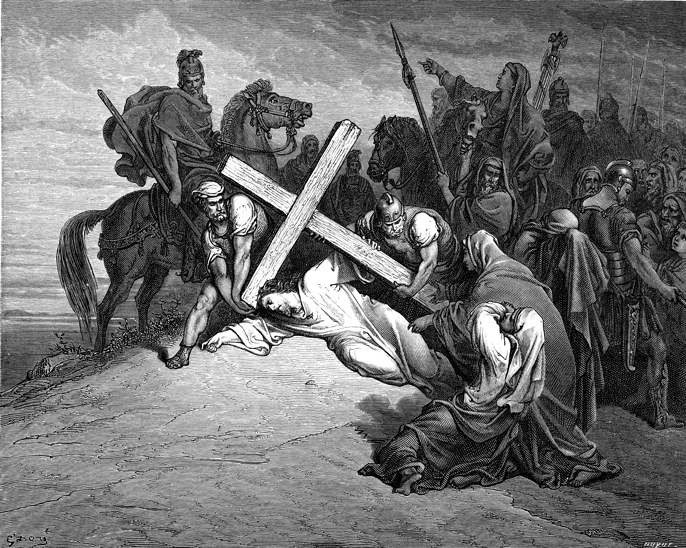
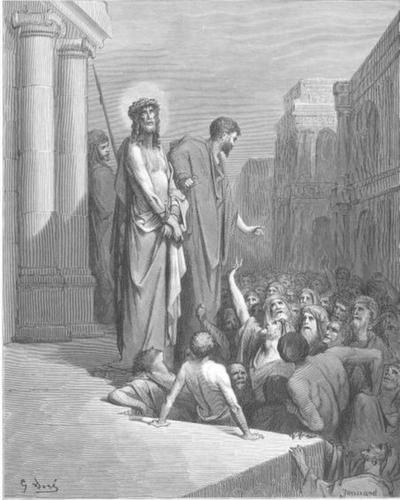
Gustave Doré, La Sainte Bible (Tours: Alfred Mame et fils, 1866). Public domain.
Summary
The Place of the Skull outside the city gate where Jesus was crucified between two criminals, and where a new tomb in a garden nearby received His body until the third day.
- Golgotha is the place outside Jerusalem where Jesus was crucified. All four Gospels name it, and every one of them stops to tell the reader that the name means the place of a skull.
- Scripture never calls it a hill or a mountain. All four accounts use the ordinary Greek word for a place. Calvary is the same name in Latin, so Golgotha and Calvary are one place under two languages.
- The location matters because the letter to the Hebrews builds an argument on it. The sin offering was burned outside the camp, so the true sin offering suffered outside the gate.
- John says the cross, a garden and a new rock-cut tomb stood together at one site, near enough to the city that passers by read the notice Pilate posted.
- Where that site was is an open question. The Church of the Holy Sepulchre has held the tradition since the fourth century, the Garden Tomb was proposed in the nineteenth, and this page gives both cases without settling them.
On this page
In Scripture
- Verses
- 3
- Books
- 3
Where it is
- Region
- Jerusalem
- Kind of place
- Geographic feature
Why Golgotha matters
What has been found
the evidence, and where it is disputed
The crucifixion at the Place of the Skull
John's account, with the words Luke preserves that John does not
Read John's account, with the words Luke preserves that John does not
- Pilate hands Him overJohn 19:16Then Pilate handed Jesus over to be crucified, and the soldiers took Him away.
- He goes out to the place, carrying the crossJohn 19:17Carrying His own cross, He went out to The Place of the Skull, which in Hebrew is called Golgotha.
- Three crosses, with Jesus in the middleJohn 19:18There they crucified Him, and with Him two others, one on each side, with Jesus in the middle.
- The notice, and the place near the cityJohn 19:20Many of the Jews read this sign, because the place where Jesus was crucified was near the city, and it was written in Hebrew, Latin, and Greek.
- The first word from the cross, in LukeLuke 23:34Then Jesus said, “Father, forgive them, for they do not know what they are doing.” And they divided up His garments by casting lots.
- The promise to the criminal beside HimLuke 23:43And Jesus said to him, “Truly I tell you, today you will be with Me in Paradise.”
- His mother, and the disciple He gave her toJohn 19:26When Jesus saw His mother and the disciple whom He loved standing nearby, He said to His mother, “Woman, here is your son.”
- Three hours of darkness, from noon until threeLuke 23:44It was now about the sixth hour, and darkness came over all the land until the ninth hour.
- It is finishedJohn 19:30When Jesus had received the sour wine, He said, “It is finished.” And bowing His head, He yielded up His spirit.
- The last word, in LukeLuke 23:46Then Jesus called out in a loud voice, “Father, into Your hands I commit My Spirit.” And when He had said this, He breathed His last.
John carries the road out, the notice, the mother, and the last word. Luke keeps three sayings John does not record, and the three hours of darkness. The beats run in the order the events happened.
The passion in JohnWhat happened here, in order
in the order the canon tells it
- Abraham names the place The LORD Will Provide, and the saying looks forwardGenesis 22:14And Abraham called that place The LORD Will Provide. So to this day it is said, “On the mountain of the LORD it will be provided.”
- The sin offering is burned outside the camp on the Day of AtonementLeviticus 16:27The bull for the sin offering and the goat for the sin offering, whose blood was brought into the Most Holy Place to make atonement, must be taken outside the camp; and their hides, flesh, and dung must be burned up.
- The bronze serpent is lifted on a pole and the bitten who look liveNumbers 21:9So Moses made a bronze snake and mounted it on a pole. If anyone who was bitten looked at the bronze snake, he would live.
- The law puts a curse on a man hanged on a treeDeuteronomy 21:23you must not leave the body on the tree overnight, but you must be sure to bury him that day, because anyone who is hung on a tree is under God’s curse. You must not defile the land that the LORD your God is giving you as an inheritance.
- David writes the cry Matthew and Mark record from the crossPsalms 22:1My God, my God, why have You forsaken me? Why are You so far from saving me, so far from my words of groaning?
- Hands and feet pierced, centuries before crucifixion reached JudeaPsalms 22:16For dogs surround me; a band of evil men encircles me; they have pierced my hands and feet.
- The garments divided and the clothing gambled forPsalms 22:18They divide my garments among them and cast lots for my clothing.
- The Servant is pierced for the transgressions of othersIsaiah 53:5But He was pierced for our transgressions, He was crushed for our iniquities; the punishment that brought us peace was upon Him, and by His stripes we are healed.
- A grave with the wicked and a rich man in His death, both in one afternoonIsaiah 53:9He was assigned a grave with the wicked, and with a rich man in His death, although He had done no violence, nor was any deceit in His mouth.
- The prophet says the LORD will make the sun go down at noonAmos 8:9And in that day, declares the Lord GOD, I will make the sun go down at noon, and I will darken the earth in the daytime.
- They will look on the One they have pierced, the verse John quotes at the spearZechariah 12:10Then I will pour out on the house of David and on the people of Jerusalem a spirit of grace and prayer, and they will look on Me, the One they have pierced. They will mourn for Him as one mourns for an only child, and grieve bitterly for Him as one grieves for a firstborn son.
- Matthew names the place and stops to translate itMatthew 27:33And when they came to a place called Golgotha, which means The Place of the Skull,
- Mark puts the crucifixion at the third hourMark 15:25It was the third hour when they crucified Him.
- Luke gives the Greek word for the name and the two men beside HimLuke 23:33When they came to the place called The Skull, they crucified Him there, along with the criminals, one on His right and the other on His left.
- John has Him go out to the place, carrying the crossJohn 19:17Carrying His own cross, He went out to The Place of the Skull, which in Hebrew is called Golgotha.
- The last word from the cross in JohnJohn 19:30When Jesus had received the sour wine, He said, “It is finished.” And bowing His head, He yielded up His spirit.
- A garden at the place of crucifixion, with a tomb never usedJohn 19:41Now there was a garden in the place where Jesus was crucified, and in the garden a new tomb in which no one had yet been laid.
- Paul reads Deuteronomy over the crossGalatians 3:13Christ redeemed us from the curse of the law by becoming a curse for us. For it is written: “Cursed is everyone who is hung on a tree.”
- The record of debt is cancelled and nailed to the crossColossians 2:14having canceled the debt ascribed to us in the decrees that stood against us. He took it away, nailing it to the cross!
- Hebrews makes the location of the place part of the argumentHebrews 13:12And so Jesus also suffered outside the city gate, to sanctify the people by His own blood.
Where it points
The voices
each quoted from the work named
Now Golgotha is interpreted "the place of a skull." Who were they, then, who prophetically named this spot Golgotha in which Christ the true head endured the cross? The apostle calls him "the image of the invisible God," and a little after, "the head of the body, the church." And again, "The head of every man is Christ." And again, "[He] is the head over all principalities and powers." The head suffered in "the place of the skull." O wondrous prophetic appellation! The very name also reminds you, saying, "Do not think of the Crucified as a mere man." He is "the head of all principalities and powers." That head that was crucified is the head of all power and has for his head the Father, "for the head of the man is Christ, and the head of Christ is God."
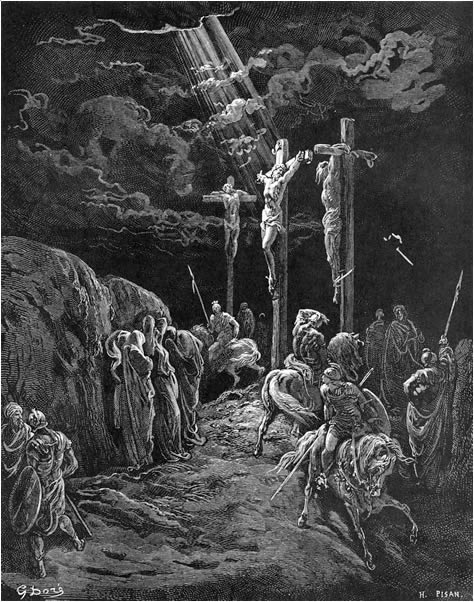
THIS darkness was not occasioned by any of the natural causes which generally produce darkness. It was in the middle of the day, precisely at noon, that the darkness came. It could not have been caused by an eclipse, for, it being the time of the Passover, we know that the moon was just then at its fullest—at which period no such thing as an eclipse of the sun could possibly occur. It could not, then, have been produced from that cause.
The place of the skull is said to have some special appropriateness for the death of him who was to die for humankind. A Hebraic tradition has come down to us that says that the body of Adam the first man was buried just where Christ was crucified. And so, as in Adam all die, so in Christ all should be made alive. In the place that is called the place of the skull or head, the head of the human race should find resurrection along with the whole people through the resurrection of the Lord and Savior who suffered there and rose again. For it was unfitting that when many born from him received remission of sins and attained the blessing of resurrection, the very father of all people should not also attain this grace.
4 more teachers on these versesJerome · Leo the Great · Albert Barnes · Derek Prince
I have heard Calvary expounded as the spot in which Adam was buried, as though it had been so called from the head of the old man being buried there. A plausible interpretation, and agreeable to the ears of the people, yet not a true one. Without the city outside the gate are the places where criminals are executed, and these have got the name of Calvary, that is, of the beheaded. And Jesus was crucified there, that where the plot of criminals had been, there might be set up the flag of martyrdom. But Adam was buried near Ebron and Arbee, as we read in the volume of Jesus the son of Navec.
"Christ, our paschal lamb, has been sacrificed," as the apostle says. Offering himself to the Father as a new and real sacrifice of reconciliation, he was crucified—not in the temple whose due worship is now completed, nor within the enclosure of the city which was to be destroyed because of its crime, but "outside the camp." That way, as the mystery of the ancient sacrifices was ceasing, a new victim would be put on a new altar, and the cross of Christ would be the altar not of the temple, but of the world.
Wherefore, Jesus also, that he might sanctify the people with his own blood - That there might be a conformity between his death for sin and the sacrifices which typified it. It is implied here that it was voluntary on the part of Jesus that he suffered out of the city; that is, it was so ordered by Providence that it should be so. This was secured by his being put to death as the result of a judicial trial, and not by popular tumult; see the notes on Isa 53:8. If he had been killed in a tumult, it is possible that it might have been done as in other cases (compare the case of Zacharias son of Barachias, Mat 23:35), even at the altar. As he was subjected, however, to a judicial process, his death was effected with more deliberation, and in the usual form. Hence, he was conducted out of the city, because no criminal was executed within the walls of Jerusalem. Without the gate - Without the gate of Jerusalem; Joh 19:17-18. The place where he was put to death was called Golgotha, the place of a skull, and hence, the Latin word which we commonly use in speaking of it, Calvary, Luk 23:33; compare notes on Mat 27:33. Calvary, as it is now shown, is within the walls of Jerusalem, but there is no reason to believe that this is the place where the Lord Jesus was crucified, for that was outside of the walls of the city. The precise direction from the city is not designated by the sacred writers, nor are there any historical records, or traditional marks by which it can now be known where the exact place was. All that we know on the subject from the New Testament is, that the name was Golgotha; that the place of the crucifixion and sepulchre were near each other; that they were without the gate and nigh to the city, and that they were in a frequented spot; Joh 19:20. […]
In order to redeem us from the curse of the law, Christ became a curse for us. This was demonstrated visibly when He hung on the cross.
Golgotha in Scripture
3 verses name it, in 3 books
Open a book to read its mentions here. Text: Berean Standard Bible.
Old TestamentNew Testamentsegment width = share of mentions
New Testament3 books · 3 mentions
Matthew1 mention
Mark1 mention
The account
Read the account as one telling
Golgotha enters Scripture as a place name and nothing more. Matthew, Mark and John give the Aramaic word and translate it for their readers. Luke writes the Greek word for skull instead. No writer says where it stood, how it got the name, or what the ground looked like. What all four agree on is that Jesus went out of the city to reach it, that two other men were crucified there at the same time, and that a garden with a new tomb lay at the same site.
The ground under the traditional site was a working limestone quarry long before any of that. The pottery from the fill puts the cutting in the Iron Age, roughly the eighth to seventh centuries BC. A quarry stands outside a town by definition, and when the stone runs out the pit is low-grade land on the edge of the city, useful for burials and for planting. That is the setting John describes at 19:41, a garden with a rock-cut tomb in it.
Jerusalem grew north and west across the following centuries, and the wall moved with it. Josephus describes three walls in The Jewish War 5.4.2. The first is well recovered. The third was begun by Herod Agrippa I in the AD 40s, after the crucifixion. The second, the one that matters, ran from a gate called Gennath to the Antonia fortress, and Josephus gives no course between those two points. Nobody has recovered its full line.
The crucifixion happened outside whatever line the wall then held. Roman execution grounds sat on roads outside towns, in view, because deterrence was the point, and Jewish law kept both burials and executions outside the city. John says the place was near enough that many people read the notice Pilate posted, written in Hebrew, Latin and Greek. Joseph of Arimathea and Nicodemus took the body down before sundown, as Deuteronomy 21:23 required, and buried it in the tomb that stood at the same site.
The first Christians in Jerusalem knew the spot. Then Hadrian refounded the city as Aelia Capitolina in the AD 130s, and the area was filled and built over with pagan construction. Jerome, writing to Paulinus about AD 395, says that for roughly 180 years a statue of Jupiter stood over the place of the resurrection and a marble Venus over the rock of the cross. The argument the tradition rests on is that the temple marked the memory rather than erasing it.
Constantine had the fill cleared in the 320s. Eusebius of Caesarea reports the clearance in Life of Constantine 3.25 to 3.28, written about AD 337 to 339, and says a rock-cut tomb came to light beneath. Macarius, bishop of Jerusalem, directed the work on the ground. By about AD 350 Cyril of Jerusalem was teaching in the new basilica and speaking of Golgotha as standing in front of his hearers, and by the 380s the pilgrim Egeria was describing a full liturgy at the Cross and at the tomb. Since arrangements formalised in the eighteenth and nineteenth centuries several Christian communities have shared custody of the building under a fixed order, which is why a wooden ladder on a ledge above the entrance has not been moved for generations.
A second candidate was proposed in the nineteenth century. Otto Thenius, a German theologian, argued in 1842 for the rocky escarpment north of the Damascus Gate. Fisher Howe took it up in 1871 and Claude Conder of the Palestine Exploration Fund in 1878. Charles George Gordon, the British general, spent 1882 to 1883 in Jerusalem making the case, and his name attached to the site. A rock-cut tomb nearby had been cleared in 1867, the Garden Tomb Association was formed in England in 1894, and the place has been the site of English-speaking Protestant pilgrimage ever since.
Excavation has since worked over both. Virgilio Corbo dug inside the Church of the Holy Sepulchre during the restoration works from 1960 through the 1970s and published his results in three volumes in 1981 and 1982. Kathleen Kenyon worked immediately south of it from 1961 to 1967, and later teams have dug in the same block. Gabriel Barkay published his study of the Garden Tomb in Biblical Archaeology Review in 1986. What each of them found, and what it does and does not settle, is set out in the section below.
Common questions
Where exactly is Golgotha?
Readers differ; the positions are named
Scripture gives four facts and no coordinates. The place was called Golgotha, it stood outside the city gate, it was near enough for passers by to read the notice, and a garden with a new rock-cut tomb stood at the same spot.
The traditional site under the Church of the Holy Sepulchre was identified in the 320s, and excavation there has recovered an Iron Age quarry and first-century Jewish tombs. That matters because Jewish burial was kept outside the city wall. The site north of the Damascus Gate, proposed by Otto Thenius in 1842 and made famous by Charles Gordon in 1883, lies outside every reconstruction of the wall, and Gabriel Barkay dated its tomb to the Iron Age in a 1986 article, which sits badly with a tomb the Gospels call new. Both cases are set out in full further up this page, and this page settles neither.
Was Golgotha a hill?
Scripture never says so. All four Gospels use the ordinary Greek word for a place, and none of them calls it a hill or a mountain. The hill comes from later art and from the guess that the name described the shape of the ground. What the text insists on is direction rather than height. He went out, outside the gate.
Why is it called the Place of the Skull?
Readers differ; the positions are named
Three answers have been given since antiquity and the Bible gives none of them. The ground may have looked like a skull, which Albert Barnes reports as a supposition rather than a fact. It may have been the public execution ground, which is the answer Jerome gives and Adam Clarke prefers. Or the skull of Adam may have been buried there, which Origen reports about AD 253 as a Hebrew tradition he had received.
Jerome rejected that third reading about AD 420 and answered that Adam was buried near Hebron. This page prints all three and marks the third as a tradition rather than a finding.
Why does it matter that Jesus died outside the city?
Hebrews builds an argument on it. Under the law the blood of the sin offering went into the sanctuary and the body was burned outside the camp, and Hebrews says Jesus suffered outside the city gate for that reason. Then the writer turns the geography into a command. Go out to Him outside the camp and carry the disgrace He carried. John Chrysostom put it in one line about AD 407, that the type shines out in the single word outside.
What was Roman crucifixion actually like?
It was a slow public execution kept for slaves, rebels and provincials, and Roman writers themselves called it the cruellest of punishments. The condemned man was flogged, carried the crossbeam to a site on a road outside the town, and was fixed with nails or ropes, with a board naming the charge posted above him, which is what John describes.
Crosses were usually low. That is why people at Golgotha could speak to Him and lift a sponge to His mouth on a short stalk. One crucified man has been recovered by excavation in the region, at Giv'at ha-Mivtar in 1968, with an iron nail still through his heel bone, and his family had taken him down and buried him in an ossuary as the law required.
What caused the darkness at noon?
Readers differ; the positions are named
An eclipse is ruled out by the calendar. Passover falls at full moon, when the moon stands opposite the sun and cannot pass in front of it, and Charles Spurgeon made that exact argument from the pulpit in the sermon quoted on this page. The Christian reading has always been that it was a sign from God, and Amos had said the LORD would make the sun go down at noon.
Some have suggested heavy cloud or a dust storm as the means, and Spurgeon himself floated a dense vapour without settling on it. The claim that pagan historians recorded the event rests on a ninth-century Byzantine chronicler quoting a third-century Christian writer quoting an undated pagan historian named Thallus, and this page says that rather than presenting it as proof.
Did the veil really tear, and does any source outside the Gospels mention it?
Matthew, Mark and Luke all report it, and Matthew and Mark both say it tore from the top downward. The direction says who tore it.
Outside the New Testament, the Babylonian Talmud in tractate Yoma 39b, compiled around AD 500 to 600 in Babylonia, records portents in the temple during the forty years before its destruction, including the doors opening by themselves. Jerome about AD 400 reports that the lost Gospel according to the Hebrews said the temple lintel broke. Neither source connects those things to Jesus, and this page does not make them say more than they say.
Where was Jesus buried, and how far was it from the cross?
John says the tomb stood in a garden at the place of the crucifixion, that it was new and had never held a body, and that they used it because it was nearby and the Sabbath was starting. Joseph of Arimathea, a member of the council who had not agreed to the verdict, asked Pilate for the body, and Nicodemus brought about seventy-five pounds of spices.
Isaiah had written that the Servant would be assigned a grave with the wicked and be with a rich man in His death. Both halves happened in one afternoon.
Do sources outside the Bible say that Jesus was crucified?
Readers differ; the positions are named
Two are usually named and each carries a caveat. Tacitus, writing about AD 116 in Annals 15.44, says Christus suffered the extreme penalty under Tiberius at the hands of Pontius Pilate, though he calls Pilate a procurator where the inscription found at Caesarea in 1961 gives his title as prefect. Josephus, writing in the 90s, reports that Pilate condemned Him to the cross, in a passage most scholars hold to be a genuine core later embellished by Christian copyists, with John Meier and Alice Whealey among those who argue that reading.
The rabbinic passage at Sanhedrin 43a in the Babylonian Talmud, compiled around AD 500 to 600, says that Yeshu was hanged on the eve of Passover. It is five centuries later than the event, and whether its Yeshu is Jesus of Nazareth is disputed by Jewish scholars including Peter Schafer and Johann Maier. The passage also speaks of Him in terms a Christian reader should see named plainly, since it denies what the Gospels teach about who He is. This page names the source and does not lean on it.
Notable art
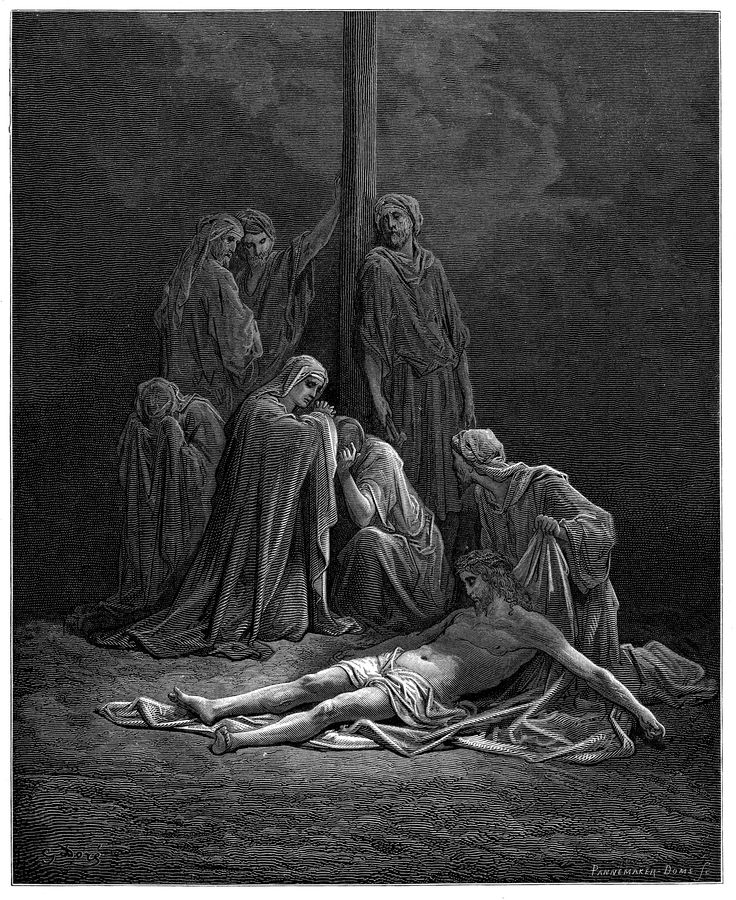
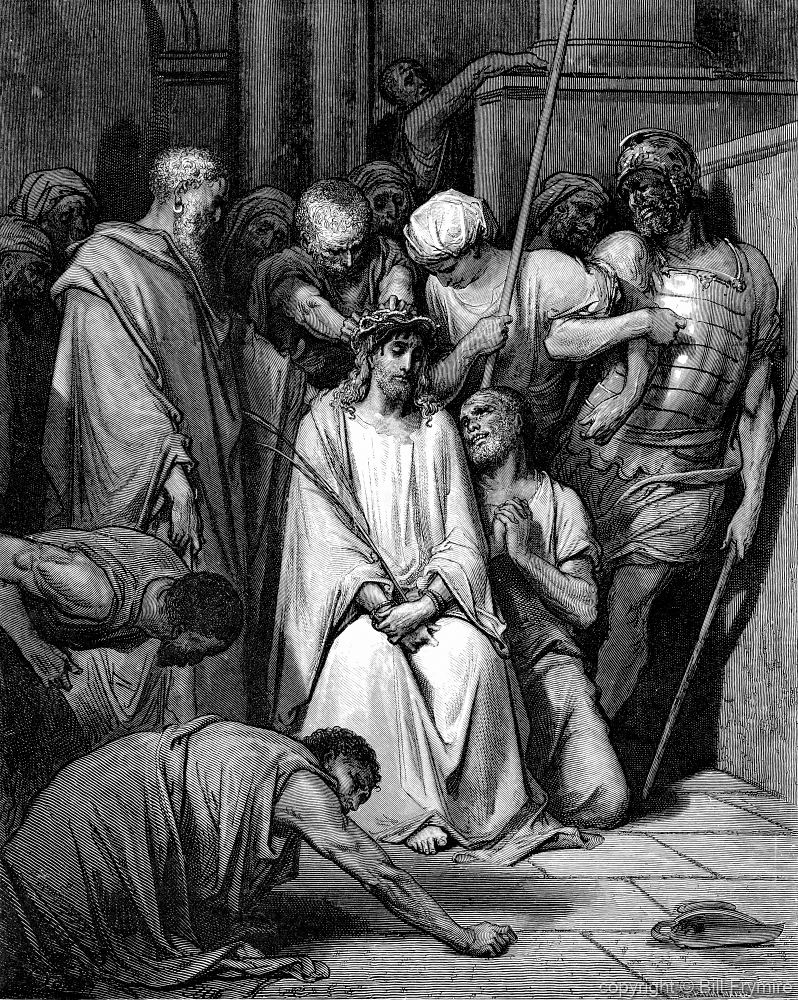
4 verified pieces depicting Golgotha
Sources cited
- MannaFest canon study of John (AI-draft)Awaiting the founder's edit.
- Berean Standard Bible (2023)Public domain. All Scripture text on this page, drawn from the site's own verse store.
- Gustave Dore, engravings for La Sainte Bible (Tours: Alfred Mame et fils, 1866)Public domain. The five plates on this page, registered with their Commons links in the site's art index.
- Eusebius of Caesarea, Life of Constantine 3.25 to 3.32, about AD 337 to 339The clearing of the fill and the tomb found beneath it, and Constantine's letter to Bishop Macarius. Public domain.
- Cyril of Jerusalem, Catechetical Lectures 13 and 14, about AD 350 and afterGolgotha named as standing before his hearers, the garden read as a type, and the Head in the place of the skull. Public domain.
- Jerome, Commentary on Matthew, Letter 58 to Paulinus and Letter 120 to Hedibia, about AD 395 to 420The Hadrianic statues over the site, the execution-ground reading of the name, the rejection of the Adam tradition, and the lost Gospel according to the Hebrews on the temple lintel. Public domain.
- Egeria, Itinerarium, the 380sThe liturgy at the Cross and at the tomb, one generation after the basilica was built. Public domain.
- Origen of Alexandria, Commentary on Matthew 126, about AD 253The earliest surviving report of the tradition that Adam was buried at the place of the crucifixion, presented on this page as tradition. Public domain.
- John Chrysostom, Homily on Hebrews 33 and Homily on the Gospel of John 85, about AD 407The type in the word outside, and Isaac bearing the wood as type against reality. Public domain.
- Leo the Great, Sermon 59, about AD 461; Ephrem the Syrian, Commentary on the Epistle to the Hebrews, about AD 373; Athanasius of Alexandria, Letter 59 to Epictetus, about AD 373The cross as the altar of the world, going outside as mission, and a fourth-century writer naming Golgotha as the burial place. Public domain.
- Augustine of Hippo and Bede, as collected in Thomas Aquinas, Catena AureaAugustine's answer that both Jesus and Simon carried the cross in turn, and Bede on the execution ground outside the gate. Public domain.
- Theophylact of Ohrid, Commentary on Luke, about 1107The Greek tradition on the burial of the forefather at the place, presented on this page as tradition. Public domain.
- Albert Barnes, Notes, Explanatory and Practical, on the Old and New Testaments (1832 to 1869)The skull-shape reading marked as a supposition, and the note on Hebrews 13:12 setting out exactly what the New Testament does and does not tell us about the location. Public domain.
- Adam Clarke, Commentary on the Bible (1832); John Gill, Exposition of the New Testament (1746 to 1748)Both readings of the name, the Hebrew behind it, and the comparison with the Gemoniae Scalae at Rome. Public domain.
- Robert Jamieson, A. R. Fausset and David Brown, Commentary Critical and Explanatory on the Whole Bible (1871)The torn veil read out of the Day of Atonement law it belonged to. Public domain.
- J.C. Ryle, Expository Thoughts on the Gospels: John (1869) and Luke (1858)The road out to Golgotha and the signs at the place. Public domain.
- Charles H. Spurgeon, The Metropolitan Tabernacle Pulpit, sermons 1853 (1885) and 3471 (1915)Why an eclipse at Passover is impossible, and why John's detail about Jesus carrying His own cross matters. Public domain.
- Derek Prince, Redeemed from the Curse (devotional); J.I. Packer, "What Did the Cross Achieve? The Logic of Penal Substitution," Tyndale Bulletin 25 (1974); Chuck Missler, "How Can We Be Sure?" (Koinonia House, 2021)All three in copyright and quoted under the site's cite-only ceiling of fifty words with the work named.
- Flavius Josephus, The Jewish War 4.317, 5.4.2, 5.212 to 5.214 and book 5 chapter 11, and 7.203; Antiquities of the Jews 18.63 to 18.64 and 20.200The three walls and the second wall's start and end, the temple curtain, the mass crucifixions of the siege, the burial of the crucified before sunset, and the Testimonium. Whiston translation, public domain.
- Tacitus, Annals 15.44, about AD 116; Cicero, In Verrem 2.5.165 and Pro Rabirio 5.16The execution recorded by a hostile Roman senator, and what Roman writers themselves said crucifixion was. Church and Brodribb translation of Tacitus, 1876, public domain.
- Mishnah, tractates Shekalim 8:5 and Parah 3:6, about AD 200; Babylonian Talmud, tractates Yoma 39b and Sanhedrin 43a, about AD 500 to 600The temple veil, the red heifer on the Mount of Olives, the portents of the last forty years, and the passage on the hanging at Passover. Named, dated and placed on this page, with the divergence from the Christian confession marked at the point of contact.
- Virgilio C. Corbo, Il Santo Sepolcro di Gerusalemme, 3 vols (Jerusalem: Franciscan Printing Press, 1981 to 1982)The excavation inside the church during the restoration works of 1960 to the 1970s: the abandoned quarry, the cut faces, and the first-century rock-cut tombs.
- Kathleen M. Kenyon, Digging Up Jerusalem (London: Ernest Benn, 1974); Nahman Avigad, Discovering Jerusalem (Nashville: Thomas Nelson, 1983)The Muristan soundings south of the church, and the Jewish Quarter excavations of 1969 to 1982 that recovered the Broad Wall and much of the first wall.
- Antonia Moropoulou et al., on the mortar dating of the edicule, Journal of Archaeological Science: Reports (2018)Mortar from the shrine's original construction over the burial bed dated to about AD 345, which confirms a Constantinian shrine and reaches no further back.
- Gabriel Barkay, "The Garden Tomb: Was Jesus Buried Here?", Biblical Archaeology Review 12:2 (March/April 1986)The Iron Age II dating of the Garden Tomb on its cutting and plan, with the Byzantine material read as later reuse.
- Otto Thenius, in Zeitschrift fur die historische Theologie (1842); Ernest L. Martin, Secrets of Golgotha (Portland: ASK Publications, 1988; 2nd ed. 1996)The first proposal of the northern site, and the Mount of Olives proposal. Both named, dated and placed, with the reception of each reported honestly.
- Vassilios Tzaferis and Nicu Haas, Israel Exploration Journal 20 (1970); Joseph Zias and Eliezer Sekeles, "The Crucified Man from Giv'at ha-Mivtar: A Reappraisal," Israel Exploration Journal 35 (1985)The only crucified man recovered by excavation in the region, and the 1985 reappraisal that supersedes the 1970 reconstruction. This page follows the reappraisal.
- The Alexamenos graffito, Palatine Hill, Rome, found 1857, commonly dated about AD 200; the Pilate Stone, Caesarea Maritima, found 1961 by the Italian expedition under Antonio FrovaThe earliest surviving picture of a crucifixion, drawn as a taunt, and the inscription that gives Pilate's title as prefect.
- Jefferson Williams, Markus Schwab and Achim Brauer, "An early first-century earthquake in the Dead Sea," International Geology Review 54:10 (2012)A seismic event in the Ein Gedi sediments datable between AD 26 and AD 36, consistent with Matthew and not a demonstration of Matthew.
- John P. Meier, A Marginal Jew, vol. 1 (New York: Doubleday, 1991); Alice Whealey, Josephus on Jesus (New York: Peter Lang, 2003); Ken Olson, "Eusebius and the Testimonium Flavianum," Catholic Biblical Quarterly 61 (1999)The three positions on the Testimonium Flavianum, with the holders of each named on this page.
- Peter Schafer, Jesus in the Talmud (Princeton University Press, 2007); Johann Maier, Jesus von Nazareth in der talmudischen Uberlieferung (Darmstadt: Wissenschaftliche Buchgesellschaft, 1978)The dispute among Jewish scholars over whether the Yeshu passages concern Jesus of Nazareth at all.
- Sextus Julius Africanus, Chronographiai, about AD 221, surviving in the quotations of George Syncellus, about AD 800The Thallus and Phlegon reports on the darkness, given here with the full chain of transmission shown. Public domain.
- MannaFest lexicon and curated quote poolThe lexicon entries for Golgotha, kranion, gulgoleth, stauros, stauroo and xylon, and the seven quotes on this page, each drawn from the site's own pool.
Keep studying
On this page
Studies13
- The crucifixion at the Place of the Skull
- The Messianic Psalms
- The Scarlet Thread
- The Tree
- The Fulfillment Formula (Matthew's Ten Quotations)
- Messianic Prophecy
- Taw: The Mark of God
- The Tabernacle
- The Lamb: Revelation's Christology
- The Seed
- Trees: Eden, Cross, New Jerusalem
- Blue, Purple & Scarlet
- Irony in Scripture: More Than the Speaker Knows
Doorway2
Keep this page