
Bethany beyond the Jordan
Summary
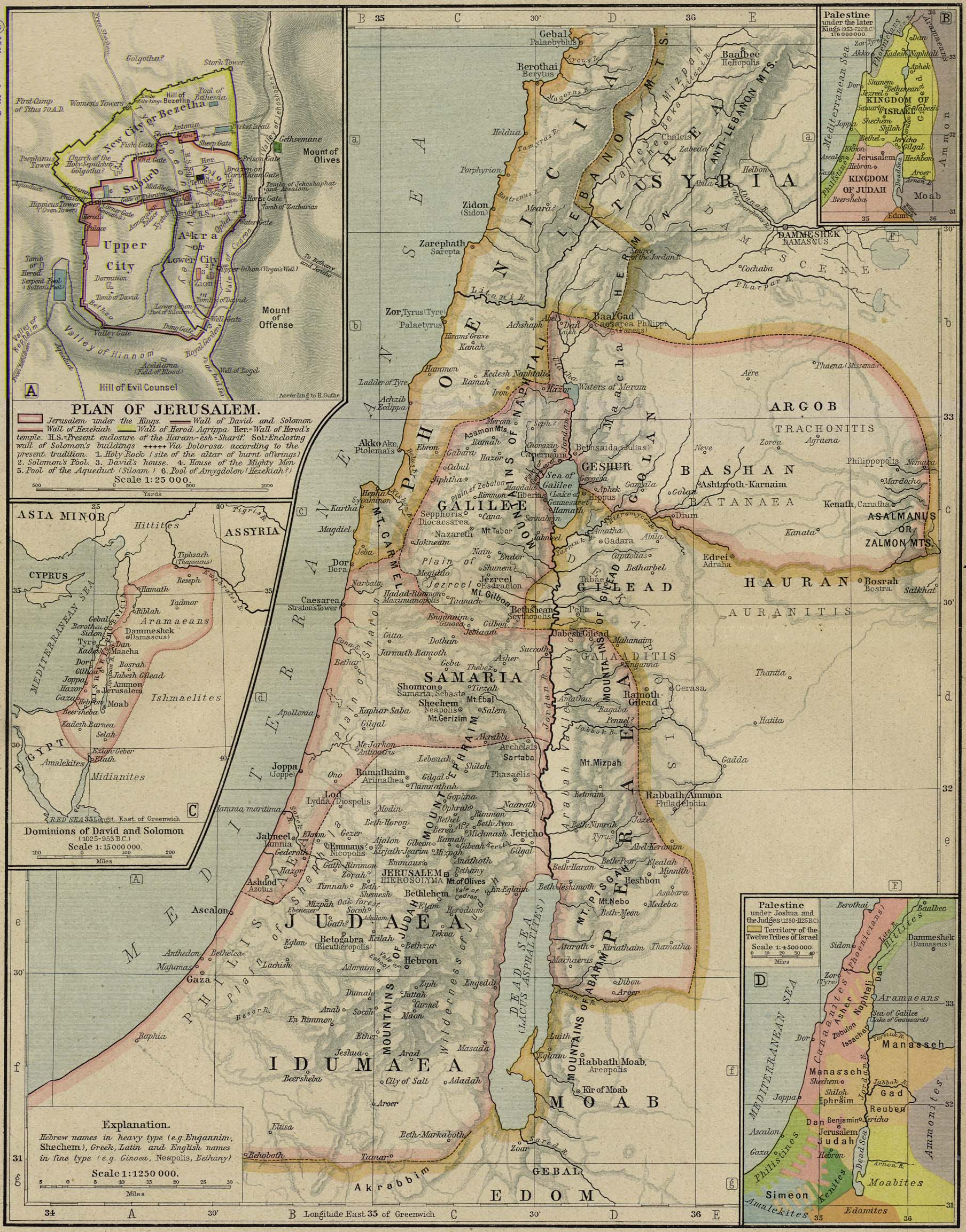
The place across the Jordan where John was baptizing and bore witness to Jesus, and where Jesus later withdrew (John 1:28; 10:40).
- The place across the Jordan, in Perea, where John was baptizing and testified that Jesus is the Lamb of God.
- Nearly all the ancient manuscripts of John 1:28 read "Bethany," not "Bethabara."
- Late in His ministry Jesus withdrew here again, to the place where John had first been baptizing, and many believed.
- The site is not the Bethany near Jerusalem where Lazarus lived; it is a separate village across the river.
- Two modern sites carry the baptism tradition today, one on each bank, both resting on real early witnesses.
On this page
In Scripture
- Verses
- 1
- Books
- 1
Near Bethany beyond the Jordan
- Gilgal4.4 km · 2.8 mi NW
- Jericho11 km · 6.8 mi W
- Mount Nebo20 km · 12 mi SE
- Ephraim27 km · 17 mi NW
- Bethany28 km · 18 mi W
- Ai29 km · 18 mi W
Straight-line distances, computed from the gazetteer coordinates.
Where it is
the country around it
- Coordinates
- 31.8363° N, 35.5526° Efind it on the Atlas →
- Region
- Perea
- Kind of place
- Region
1 place the record names with Bethany beyond the Jordan, the farthest 33 km away
- Located: the gazetteer fixes one site
- Placed: the point stands for an area, or is rounded
- ? Proposed: one candidate among several
- A dashed line ends at a place the gazetteer does not fix
Why Bethany beyond the Jordan matters
John's testimony at Bethany beyond the Jordan
John 1:19-34 and John 10:40-42, in the order it happens
Read John 1:19-34 and John 10:40-42, in the order it happens
- John denies being the Christ, Elijah or the ProphetJohn 1:20He did not refuse to confess, but openly declared, “I am not the Christ.”
- A voice crying in the wildernessJohn 1:23John replied in the words of Isaiah the prophet: “I am a voice of one calling in the wilderness, ‘Make straight the way for the Lord.’”
- Where this happenedJohn 1:28All this happened at Bethany beyond the Jordan, where John was baptizing.
- "Look, the Lamb of God"John 1:29The next day John saw Jesus coming toward him and said, “Look, the Lamb of God, who takes away the sin of the world!
- The Spirit descending like a doveJohn 1:32Then John testified, “I saw the Spirit descending from heaven like a dove and resting on Him.
- "This is the Son of God"John 1:34I have seen and testified that this is the Son of God.”
- Jesus returns to the place where John first baptizedJohn 10:40Then Jesus went back across the Jordan to the place where John had first been baptizing, and He stayed there.
- Many believed thereJohn 10:42And many in that place believed in Jesus.
The name itself is disputed. Nearly all the manuscripts of John 1:28 read "Bethany," and Origen's proposed "Bethabara" is a third-century conjecture, not a rival original text.
What happened here, in order
in the order the canon tells it
- Priests and Levites sent from Jerusalem to ask John who he isJohn 1:19And this was John’s testimony when the Jews of Jerusalem sent priests and Levites to ask him, “Who are you?”
- John baptizes with water; one greater stands among themJohn 1:26“I baptize with water,” John replied, “but among you stands One you do not know.
- Why John came baptizing at allJohn 1:31I myself did not know Him, but the reason I came baptizing with water was that He might be revealed to Israel.”
- The Feast of Dedication in Jerusalem, just beforeJohn 10:22At that time the Feast of Dedication took place in Jerusalem. It was winter,
- The Jews take up stones to stone HimJohn 10:31At this, the Jews again picked up stones to stone Him.
- Everything John said about Him was trueJohn 10:41Many came to Him and said, “Although John never performed a sign, everything he said about this man was true.”
Bethany beyond the Jordan in Scripture
1 verse names it, in 1 book
Open a book to read its mentions here. Text: Berean Standard Bible.
New Testament1 book · 1 mention
Common questions
Was the place called Bethany or Bethabara?
Readers differ; the positions are named
Nearly all the ancient Greek manuscripts of John 1:28 read "Bethany." In the middle of the third century, Origen wrote that he could find no Bethany on that side of the Jordan in his own day and proposed reading "Bethabara" instead, a site then being pointed out as the baptism place. Later commentators such as Adam Clarke and Albert Barnes both recorded that proposal and both held Bethany to be the true reading. This page follows the manuscripts and names Bethabara as Origen's conjecture rather than an equal alternative.
Where exactly did John baptize, and where was Jesus baptized?
Readers differ; the positions are named
Scripture gives no coordinates, only the name of the place and that it lay "beyond the Jordan." Two sites carry the tradition today. Al-Maghtas, on the eastern bank, holds the remains of a church built there in the reign of the Emperor Anastasius (491 to 518) and was excavated from 1997 onward; it is on the UNESCO World Heritage List. Qasr el-Yahud, on the western bank, is supported by the sixth-century Madaba mosaic, which labels the place Bethabara on that side of the river. Both rest on real early witnesses, and this page names both without choosing between them.
Why did John call Jesus "the Lamb of God" the very next day?
John had just told the priests and Levites plainly that he was not the Christ, only the voice preparing the way. The next day, seeing Jesus approach, he named Him the Lamb of God who takes away the sin of the world, and testified that he had seen the Spirit come down and rest on Him like a dove, the very sign he had been told would mark the one who baptizes with the Holy Spirit.
Why did Jesus go back to this place late in His ministry?
Jesus had just faced an attempt to stone Him in Jerusalem, at the Feast of Dedication, after telling the Jews plainly that He and the Father are one. He withdrew back across the Jordan to the place where John had first been baptizing, and John records that many came to Him there, remembering that everything John had said about Him was true, and many believed.
Is this the same Bethany as the village near Jerusalem where Lazarus lived?
No. That Bethany sat on the Mount of Olives, a little less than two miles from Jerusalem. This Bethany lay across the Jordan, in the region called Perea, and the two never share a page on this site.
Sources cited
- MannaFest canon study of John (AI-draft)Awaiting the founder's edit.
- OpenBible.info Bible Geocoding: Bethany 2read 2026-08-20The coordinates on this page. Used under CC-BY with attribution to OpenBible.info.
- Origen of Alexandria, Commentary on the Gospel of John, Book 6Cited for the Bethabara proposal, c. AD 248 to 253.
- The Madaba Map, sixth-century mosaic floor, Saint George's church, MadabaCited for the Bethabara label and its placement on the western bank.
- UNESCO World Heritage List inscription 1446, Baptism Site "Bethany Beyond the Jordan" (Al-Maghtas)Cited for the eastern-bank excavation, directed by Mohammad Waheeb from 1997, and the Anastasius-era church.
Keep studying
On this page
Books that name it1
Doorway2
Keep this page