
Genesis 17:12 and 21:4 · Subject · Featured Study
Brit milah: circumcision on the eighth day
Genesis 17:12 sets circumcision on the eighth day, and Scripture records the day for Isaac, John the Baptist, Jesus and Paul.
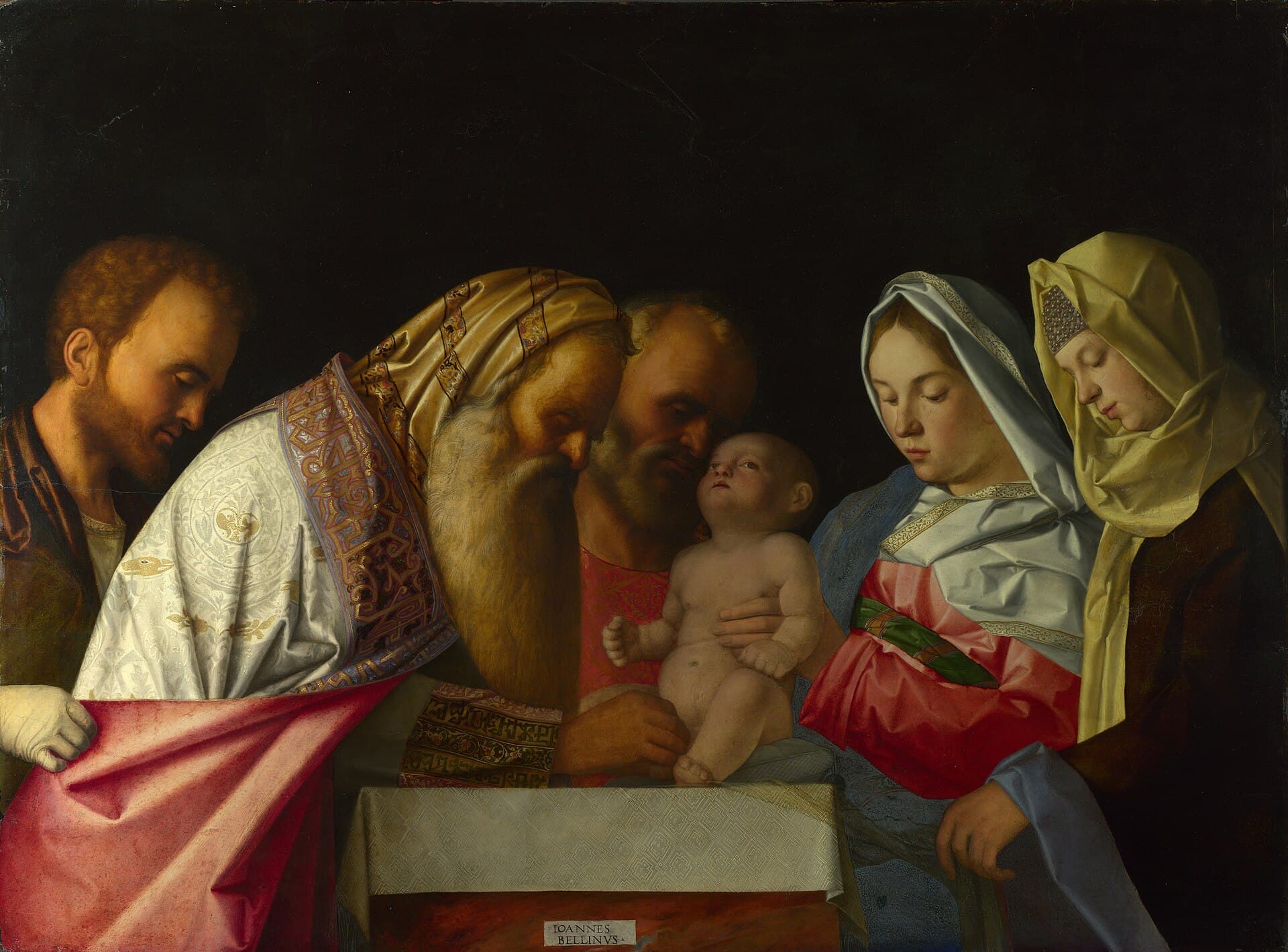
Workshop of Giovanni Bellini, The Circumcision, about 1500, National Gallery, London. Public domain, via Wikimedia Commons.
THE ARTWORKThe child Jesus is held up before the priest on the eighth day, the day Luke 2:21 gives for his naming. Mary stands at the right with her eyes on her son.
The day of the sign was set by God before the child was born.
Summary
Brit milah (ברית מילה), the covenant of circumcision, is the sign God gave Abraham in Genesis 17, given to a son in Israel on the eighth day of his life.
- Leviticus 12:3 sets the son's circumcision after his mother's seven days of uncleanness.
- John the Baptist and Jesus were each named on the day of their circumcision.
- In John 7:22 to 23 Jesus says that a boy can be circumcised on the Sabbath so that the law of Moses will not be broken.
- Jesus was circumcised under the law, and Paul calls Christ a servant of the circumcised.
The Command and the Day
The command of Genesis 17 is repeated in Leviticus 12 and recalled by Stephen in Acts 7.
God gave Abraham circumcision as the sign of His covenant when Abraham was ninety-nine years old.
Generation after generation, every male must be circumcised when he is eight days old, including those born in your household and those purchased from a foreigner—even those who are not your offspring. Whether they are born in your household or purchased, they must be circumcised. My covenant in your flesh will be an everlasting covenant.Every circumcision on the eighth day that Scripture records after this verse keeps this command.
Abraham circumcised Ishmael and every male of his household on the day God spoke, so the eighth day was first kept for a son born after the command.
And on the eighth day the flesh of the boy’s foreskin is to be circumcised.Leviticus places the son's circumcision inside the law for a mother after childbirth.
Stephen tells of the rite and its day in his account of Israel's fathers.
Then God gave Abraham the covenant of circumcision, and Abraham became the father of Isaac and circumcised him on the eighth day. And Isaac became the father of Jacob, and Jacob of the twelve patriarchs.Stephen gives the rite the name the covenant of circumcision.
Four Circumcised on the Eighth Day
Two of the four stand in Luke's Gospel, and Paul tells of his own eighth day.
| Who | The circumcision | The naming | Verse |
|---|---|---|---|
| Isaac | Abraham circumcised him at eight days old, as God had commanded him | Abraham gave him the name Isaac in Genesis 21:3 | Genesis 21:4 |
| John the Baptist | Neighbors and relatives came on the eighth day to circumcise the child | Elizabeth said he would be called John, and Zechariah wrote the name | Luke 1:59 |
| Jesus | Circumcised when the eight days had passed | Named Jesus, the name the angel had given before He was conceived | Luke 2:21 |
| Paul | Circumcised on the eighth day, as he writes of himself | Not recorded | Philippians 3:5 |
- Who
- Isaac
- The circumcision
- Abraham circumcised him at eight days old, as God had commanded him
- The naming
- Abraham gave him the name Isaac in Genesis 21:3
- Verse
- Genesis 21:4
- The circumcision
- Neighbors and relatives came on the eighth day to circumcise the child
- The naming
- Elizabeth said he would be called John, and Zechariah wrote the name
- Verse
- Luke 1:59
- Who
- Jesus
- The circumcision
- Circumcised when the eight days had passed
- The naming
- Named Jesus, the name the angel had given before He was conceived
- Verse
- Luke 2:21
- Who
- Paul
- The circumcision
- Circumcised on the eighth day, as he writes of himself
- The naming
- Not recorded
- Verse
- Philippians 3:5
The Rite in Israel's Life
Genesis, Luke and John show who performed the rite, when the child was named and how the day was kept.
Radak, the commentator of Provence (1160 to 1235), notes on Genesis 21:4 that the sages read the command as laid on the father alone.
Adam Clarke, in his Commentary on the Bible, reports from the Jewish writers that the father circumcised his son and the master the servant born in his house.
Albert Barnes, in his Notes on Luke 1:59, writes that a child was commonly named at his circumcision.
But because Moses gave you circumcision, you circumcise a boy on the Sabbath (not that it is from Moses, but from the patriarchs.) If a boy can be circumcised on the Sabbath so that the law of Moses will not be broken, why are you angry with Me for making the whole man well on the Sabbath?Jesus takes it as known that a boy is circumcised on the Sabbath when his appointed day falls on it.
The Hebrew of the Eighth Day
Genesis and Leviticus name the day in two phrases, and the verb for circumcising and the word for covenant stand beside them.
Genesis 17:12 and 21:4 give the child's age as a son of eight days. The Hebrew is ben shemonat yamim (בֶּן־שְׁמֹנַת יָמִים), and the word for eight is in its construct form, bound to the word for days, in both verses.
Leviticus 12:3 names the day itself with the ordinal number, the eighth; the Hebrew words uvayom hashemini (וּבַיּוֹם הַשְּׁמִינִי) mean and on the eighth day.
All three verses use the same Hebrew word for circumcising, the verb mul (מוּל). Counted by Strong's number in the tagged Hebrew text, it stands 37 times, 17 of them in Genesis.
Genesis 17:13 says covenant twice in one sentence, of the covenant in the flesh and of the everlasting covenant, and the Hebrew word is brit (בְּרִית).
What the Text Leaves Unsaid
Genesis and Luke leave three questions of the rite unanswered.
Genesis 17:12 gives the day and gives no reason for it.
Genesis 21 records no feast at Isaac's circumcision, and the great feast of the chapter comes on the day he was weaned.
Luke names no single person who performed the circumcision of John or of Jesus.
Paul and the Eighth Day
Paul counted his own eighth day as loss beside Christ, and Acts records how the apostles treated the rite for Jews and for Gentiles.
Paul begins his list of grounds for confidence in the flesh with his circumcision on the eighth day.
But whatever was gain to me I count as loss for the sake of Christ. More than that, I count all things as loss compared to the surpassing excellence of knowing Christ Jesus my Lord, for whom I have lost all things. I consider them rubbish, that I may gain ChristPaul sets every gain of birth and law beside the worth of knowing Christ.
Matthew Henry reads Paul's eighth day as the mark of a family that kept the day God had appointed.
“A Hebrew of the Hebrews, an Israelite on both sides, by father and mother, and from one generation to another; none of his ancestors had matched with Gentiles. He could boast of his relations to the church and the covenant, for he was circumcised the eighth day; he had the token of God's covenant in his flesh, and was circumcised the very day which God had appointed.”
Matthew Henry · Commentary on the Whole Bible · on Philippians 3:4Puritan
Paul wanted Timothy to accompany him, so he took him and circumcised him on account of the Jews in that area, for they all knew that his father was a Greek.After the council of Acts 15, Paul himself circumcises a disciple whose mother was a believing Jewish woman.
Acts 15:19 to 20, what the council asked of the Gentiles1 passage
It is my judgment, therefore, that we should not cause trouble for the Gentiles who are turning to God. Instead, we should write and tell them to abstain from food polluted by idols, from sexual immorality, from the meat of strangled animals, and from blood.James's judgment names four things for Gentile believers to abstain from, and circumcision stands outside the list.
Acts 21:20 to 24, the charge brought against Paul2 passages
When they heard this, they glorified God. Then they said to Paul, “You see, brother, how many thousands of Jews have believed, and all of them are zealous for the law. But they are under the impression that you teach all the Jews who live among the Gentiles to forsake Moses, telling them not to circumcise their children or observe our customs.The charge shows that circumcising their children still mattered to the thousands of Jews in Jerusalem who had believed and were zealous for the law.
Take these men, purify yourself along with them, and pay their expenses so they can have their heads shaved. Then everyone will know that there is no truth to these rumors about you, but that you also live in obedience to the law.The elders count the rumor about circumcision false, and this agrees with Paul's circumcising of Timothy in Acts 16:3.
Three Voices on the Rite
Irenaeus, Cyril of Alexandria and Matthew Henry speak on the rite and its day, earliest first.
Irenaeus, in Against Heresies, draws on the circumcision of a boy on the Sabbath to defend the healings of Christ.
“It is clear therefore, that He loosed and vivified those who believe in Him as Abraham did, doing nothing contrary to the law when He healed upon the Sabbath-day. For the law did not prohibit men from being healed upon the Sabbaths; [on the contrary,] it even circumcised them upon that day, and gave command that the offices should be performed by the priests for the people; yea, it did not disallow the healing even of dumb animals.”
Irenaeus · Against Heresies 4.8.2 · on John 7:22 to 23Patristic
Cyril of Alexandria reads the covenant in the flesh of Genesis 17:13 as a picture of the believer's life.
“God's covenant is ‘in the flesh’ of the person who ‘does not fight on the terms of the flesh’ and who ‘always carries about in his body the death of Jesus.’”
Cyril of Alexandria · Catena on Genesis 3.1027 · on Genesis 17:13Patristic
Matthew Henry sets Abraham's promptness beside God's own keeping of time.
“The covenant being established with him, the seal of the covenant was administered to him; and though a bloody ordinance, and he a darling, yet it must not be omitted, no, nor deferred beyond the eighth day. God had kept time in performing the promise, and therefore Abraham must keep time in obeying the precept.”
Matthew Henry · Commentary on the Whole Bible · on Genesis 21:4Puritan
Why the Eighth Day
Two readings draw a reason for the day from the law of Moses.
The mother's days of uncleanness end firstJohn Gill; the Targum of Jonathan
John Gill, in his Exposition of the Old Testament, finds the reason in the order of Leviticus 12. On his reading the son is circumcised on the eighth day because his mother's separation has then ended, and Gill reports the same reading in the Targum of Jonathan.
“Say to the Israelites, ‘A woman who becomes pregnant and gives birth to a son will be unclean for seven days, as she is during the days of her menstruation.The law of childbirth counts the mother's seven days before it names the eighth.
The objection: Genesis 17:12 gave the eighth day to Abraham's household long before the law of childbirth was given through Moses.
A newborn offering waits for its eighth dayAdam Clarke
Adam Clarke, in his Commentary on the Bible, calls circumcision a consecration of the person to God. He reads the command of Genesis 17:12 by the rule of Leviticus 22:27.
“When an ox, a sheep, or a goat is born, it must remain with its mother for seven days. From the eighth day on, it will be acceptable as an offering made by fire to the LORD.The law makes the eighth day the first on which a newborn animal is acceptable as an offering.
On Leviticus 12:3 Clarke adds that before the eighth day a child could scarcely bear the operation.
The objection: Leviticus 22:27 governs animals offered by fire, and Genesis 17 calls circumcision a sign of the covenant.
The Son Born Under the Law
Mary and Joseph kept the law of Leviticus 12 for Jesus, from His eighth day to the offering of two birds at the temple.
But when the time had fully come, God sent His Son, born of a woman, born under the law, to redeem those under the law, that we might receive our adoption as sons.Paul names the purpose of the Son's birth under the law.
For I tell you that Christ has become a servant of the circumcised on behalf of God’s truth, to confirm the promises made to the patriarchs, so that the Gentiles may glorify God for His mercy. As it is written: “Therefore I will praise You among the Gentiles; I will sing hymns to Your name.”The covenant of Genesis 17 reaches its goal here, for Abraham's line and for the nations.
The eighth day asks the reader to trust the God who set it and kept His promises, and to receive Christ, in whom those promises are confirmed.
Keep studying
People10
Places1