
Tyre
Summary
Phoenician island-fortress and merchant power, judged in Amos 1:9-10 and at length in Ezekiel 26-28.
- Tyre was a Phoenician merchant city built partly on an offshore island, and Ezekiel gives it three whole chapters of prophecy, more space than most cities in the Bible ever receive.
- Hiram king of Tyre supplied cedar for David's palace and for Solomon's temple, but Tyre's neighbor Sidon later sent Israel its most notorious queen, Jezebel.
- Ezekiel's lament for the king of Tyre describes a figure once in Eden, an anointed guardian cherub, cast down for pride. Both a human ruler and something more are read into that passage, and this page holds both readings without a verdict.
- Jesus said it would be more bearable for Tyre and Sidon on judgment day than for the Israelite towns of Chorazin and Bethsaida, and He healed a Gentile woman's daughter there.
- Paul spent seven days with the disciples at Tyre near the end of his final journey, and the whole church knelt on the beach to pray with him before he sailed on.
On this page
In Scripture
- Verses
- 57
- Books
- 19
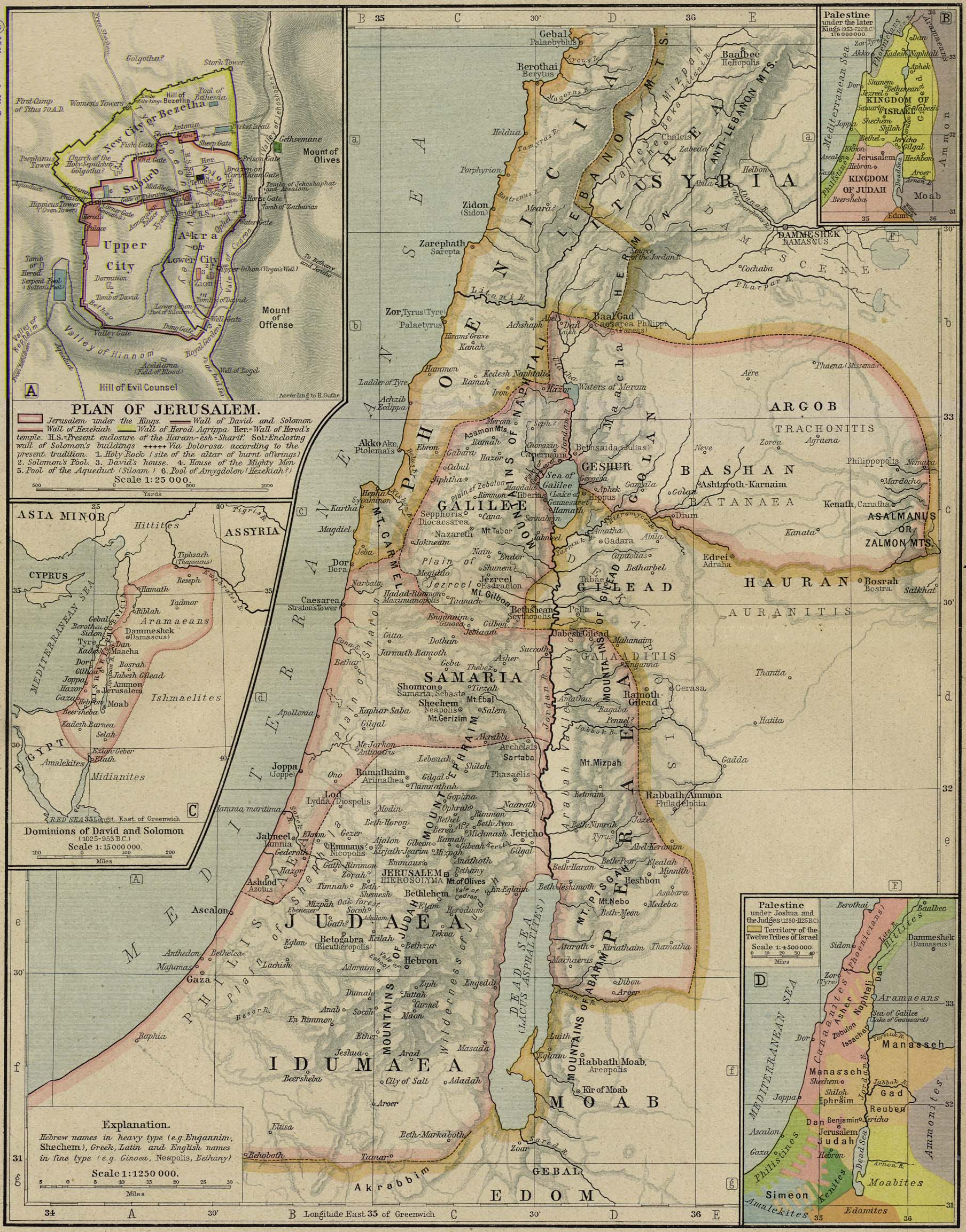
Near Tyre
- Zarephath20 km · 13 mi NE
- Dan43 km · 27 mi E
- Capernaum57 km · 35 mi SE
- Cana of Galilee60 km · 38 mi S
- Mount Carmel62 km · 39 mi S
- Sea of Galilee63 km · 39 mi SE
Straight-line distances, computed from the gazetteer coordinates.
Where it is
the country around it
- Coordinates
- 33.2758° N, 35.1926° Efind it on the Atlas →
- Region
- Phoenician coast
- Kind of place
- City
- Located: the gazetteer fixes one site
Not located: The Temple, Philistia, Edom. The gazetteer records no location for them, so they are not marked.
Why Tyre matters
Ezekiel's three oracles against Tyre
Ezekiel 26 to 28, in the order they come
Read Ezekiel 26 to 28, in the order they come
- Tyre gloats over Jerusalem's fallEzekiel 26:2“Son of man, because Tyre has said of Jerusalem, ‘Aha! The gate to the nations is broken; it has swung open to me; now that she lies in ruins I will be filled,’
- Many nations rise against TyreEzekiel 26:3therefore this is what the Lord GOD says: ‘Behold, O Tyre, I am against you, and I will raise up many nations against you, as the sea brings up its waves.
- A bare rock, never rebuiltEzekiel 26:14I will make you a bare rock, and you will become a place to spread the fishing nets. You will never be rebuilt, for I, the LORD, have spoken, declares the Lord GOD.’
- The lament: Tyre as a magnificent shipEzekiel 27:3Tell Tyre, who dwells at the gateway to the sea, merchant of the peoples on many coasts, that this is what the Lord GOD says: You have said, O Tyre, ‘I am perfect in beauty.’
- The ship goes down in the heart of the seaEzekiel 27:26Your oarsmen have brought you onto the high seas, but the east wind will shatter you in the heart of the sea.
- The prince of Tyre: I am a godEzekiel 28:2“Son of man, tell the ruler of Tyre that this is what the Lord GOD says: Your heart is proud, and you have said, ‘I am a god; I sit in the seat of gods in the heart of the sea.’ Yet you are a man and not a god, though you have regarded your heart as that of a god.
- The lament for the king of Tyre: you were in EdenEzekiel 28:13You were in Eden, the garden of God. Every kind of precious stone adorned you: ruby, topaz, and diamond, beryl, onyx, and jasper, sapphire, turquoise, and emerald. Your mountings and settings were crafted in gold, prepared on the day of your creation.
- Cast down from the mountain of GodEzekiel 28:16By the vastness of your trade, you were filled with violence, and you sinned. So I drove you in disgrace from the mountain of God, and I banished you, O guardian cherub, from among the fiery stones.
The question of Nebuchadnezzar's inconclusive siege, Alexander's later causeway, and who the king of Tyre lament ultimately addresses are carried in full on the Ezekiel study rather than repeated here.
Ezekiel: the full studyWhat happened here, in order
in the order the canon tells it
- Hiram of Tyre sends cedar and builders for David's palace2 Samuel 5:11Now Hiram king of Tyre sent envoys to David, along with cedar logs, carpenters, and stonemasons, and they built a palace for David.
- Hiram sends envoys to Solomon1 Kings 5:1Now when Hiram king of Tyre heard that Solomon had been anointed king in his father’s place, he sent envoys to Solomon; for Hiram had always been a friend of David.
- Hiram supplies cedar and cypress for the temple1 Kings 5:10So Hiram provided Solomon with all the cedar and cypress timber he wanted,
- Ahab marries Jezebel, daughter of the king of the Sidonians1 Kings 16:31And as if it were not enough for him to walk in the sins of Jeroboam son of Nebat, he even married Jezebel the daughter of Ethbaal king of the Sidonians, and he then proceeded to serve and worship Baal.
- The burden against Tyre: laid waste, without house or harborIsaiah 23:1This is the burden against Tyre: Wail, O ships of Tarshish, for Tyre is laid waste, without house or harbor. Word has reached them from the land of Cyprus.
- After seventy years, the LORD restores TyreIsaiah 23:17And at the end of seventy years, the LORD will restore Tyre. Then she will return to hire as a prostitute and sell herself to all the kingdoms on the face of the earth.
- Tyre and Sidon charged with selling Judah's peopleJoel 3:4Now what do you have against Me, O Tyre, Sidon, and all the regions of Philistia? Are you rendering against Me a recompense? If you retaliate against Me, I will swiftly and speedily return your recompense upon your heads.
- For three transgressions of Tyre, even fourAmos 1:9This is what the LORD says: “For three transgressions of Tyre, even four, I will not revoke My judgment, because they delivered up a whole congregation of exiles to Edom and broke a covenant of brotherhood.
- Tyre's fortress and her silver like dustZechariah 9:3Tyre has built herself a fortress;she has heaped up silver like dust,and gold like the dirt of the streets.
- It would have repented long ago in Tyre and SidonMatthew 11:21“Woe to you, Chorazin! Woe to you, Bethsaida! For if the miracles that were performed in you had been performed in Tyre and Sidon, they would have repented long ago in sackcloth and ashes.
- The Canaanite woman of Tyre and Sidon cries outMatthew 15:22And a Canaanite woman from that region came to Him, crying out, “Lord, Son of David, have mercy on me! My daughter is miserably possessed by a demon.”
- Your faith is greatMatthew 15:28“O woman,” Jesus answered, “your faith is great! Let it be done for you as you desire.” And her daughter was healed from that very hour.
- A great crowd comes from the vicinity of Tyre and SidonMark 3:8Jerusalem, Idumea, the region beyond the Jordan, and the vicinity of Tyre and Sidon. The large crowd came to Him when they heard what great things He was doing.
- Herod is in dispute with Tyre and SidonActs 12:20Now Herod was in a furious dispute with the people of Tyre and Sidon, and they convened before him. Having secured the support of Blastus, the king’s chamberlain, they asked for peace, because their region depended on the king’s country for food.
- The disciples at Tyre warn Paul not to go to JerusalemActs 21:4We sought out the disciples in Tyre and stayed with them seven days. Through the Spirit they kept telling Paul not to go up to Jerusalem.
- The whole church kneels on the beach to prayActs 21:5But when our time there had ended, we set out on our journey. All the disciples, with their wives and children, accompanied us out of the city and knelt down on the beach to pray with us.
Tyre in Scripture
57 verses name it, in 19 books
Open a book to read its mentions here. Text: Berean Standard Bible.
Old TestamentNew Testamentsegment width = share of mentions
Old Testament15 books · 44 mentions
Joshua1 mention
2 Samuel2 mentions
- 2 Samuel 5:11Now Hiram king of Tyre sent envoys to David, along with cedar logs, carpenters, and stonemasons, and they built a palace for David.
- 2 Samuel 24:7They went toward the fortress of Tyre and all the cities of the Hivites and Canaanites. Finally, they went on to the Negev of Judah, to Beersheba.
1 Kings5 mentions
- 1 Kings 5:1Now when Hiram king of Tyre heard that Solomon had been anointed king in his father’s place, he sent envoys to Solomon; for Hiram had always been a friend of David.
- 1 Kings 7:13Now King Solomon sent to bring Huram from Tyre.
- 1 Kings 7:14He was the son of a widow from the tribe of Naphtali, and his father was a man of Tyre, a craftsman in bronze. Huram had great skill, understanding, and knowledge for every kind of bronze work. So he came to King Solomon and carried out all his work.
- 1 Kings 9:11King Solomon gave twenty towns in the land of Galilee to Hiram king of Tyre, who had supplied him with cedar and cypress logs and gold for his every desire.
- 1 Kings 9:12So Hiram went out from Tyre to inspect the towns that Solomon had given him, but he was not pleased with them.
1 Chronicles1 mention
2 Chronicles3 mentions
- 2 Chronicles 2:3Then Solomon sent word to Hiram king of Tyre: “Do for me as you did for my father David when you sent him cedars to build himself a house to live in.
- 2 Chronicles 2:11Then Hiram king of Tyre wrote a letter in reply to Solomon: “Because the LORD loves His people, He has set you over them as king.”
- 2 Chronicles 2:14He is the son of a woman from the daughters of Dan, and his father is a man of Tyre. He is skilled in work with gold and silver, bronze and iron, stone and wood, purple, blue, and crimson yarn, and fine linen. He is experienced in every kind of engraving and can execute any design that is given him. He will work with your craftsmen and with those of my lord, your father David.
Ezra1 mention
Nehemiah1 mention
Psalms3 mentions
- Psalms 45:12The Daughter of Tyre will come with a gift; men of wealth will seek your favor.
- Psalms 83:7of Gebal, Ammon, and Amalek, of Philistia with the people of Tyre.
- Psalms 87:4“I will mention Rahab and Babylon among those who know Me— along with Philistia, Tyre, and Cush— when I say, ‘This one was born in Zion.’”
Isaiah6 mentions
- Isaiah 23:1This is the burden against Tyre: Wail, O ships of Tarshish, for Tyre is laid waste, without house or harbor. Word has reached them from the land of Cyprus.
- Isaiah 23:3On the great waters came the grain of Shihor; the harvest of the Nile was the revenue of Tyre; she was the merchant of the nations.
- Isaiah 23:5When the report reaches Egypt, they will writhe in agony over the news of Tyre.
- Isaiah 23:8Who planned this against Tyre, the bestower of crowns, whose traders are princes, whose merchants are renowned on the earth?
- Isaiah 23:15At that time Tyre will be forgotten for seventy years—the span of a king’s life. But at the end of seventy years, it will happen to Tyre as in the song of the harlot:
- Isaiah 23:17And at the end of seventy years, the LORD will restore Tyre. Then she will return to hire as a prostitute and sell herself to all the kingdoms on the face of the earth.
Jeremiah3 mentions
- Jeremiah 25:22all the kings of Tyre and Sidon; the kings of the coastlands across the sea;
- Jeremiah 27:3Send word to the kings of Edom, Moab, Ammon, Tyre, and Sidon through the envoys who have come to Jerusalem to Zedekiah king of Judah.
- Jeremiah 47:4For the day has come to destroy all the Philistines, to cut off from Tyre and Sidon every remaining ally. Indeed, the LORD is about to destroy the Philistines, the remnant from the coasts of Caphtor.
Ezekiel12 mentions
- Ezekiel 26:2“Son of man, because Tyre has said of Jerusalem, ‘Aha! The gate to the nations is broken; it has swung open to me; now that she lies in ruins I will be filled,’
- Ezekiel 26:3therefore this is what the Lord GOD says: ‘Behold, O Tyre, I am against you, and I will raise up many nations against you, as the sea brings up its waves.
- Ezekiel 26:4They will destroy the walls of Tyre and demolish her towers. I will scrape the soil from her and make her a bare rock.
- Ezekiel 26:7For this is what the Lord GOD says: ‘Behold, I will bring against Tyre from the north Nebuchadnezzar king of Babylon, king of kings, with horses and chariots, with cavalry and a great company of troops.
- Ezekiel 26:15This is what the Lord GOD says to Tyre: ‘Will not the coastlands quake at the sound of your downfall, when the wounded groan at the slaughter in your midst?
- Ezekiel 27:2“Now you, son of man, take up a lament for Tyre.
- Ezekiel 27:3Tell Tyre, who dwells at the gateway to the sea, merchant of the peoples on many coasts, that this is what the Lord GOD says: You have said, O Tyre, ‘I am perfect in beauty.’
- Ezekiel 27:8The men of Sidon and Arvad were your oarsmen. Your men of skill, O Tyre, were there as your captains.
4 further mentions in Ezekiel, read them in the book.
Hosea1 mention
Joel1 mention
Amos2 mentions
New Testament4 books · 13 mentions
Matthew3 mentions
- Matthew 11:21“Woe to you, Chorazin! Woe to you, Bethsaida! For if the miracles that were performed in you had been performed in Tyre and Sidon, they would have repented long ago in sackcloth and ashes.
- Matthew 11:22But I tell you, it will be more bearable for Tyre and Sidon on the day of judgment than for you.
- Matthew 15:21Leaving that place, Jesus withdrew to the district of Tyre and Sidon.
Mark3 mentions
- Mark 3:8Jerusalem, Idumea, the region beyond the Jordan, and the vicinity of Tyre and Sidon. The large crowd came to Him when they heard what great things He was doing.
- Mark 7:24Jesus left that place and went to the region of Tyre. Not wanting anyone to know He was there, He entered a house, but was unable to escape their notice.
- Mark 7:31Then Jesus left the region of Tyre and went through Sidon to the Sea of Galilee and into the region of the Decapolis.
Luke3 mentions
- Luke 6:17Then Jesus came down with them and stood on a level place. A large crowd of His disciples was there, along with a great number of people from all over Judea, Jerusalem, and the seacoast of Tyre and Sidon.
- Luke 10:13Woe to you, Chorazin! Woe to you, Bethsaida! For if the miracles that were performed in you had been performed in Tyre and Sidon, they would have repented long ago, sitting in sackcloth and ashes.
- Luke 10:14But it will be more bearable for Tyre and Sidon at the judgment than for you.
Acts4 mentions
- Acts 12:20Now Herod was in a furious dispute with the people of Tyre and Sidon, and they convened before him. Having secured the support of Blastus, the king’s chamberlain, they asked for peace, because their region depended on the king’s country for food.
- Acts 21:3After sighting Cyprus and passing south of it, we sailed on to Syria and landed at Tyre, where the ship was to unload its cargo.
- Acts 21:4We sought out the disciples in Tyre and stayed with them seven days. Through the Spirit they kept telling Paul not to go up to Jerusalem.
- Acts 21:7When we had finished our voyage from Tyre, we landed at Ptolemais, where we greeted the brothers and stayed with them for a day.
Common questions
Why does Tyre get three whole chapters of prophecy in Ezekiel?
Tyre gloated openly over Jerusalem's fall, saying the gate to the nations is broken and now I will be filled. Ezekiel answers with an oracle of judgment against the city, a funeral lament pictured as a magnificent trading ship sunk in the heart of the sea, and a final lament for its king. Few cities in the Bible receive this much sustained attention, and it matches how large Tyre's wealth and pride had grown by the sixth century BC.
Who is the king of Tyre in Ezekiel 28:11 to 28:19, a man or something more?
Readers differ; the positions are named
Both readings are held seriously. The oracle names its addressee as the king of Tyre and reads naturally as hyperbolic lament, the twin of Isaiah 14's taunt against Babylon's king. Readers in the unseen-realm-aware tradition note that the language, thou wast in Eden, the anointed cherub that covereth, perfect till unrighteousness was found in thee, strains past any Phoenician ruler. The double reference is presented here as a live reading, with the exegetical caution named rather than smoothed over. The full case for both readings is carried on the Ezekiel study.
Did Ezekiel's prophecy against Tyre actually come true?
Readers differ; the positions are named
Nebuchadnezzar besieged Tyre for roughly thirteen years with meagre result, a fact Ezekiel's own book concedes: the siege yielded no wages, so God gave Nebuchadnezzar Egypt instead. The fuller ruin the oracle describes, many nations, the city scraped like the top of a rock, is commonly read as realized under Alexander the Great, who built a causeway to the island city out of the mainland's rubble in 332 BC, literally casting her stones and her timber into the water as Ezekiel had said. Skeptics read a failed prophecy in the gap between Nebuchadnezzar's siege and that later fulfillment; the text's own candour about the first siege is the answer this site's Ezekiel study gives.
Why did Jesus compare Tyre and Sidon so favorably to Chorazin and Bethsaida?
Jesus said that if the miracles performed in Chorazin and Bethsaida had been performed in Tyre and Sidon, those Gentile cities would have repented long ago in sackcloth and ashes, and that it would be more bearable for Tyre and Sidon on the day of judgment. The point was not to praise Tyre and Sidon but to indict Israelite towns that had seen far greater evidence and refused to repent. Greater revelation brings greater responsibility.
Who was the Syrophoenician woman, and why did Jesus test her the way He did?
Readers differ; the positions are named
Matthew calls her a Canaanite woman from the region of Tyre and Sidon; Mark calls her Syrophoenician. She pressed Jesus for mercy for her demon-possessed daughter, and Jesus first answered that He was sent only to the lost sheep of the house of Israel, and that it was not right to take the children's bread and toss it to the dogs. She answered that even the dogs eat the crumbs that fall from their master's table, and Jesus praised her great faith and healed her daughter at once. Interpreters have long debated whether Jesus was testing her faith, teaching His disciples a lesson about Gentile inclusion, or both at once; the text itself does not say which.
Sources cited
- OpenBible.info Bible Geocoding: Tyreread 2026-08-20The coordinates on this page. Used under CC-BY with attribution to OpenBible.info.
- Berean Standard Bible (2023)Public domain. All Scripture text on this page, drawn from the site's own verse store.
- Research brief: TyreThe brief this page is built from. Scripture and sources, prepared 2026-09-02.
- The site's Ezekiel studyQueried 2026-09-02 for the Nebuchadnezzar and Alexander fulfillment reading and the king-of-Tyre double-reference reading, both carried here in that page's own words.
Keep studying
On this page
Studies4
Lives that run through it4
Doorway2
Keep this page