

Jesus Christ · On the Holy Spirit
The Promise of the Father
Jesus’s last recorded words in Luke’s Gospel, before He is ever seen going up, are a promise: send them what His Father promised, and tell them to wait for it. He repeats the same promise forty days later on the same hillside, then names exactly what it is for: witnesses, to the ends of the earth. Between the promise and its keeping stands a fixed, dated wait, not an open one, and a standing invitation He had already given at a feast: whoever is thirsty may come and drink.
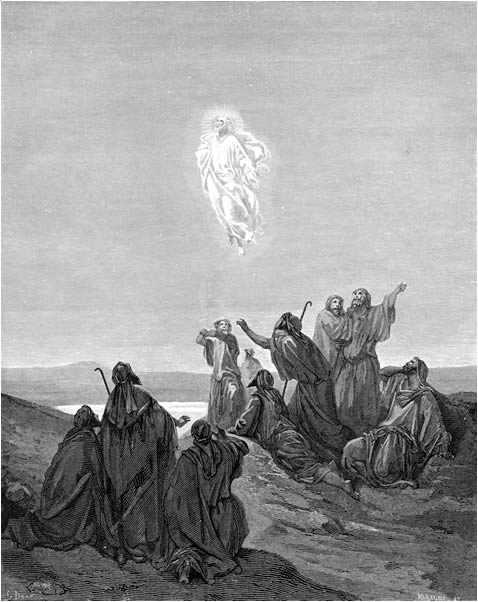
Rembrandt van Rijn, The Ascension of Christ, 1636. Public domain.
Summary
The page traces one continuous promise across five beats, from Jesus's last words in Luke's Gospel to Peter naming it kept at Pentecost. It also covers the standing invitation at the Feast of Tabernacles and the argument from a good father giving good gifts, both spoken months before the promise was ever fulfilled.
- Luke 24:49 and Acts 1:4-5 are read as one continuous scene split across two of Luke's own books, not two separate teachings.
- The command to wait names Jerusalem as the place and power for witness as the purpose, in Acts 1:8.
- John 7:37-39's invitation at the Feast of Tabernacles ties Jesus's offer to the feast's own water-drawing ceremony.
- Luke 11:13 argues from a lesser to a greater: if flawed parents give good gifts, how much more will a perfect Father give the Spirit.
- Peter's sermon in Acts 2:33 closes the loop, naming the promise kept in the same words Jesus used in Luke 24:49.
The Text
Luke 24:49
And behold, I am sending the promise of My Father upon you. But remain in the city until you have been clothed with power from on high.”“The promise of my Father”: the exact phrase Peter will later use to announce that it has arrived.
These are among the very last words Jesus speaks in Luke’s Gospel, moments before He leads the disciples out toward Bethany and is carried up (Luke 24:50–51). Luke’s Gospel ends here; the book of Acts, by the same author, opens with the same promise repeated. It is one continuous scene split across two volumes, not two separate teachings.
The Voices on Luke 24
the church hears the last promise before the ascension
After His resurrection He promises in a pledge to His disciples that He will send them the promise of His Father; and lastly, He commands them to baptize into the Father and the Son and the Holy Ghost, not into a unipersonal God.
Tertullian · Against Praxeas (220), on Luke 24:49
The promise of my Father - That is, the Holy Ghost, promised, Joh 15:26. See Act 1:4; Act 2:33. Until ye be endued with power - The energy of the Holy Ghost was to be communicated to them for three particular purposes. 1. That he might be in them, a sanctifying comforter, fortifying their souls and bringing to their remembrance whatever Jesus had before spoken to them. 2. That their preaching might be accompanied by his demonstration and power to the hearts of their hearers, so that they might believe and be saved. 3. That they might be able to work miracles to confirm their pretensions to a Divine mission, and to establish the truth of the doctrines they preached.
Adam Clarke · Commentary on the Bible (1832), on Luke 24:49
For when the Lord not only shed his blood but also expended his very death for the making of the medicine; he rose again to demonstrate the example of resurrection. By his patience, he suffered to teach our patience; and in his resurrection, he demonstrated the reward of patience. Also, as you know and as we all confess, he ascended into heaven, then from him the Holy Spirit was sent, formerly promised. For he had said to his disciples: Stay in the city, until you are clothed with power from on high. Therefore, his promise came, the Holy Spirit came, filled the disciples, they began to speak in the tongues of all nations: a sign of unity proceeded in them. For then one man spoke in all tongues; because the unity of the Church was going to speak in all tongues. Those who heard were astonished. For they knew that they were simple men, of only one language; and they marveled and were amazed that men of one language, or at most two, spoke in the tongues of all nations: they were stunned with amazement, lost their arrogance, turned from mountains into valleys.
Augustine of Hippo · Sermon 175.3 (430), on Luke 24:49
From the Promise to the Keeping
five beats, one continuous promise
DAY 1: JERUSALEM, RESURRECTION DAY
Luke 24:49The Promise Given
“Behold, I send the promise of my Father upon you: but tarry ye… until ye be endued with power from on high.”
Jesus's own last recorded words on the subject in Luke's Gospel, spoken before He is ever seen ascending.
DAY 40: MOUNT OF OLIVES, THE ASCENSION
Acts 1:4–5The Promise Repeated
“Wait for the promise of the Father, which… ye have heard of me… ye shall be baptized with the Holy Ghost not many days hence.”
The same promise, in the same city, forty days later: Luke's own Gospel ending is Acts's own opening.
DAY 40: SAME MOMENT
Acts 1:8The Purpose Named
“Ye shall receive power, after that the Holy Ghost is come upon you: and ye shall be witnesses unto me.”
Not power for its own sake, power aimed at a job: Jerusalem, then Judea and Samaria, then the ends of the earth.
DAYS 41–49: AN UPPER ROOM, JERUSALEM
The Wait
Ten days, not an open one: the fixed distance on Israel's calendar from Firstfruits (the week of the resurrection) to Pentecost/Shavuot.
DAY 50: PENTECOST, THE SAME UPPER ROOM
Acts 2:1–4, 33The Promise Kept
“Having received of the Father the promise of the Holy Ghost, he hath shed forth this, which ye now see and hear.”
Peter's own sermon names it: not a new gift improvised that morning, but the exact promise, arriving on schedule.
What He Is Saying
wait for it, and what it is for
Jesus does not tell the disciples to go preach immediately. He tells them to tarry: to stay put in Jerusalem, until something happens to them first. The command is repeated on the day of the ascension itself, with a name attached to what they are waiting for: not a feeling, and not information, but power, aimed at a specific job.
And while they were gathered together, He commanded them: “Do not leave Jerusalem, but wait for the gift the Father promised, which you have heard Me discuss. For John baptized with water, but in a few days you will be baptized with the Holy Spirit.”The same promise Jesus gave in Luke 24:49, repeated on the day of the ascension.
But you will receive power when the Holy Spirit comes upon you, and you will be My witnesses in Jerusalem, and in all Judea and Samaria, and to the ends of the earth.”The purpose named: power for witness, in widening circles, to the ends of the earth.
Why Jerusalem, and why the waitthe pattern of the promise
Jesus ties the promise to a place before He ties it to a time. The disciples are not told to scatter and wait wherever is convenient; they are told to stay in the one city, until the one gift arrives. Chrysostom reads the command this way: like a general who will not send untrained soldiers into a large engagement, Jesus does not send the disciples out to face the world until they have received what they will need to face it.
Now in these diverse activities that Gift is set forth in no uncertain light of which our Lord had spoken to the apostles when He taught them not to depart from Jerusalem; but wait, said He, for the promise of the Father which ye heard from My lips: for John indeed baptized with water, but ye shall be baptized with the Holy Ghost, which ye shall also receive not many days hence.
Hilary of Poitiers · On the Trinity 8.30 (367), on Acts 1:4
This grace was not in part, but his power was in full perfection; for as he who plunges into the waters and is baptized is encompassed on all sides by the waters, so were they also baptized completely by the Holy Spirit. The water, however, flows round the outside only, but the Spirit baptizes also the soul within, and that completely.
Cyril of Jerusalem · Catechetical Lecture 17.14 (386), on Acts 1:5
And so, when the Lord appointed his servants the apostles, that we might recognize that the creature was one thing and the grace of the Spirit another, he appointed them to different places, because all could not be everywhere at once. But he gave the Holy Spirit to all, to shed upon the apostles though separated the gift of indivisible grace.
Ambrose of Milan · On the Holy Spirit 1.7.81-82 (397), on Acts 1:8
The Thirsty Invitation
John 7:37–39: a standing offer, and a note about its timing
Months earlier, at the Feast of Tabernacles, Jesus had already stood up in public and made the same promise a different way, not a command to wait, but an open invitation to come. John, writing decades later, stops the narrative to tell the reader plainly what the invitation meant, and to flag something important about its timing.
On the last and greatest day of the feast, Jesus stood up and called out in a loud voice, “If anyone is thirsty, let him come to Me and drink. Whoever believes in Me, as the Scripture has said: ‘Streams of living water will flow from within him.’” He was speaking about the Spirit, whom those who believed in Him were later to receive. For the Spirit had not yet been given, because Jesus had not yet been glorified.“The Holy Ghost was not yet given”: John names the very gap this page traces.
A feast, and a day, chosen on purposethe Feast of Tabernacles
“The last day, that great day of the feast” was the culmination of a week-long harvest festival that included a daily water-drawing ceremony: water carried from the pool of Siloam and poured out at the altar. Standing at that exact public moment, Jesus offers Himself as the true source of the water the ceremony only pictured. John Wesley notes the setting plainly: this was the day “there was the greatest concourse of people,” the day the crowd itself was already thinking about water and drinking it “with joy… from the wells of salvation.”
Hold on to the gift but acknowledge the giver. When the Lord promised he was going to give his Spirit, he said, "If anyone is thirsty let him come to me and drink. Whoever believes in me, rivers of living water will flow from his belly." Where does this river in you come from? Remember your former dryness. I mean, if you had not been dry, you would not have been thirsty. If you had not been thirsty, you would not have drunk. What do I mean when I say: if you had not been thirsty, you would not have believed in Christ? Unless you had discovered how empty you were, you would not have believed in Christ. Before saying "rivers of living water will flow from his belly," he first said, "If anyone is thirsty, let him come and drink." The reason you will have a river of living water is that you drink. You do not drink if you are not thirsty.
Augustine of Hippo · Sermon 160.2 (430), on John 7:37
Let us drink waters out of our own cisterns and out of our own springing wells. We drink of living water springing up into everlasting life. But this is what the Savior said of the Spirit, which those who believe on him should receive. For observe what he says: "He who believes on me—not simply this, but—as the Scripture has said—here he sends you back to the Old Testament—out of his belly shall flow rivers of living water." These are not rivers perceived by sense that merely water the earth with its thorns and trees. But these are rivers that bring souls to the light.
Cyril of Jerusalem · Catechetical Lecture 16:11-12 (386), on John 7:38
In Joh 16:7 the Holy Ghost is represented not only as the gift of Christ, but a gift the communication of which was dependent upon His own departure to the Father. Now as Christ was not yet gone, so the Holy Ghost was not yet given.
Jamieson, Fausset & Brown · Commentary Critical and Explanatory on the Whole Bible (1871), on John 7:39
The Father's Best Gift
Luke 11:13: the paradigm answer to prayer
At the end of teaching His disciples to pray, and right after a parable about a friend who keeps knocking at midnight, Jesus makes an argument from the lesser to the greater: if imperfect, sinful parents still know how to give their children good things, how much more certainly will a perfect Father give the best gift there is, to anyone who simply asks?
So if you who are evil know how to give good gifts to your children, how much more will your Father in heaven give the Holy Spirit to those who ask Him!”Not one gift among many: the gift a good Father is most certain to give.
We sometimes come near to our bounteous God offering him petitions for various objects according to each one's pleasure. Sometimes we pray without discernment or any careful examination of what truly is to our advantage, and if granted by God would prove a blessing or would be to our injury if we received it. Rather, by the inconsiderate impulse of our fancy, we fall into desires full of ruin that thrust the souls of those that entertain them into the snare of death and the meshes of hell. When we ask of God anything of this kind, we will by no means receive it. On the contrary, we offer a petition suitable only for ridicule. Why will we not receive it? Is the God of all weary of bestowing gifts on us? By no means. "Why then," someone may say, "will he not give, since he is bounteous in giving?" ...When he says, "You who are evil," he means "you whose mind is capable of being influenced by evil and not uniformly inclined to good like the God of all." "You know how to give good gifts to your children; how much more shall your heavenly Father give a good spirit to them that ask him?" By a "good spirit" he means "spiritual grace." This is good in every way. If a person receives it, he will become most blessed and worthy of admiration.
Cyril of Alexandria · Commentary on Luke, Homily 79 (444), on Luke 11:13
Now unless the Holy Spirit were of the substance of God, Who alone is good, He would by no means be called good, since our Lord refused to be called good, inasmuch as He was made man.
Athanasius of Alexandria · Catena Aurea by Aquinas (1264), on Luke 11:13
Where It Points
the promise, kept on schedule
Ten days after the ascension, on Pentecost, the fixed harvest feast fifty days after Firstfruits, the wait ends. Peter stands up in front of the same city and names what has just happened in the same words Jesus used in Luke 24:49: the promise, kept.
Exalted, then, to the right hand of God, He has received from the Father the promised Holy Spirit and has poured out what you now see and hear.Peter's own sermon closes the loop this page opened: the promised gift, now poured out.
A commentator names the promise keptAdam Clarke, 1832
The promise of the Holy Ghost - This was the promise that he had made to them a little before he suffered, as may be seen in Joh 14:16, etc., Joh 16:7, etc., and after he had risen from the dead. Luk 24:49, and which as the apostle says was now shed forth.
Adam Clarke · Commentary on the Bible (1832), on Acts 2:33
What happens next at Pentecost (the sound, the tongues of fire, the sermon, the three thousand) belongs to its own study, not a re-telling here. This page stops at the moment the promise is kept; the two doors below carry the story onward.
Closing
Jesus does not leave His disciples with vague comfort about an absence. He leaves them with a promise, a place to wait for it, and a purpose it is for, and then He keeps His word, on a day fixed on the calendar long before any of them were born. The same invitation He gave a thirsty crowd at a feast, and the same gift He told His disciples to wait for in an upper room, is still the paradigm answer to a simple prayer: ask, and your Father will give it.
Keep studying
Read it1