
Leviticus 16 · Subject · Featured Study
The Scapegoat and the Word Azazel
What the Hebrew word azazel of Leviticus 16 has been taken to mean, who has held each reading, and how the rite of the live goat was kept and read.
Aaron cast lots over two goats, one lot for the LORD and the other for azazel.
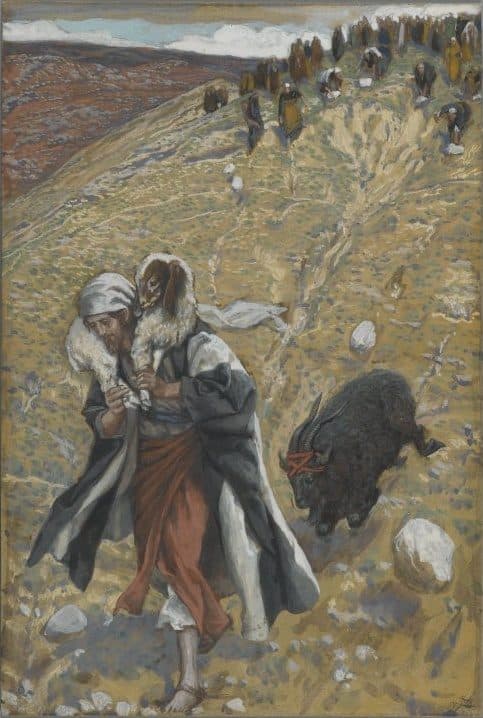
James Tissot, Agnus-Dei: The Scapegoat, 1886 to 1894, opaque watercolor over graphite, Brooklyn Museum. Public domain (made before 1930), via the Internet Archive.
THE ARTWORKTissot set two animals side by side on a bare hillside. The goat runs downhill with a red band bound about its horns, and the man walking beside it carries a lamb on his shoulders.
Summary
On the Day of Atonement one goat died as a sin offering and the other was sent away alive to azazel.
- The word stands four times, at Leviticus 16:8, twice at Leviticus 16:10 and at Leviticus 16:26.
- Aaron confessed the sins of Israel over the live goat, and a man led it into the wilderness.
- Readers have taken azazel as a cliff, as the goat that goes away, as entire removal and as a spirit of the desert.
- The Mishnah records that in the Second Temple the goat was pushed backward from a cliff.
- Hebrews 9 and 13 compare the blood and the burning of the day with the one offering of Christ.
Two Goats and Two Lots
Leviticus 16 names azazel in the casting of the lots and in the sending of the live goat.
On the Day of Atonement Aaron took two male goats from the congregation of Israel for a sin offering and presented both at the entrance to the Tent of Meeting.
After Aaron casts lots for the two goats, one for the LORD and the other for the scapegoat,The word azazel first stands in this verse, and every reading of it begins here.
But the goat chosen by lot as the scapegoat shall be presented alive before the LORD to make atonement by sending it into the wilderness as the scapegoat.The word stands twice in this verse, and the goat sent to azazel is first presented alive before the LORD.
The Forms Behind the Readings
Each reading divides or derives the Hebrew word in its own way, and a lexicon records each.
| Reading | The word taken as | Lexicon |
|---|---|---|
| A place, the hard cliff | az, hard, joined to el, mighty | Jastrow, 1903, after Yoma 67b; Klein, after the Talmud |
| The goat that goes away | ez, goat, joined to azal, to go away | Klein, as one of three etymologies |
| Entire removal | an abstract noun of intensive form, from a root azal, remove | Brown, Driver and Briggs, 1906; BDB Augmented Strong |
| A spirit of the wilderness | the name of a being | Brown, Driver and Briggs, 1906 |
The Rite of the Live Goat
Leviticus 16:20 to 26 gives the laying on of hands, the confession, the release and the washing.
Then he is to lay both hands on the head of the live goat and confess over it all the iniquities and rebellious acts of the Israelites in regard to all their sins. He is to put them on the goat’s head and send it away into the wilderness by the hand of a man appointed for the task.The confession uses three words for wrongdoing, and Aaron puts all of them on the goat's head.
The goat will carry on itself all their iniquities into a solitary place, and the man will release it into the wilderness.The sins confessed in the previous verse now leave the camp with the animal, far from the tabernacle.
The man who released the goat as the scapegoat must wash his clothes and bathe himself with water; afterward he may reenter the camp.Adam Clarke, in his Commentary on this verse, held that the goat was unclean because it bore the sins of the whole congregation.
The two birds of the cleansing from skin diseaseLeviticus 14:4 to 7
Leviticus 14 gives a rite of the same shape for a person healed of skin disease. One bird was killed over fresh water, and the live bird was dipped in its blood.
Seven times he shall sprinkle the one to be cleansed of the skin disease. Then he shall pronounce him clean and release the live bird into the open field.Keil and Delitzsch set this release of the live bird beside the release of the live goat, since in each rite one creature dies and the other goes free.
How the goat endedRashi on Leviticus 16:10; Tyndale
Rashi, on Leviticus 16:10, reasoned from the words presented alive that the goat had to live only until it was sent, so it was sent to its death. He cites the Sifra for the reading.
William Tyndale rendered the end of the same verse as letting the goat go free into the wilderness.
Presented Alive Before the LORD
What Leviticus 16 says of the live goat, set beside the reading that it was a gift to Sammael.
Pirkei de-Rabbi Eliezer, which Ramban cites on Leviticus 16:8, calls the lot for azazel a gift to Sammael so that he would not annul Israel's offerings. Leviticus 16:5 bears on that reading.
Keil and Delitzsch read azazel as the name of Satan, and they still wrote that there was not the slightest idea of presenting a sacrifice to Azazel. Ibn Ezra, on Leviticus 16:8, wrote that the goat sent away was no offering, because it was not slaughtered.
And he shall take from the congregation of Israel two male goats for a sin offering and one ram for a burnt offering.The congregation gives both goats for a single sin offering before any lot has fallen.
The Live Goat in the Mishnah
Mishnah Yoma 6, set down about AD 200, records how the goat was sent out in the days of the Second Temple.
| Mishnah | What it records |
|---|---|
| Yoma 6:1 | The two goats were to match in appearance, in height and in price, and to be bought together. |
| Yoma 6:2 | The high priest laid both hands on the goat and confessed the sins of the house of Israel, citing Leviticus 16:30. |
| Yoma 6:3 | Any man was fit to lead the goat, but the high priests kept the task for priests; Rabbi Yosei names an Israelite, Arsela, who once led it. |
| Yoma 6:4 to 5 | Ten booths stood between Jerusalem and the cliff, food and water were offered at each, and the last escort watched from a distance. |
| Yoma 6:6 | The man tied half a strip of crimson to the rock and half between the goat's horns, and pushed the goat backward over the edge. |
| Yoma 6:8 | Rabbi Ishmael says a crimson strip at the entrance to the sanctuary turned white when the goat reached the wilderness, citing Isaiah 1:18. |
Keil and Delitzsch held that the cliff of the Mishnah is probably a later addition with no ground in the Law.
“Come now, let us reason together,” says the LORD. “Though your sins are like scarlet, they will be as white as snow; though they are as red as crimson, they will become like wool.Rabbi Ishmael's sign of the crimson strip rests on this promise that sins like scarlet will be as white as snow.
The Words of the Rite
Four Hebrew words from Brown, Driver and Briggs and from Klein, and the word azazel in seven versions.
AZAZEL
The Hebrew writes the noun each time with the prefix la, for azazel or to azazel. Brown, Driver and Briggs list its four places in the ritual of the Day of Atonement.
SE'IR
Brown, Driver and Briggs give the word for each goat as a he-goat, the hairy one, and count it alone eleven times in Leviticus 16.
SE'IRIM
Brown, Driver and Briggs list a second word of the same spelling for a satyr or demon. The Berean renders it wild goats among the ruins of Babylon and goat demons in Leviticus 17:7.
GEZERAH
Brown, Driver and Briggs give separation for the word the Berean renders a solitary place, and Klein gives a land cut off that occurs only here in the Bible.
| Version | Leviticus 16:8 | Edition read |
|---|---|---|
| The Hebrew text | la'aza'zel, for azazel | Miqra according to the Masorah, on Sefaria |
| The Septuagint | to apopompaio | H. B. Swete, The Old Testament in Greek, volume 1, 1887 |
| The Vulgate | capro emissario, for the emissary goat | Biblia Sacra Vulgata, Leviticus 16 |
| Tyndale | for a scapegoote | J. I. Mombert's reprint of the edition of 1530 |
| The Douay-Rheims | the emissary goat | Project Gutenberg, Leviticus |
| Brenton's Septuagint | the scape-goat | L. C. L. Brenton, 1844 |
| The King James and the Berean | the scapegoat | Leviticus 16:8 in the reader |
At Leviticus 16:10 the Septuagint sends the goat eis ten apopompen, and at Leviticus 16:26 it calls the goat the one set apart for release. Keil and Delitzsch, after Ewald, took apopompaios for the name of a fiend that is driven away.
What the Text Leaves Unsaid
Three matters on which Leviticus and the New Testament are silent.
Leviticus never says what azazel is, and the lexicon of Brown, Driver and Briggs finds the name nowhere else.
The text says that the man released the goat in the wilderness and is silent on how it died.
The New Testament never names the scapegoat, and in the Berean and King James texts the word stands only in Leviticus 16.
The Goat That Carried Iniquity
The church read the live goat as a figure of Christ by Isaiah 53 and by Hebrews.
We all like sheep have gone astray, each one has turned to his own way; and the LORD has laid upon Him the iniquity of us all.In this verse one servant bears what many have done.
so also Christ was offered once to bear the sins of many; and He will appear a second time, not to bear sin, but to bring salvation to those who eagerly await Him.The words come from the last verse of Isaiah 53, the song of the servant.
Hebrews builds its comparison on the blood carried within the veil and on the sin offerings burned away from the camp.
Tertullian, in Against Marcion, Book 3, read the goat bound with scarlet and driven out of the camp amid cursing and spitting as a sign of the Lord's passion. He read the goat offered for sins as a sign of the second coming. Adam Clarke, on Leviticus 16:7, read the two goats together as Christ put to death for our sins and raised again.
He did not enter by the blood of goats and calves, but He entered the Most Holy Place once for all by His own blood, thus securing eternal redemption.The verse sets Christ's one entry beside the high priest's yearly entry with the goat's blood in Leviticus 16:15.
Although the high priest brings the blood of animals into the Holy Place as a sacrifice for sin, the bodies are burned outside the camp. And so Jesus also suffered outside the city gate, to sanctify the people by His own blood.The writer draws on Leviticus 16:27, the law for the remains of the two sin offerings of the day.
Voices on the Goat and the Camp
Matthew Henry on the choice of goats, and Leo the Great, Jamieson, Fausset and Brown and Theophylact on Hebrews 13.
Matthew Henry on why goats were chosenCommentary on the Whole Bible, on Leviticus 16:10
“Some think that goats were chosen for the sin-offering because, by the disagreeableness of their smell, the offensiveness of sin is represented: others think, because it was said that the demons which the heathens then worshipped often appeared to their worshippers in the form of goats, God therefore obliged his people to sacrifice goats, that they might never be tempted to sacrifice to goats.”
Matthew Henry · Commentary on the Whole Bible · on Leviticus 16:10Puritan
Leo the Great on the altar of the worldSermon 59, chapter 5, trans. C. L. Feltoe, 1895
Leo the Great, in his Sermon 59, preached that Christ was crucified outside the camp so that "the cross of Christ might be the altar not of the temple but of the world."
Jamieson, Fausset and Brown on the burning of the victimsCommentary Critical and Explanatory, on Hebrews 13:12
“The fiery ordeal of His suffering on the cross, answers to the burning of the victims; thereby His mere fleshly life was completely destroyed, as their bodies were; the second part of His offering was His carrying His blood into the heavenly holiest before God at His ascension, that it should be a perpetual atonement for the world's sin.”
Jamieson, Fausset & Brown · Commentary Critical and Explanatory on the Whole Bible · on Hebrews 13:12Reformed
Theophylact on going out to HimCommentary on Hebrews, on Hebrews 13:13
“Since Jesus Christ suffered outside the gates, let us also go out to Him outside the gates, that is, let us be outside the world, ‘bearing His reproach,’ enduring the same sufferings. He, as one condemned and a robber, was crucified outside; let us also …”
Theophylact of Ohrid · Commentary on Hebrews · on Hebrews 13:13Patristic
What Does Azazel Name?
Four readings of the word, each with its holders, its case and the strongest objection.
A place: the hard cliffThe Talmud; Rashi; Saadia Gaon; Jastrow · Rabbinic tradition and Jewish lexicons
The Babylonian Talmud, set down between about 450 and 550, at Yoma 67b reads azazel as hard and rough and reads the land cut off of Leviticus 16:22 as a cliff. Rashi, the French commentator of the eleventh century, follows it on Leviticus 16:8 and calls azazel a towering, flinty rock. Jastrow's dictionary of 1903 glosses the word a rough and rocky mountain.
Abraham ibn Ezra, writing in the twelfth century, reports that Saadia Gaon took azazel as the name of a mountain.
The objection is the parallel of the two lots, on which the spirit reading rests. Keil and Delitzsch held that the word names no locality in the desert.
The goat that goes awayWilliam Tyndale; the King James Version; Adam Clarke · English Reformation translation and Methodist commentary
Here azazel is a name for the goat itself, and Adam Clarke, on Leviticus 16:10, derives it so. Keil and Delitzsch list Symmachus, Theodotion, the Vulgate and Luther as rendering it so. Tyndale's Pentateuch of 1530 casts one lot for the Lord and another for a scapegoat, and the King James Version and the Berean text keep the word.
The objection is Leviticus 16:10, which sends the goat to azazel into the wilderness, so the word names where the goat is sent.
Entire removalBähr; Winer; Tholuck; Brown, Driver and Briggs · German Protestant scholarship and the Oxford lexicon
Brown, Driver and Briggs read the rite as sin and guilt carried from the holy places into the desert, a sign of complete forgiveness. Keil and Delitzsch name Bähr, Winer and Tholuck among the holders.
The objection comes from the same lexicon, which records that most scholars take the word as the name of a spirit haunting the desert.
A spirit of the wildernessGesenius; Dillmann; Driver; Keil and Delitzsch; Ramban · Protestant scholarship and medieval Jewish commentary
This reading takes azazel as a proper name set opposite the LORD in the lots of Leviticus 16:8. Brown, Driver and Briggs list Gesenius, Dillmann and Driver among its holders, and T. K. Cheyne took it as the name of a fallen angel. Keil and Delitzsch named Satan himself, and they noted the desert as the haunt of evil spirits in Isaiah 13:21 and Isaiah 34:14.
Keil and Delitzsch noted that the Book of Enoch makes Azazel a fallen angel who leads men into wickedness.
The objection is the law of Leviticus 17:7, which forbids sacrifice to goat demons. Brown, Driver and Briggs judge that the angel Azazel of later Jewish writings was probably drawn from Leviticus 16 itself.
Books on the Word and the Rite
Four works on azazel and the live goat, all four free to read.
Biblical Commentary on the Old Testament: The Pentateuch, volume 2
C. F. Keil and F. Delitzsch · 1872
Keil and Delitzsch weighed every reading of azazel with its holders and argued for a personal being.
Read at the Internet ArchiveMishnah Yoma
The Mishnah · about 200
Its sixth chapter is the Mishnah's record of the two goats, the confession, the booths on the road and the crimson strip.
Read at SefariaWilliam Tyndale's Five Books of Moses
William Tyndale, edited by J. I. Mombert · 1530
Mombert reprints Tyndale's Leviticus 16 with its word scapegoote and compares it with the Vulgate and Luther.
Read at the Internet ArchiveThe Old Testament in Greek, volume 1
Henry Barclay Swete · 1887
Swete prints the Septuagint's Leviticus 16 with apopompaios at verses 8 and 10.
Read at the Internet ArchiveSins Carried Away
Hebrews 13 calls the reader out of the camp to the One who suffered there.
Once a year the confessed sins of Israel left the camp on the live goat, and the next year the rite was kept again.
So the text asks the reader to confess sin to God, who laid it on Christ, and to follow Christ beyond the camp.
Therefore let us go to Him outside the camp, bearing the disgrace He bore.The verse asks the reader to leave the safety of the camp for Christ's sake.
Keep studying
Places2
Doctrines8