
Genesis 28 · Story · Featured Study
Jacob's Ladder
Genesis 28:10 to 22 tells of Jacob's dream at Bethel, where the LORD speaks to him from the top of a ladder set between earth and heaven.
A fleeing deceiver lies down on a stone in the wilderness and meets God. Jesus later claims the ladder of that night as Himself.
- Where
- Bethel
- Who
- Jacob
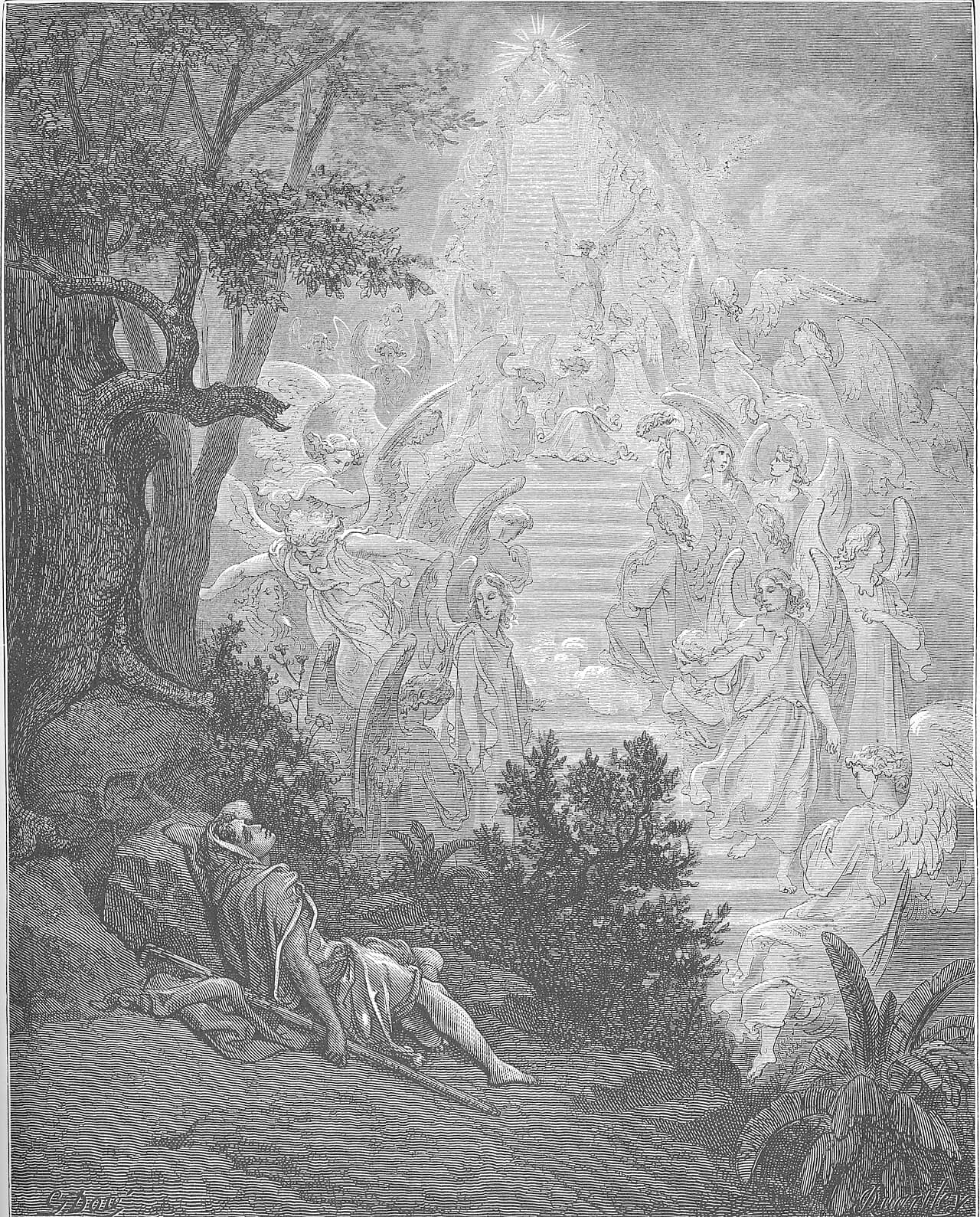
Gustave Doré, Jacob's Dream, 1866. Public domain.
Summary
Jacob leaves Beersheba for Haran, and God meets him in a dream at the place where he stops for the night.
- Jacob sets up his stone as a pillar, names the place Bethel and vows a tenth of all God gives him (Genesis 28:18 to 22).
- Bethel returns when God calls Jacob home and names him Israel there (Genesis 31:13 and 35:1 to 15).
- The Hebrew word for the ladder, sullam, stands nowhere else in Scripture.
The Vision at Bethel
Genesis 28:10 to 15, the stone at sunset, the dream and the LORD's words to Jacob
Esau held a grudge against Jacob for taking the blessing, and Rebekah sent Jacob to her brother Laban in Haran (Genesis 27:41 to 45). On reaching a certain place at sunset, Jacob takes one of its stones, puts it under his head and lies down to sleep (Genesis 28:10 to 11).
And Jacob had a dream about a ladder that rested on the earth with its top reaching up to heaven, and God’s angels were going up and down the ladder.Jacob sees the ladder and the angels before the LORD speaks a word to him.
And there at the top the LORD was standing and saying, “I am the LORD, the God of your father Abraham and the God of Isaac. I will give you and your descendants the land on which you now lie.Your descendants will be like the dust of the earth, and you will spread out to the west and east and north and south. All the families of the earth will be blessed through you and your offspring.God spoke the blessing of the families of the earth first to Abram in Genesis 12:3, and He speaks it now to Jacob.
Look, I am with you, and I will watch over you wherever you go, and I will bring you back to this land. For I will not leave you until I have done what I have promised you.”The promise is grace to the runaway, spoken before Jacob has asked God for anything.
Genesis 28:14, Genesis 28:15
Bethel in Scripture
the place from Abram's altar to Hosea
Six texts before and after Genesis 28 that name Bethel, in the order of the canon, each with its reference.
- Abram pitches his tent east of Bethel and builds an altar to the LORDAbramGenesis 12:8
- Abram comes back from Egypt to the place between Bethel and AiAbramGenesis 13:1 to 3
- God names Himself the God of Bethel and calls Jacob homeJacobGenesis 31:13
- Jacob builds an altar at Luz and calls the place El-bethelJacobGenesis 35:6 to 7
- God names Jacob Israel, and Jacob sets up a pillar where God spoke with himJacobGenesis 35:9 to 15
- Hosea recalls that Jacob found God at Bethel and spoke with Him thereHoseaHosea 12:4
The Stone, the Pillar and the Vow
Genesis 28:16 to 22, from Jacob's waking to his vow
Jacob wakes and says that the LORD is in this place and he was unaware of it (Genesis 28:16).
And he was afraid and said, “How awesome is this place! This is none other than the house of God; this is the gate of heaven!”Jacob's fear gives the place its meaning before he gives it a name in Genesis 28:19.
Early the next morning Jacob sets up the stone from under his head as a pillar and pours oil on top of it. He names the place Bethel, the house of God, though the city had been named Luz (Genesis 28:18 to 19). Before he leaves the place he makes a vow to God.
Then Jacob made a vow, saying, “If God will be with me and watch over me on this journey, and if He will provide me with food to eat and clothes to wear,The words of the vow, with me and watch over me, are the words of the promise in Genesis 28:15.
And this stone I have set up as a pillar will be God’s house, and of all that You give me I will surely give You a tenth.”The tenth Jacob vows recalls the tenth Abram gave Melchizedek in Genesis 14:20.
Genesis 28 Read Closely
Genesis 28:11 to 22, the word for ladder, the angels, the place, the LORD at the top and the vow
Sullam, the Hebrew word behind ladderGenesis 28:12
Sullam occurs exactly once in the whole of Scripture, here in Genesis 28:12.
The STEP lexicon glosses sullam as a stair-case, and the King James Version and the Berean Standard Bible both render it ladder.
The order of the angels on the ladderGenesis 28:12
The angels in Jacob's dream go up the ladder first and then come down it. Rashi, the eleventh-century Jewish commentator, followed Genesis Rabbah 68:12 in reading the order. The angels who had kept Jacob in the land went up to heaven, and other angels came down to go with him outside it.
The place Jacob reachedGenesis 28:11
Genesis 28:11 says Jacob reached the place, with the article, before the place has a name. Rashi read it as a place named earlier in Scripture, Mount Moriah, where Abraham saw the place in the distance (Genesis 22:4).
The LORD at the top of the ladderGenesis 28:13
Rashi read the Hebrew of Genesis 28:13 as the LORD standing over Jacob to guard him, where the Berean text has Him at the top of the ladder. The question of who appears to Jacob as God returns at Peniel (Genesis 32:30), and the study of Jacob wrestling the angel sets out its readings.
The word if in Jacob's vowGenesis 28:20 to 22
Four commentators read the word if in Jacob's vow in four ways. Rashi read it as Jacob asking God to keep the promises He had just made in Genesis 28:15. Jamieson, Fausset and Brown, in their Commentary Critical and Explanatory (1871), read the if as since, so that the vow expresses Jacob's faith in the promise.
Adam Clarke, in his Commentary on the Bible, read the vow as made more for Jacob's offspring than for himself, since it looks to the promises about his descendants and the land. John Wesley, in his Explanatory Notes upon the Old Testament (1765), read it as the second half of a covenant God had just renewed, in which Jacob repeats his promises to God.
What the Text Leaves Unsaid
the distance, the ladder, the form of the LORD and the tenth
How far had Jacob travelled?Genesis 28:10 to 11
What was the ladder like?Genesis 28:12
The text gives the ladder's foot on the earth and its top in heaven, and it gives no size or material.
What did Jacob see of the LORD?Genesis 28:13
The text says the LORD stood at the top and spoke, and it describes no form that Jacob saw.
How was the tenth given?Genesis 28:22
Genesis records Jacob's vow of a tenth and does not say when or to whom he gave it.
Christ the Ladder
John 1:47 to 51, Jesus and Nathanael
Jesus had just called Nathanael a true Israelite in whom there is no deceit, and Nathanael had confessed Him as the Son of God and the King of Israel (John 1:47 to 49).
Then He declared, “Truly, truly, I tell you, you will all see heaven open and the angels of God ascending and descending on the Son of Man.”Jesus answers Nathanael's confession with the angels of Jacob's dream, now ascending and descending on the Son of Man.
Paul names the man Christ Jesus the one mediator between God and men (1 Timothy 2:5), and the fathers read Jacob's night of Christ.
Ambrose of Milan, in On Jacob and the Blessed Life, read the angels going up and coming down as serving Christ, their rightful master.
Cyril of Alexandria, in his Glaphyra on Genesis, read the stone Jacob set up and anointed with oil as a figure of Christ, anointed by the Father and raised from the dead.
How Jacob's Ladder Has Been Taught
three readings from Matthew Henry and John Wesley
1662 to 1714 · Matthew Henry
Commentary on the Whole Bible
The quotation1 quotation
“All the intercourse between heaven and earth, since the fall, is by this ladder. Christ is the way; all God's favours come to us, and all our services go to him, by Christ. If God dwell with us, and we with him, it is by Christ.”
Matthew Henry · Commentary on the Whole Bible · on Genesis 28:12Puritan
1662 to 1714 · Matthew Henry
Commentary on the Whole Bible
The quotation1 quotation
“He will cheerfully content himself with bread to eat, and raiment to put on; and, though God's promise had now made him heir to a very great estate, yet he indents not for soft clothing and dainty meat. Agur's wish is his, Feed me with food convenient for me; and see 1 Tim. vi. Nature is content with a little, and grace with less.”
Matthew Henry · Commentary on the Whole Bible · on Genesis 28:20Puritan
1703 to 1791 · John Wesley
Explanatory Notes upon the Old Testament
The quotation1 quotation
“He knew not, but God foresaw what hardships he would meet with in his uncle's service, and therefore promiseth to preserve him in all places. God knows how to give his people graces and comforts accommodated to the events that shall be, as well as to those that are. He was now going as an exile into a place far distant, but God promiseth him to bring him again to this land.”
John Wesley · Explanatory Notes upon the Old Testament · on Genesis 28:15Evangelical
Books to Read Next
five works that read Genesis 28, from Ambrose to John Wesley
On Jacob and the Blessed Life
Ambrose of Milan · fourth century
The second book of the treatise takes up Jacob's dream at Bethel in its fourth chapter.
Glaphyra on Genesis
Cyril of Alexandria · fifth century
Cyril reaches Jacob at Bethel in part 4.4 of the Glaphyra.
Rashi on Genesis
Rashi, translated by M. Rosenbaum and A. M. Silbermann · 1929 to 1934
Each of Rashi's notes on Genesis 28 opens with the Hebrew words it explains.
Read Rashi on Genesis 28 at SefariaCommentary on the Whole Bible
Matthew Henry · 1706
Henry's commentary takes Genesis 28 from Isaac's charge in verse 1 to Jacob's vow in verse 20.
Explanatory Notes upon the Old Testament
John Wesley · 1765
Wesley wrote notes on Genesis 28 from Rebekah's sons in verse 5 to Jacob's vow in verse 20.
Sources
Scripture is the Berean Standard Bible.
- STEP Bible TBESH lexicon and the word index.
- Rashi on Genesis, in the Pentateuch with Rashi's commentary by M. Rosenbaum and A. M. Silbermann (1929 to 1934)
Keep Studying
Studies4
Symbols2
Doctrines5