
Bethany
Summary
The village near Jerusalem, home of Mary, Martha, and Lazarus and the setting of the seventh sign (John 11; 12:1).
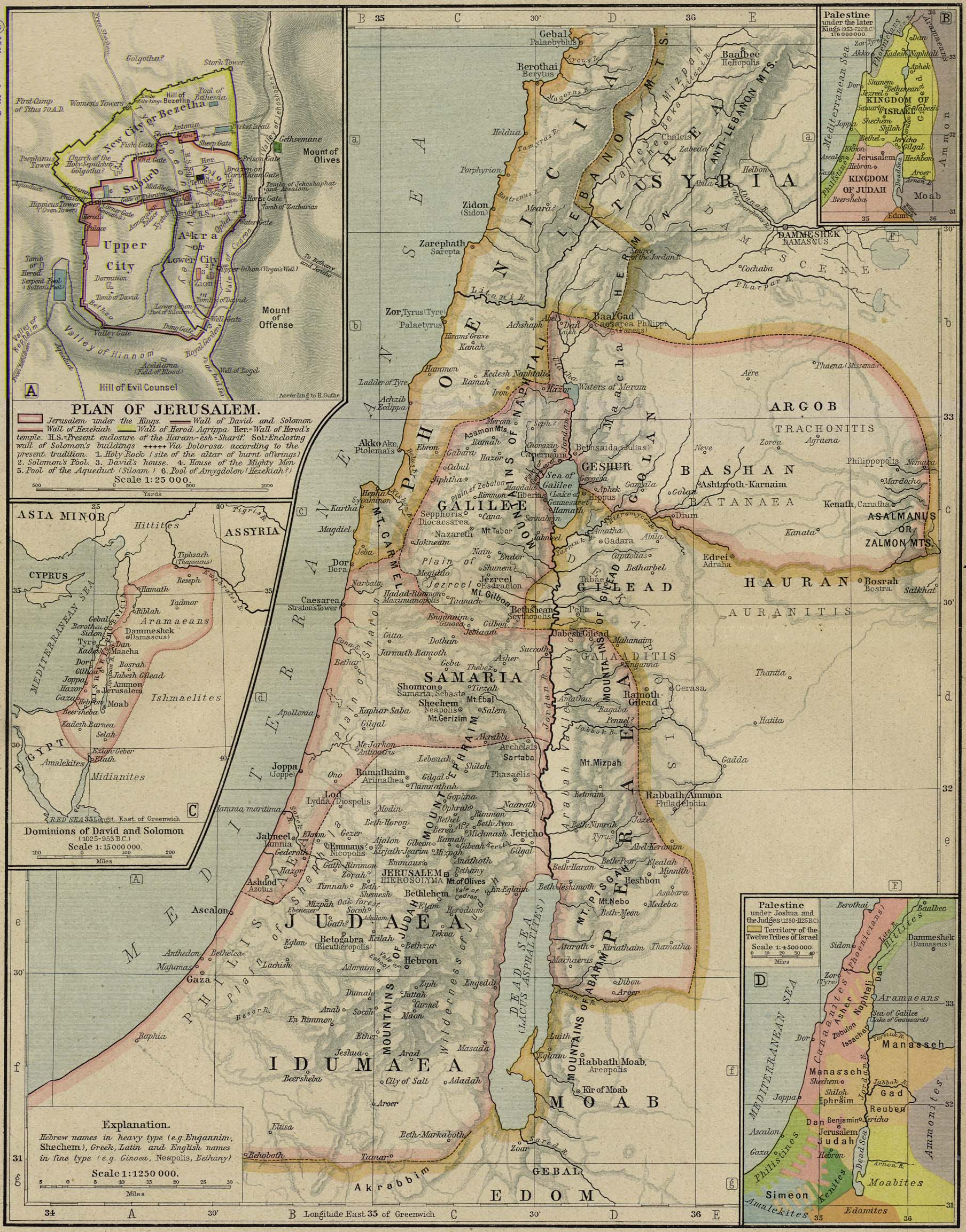
- A village on the Mount of Olives, less than two miles from Jerusalem, home to Mary, Martha and Lazarus.
- Jesus raised Lazarus from the dead here after four days in the tomb, the last and greatest of John's signs.
- In the same last week, a woman anointed Jesus for burial in Bethany, an act He said would be told wherever the gospel is preached.
- Bethany was where Jesus lodged during His final week in Jerusalem.
- Luke places the ascension itself "as far as Bethany," on the ridge above the village.
On this page
In Scripture
- Verses
- 12
- Books
- 4
Near Bethany
- Mount of Olives1.6 km · 1.0 mi NW
- Zion2.5 km · 1.6 mi W
- Moriah2.6 km · 1.6 mi W
- Nob4.2 km · 2.6 mi NW
- Jerusalem4.6 km · 2.9 mi W
- Gibeah6.5 km · 4.0 mi NW
Straight-line distances, computed from the gazetteer coordinates.
Where it is
the country around it
- Coordinates
- 31.7717° N, 35.2621° Efind it on the Atlas →
- Region
- Judea
- Kind of place
- Town
1 place the record names with Bethany, the farthest 4.6 km away
- Located: the gazetteer fixes one site
- ? Proposed: one candidate among several
- A dashed line ends at a place the gazetteer does not fix
Why Bethany matters
The raising of Lazarus, outlined
John 11, in the order it happens
Read John 11, in the order it happens
- Lazarus falls sick in BethanyJohn 11:1At this time a man named Lazarus was sick. He lived in Bethany, the village of Mary and her sister Martha.
- Jesus stays two more days before goingJohn 11:6So on hearing that Lazarus was sick, He stayed where He was for two days,
- Martha's confession on the roadJohn 11:25Jesus said to her, “I am the resurrection and the life. Whoever believes in Me will live, even though he dies.
- Jesus weepsJohn 11:35Jesus wept.
- "Lazarus, come out!"John 11:43After Jesus had said this, He called out in a loud voice, “Lazarus, come out!”
- The plot to kill Jesus beginsJohn 11:53So from that day on they plotted to kill Him.
- Mary anoints Jesus's feet for burialJohn 12:3Then Mary took about a pint of expensive perfume, made of pure nard, and she anointed Jesus’ feet and wiped them with her hair. And the house was filled with the fragrance of the perfume.
- A different anointing, at Simon the leper's houseMark 14:3While Jesus was in Bethany reclining at the table in the home of Simon the Leper, a woman came with an alabaster jar of expensive perfume, made of pure nard. She broke open the jar and poured it on Jesus’ head.
The same week, at Bethany, a woman anointed Jesus for burial. Mark 14 and John 12 describe the anointing from different angles; both are quoted below rather than merged into one account.
The Raising of Lazarus: the full studyWhat happened here, in order
in the order the canon tells it
- Bethany's distance from JerusalemJohn 11:18Now Bethany was near Jerusalem, a little less than two miles away,
- Martha warns the body will smellJohn 11:39“Take away the stone,” Jesus said. “Lord, by now he stinks,” said Martha, the sister of the dead man. “It has already been four days.”
- Lazarus comes out, still boundJohn 11:44The man who had been dead came out with his hands and feet bound in strips of linen, and his face wrapped in a cloth. “Unwrap him and let him go,” Jesus told them.
- Caiaphas's unwitting prophecyJohn 11:50You do not realize that it is better for you that one man die for the people than that the whole nation perish.
- Jesus returns to Bethany six days before PassoverJohn 12:1Six days before the Passover, Jesus came to Bethany, the hometown of Lazarus, whom He had raised from the dead.
- Jesus answers Judas's objectionJohn 12:7“Leave her alone,” Jesus replied. “She has kept this perfume in preparation for the day of My burial.
- Told in memory of her, wherever the gospel is preachedMark 14:9And truly I tell you, wherever the gospel is preached in all the world, what she has done will also be told in memory of her.”
- Jesus lodges at Bethany during His last weekMatthew 21:17Then He left them and went out of the city to Bethany, where He spent the night.
- Martha welcomes Jesus into her home, in an unnamed villageLuke 10:38As they traveled along, Jesus entered a village where a woman named Martha welcomed Him into her home.
- Mary's chosen portionLuke 10:42But only one thing is necessary. Mary has chosen the good portion, and it will not be taken away from her.”
- Jesus leads the disciples out as far as BethanyLuke 24:50When Jesus had led them out as far as Bethany, He lifted up His hands and blessed them.
- Carried up into heaven while blessing themLuke 24:51While He was blessing them, He left them and was carried up into heaven.
Bethany in Scripture
12 verses name it, in 4 books
Open a book to read its mentions here. Text: Berean Standard Bible.
Old TestamentNew Testamentsegment width = share of mentions
New Testament4 books · 12 mentions
Matthew2 mentions
Mark4 mentions
- Mark 11:1As they approached Jerusalem and came to Bethphage and Bethany at the Mount of Olives, Jesus sent out two of His disciples
- Mark 11:11Then Jesus entered Jerusalem and went into the temple courts. He looked around at everything, but since it was already late, He went out to Bethany with the Twelve.
- Mark 11:12The next day, when they had left Bethany, Jesus was hungry.
- Mark 14:3While Jesus was in Bethany reclining at the table in the home of Simon the Leper, a woman came with an alabaster jar of expensive perfume, made of pure nard. She broke open the jar and poured it on Jesus’ head.
Luke2 mentions
John4 mentions
- John 1:28All this happened at Bethany beyond the Jordan, where John was baptizing.
- John 11:1At this time a man named Lazarus was sick. He lived in Bethany, the village of Mary and her sister Martha.
- John 11:18Now Bethany was near Jerusalem, a little less than two miles away,
- John 12:1Six days before the Passover, Jesus came to Bethany, the hometown of Lazarus, whom He had raised from the dead.
Common questions
Was Luke's story of Mary and Martha set at Bethany?
Readers differ; the positions are named
Luke does not name the village. He says only that Jesus entered "a village" where Martha welcomed Him and her sister Mary sat at His feet. Readers commonly assume this is the same Martha and Mary of John 11 and 12, since the names and the household match, but the text itself leaves the place unnamed. This page names the assumption rather than asserting it as settled.
Are the anointing in John 12 and the anointing in Mark 14 the same event?
Readers differ; the positions are named
Both happen at Bethany in the last week before the crucifixion, both use a jar of pure nard, and both draw an objection that the perfume should have been sold for the poor. Mark names the house as Simon the leper's and does not name the woman; John names Mary, sister of Lazarus, and sets it at a dinner in her own household. Many readers take these as one event told from two angles; others hold them as two separate anointings in the same week. This page quotes both Gospels as they stand rather than merging them into one account.
Why does Bethany appear at the very end of Luke, at the ascension?
Bethany was already the place where Jesus lodged through His final week, walking into Jerusalem by day and back out again at night. Luke's phrase, that Jesus led the disciples out "as far as Bethany," places the ascension on the ridge of the Mount of Olives above the village, the same slope Jesus had been climbing and descending all that week.
What is the modern name for the site, and how far back does the Lazarus tradition go?
The modern town is called el-Azariyeh, a name that derives from "Lazarium," the place of Lazarus. Christian writers already knew the village and a tomb shown as his by the fourth century: Eusebius names it in his Onomasticon, and the pilgrim who left the Bordeaux Itinerary in AD 333 records it as a fixed local site. That is a naming tradition with early, dated witnesses, not an inscription proving the tomb itself.
Why did the raising of Lazarus lead to a plot against Jesus?
Many who saw Lazarus raised believed in Jesus, but others reported it to the Pharisees, who convened the Sanhedrin fearing that if everyone believed, the Romans would come and take away both their place and their nation. Caiaphas, the high priest that year, said it was better for one man to die for the people than for the whole nation to perish, and John notes that without knowing it he was prophesying that Jesus would die for the nation and for the scattered children of God.
Sources cited
- MannaFest canon study of John (AI-draft)Awaiting the founder's edit.
- OpenBible.info Bible Geocoding: Bethany 1read 2026-08-20The coordinates on this page. Used under CC-BY with attribution to OpenBible.info.
- Eusebius of Caesarea, OnomasticonCited for the early, dated naming tradition of Bethany and the tomb of Lazarus.
- The Bordeaux Pilgrim, Itinerarium Burdigalense (AD 333)Cited for the fourth-century record of Bethany as a fixed pilgrimage site.
Keep studying
On this page
Studies3
Lives that run through it4
Doorway2
Keep this page