
Genesis 49:8 to 12 · Passage · Featured Study
Shiloh and the Scepter: Genesis 49:10
Jacob's blessing on Judah promises his tribe the scepter until Shiloh comes and the nations give him their allegiance.
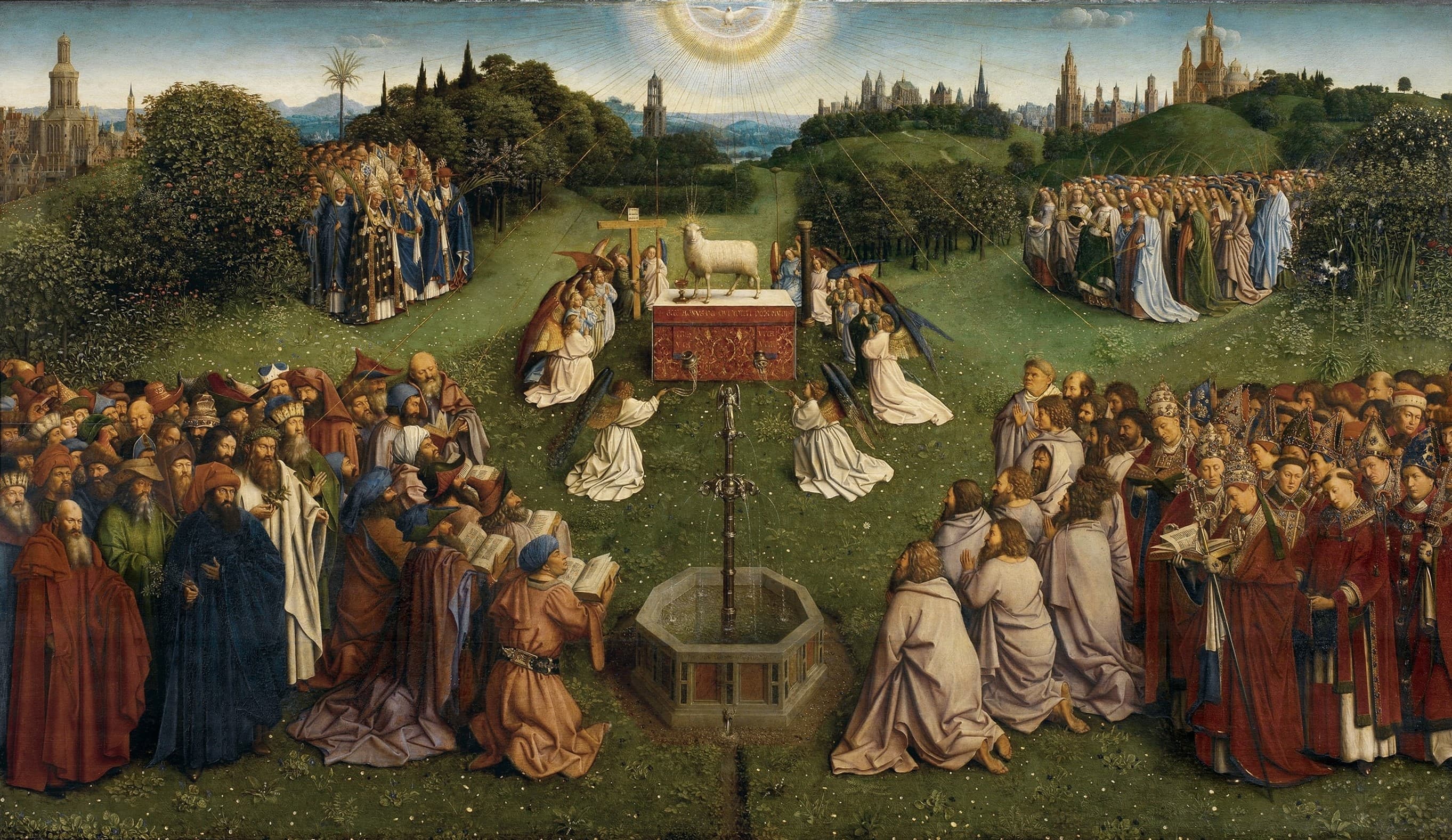
Jan and Hubert van Eyck, The Adoration of the Mystic Lamb, the central panel of the Ghent Altarpiece, 1432. Public domain, via Wikimedia Commons.
THE ARTWORKVan Eyck sets the Lamb on an altar in the middle of a meadow. It is the Lamb John sees in Revelation 5:6, standing at the center of the throne.
Jacob passes over Reuben, Simeon and Levi and gives the rule of his house to his fourth son, Judah.
Summary
In Genesis 49:8 to 12 Jacob blesses Judah with the praise of his brothers, the strength of a lion, a ruler's scepter and a land rich in vines.
- The Hebrew word for scepter in verse 10 is also the word for a tribe.
- Readers divide over whether Shiloh is a title of the Messiah or a phrase meaning the one to whom it belongs.
- David, anointed by Samuel at Bethlehem, was the first king from the tribe of Judah.
- Christian readers since the fathers have argued over when the scepter left Judah.
The Blessing of Judah, Verse by Verse
Jacob gives Judah five verses, as many as he gives Joseph and more than he gives any other son.
Jacob calls his sons together to tell them what will happen to them in the days to come.
Judah, your brothers shall praise you. Your hand shall be on the necks of your enemies; your father’s sons shall bow down to you.The bowing once promised to Joseph in his dreams now falls to Judah.
And once more she conceived and gave birth to a son and said, “This time I will praise the LORD.” So she named him Judah. Then Leah stopped having children.Jacob's first word to this son is a play on the name his mother gave him.
Judah is a young lion—my son, you return from the prey. Like a lion he crouches and lies down; like a lioness, who dares to rouse him?Balaam gives this same picture of the lion no one dares to rouse to all Israel in Numbers 24:9.
The scepter will not depart from Judah, nor the staff from between his feet, until Shiloh comes and the allegiance of the nations is his.The verse sets a term on Judah's rule, and what that term is depends on the word Shiloh.
He ties his donkey to the vine, his colt to the choicest branch. He washes his garments in wine, his robes in the blood of grapes. His eyes are darker than wine, and his teeth are whiter than milk.The last two verses turn from rule to the wealth of Judah's land and the look of its ruler.
John Gill, in his Exposition of the Old Testament, reads verse 11 of the plenty of Judah's land. A man there might tie his donkey to a vine and lose little if it ate, or load the donkey from one vine's clusters.
The Four Hebrew Words of Verse 10
Each word of the promise in verse 10 is set beside what the lexicons give for it.
| Hebrew word | Strong's | The Berean's English | The lexicon's sense |
|---|---|---|---|
| shevet | H7626 | scepter | a rod or staff for ruling, walking or punishing, and a tribe; 190 occurrences |
| mechoqeq, from chaqaq | H2710 | staff | to engrave or to decree; the King James renders it lawgiver in this verse |
| Shiloh | H7886 | Shiloh | one occurrence as this word; the town of Shiloh has its own number, H7887 |
| yiqqehat, from yiqqahah | H3349 | allegiance | obedience; two occurrences, this verse and Proverbs 30:17 |
- Hebrew word
- shevet
- Strong's
- H7626
- The Berean's English
- scepter
- The lexicon's sense
- a rod or staff for ruling, walking or punishing, and a tribe; 190 occurrences
- Hebrew word
- mechoqeq, from chaqaq
- Strong's
- H2710
- The Berean's English
- staff
- The lexicon's sense
- to engrave or to decree; the King James renders it lawgiver in this verse
- Hebrew word
- Shiloh
- Strong's
- H7886
- The Berean's English
- Shiloh
- The lexicon's sense
- one occurrence as this word; the town of Shiloh has its own number, H7887
- Hebrew word
- yiqqehat, from yiqqahah
- Strong's
- H3349
- The Berean's English
- allegiance
- The lexicon's sense
- obedience; two occurrences, this verse and Proverbs 30:17
What Shiloh Means
The Talmud, the Targum and the commentators read Shiloh either as a title or as a phrase.
A title of the MessiahStrong's dictionary, Sanhedrin 98b, Jamieson, Fausset & Brown
Strong's Exhaustive Concordance (1890) enters Shiloh as an epithet of the Messiah, and the King James Version, like the Berean, prints the word as a name.
The Babylonian Talmud, finished in the rabbinic academies of Babylonia around 500 to 600 AD, reads the verse of the Messiah in Sanhedrin 98b. Jamieson, Fausset & Brown, in their Commentary Critical and Explanatory (1871), list the senses given to the word, the sent, the seed and the peaceable one, and read each as the Messiah. Adam Clarke, in his note on Luke 7:19, reports that Grotius derived the word from shalach, to send.
The objection: no New Testament writer quotes Genesis 49:10, and none calls Jesus Shiloh.
Until he comes to whom it belongsTargum Onqelos, Ambrose of Milan
This reading takes Shiloh as a phrase. Targum Onqelos, the Aramaic translation of the Torah read beside the Hebrew in the synagogue and traditionally dated to the early centuries AD, gives the line as until the Messiah comes, whose is the kingdom.
Ambrose of Milan, in On the Blessings of the Patriarchs, reads the line as until he comes for whom it has been reserved. He takes it of a succession kept among the judges and kings of the Jews until that one comes.
A ruin, a ruin, I will make it a ruin! And it will not be restored until the arrival of Him to whom it belongs, to whom I have assigned the right of judgment.’This line of Ezekiel is the echo the phrase reading of Shiloh points to.
The objection: Strong's Exhaustive Concordance and the Tyndale House lexicon published with STEP Bible each enter Shiloh as a single word with its own number, H7886.
Shiloh, the Town of the Tent of Meeting
The same Hebrew letters spell the name of the town that held Israel's tent and ark before David's reign.
Then the whole congregation of Israel assembled at Shiloh and set up the Tent of Meeting there. And though the land was subdued before them,Israel's worship centers on Shiloh from the days of Joshua, so the town was known long before David.
The ark of the covenant stayed at Shiloh until the elders of Israel carried it into battle against the Philistines.
So the Philistines fought, and Israel was defeated, and each man fled to his tent. The slaughter was very great—thirty thousand foot soldiers of Israel fell. The ark of God was captured, and Eli’s two sons, Hophni and Phinehas, died.The ark taken in this defeat was never brought back to Shiloh.
He abandoned the tabernacle of Shiloh, the tent He had pitched among men.Jeremiah 7:12 later sends Judah to look at Shiloh's ruin as a warning.
He rejected the tent of Joseph and refused the tribe of Ephraim. But He chose the tribe of Judah, Mount Zion, which He loved. He built His sanctuary like the heights, like the earth He has established forever. He chose David His servant and took him from the sheepfolds;The psalm moves the LORD's choice from the north to the tribe Jacob blessed with the scepter.
What the Blessing Leaves Unsaid
Genesis 49:8 to 12 leaves three questions open.
Jacob gives no reason for the choice of Judah.
These were the sons of Reuben the firstborn of Israel. Though he was the firstborn, his birthright was given to the sons of Joseph son of Israel, because Reuben defiled his father’s bed. So he is not reckoned according to birthright. And though Judah prevailed over his brothers and a ruler came from him, the birthright belonged to Joseph.The Chronicler separates the ruler, who came from Judah, from the birthright, which went to Joseph.
The verse does not say who or what Shiloh is.
Jacob does not say whether verse 10 speaks of Judah himself, of his tribe or of one descendant.
The Scepter in David's House
From Samuel's day the line of Judah's kings runs through David and the covenant made with his house.
Now the LORD said to Samuel, “How long are you going to mourn for Saul, since I have rejected him as king over Israel? Fill your horn with oil and go. I am sending you to Jesse of Bethlehem, for I have selected from his sons a king for Myself.”The LORD's choice of a king turns from Saul to a house in Bethlehem.
So Jesse sent for his youngest son and brought him in. He was ruddy, with beautiful eyes and a handsome appearance. And the LORD said, “Rise and anoint him, for he is the one.” So Samuel took the horn of oil and anointed him in the presence of his brothers, and the Spirit of the LORD rushed upon David from that day forward. Then Samuel set out and went to Ramah.Ruth 4:18 to 22 traces this David from Perez, the son Tamar bore to Judah.
And when your days are fulfilled and you rest with your fathers, I will raise up your descendant after you, who will come from your own body, and I will establish his kingdom. He will build a house for My Name, and I will establish the throne of his kingdom forever. I will be his Father, and he will be My son. When he does wrong, I will discipline him with the rod of men and with the blows of the sons of men. But My loving devotion will never be removed from him as I removed it from Saul, whom I moved out of your way. Your house and kingdom will endure forever before Me, and your throne will be established forever.”The promise to David's house gives Jacob's scepter a term with no end.
For it is clear that our Lord descended from Judah, a tribe as to which Moses said nothing about priests.The writer to the Hebrews counts the Lord's descent from Judah as plain to all.
Judah's blessing ties a colt to the vine in Genesis 49:11, and Zechariah 9:9 sets Zion's king on a colt.
Rejoice greatly, O Daughter of Zion! Shout in triumph, O Daughter of Jerusalem! See, your King comes to you, righteous and victorious, humble and riding on a donkey, on a colt, the foal of a donkey.Zechariah's king comes humble, and Matthew quotes these words in Matthew 21:5.
As they approached Jerusalem and came to Bethphage on the Mount of Olives, Jesus sent out two disciples, saying to them, “Go into the village ahead of you, and at once you will find a donkey tied there, with her colt beside her. Untie them and bring them to Me. If anyone questions you, tell him that the Lord needs them, and he will send them right away.” This took place to fulfill what was spoken through the prophet: “Say to the Daughter of Zion, ‘See, your King comes to you, gentle and riding on a donkey, on a colt, the foal of a donkey.’” So the disciples went and did as Jesus had directed them. They brought the donkey and the colt and laid their cloaks on them, and Jesus sat on them.Of the four Gospels, only Matthew has the disciples bring both a donkey and her colt.
Voices on the Lion and the Vine
Ambrose of Milan and John Wesley read verses 8, 9 and 11 of the blessing.
Ambrose hears in verse 8 a second Judah, praised by his brothers and stretching out his hands.
“This text appears to be directed to the patriarch Judah, indeed, but more so that later Judah is meant, the true confessor who was born of that tribe and who alone is praised by his brothers; of them he says, ‘I will declare your name to my brothers.’ He is the Lord by nature but a brother by grace; his hands, which he stretched out to an unbelieving people, are on the back of his enemies.”
Ambrose of Milan · On the Blessings of the Patriarchs · on Genesis 49:8Patristic
Wesley reads verse 9 as the history of the tribe.
“By this it is foretold that the tribe of Judah should become very formidable, and should not only obtain great victories but should peaceably enjoy what was got by those victories. Judah is compared not to a lion rampant, always raging but to a lion couching, enjoying the satisfaction of his success, without creating vexation to others.”
John Wesley · Explanatory Notes upon the Old Testament · on Genesis 49:9Evangelical
Ambrose reads the same verse as the death and burial of Christ.
“Therefore you have become acquainted with the incarnation; learn of the passion. ‘Resting, you have slept like a lion.’ When Christ lay at rest in the tomb, it was as if he were in a kind of bodily sleep, as he himself says, ‘I have slept and have taken my rest and have risen up, because the Lord will sustain me.’”
Ambrose of Milan · On the Blessings of the Patriarchs · on Genesis 49:9Patristic
Ambrose finds in verse 11 the reason Jesus sent for a colt.
“Let us be bound with bonds of a faith that is like a fruitful branch and cannot be undone, as it were, to that everlasting vine, that is, to the Lord Jesus, who says, ‘I am the vine; my Father is the gardener.’ This explains the mystery that the Lord Jesus in the Gospel ordered an ass's colt to be loosed and himself sat upon it; thus, like one that was bound to a vine, he could find rest in the everlasting goodness of the saints.”
Ambrose of Milan · On the Blessings of the Patriarchs · on Genesis 49:11Patristic
When the Scepter Departed
Tyrannius Rufinus, Matthew Henry and Ryle date the scepter's departure to the years of Jesus' birth and death.
At the reign of HerodTyrannius Rufinus
Rufinus sets the departure at Herod's seizure of the throne.
“This passage clearly refers to Judah. It appears that until the birth of Christ there was no lack of princes from the family of Judah or of heads from its sides, until Herod came, who according to the history written by Josephus was a foreigner and usurped the throne of Judea through his plots. As soon as this happened and a head from the sides of Judah was lacking, the one to whom the kingdom had been reserved immediately came.”
Tyrannius Rufinus · The Blessings of the Patriarchs 1.7 · on Genesis 49:10Patristic
At the census of AugustusMatthew Henry
Matthew Henry finds the moment in the census of Luke 2.
“Now just at this juncture, the Messiah was to be born, for so was dying Jacob's prophecy, that Shiloh should come when the sceptre was departed from Judah, and the lawgiver from between his feet, Gen. xlix. This was the first taxing that was made in Judea, the first badge of their servitude; therefore now Shiloh must come, to set up his kingdom.”
Matthew Henry · Commentary on the Whole Bible · on Luke 2:2Puritan
At the trial of JesusJ.C. Ryle
Ryle reads the handing over of Jesus to Pilate as the priests' own confession.
“The opening of this chapter describes the delivery of our Lord Jesus Christ into the hands of the Gentiles. The chief priests and elders of the Jews led him away to Pontius Pilate, the Roman governor. We may see in this incident the finger of God: it was ordered by his providence that Gentiles as well as Jews should be concerned in the murder of Christ; it was ordered by his providence that the priests should publicly confess that the ‘scepter had departed from Judah.’”
J.C. Ryle · Expository Thoughts on the Gospels: Matthew · on Matthew 27:1 to 10Reformed Evangelical
“You take Him and judge Him by your own law,” Pilate told them. “We are not permitted to execute anyone,” the Jews replied.The power of death lay with Rome that year, so the leaders could not try Jesus to the end without Pilate.
The objection to all three reckonings: Zedekiah of Judah was blinded and taken to Babylon in 2 Kings 25:6 to 7, so the kings of David's house had ceased long before Herod reigned.
The Lion of the Tribe of Judah
The New Testament gives Judah's lion and David's throne to Jesus.
In John's vision no one in heaven or on earth can open the sealed scroll until an elder points to one from Judah's tribe.
Then one of the elders said to me, “Do not weep! Behold, the Lion of the tribe of Judah, the Root of David, has triumphed to open the scroll and its seven seals.”John hears Jacob's picture of Judah used as a name of the risen Christ.
He will be great and will be called the Son of the Most High. The Lord God will give Him the throne of His father David, and He will reign over the house of Jacob forever. His kingdom will never end!”Gabriel's promise places Mary's son on the throne of Judah's royal line.
These two texts ask the reader to honor Jesus as King and to bow before Him.
Keep studying
Read it1
Studies6
People8
Symbols6
Doctrines5
Peoples and groups1