
Cana of Galilee
Summary
The Galilean village where Jesus turned water into wine (the first sign) and, from there, healed the official's son at Capernaum (John 2:1-11; 4:46-54).
- At a wedding in this Galilean village, Jesus turned water into wine, the first of the signs John records.
- John calls it a sign, not a wonder for its own sake: it revealed Jesus's glory, and his disciples believed in him.
- Jesus performed a second sign from Cana, healing a royal official's dying son at Capernaum with a word spoken at a distance.
- Nathanael, one of the Twelve, came from Cana.
- Where exactly Cana stood is disputed between two candidate sites.
On this page
In Scripture
- Verses
- 4
- Books
- 1
Near Cana of Galilee
- Nazareth5.7 km · 3.5 mi SW
- Mount Tabor8.3 km · 5.1 mi SE
- Nain13 km · 8.0 mi S
- Shunem16 km · 9.8 mi S
- Jezreel21 km · 13 mi S
- Sea of Galilee24 km · 15 mi E
Straight-line distances, computed from the gazetteer coordinates.
Where it is
the country around it
- Coordinates
- 32.7470° N, 35.3388° Efind it on the Atlas →
- Region
- Galilee
- Kind of place
- Town
1 place the record names with Cana of Galilee, the farthest 27 km away
- Located: the gazetteer fixes one site
- A dashed line ends at a place the gazetteer does not fix
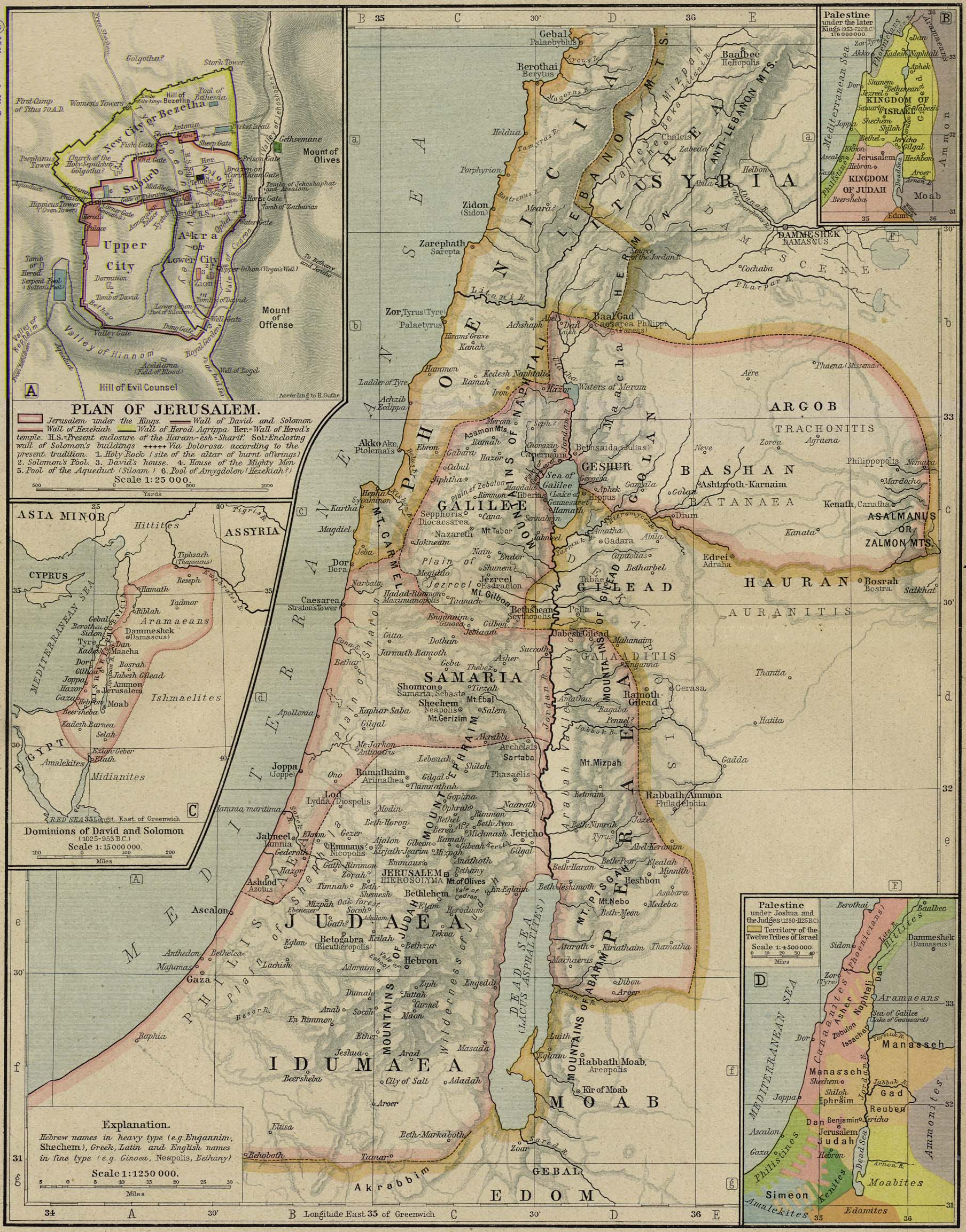
Why Cana of Galilee matters
What has been found
the evidence, and where it is disputed
The wedding at Cana, the first sign
John 2:1-11, in the order it happens
Read John 2:1-11, in the order it happens
- A wedding at CanaJohn 2:1On the third day a wedding took place at Cana in Galilee. Jesus’ mother was there,
- The wine runs outJohn 2:3When the wine ran out, Jesus’ mother said to Him, “They have no more wine.”
- "My hour has not yet come"John 2:4“Woman, why does this concern us?” Jesus replied. “My hour has not yet come.”
- "Do whatever He tells you"John 2:5His mother said to the servants, “Do whatever He tells you.”
- The stone water jarsJohn 2:6Now six stone water jars had been set there for the Jewish rites of purification. Each could hold from twenty to thirty gallons.
- Taken to the master of the banquetJohn 2:9and the master of the banquet tasted the water that had been turned into wine. He did not know where it was from, but the servants who had drawn the water knew. Then he called the bridegroom aside
- "You have saved the fine wine until now"John 2:10and said, “Everyone serves the fine wine first, and then the cheap wine after the guests are drunk. But you have saved the fine wine until now!”
- The first sign, and the disciples believedJohn 2:11Jesus performed this, the first of His signs, at Cana in Galilee. He thus revealed His glory, and His disciples believed in Him.
What happened here, in order
in the order the canon tells it
- A wedding at CanaJohn 2:1On the third day a wedding took place at Cana in Galilee. Jesus’ mother was there,
- Water turned to wineJohn 2:9and the master of the banquet tasted the water that had been turned into wine. He did not know where it was from, but the servants who had drawn the water knew. Then he called the bridegroom aside
- The first sign, at Cana in GalileeJohn 2:11Jesus performed this, the first of His signs, at Cana in Galilee. He thus revealed His glory, and His disciples believed in Him.
- Jesus returns to Cana; the official's dying sonJohn 4:46So once again He came to Cana in Galilee, where He had turned the water into wine. And there was a royal official whose son lay sick at Capernaum.
- "Unless you see signs and wonders"John 4:48Jesus said to him, “Unless you people see signs and wonders, you will never believe.”
- "Go, your son will live"John 4:50“Go,” said Jesus. “Your son will live.” The man took Jesus at His word and departed.
- The father and his household believeJohn 4:53Then the father realized that this was the very hour in which Jesus had told him, “Your son will live.” And he and all his household believed.
- The second signJohn 4:54This was now the second sign that Jesus performed after coming from Judea into Galilee.
- Nathanael of Cana, named among the disciplesJohn 21:2Simon Peter, Thomas called Didymus, Nathanael from Cana in Galilee, the sons of Zebedee, and two other disciples were together.
Cana of Galilee in Scripture
4 verses name it, in 1 book
Open a book to read its mentions here. Text: Berean Standard Bible.
New Testament1 book · 4 mentions
John4 mentions
- John 2:1On the third day a wedding took place at Cana in Galilee. Jesus’ mother was there,
- John 2:11Jesus performed this, the first of His signs, at Cana in Galilee. He thus revealed His glory, and His disciples believed in Him.
- John 4:46So once again He came to Cana in Galilee, where He had turned the water into wine. And there was a royal official whose son lay sick at Capernaum.
- John 21:2Simon Peter, Thomas called Didymus, Nathanael from Cana in Galilee, the sons of Zebedee, and two other disciples were together.
Common questions
Why does John call this a "sign" instead of a "miracle"?
John uses the word sign for this event and for the others he records through the Gospel. A sign points past itself to who Jesus is. John says this one revealed Jesus's glory and led his disciples to believe in him, which is the purpose John gives every sign in this Gospel.
Where was Cana of Galilee?
Readers differ; the positions are named
The location is genuinely disputed. The traditional site, held since at least the Crusader period, is the village of Kefr Kenna northeast of Nazareth. The leading scholarly alternative is Khirbet Qana, a ruin further north that shows first-century Jewish occupation. Scripture does not settle which one it was, and this page names both without deciding between them.
Why did Jesus say "My hour has not yet come" and then act anyway?
John records Jesus using the phrase "my hour" several times through the Gospel for the time appointed for his death and glorification. At Cana he speaks it and still turns the water into wine, so the site reads this as Jesus's own sense of timing at work, not a refusal that his mother's request overturned.
What do the two Cana signs have in common?
Both happen at Jesus's own spoken word rather than any visible act at the point of need. In the second sign, Jesus is not even present with the boy who is healed, he simply speaks and the boy lives at that hour. John closes both accounts by numbering them as signs, first and second.
Who was Nathanael of Cana?
Nathanael is one of the disciples John names by his hometown, Cana in Galilee, in the list of those gathered by the Sea of Galilee after the resurrection. He is first brought to Jesus by Philip earlier in the Gospel.
Sources cited
- MannaFest canon study of John (AI-draft)Awaiting the founder's edit.
- OpenBible.info Bible Geocoding: Canaread 2026-08-20The coordinates on this page. Used under CC-BY with attribution to OpenBible.info.
- Berean Standard BiblePublic domain since 2023. All Scripture text on this page.
- University of Puget Sound, Khirbet Cana Excavations (Douglas Edwards, director, 1998-2007)Excavation summary: first-century Jewish remains and stone vessels at Khirbet Qana.
- See the Holy Land: CanaKefr Kenna excavation details and the two-jars tradition. Used because no excavation report for Kefr Kenna is in this repository or database.
Keep studying
On this page
Books that name it1
Doorway2
Keep this page