
Matthew 17:2
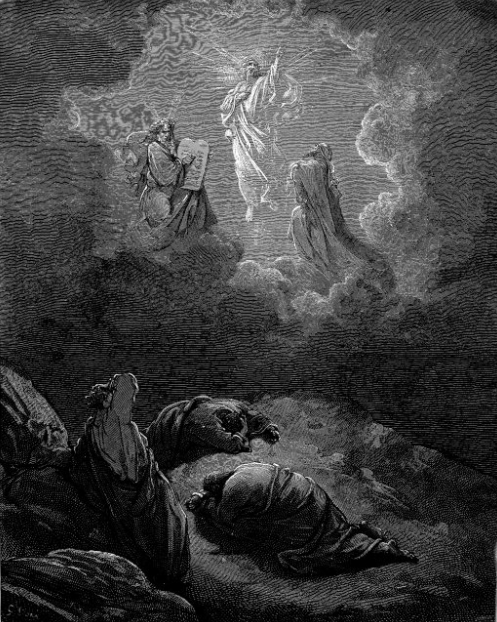
in Matthew 17There He was transfigured before them. His face shone like the sun, and His clothes became as white as the light.
BSB
The same verse in ASV and KJV ▾
ASV
and he was transfigured before them; and his face did shine as the sun, and his garments became white as the light.
KJV
And was transfigured before them: and his face did shine as the sun, and his raiment was white as the light.
⋯
This verse in Matthew 17
Commentary
24 notes on this verse(V2.) And he was transfigured before them. Just as he will be at the time of judgment, so he appeared to the apostles. But when it says, 'He was transfigured before them,' no one can think that he lost or abandoned his original form and appearance, or that he took on a spiritual or aerial body. Rather, the evangelist demonstrates how he was transformed, saying. And his face shone like the sun, and his garments became white as snow.
This site's exposition
an high mountain apart
on Matthew 17:1-2
Six days after Peter's confession and rebuke, Jesus takes the same three he will later bring nearest him in Gethsemane, Peter, James and John, up a high mountain the tradition has argued between Tabor and Hermon, with Hermon's nearness to Caesarea Philippi favored by the older harmonists. Luke's about eight days is not a contradiction but an inclusive count against Matthew's exclusive one, both reckoning the same interval by different customary methods. Transfigured, metamorphothe in the Greek, describes a change from within shining outward, his face as the sun and his raiment white as the light, language that echoes Moses' own shining face after Sinai in Exodus 34 and anticipates the promised brightness of the resurrected in Daniel 12:3.
The record, by era
The Church Fathers5 voices
Indeed, Jesus himself shone as the sun, indicating that he is the light which illuminates every one who comes into this world. And this is the sun to the eyes of the flesh, that is the sun to the eyes of the heart. His garments are a type of his church. For garments, unless held up by the one having donned them, fall. Paul was like the lowest hem of these garments. For he himself says, "For I am the least of the apostles," 14 and in another passage, "I am the last of the apostles." On a garment, the hem is the last thing and the least. Just as that woman who touched the Lord's hem was made well, so the church which came out of the Gentiles was saved by means of Paul's preaching.
But some may ask, when he was transfigured before those who were led up by him into the lofty mountain, did he appear to them in the form of God or in the preincarnate form that he earlier had? Did he appear to those left below in the form of a servant, but to those who had followed him after the six days to the lofty mountain, did he have not the form of a servant but the form of God? Listen carefully, if you can, and at the same time be attentive spiritually. It is not simply said that he was transfigured, but with a certain necessary addition. Both Matthew and Mark have recorded this: he was transfigured before them. Is it therefore possible for Jesus to be transfigured before some but not before others?Do you wish to see the transfiguration of Jesus? Behold with me the Jesus of the Gospels. Let him be simply apprehended. There he is beheld both "according to the flesh" and at the same time in his true divinity. He is beheld in the form of God according to our capacity for knowledge. This is how he was beheld by those who went up upon the lofty mountain to be apart with him. Meanwhile those who do not go up the mountain can still behold his works and hear his words, which are uplifting. It is before those who go up that Jesus is transfigured, and not to those below. When he is transfigured, his face shines as the sun, that he may be manifested to the children of light, who have put off the works of darkness and put on the armor of light. They are no longer the children of darkness or night but have become the children of day. They walk honestly as in the day. Being manifested, he will shine to them not simply as the sun but as he is demonstrated to be, the sun of righteousness.
Mystically; When any one has passed the six days according as we have said, he beholds Jesus transfigured before the eyes of his heart. For the Word of God has various forms, appearing to each man according as He knows that it will be expedient for him; and He shows Himself to none in a manner beyond his capacity; whence he says not simply, He was transfigured, but, before them. For Jesus, in the Gospels, is merely understood by those who do not mount by means of exalting works and words upon the high mountain of wisdom; but to them that do mount up thus, He is no longer known according to the flesh, but is understood to be God the Word. Before these then Jesus is transfigured, and not before those who live sunk in worldly conversation. But these, before whom He is transfigured, have been made sons of God, and He is shown to them as the Sun of righteousness. His raiment is made white as the light, that is, the words and sayings of the Gospels with which Jesus is clothed according to those things which were spoken of Him by the Apostles.
If then the face of the Lord shone as the sun, and the saints shall shine as the sun, are then the brightness of the Lord and the brightness of His servants to be equal? By no means. But forasmuch as nothing is known more bright than the sun, therefore to give some illustration of the future resurrection, it is expressed to us that the brightness of the Lord's countenance, and the brightness of the righteous, shall be as the sun.
The Lord, again, in the retirement of the mount, had changed His raiment for a robe of light; but He still retained features which Peter could recognise. In that same scene Moses also and Elias gave proof that the same condition of bodily existence may continue even in glory-the one in the likeness of a flesh which he had not yet recovered, the other in the reality of one which he had not yet put off.
17 more voices on this verse
The Church Fathers3 voices
Such as He is to be in the time of the Judgment, such was He now seen of the Apostles. Let none suppose that He lost His former form and lineaments, or laid aside His bodily reality, taking upon Him a spiritual or ethereal Body. How His transfiguration was accomplished, the Evangelist shows, saying, And his face did shine as the sun, and his raiment became white as snow, For that His face is said to shine, and His raiment described to become white, does not take away substance, but confer glory. In truth, the Lord was transformed into that glory in which He shall hereafter come in His Kingdom. The transformation enhanced the brightness, but did not destroy the countenance, although the body were spiritual; whence also His raiment was changed and became white to such a degree, as in the expression of another Evangelist, no fuller on earth can whiten them. But all this is the property of matter, and is the subject of the touch, not of spirit and ethereal, an illusion upon the sight only beheld in phantasm.
A commentator
John ChrysostomHomily on the Gospel of Matthew 56 · Written in the 5th century.
proposed
Having taken therefore the leaders, "He bringeth them up into a high mountain apart, and was transfigured before them: and His face did shine as the sun, and His raiment was white as the light. And there appeared unto them Moses and Elias talking with Him." But wherefore doth He also bring forward Moses and Elias? One might mention many reasons. And first of all this: because the multitudes said He was, some Elias, some Jeremias, some one of the old prophets, He brings the leaders of His choir, that they might see the difference even hereby between the servants and the Lord; and that Peter was rightly commended for confessing Him Son of God. But besides that, one may mention another reason also: that because men were continually accusing Him of transgressing the law, and accounting Him to be a blasphemer, as appropriating to Himself a glory which belonged not to Him, even the Father's, and were saying, "This Man is not of God, because He keepeth not the Sabbath day;" and again, "For a good work we stone Thee not, but for blasphemy, and because that Thou, being a man, makest Thyself God:" that both the charges might be shown to spring from envy, and He be proved not liable to either; and that neither is His conduct a transgression of the law, nor His calling Himself equal to the Father an appropriation of glory not His own; He brings forward them who had shone out in each of these respects: Moses, because he gave the law, and the Jews might infer that he would not have overlooked its being trampled on, as they supposed, nor have shown respect to the transgressor of it, and the enemy of its founder: Elias too for his part was jealous for the glory of God, and were any man an adversary of God, and calling himself God, making himself equal to the Father, while he was not what he said, and had no right to do so; he was not the person to stand by, and hearken unto him. A […]
[Daniel 7:9] "I beheld until thrones were set up, and the Ancient of days took His seat. His garment was as white as snow, and the hair of His head was like pure wool. His throne was composed of fiery flames and its wheels were set on fire. From before His presence there issued forth a rushing, fiery stream." We read something similar in John's Apocalypse: "After these things I was immediately in the Spirit, and lo, a throne was set up in heaven, and one was seated upon the throne; and He who sat upon it had the likeness of jasper and sardine stone, and there was a rainbow round about the throne like the appearance of emerald. Around the throne there were twenty-four other thrones, and upon the twenty-four thrones there sat twenty-four elders, clothed in shining garments; upon their heads was a golden crown, and lightning flashes issued from the throne, and voices and thunder. And in front of the throne there were seven torches of burning fire, which were the seven spirits of God. And in front of the throne lay a glassy sea like unto crystal." (Revelation 4:2-6) And so the many thrones which Daniel saw seem to me to be what John called the twenty-four thrones. And the Ancient of days is the One who, according to John sits alone upon His throne. Likewise the Son of man, who came unto the Ancient of days, is the same as He who, according to John, is called the Lion of the tribe of Judah, the Root of David, and the titles of that sort (Revelation 5:5). I imagine that these thrones are the ones of which the Apostle Paul says, "Whether thrones or dominions..." (Colossians 1:16). And in the Gospel we read, "Ye yourselves shall sit upon twelve thrones, judging the twelve tribes of Israel" (Matthew 19:28). And God is called the One who sits and who is the Ancient of days, in order that His character as eternal Judge might be indicated. […]
The Medieval Church4 voices
Then follows the transfiguration: and he was transfigured before them. And first the transfiguration is presented; secondly, the testimony, at while he was yet speaking, etc. Concerning the first, the transfiguration is presented; secondly, the manner; thirdly, Peter's admiration. He says therefore and he was …
(e Bed. in Luc.) Or; the raiment of Christ shadows out the saints, of whom Esaias says, With all these shalt than clothe thee as with a garment; (Isa. 49:18.) and they are likened to snow because they shall be white with virtues, and all the heat of vices shall be put far away from them. It follows, And there appeared unto them Moses and Elias talking with them.
And after six days Jesus taketh Peter, James, and John his brother. This does not contradict what Luke says, "And it came to pass about eight days after these sayings" (Lk 9:28). For Luke counts both the first day and the last day on which …
A commentator
BonaventureItinerarium Mentis in Deum, Chapter 1 · Written in the 13th century.
proposed
Just as God completed the whole world in six days and rested on the seventh, so the lesser world may be led in most orderly fashion through six stages of successive illuminations to the repose of contemplation. As a figure of this, one ascended by …
The Reformation1 voice
And Peter, and they that were with him, were overpowered with sleep; and when they awoke, they saw his glory, and the two men who were with him. And it happened, while they were departing from him, Peter said to Jesus, Master, it is good for us to be here: and let us make three tabernacles; one for thee, and one for Moses, and one for Elijah: not knowing what he said.
The Puritans and the Awakening3 voices
16 ), covers himself with light, Ps. civ. And therefore when Christ would appear in the form of God, he appeared in light, the most glorious of all visible beings, the first-born of the creation, and most nearly resembling the eternal Parent. Christ is the Light; while he was in the world, he shined in darkness, and therefore the world knew him not ( John i.
quarantine:debris (2026-07-29) — leading-citation-number
His face shone with Divine majesty, like the sun in its strength; and all his body was so irradiated by it, that his clothes could not conceal its glory, but became white and glittering as the very light, with which he covered himself as with a garment.
And was transfigured before them,....
The Nineteenth Century6 voices
Was transfigured - That fullness of the Godhead, which dwelt bodily in Christ, now shone forth through the human nature, and manifested to his disciples not only that Divinity which Peter had before confessed, Mat 16:16, but also the glorious resurrection body, in which they should exist in the presence of God to eternity. White as the light - But the Cod. Bezae, some of the ancient versions, and several of the fathers, read ως χιων, as snow; and this is the reading in Mar 9:3.
These verses contain one of the most remarkable events in our Lord’s earthly ministry, the event commonly called the transfiguration. The order in which it is recorded is beautiful and instructive. The latter part of the last chapter showed us the cross; here we are graciously allowed to see something of the coming reward. The hearts which have just been saddened by a plain statement of Christ’s sufferings are at once gladdened by a vision of Christ’s glory. Let us mark this. We often lose much by not tracing the connection between chapter and chapter in the Word of God.
A commentator
Charles Spurgeon1834–1892
The Metropolitan Tabernacle Pulpit, Sermon No. 2729: “Christ's Transfigured Face” (lightly modernized text, CCEL edition) · Written before 1892.
WHILE our Lord Jesus Christ was upon this earth, He was as much Divine as before He left His Father's court in Heaven. He never ceased to be God, nor was the Godhead for a single moment separated from His Humanity. He was, therefore, always glorious. Yet there was a greater Glory about Him than could usually be seen. This may seem to be a paradox, but it is true. For Christ to be glorious was almost a less matter than for Him to restrain or hide His Glory.
These verses contain one of the most remarkable events in our Lord’s earthly ministry, the event commonly called the transfiguration. The order in which it is recorded is beautiful and instructive. The latter part of the last chapter showed us the cross; here we are graciously allowed to see something of the coming reward. The hearts which have just been saddened by a plain statement of Christ’s sufferings are at once gladdened by a vision of Christ’s glory. Let us mark this. We often lose much by not tracing the connection between chapter and chapter in the Word of God. There are some mysterious things, no doubt, in the vision here described. It must needs be so. We are yet in the body. Our senses are conversant with gross and material things; our ideas and perceptions about glorified bodies and dead saints must necessarily be vague and imperfect. Let us content ourselves with endeavoring to mark out the practical lessons which the transfiguration is meant to teach us. In the first place we have in these verses a striking pattern of the glory in which Christ and his people will appear when he comes the second time. There can be little question that this was one main object of this wonderful vision. It was meant to encourage the disciples by giving them a glimpse of good things yet to come. That face “shining as the sun” and that raiment “white as the light” were intended to give the disciples some idea of the majesty in which Jesus will appear to the world when he comes the second time, and all his saints with him. The corner of the veil was lifted up to show them their Master’s true dignity. They were taught that if he did not yet appear to the world in the guise of a King, it was only because the time for putting on his royal apparel was not yet come. It is impossible to draw any other conclusion from St. Peter’s language when writing on the subject.
A commentator
Charles Spurgeon1834–1892
The Metropolitan Tabernacle Pulpit, Sermon No. 2729: “Christ's Transfigured Face” (lightly modernized text, CCEL edition) · Written before 1892.
proposed
WHILE our Lord Jesus Christ was upon this earth, He was as much Divine as before He left His Father's court in Heaven. He never ceased to be God, nor was the Godhead for a single moment separated from His Humanity. He was, therefore, always glorious. Yet there was a greater Glory about Him than could usually be seen. This may seem to be a paradox, but it is true. For Christ to be glorious was almost a less matter than for Him to restrain or hide His Glory. It is forever His Glory that He concealed His Glory and that, though He was rich, for our sakes He became poor. Though He was God over all, blessed forever, He "made Himself of no reputation, and took upon Him the form of a servant, and was made in the likeness of men." Our Lord's humiliation was all perfectly voluntary and I should not be surprised to learn that, when alone, His face was frequently radiant with Glory as it was on this occasion of His Transfiguration. I can easily imagine that He may often have returned to what must have been His natural condition when there were no human eyes to gaze upon Him. If you carefully read the four Gospels, I think you will see that there are indications that the Glory was always there, ready to flash forth. What was it that made those who came to take Him in the garden of Gethsemane, go backward and fall to the ground when He said, "I am"? Was it, do you think, because the light of Jehovah gleamed upon them at least in some degree? Certainly there was a mystic Glory shining about Him at times, and those who came near Him appear to have been arrested by it.
A commentator
Albert Barnes1798–1870
Notes, Explanatory and Practical, on the Old and New Testaments (1832-1869)
proposed
And was transfigured before them - The word “transfigure” means to change the appearance or form. It does not denote the change of the substance of a thing, but simply of its appearance. It puts on a new aspect. What this change was we are expressly told. 1. His face shone as the sun; that is, with a special brightness. A similar appearance is described respecting Moses when he came down from the mount, Exo 34:29-30. See also Heb 1:3, where Christ is called the brightness of the glory of God: in the original, the splendor or shining, like the brightness of the sun. 2. The second change was that of his garments. They were white as the light. Mark says, “exceeding white as snow; so as no fuller on earth could white them.” The word “fuller” means, commonly, one who dresses cloth or fulls it, so as to make it more thick and strong. Here it means one who bleaches cloth or makes it white; one who cleanses garments when by wearing they become soiled. Among the Greeks that was a distinct trade. Luke says, “white and glistering,” that is, resplendent, shining, or a very bright white. There is no evidence here that what is commonly said of him is true, that his body was so changed as to show what his glorified body is. His body, so far as the sacred writers inform us, underwent no change. All this splendor and glory was a change in appearance only. The Scriptures should be taken just as they are, without any attempt to affix a meaning to them which the sacred writers did not intend. Raiment - Clothing. John may refer to this transfiguration in Joh 1:14, as Peter does in 2Pe 1:16-17.
The words behind it
21 Greek wordsEvery Greek word of this verse in the order it stands, with what it means and the door to its own study. The last column counts the times a word stands in the whole Bible: the rarer the word, the more the places it appears belong together.
| Greek | Sound | Meaning | Word study | In the Bible |
|---|---|---|---|---|
| καὶ | kai | And | G2532 → | 9120 times |
| μετεμορφώθη | metemorphothe | He was transfigured | G3339 → | |
| ἔμπροσθεν | emprosthen | before | G1715 → | 48 times |
| αὐτῶν, | auton | them, | G846 → | 5565 times |
| καὶ | kai | and | G2532 → | 9120 times |
| ἔλαμψεν | elampsen | shone | G2989 → | 7 times |
| τὸ | to | the | G3588 → | 19766 times |
| πρόσωπον | prosopon | face | G4383 → | 75 times |
| αὐτοῦ | autou | of Him | G846 → | 5565 times |
| ὡς | hos | like | G5613 → | 500 times |
| ὁ | ho | the | G3588 → | 19766 times |
| ἥλιος, | helios | sun, | G2246 → | 32 times |
| τὰ | ta | <the> | G3588 → | 19766 times |
| δὲ | de | and | G1161 → | 2765 times |
| ἱμάτια | himatia | the clothes | G2440 → | 60 times |
| αὐτοῦ | autou | of Him | G846 → | 5565 times |
| ἐγένετο | egeneto | he became | G1096 → | 667 times |
| λευκὰ | leuka | white | G3022 → | 25 times |
| ὡς | hos | as | G5613 → | 500 times |
| τὸ | to | the | G3588 → | 19766 times |
| φῶς. | phos | light. | G5457 → | 72 times |
καὶAnd
kaiG2532 →9120 times
μετεμορφώθηHe was transfigured
metemorphotheG3339 →
ἔμπροσθενbefore
emprosthenG1715 →48 times
αὐτῶν,them,
autonG846 →5565 times
καὶand
kaiG2532 →9120 times
ἔλαμψενshone
elampsenG2989 →7 times
τὸthe
toG3588 →19766 times
πρόσωπονface
prosoponG4383 →75 times
αὐτοῦof Him
autouG846 →5565 times
ὡςlike
hosG5613 →500 times
ὁthe
hoG3588 →19766 times
ἥλιος,sun,
heliosG2246 →32 times
τὰ<the>
taG3588 →19766 times
δὲand
deG1161 →2765 times
ἱμάτιαthe clothes
himatiaG2440 →60 times
αὐτοῦof Him
autouG846 →5565 times
ἐγένετοhe became
egenetoG1096 →667 times
λευκὰwhite
leukaG3022 →25 times
ὡςas
hosG5613 →500 times
τὸthe
toG3588 →19766 times
φῶς.light.
phosG5457 →72 times
A shaded row is a word that stands 400 times or fewer in the Bible.
The walk
8 stopsEach card is a verse this one points to, and under it the verses that one points to in turn. Where several paths arrive at the same place, that place is listed first: the text keeps returning to it.
Through
John 1:14The Word became flesh and made His dwelling among us. We have seen His glory, the glory of the one and only Son from the Father, full of grace and truth.
it leads to
- 1 John 4:9
This is how God’s love was revealed among us: God sent His one and only Son into the world, so that we might live through Him.
- 1 Timothy 3:16
By common confession, the mystery of godliness is great: He appeared in the flesh, was vindicated by the Spirit, was seen by angels, was proclaimed among the nations, was believed in throughout the world,…
- Galatians 4:4
But when the time had fully come, God sent His Son, born of a woman, born under the law,
- John 1:1
In the beginning was the Word, and the Word was with God, and the Word was God.
- Isaiah 40:5
And the glory of the LORD will be revealed, and all humanity together will see it. For the mouth of the LORD has spoken.”
- 1 John 4:9
Through
Revelation 10:1Then I saw another mighty angel coming down from heaven, wrapped in a cloud, with a rainbow above his head. His face was like the sun, and his legs were like pillars of fire.
it leads to
- Ezekiel 1:28
The appearance of the brilliant light all around Him was like that of a rainbow in a cloud on a rainy day. This was the appearance of the likeness of the glory of the…
- Revelation 1:15–16
His feet were like polished bronze refined in a furnace, and His voice was like the roar of many waters.
- Ezekiel 1:28
Through
Psalms 104:2He wraps Himself in light as with a garment; He stretches out the heavens like a tent,
it leads to
- Isaiah 40:22
He sits enthroned above the circle of the earth; its dwellers are like grasshoppers. He stretches out the heavens like a curtain, and spreads them out like a tent to dwell in.
- Isaiah 40:22
Where this verse is studied
On this page
About Matthew
This page draws on 22 works. Open the list of works
This page draws on Adam Clarke, Commentary on the Bible; Albert Barnes, Notes, Explanatory and Practical, on the Old and New Testaments (1832-1869); Augustine of Hippo, SERMON 78.2; Bonaventure, Itinerarium Mentis in Deum, Chapter 1; Charles Spurgeon, The Metropolitan Tabernacle Pulpit, Sermon No. 2729: “Christ's Transfigured Face” (lightly modernized text, CCEL edition); Glossa Ordinaria, Catena Aurea by Aquinas; J.C. Ryle, Expository Thoughts on the Gospels: Matthew; Jerome, Commentary on Matthew; Jerome, Catena Aurea by Aquinas; Jerome, St. Jerome, Commentary on Daniel, CHAPTER SEVEN; John Calvin, Commentary on a Harmony of the Evangelists; John Calvin, Commentaries; John Chrysostom, Homily on the Gospel of Matthew 56; John Gill, Exposition of the New Testament (1746-1748); John Wesley, Explanatory Notes upon the New Testament; Matthew Henry, Commentary on the Whole Bible; Origen of Alexandria, COMMENTARY ON MATTHEW 12.37; Origen of Alexandria, Catena Aurea by Aquinas; Remigius of Rheims, Catena Aurea by Aquinas; Tertullian, On the Resurrection of the Flesh; Theophylact of Ohrid, Commentary on Matthew and Thomas Aquinas, Commentary on Matthew.