
Acts 1:9
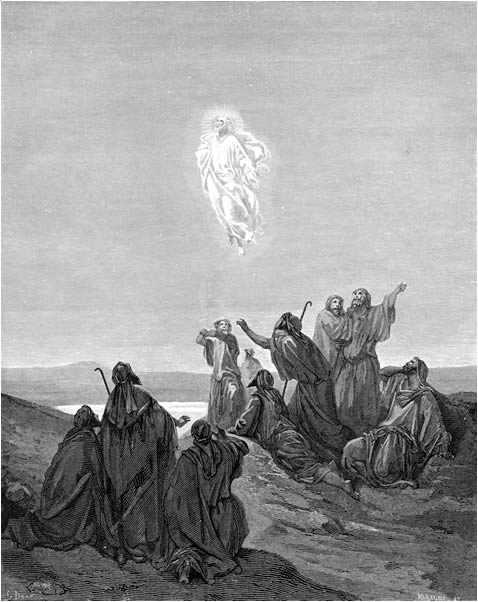
in Acts 1After He had said this, they watched as He was taken up, and a cloud hid Him from their sight.
BSB
The same verse in ASV and KJV ▾
ASV
And when he had said these things, as they were looking, he was taken up; and a cloud received him out of their sight.
KJV
And when he had spoken these things, while they beheld, he was taken up; and a cloud received him out of their sight.
⋯
This verse in Acts 1
Commentary
24 notes on this verseA commentator
Albert Barnes1798–1870
Notes, Explanatory and Practical, on the Old and New Testaments (1832-1869)
While they beheld - While they saw him. It was of importance to state that circumstance, and to state it distinctly. It is not affirmed in the New Testament that they “saw him rise” from the dead, because the evidence of that fact could be better established by their seeing him after he was risen. But the truth of his “ascension to heaven” could not be confirmed in that manner.
This site's exposition
he was taken up
on Acts 1:9-11
While they beheld, he was taken up, and a cloud received him out of their sight, the ascension told with the same restraint Luke uses throughout, the cloud recalling the pillar of Exodus and the overshadowing of the transfiguration without the text saying so outright. Two men in white apparel ask why they stand gazing up into heaven, gently turning the disciples from staring at the sky toward the work ahead of them. This same Jesus, which is taken up from you into heaven, shall so come in like manner as ye have seen him go: the bench reads the promise as a bodily and visible return matching a bodily and visible departure, the church's traditional ground for a literal second coming.
The record, by era
The Church Fathers5 voices
And having said these things, while they were watching, Jesus was taken up; leading them to another place on the shore, so that they would not question him again, he immediately began his ascent into heaven. And he adds, while they were watching: since here …
Indeed, a cloud received the Lord, to demonstrate the equality of honor to the Father. For it is said of the Father: A cloud and darkness are round about Him. (Ps. 97:2) And indeed God who became flesh, having used a cloud as a chariot, …
The Passover affords a more than usually solemn day for baptism; when, withal, the Lord's passion, in which we are baptized, was completed. Nor will it be incongruous to interpret figuratively the fact that, when the Lord was about to celebrate the last Passover, He said to the disciples who were sent to make preparation, "You will meet a man bearing water." He points out the place for celebrating the Passover by the sign of water. After that, Pentecost is a most joyous space for conferring baptisms; wherein, too, the resurrection of the Lord was repeatedly proved among the disciples [Acts 1:3], and the hope of the advent of the Lord indirectly pointed to, in that, at that time, when He had been received back into the heavens [Acts 1:9], the angels told the apostles that "He would so come, as He had withal ascended into the heavens;" [Acts 1:11] at Pentecost, of course. But, moreover, when Jeremiah says, "And I will gather them together from the extremities of the land in the feast-day," he signifies the day of the Passover and of Pentecost, which is properly a "feast-day." However, every day is the Lord's; every hour, every time, is apt for baptism: if there is a difference in the solemnity, distinction there is none in the grace.
"And when he had said these things, while they looked on, he was raised up: and a cloud received him out of their sight," etc. Luke declares that, with those words which he said above, while the apostles looked on, the Lord suddenly ascended to …
A commentator
Lucius Caecilius Firmianus LactantiusThe Divine Institutes, Book 4, Chapter XII · Written before 325.
proposed
The prophet comprises both His advents in few words. Behold, he says, one like the Son of man coming with the clouds of heaven. He did not say, like the Son of God, but the Son of man, that he might show that He had to be clothed with flesh on the earth, that having assumed the form of a man and the condition of mortality, He might teach men righteousness; and when, having completed the commands of God, He had revealed the truth to the nations, He might also suffer death, that He might overcome and lay open the other world also, and thus at length rising again, He might proceed to His Father borne aloft on a cloud. For the prophet said in addition: And came even to the Ancient of days, and was presented to Him. He called the Most High God the Ancient of days, whose age and origin cannot be comprehended; for He alone was from generations, and He will be always to generations.
17 more voices on this verse
The Church Fathers6 voices
Why did He rise in the flesh in which He suffered, unless to show the resurrection of the flesh? And wishing to confirm this, when His disciples did not know whether to believe He had truly risen in the body, and were looking upon Him and doubting, He said to them, "Ye have not yet faith, see that it is I;" and He let them handle Him, and showed them the prints of the nails in His hands. And when they were by every kind of proof persuaded that it was Himself, and in the body, they asked Him to eat with them, that they might thus still more accurately ascertain that He had in verity risen bodily; and He did eat honey-comb and fish. And when He had thus shown them that there is truly a resurrection of the flesh, wishing to show them this also, that it is not impossible for flesh to ascend into heaven (as He had said that our dwelling-place is in heaven), "He was taken up into heaven while they beheld," as He was in the flesh.
[And] let us commend the manner of his rule through the powers that are subject to him: born of a virgin mother, rising again by treading upon death, seeking the scepter of heaven. He announces [such] deeds by these [angelic] servants. Nor do the elements …
"And having this said, while they beheld, He was taken up; and a cloud received Him out of their sight." Seest thou that they did preach and fulfil the Gospel? For great was the gift He had bestowed on them. In the very place, He says, where ye are afraid, that is, in Jerusalem, there preach ye first, and afterwards unto the uttermost part of the earth. Then for assurance of what He had said, "While they beheld, He was taken up." Not "while they beheld" did He rise from the dead, but "while they beheld, He was taken up." Inasmuch, however, as the sight of their eyes even here was not all-sufficient; for in the Resurrection they saw the end, but not the beginning, and in the Ascension they saw the beginning, but not the end: because in the former it had been superfluous to have seen the beginning, the Lord Himself Who spake these things being present, and the sepulchre showing clearly that He is not there; but in the latter, they needed to be informed of the sequel by word of others.
But why did "a cloud receive Him?" This too was a sure sign that He went up to Heaven. Not fire, as in the case of Elijah, nor fiery chariot but "a cloud received Him;" which was a symbol of Heaven, as the Prophet says; "Who maketh the clouds His chariot" (Ps. civ. 3); it is of the Father Himself that this is said. Therefore he says, "on a cloud;" in the symbol, he would say, of the Divine power, for no other Power is seen to appear on a cloud. For hear again what another Prophet says: "The Lord sitteth upon a light cloud" (Is. xix. 1). For it was while they were listening with great attention to what He was saying, and this in answer to a very interesting question, and with their minds fully aroused and quite awake, that this thing took place. Also on the mount Sinai the cloud was because of Him; since Moses also entered into the darkness, but the cloud there was not because of Moses. And He did not merely say, "I go," lest they should again grieve, but He said, "I send the Spirit"; and that He was going away into heaven they saw with their eyes.
"He was taken up." Already it has been shown, that He went up into heaven. "And a cloud, etc." "Clouds and darkness are under His feet," (Ps. xviii. 9; xcvii. 2) saith the Scripture: for this is declared by the expression, "And a cloud received Him:" the Lord of heaven, it means. For as a king is shown by the royal chariot, so was the royal chariot sent for Him.
That, however, which we have reserved for a concluding argument, will now stand as a plea for all, and for the apostle himself, who in very deed would have to be charged with extreme indiscretion, if he had so abruptly, as some will have it, and as they say, blindfold, and so indiscriminately, and so unconditionally, excluded from the kingdom of God, and indeed from the court of heaven itself, all flesh and blood whatsoever; since Jesus is still sitting there at the right hand of the Father, man, yet God-the last Adam, yet the primary Word-flesh and blood, yet purer than ours-who "shall descend in like manner as He ascended into heaven" the same both in substance and form, as the angels affirmed, so as even to be recognised by those who pierced Him.
The Medieval Church6 voices
A commentator
BonaventureCollations on the Hexaemeron, Collation 1 · Written in the 13th century.
proposed
Christ was such a Center in His ascension. Hence it is written in Acts: "A cloud took Him out of their sight." Likewise the Christian must rise "from strength to strength," and not stand still at the terminal point of virtue, for by so doing …
To establish the truth of the Lord's resurrection, we should also note what Luke reports, saying: "Eating together with them, he commanded them not to depart from Jerusalem." And a little later: "While they were watching, he was lifted up, and a cloud received him from their sight." Note the words, mark the mysteries. Eating together he was lifted up. He ate, and he ascended, so that through the act of eating the truth of his flesh might be made evident.
And when they were by every kind of proof persuaded that it was himself [resurrected], and in the body, they asked him to eat with them, that they might thus still more accurately ascertain that he had truly risen bodily; and he did eat honeycomb …
And when he had spoken these things, while they beheld, he was taken up. Mark, indeed, recounting another discourse of the Lord, says: And the Lord Jesus, after he had spoken to them, was taken up into heaven (Mark 16). But since Luke added more …
And a cloud received him out of their sight. Everywhere the creation obeys its Creator. The stars point out his birth, they cover him when suffering, the clouds receive him as he ascends, and they will accompany him when he returns for judgment.
He rose in such a way that they did not see it, but His ascension they did see; since even seeing did not resolve everything on this occasion: they saw the end of the resurrection, but did not see its beginning; they saw the beginning …
The Puritans and the Awakening3 voices
By the clouds there is a sort of communication kept up between the upper and lower world; in them the vapours are sent up from the earth, and the dews sent down from heaven. Fitly therefore does he ascend in a cloud who is the Mediator between God and man, by whom God's mercies come down upon us and our prayers come up to him.
And when he had spoken these things,....
With a general idea of the embryo of the Christian church, and its state from Christ's ascension to the pouring out of the Spirit,
The Nineteenth Century2 voices
A commentator
Jamieson, Fausset & Brown1802–1910
Commentary Critical and Explanatory on the Whole Bible (1871)
Lest it should be thought He had disappeared when they were looking in some other direction, and so was only concluded to have gone up to heaven, it is here expressly said that "while they were looking He was taken up, and a cloud received Him out of their sight." So Elijah, "If thou see me when I am taken from thee" (2Ki 2:10);
He was taken up - He was speaking face to face with them, and while they beheld he was taken up; he began to ascend to heaven, and they continued to look after him till a cloud received him out of their sight - till he had ascended above the region of the clouds, by the density of which all farther distinct vision was prevented. These circumstances are very remarkable, and should be carefully noted. They render insupportable the theory that states, “that our Lord did not ascend to heaven; that his being taken up signifies his going into some mountain, the top of which was covered with clouds, or thick vapours; and that the two men in white garments were two priests, or Levites, who simply informed the disciples of his revisiting them again at some future time.” One would suppose that an opinion of this kind could hardly ever obtain credit among people professing Christianity; and yet it is espoused by some men of considerable learning and ingenuity. But the mere letter of the text will be ever sufficient for its total confutation. He that believes the text cannot receive such a miserable comment. Foreign critics and divines take a most sinful latitude on subjects of this kind.
The words behind it
14 Greek wordsEvery Greek word of this verse in the order it stands, with what it means and the door to its own study. The last column counts the times a word stands in the whole Bible: the rarer the word, the more the places it appears belong together.
| Greek | Sound | Meaning | Word study | In the Bible |
|---|---|---|---|---|
| καὶ | kai | And | G2532 → | 9120 times |
| ταῦτα | tauta | these things | G3778 → | 1381 times |
| εἰπὼν | eipon | having said | G2036 → | 925 times |
| βλεπόντων | bleponton | when are looking | G991 → | 132 times |
| αὐτῶν | auton | they | G846 → | 5565 times |
| ἐπήρθη | eperthe | He was taken up | G1869 → | 19 times |
| καὶ | kai | and | G2532 → | 9120 times |
| νεφέλη | nephele | a cloud | G3507 → | |
| ὑπέλαβεν | hupelaben | hid | G5274 → | |
| αὐτὸν | auton | Him | G846 → | 5565 times |
| ἀπὸ | apo | from | G575 → | 640 times |
| τῶν | ton | the | G3588 → | 19766 times |
| ὀφθαλμῶν | ophthalmon | eyes | G3788 → | 100 times |
| αὐτῶν. | auton | of them. | G846 → | 5565 times |
καὶAnd
kaiG2532 →9120 times
ταῦταthese things
tautaG3778 →1381 times
εἰπὼνhaving said
eiponG2036 →925 times
βλεπόντωνwhen are looking
blepontonG991 →132 times
αὐτῶνthey
autonG846 →5565 times
ἐπήρθηHe was taken up
epertheG1869 →19 times
καὶand
kaiG2532 →9120 times
νεφέληa cloud
nepheleG3507 →
ὑπέλαβενhid
hupelabenG5274 →
αὐτὸνHim
autonG846 →5565 times
ἀπὸfrom
apoG575 →640 times
τῶνthe
tonG3588 →19766 times
ὀφθαλμῶνeyes
ophthalmonG3788 →100 times
αὐτῶν.of them.
autonG846 →5565 times
A shaded row is a word that stands 400 times or fewer in the Bible.
The walk
8 stopsEach card is a verse this one points to, and under it the verses that one points to in turn. Where several paths arrive at the same place, that place is listed first: the text keeps returning to it.
Through
Daniel 7:13In my vision in the night I continued to watch, and I saw One like the Son of Man coming with the clouds of heaven. He approached the Ancient of Days and was led…
it leads to
- Matthew 26:64
“You have said it yourself,” Jesus answered. “But I say to all of you, from now on you will see the Son of Man sitting at the right hand of Power and coming on…
- Revelation 1:7
Behold, He is coming with the clouds, and every eye will see Him—even those who pierced Him. And all the tribes of the earth will mourn because of Him. So shall it be! Amen.
- Luke 21:27
At that time they will see the Son of Man coming in a cloud with power and great glory.
- Revelation 14:14
And I looked and saw a white cloud, and seated on the cloud was One like the Son of Man, with a golden crown on His head and a sharp sickle in His hand.
- Matthew 24:30
At that time the sign of the Son of Man will appear in heaven, and all the tribes of the earth will mourn. They will see the Son of Man coming on the clouds…
- Matthew 26:64
Through
Mark 16:19After the Lord Jesus had spoken to them, He was taken up into heaven and sat down at the right hand of God.
it leads to
- 1 Peter 3:22
who has gone into heaven and is at the right hand of God, with angels, authorities, and powers subject to Him.
- Hebrews 1:3
The Son is the radiance of God’s glory and the exact representation of His nature, upholding all things by His powerful word. After He had provided purification for sins, He sat down at the…
- Hebrews 12:2
Let us fix our eyes on Jesus, the author and perfecter of our faith, who for the joy set before Him endured the cross, scorning its shame, and sat down at the right hand…
- 1 Peter 3:22
Where this verse is studied
On this page
Studies12
About Acts
This page draws on 20 works. Open the list of works
This page draws on Adam Clarke, Commentary on the Bible; Albert Barnes, Notes, Explanatory and Practical, on the Old and New Testaments (1832-1869); Arator, ON THE ACTS OF THE APOSTLES 1; Bede, Commentary on Acts; Bonaventure, Collations on the Hexaemeron, Collation 1; Cassiodorus, Complexiones on the Acts of the Apostles; Gregory the Dialogist, Forty Gospel Homilies, Homily 29; Jamieson, Fausset & Brown, Commentary Critical and Explanatory on the Whole Bible; John Calvin, Commentary upon the Acts of the Apostles; John Chrysostom, Homilies on the Acts of the Apostles; John Chrysostom, Homily on Acts 2; John Gill, Exposition of the New Testament (1746-1748); Justin Martyr, On the Resurrection - Fragments, Chapter IX; Lucius Caecilius Firmianus Lactantius, The Divine Institutes, Book 4, Chapter XII; Matthew Henry, Commentary on the Whole Bible; Oecumenius, Commentary on Acts; Pseudo-Justin, FRAGMENTS OF THE LOST WORK OF JUSTIN ON THE RESURRECTION 9; Tertullian, On Baptism, Chapter 19; Tertullian, On the Resurrection of the Flesh and Theophylact of Ohrid, Commentary on Acts.