
Emmaus
Summary
The village on the road from Jerusalem where the risen Christ opened Moses, the Prophets and the Psalms to two disciples and was known to them in the breaking of the bread.
- On the day He rose, Jesus walked about seven miles with two of His followers and taught them out of Moses and the Prophets.
- One of the two is named Cleopas, and Luke never names the other.
- They recognized Him at the table, when He broke the bread, and then He was gone.
- Nobody knows which village Emmaus was. Four sites carry the claim, and Luke's own manuscripts disagree on the distance.
- Everything this site says about reading the Old Testament as a book about Jesus runs back to Luke 24:27.
On this page
In Scripture
- Verses
- 1
- Books
- 1
Near Emmaus
- The Valley of Elah17 km · 10 mi S
- Ramah21 km · 13 mi E
- Jerusalem23 km · 14 mi E
- Gibeah23 km · 14 mi E
- Nob23 km · 15 mi E
- Bethel24 km · 15 mi NE
Straight-line distances, computed from the gazetteer coordinates.
Where it is
the country around it
- Coordinates
- 31.8395° N, 34.9895° Efind it on the Atlas →
- Region
- Judaea
- Kind of place
- Town
2 places the record names with Emmaus, the farthest 27 km away
- 1Two set out for a village called EmmausLuke 24:13 · 23 kmThat same day two of them were going to a village called Emmaus, about seven miles from Jerusalem.
- 2The blessing at Bethany, on the other side of the cityLuke 24:50 · 27 kmWhen Jesus had led them out as far as Bethany, He lifted up His hands and blessed them.
- Located: the gazetteer fixes one site
- Placed: the point stands for an area, or is rounded
- ? Proposed: one candidate among several
- A dashed line ends at a place the gazetteer does not fix
Why Emmaus matters
What has been found
the evidence, and where it is disputed
The road to Emmaus, outlined
Luke 24:13 to 24:35, in the order it happens
Read Luke 24:13 to 24:35, in the order it happens
- Two of them, walking out of JerusalemLuke 24:13That same day two of them were going to a village called Emmaus, about seven miles from Jerusalem.
- A stranger comes up and walks with themLuke 24:15And as they talked and deliberated, Jesus Himself came up and walked along with them.
- They do not know who He isLuke 24:16But their eyes were kept from recognizing Him.
- The hope they had given upLuke 24:21But we were hoping He was the One who would redeem Israel. And besides all this, it is the third day since these things took place.
- The suffering came first, and it had toLuke 24:26Was it not necessary for the Christ to suffer these things and then to enter His glory?”
- He teaches them out of their own ScripturesLuke 24:27And beginning with Moses and all the Prophets, He explained to them what was written in all the Scriptures about Himself.
- They ask Him to stay the nightLuke 24:29But they pleaded with Him, “Stay with us, for it is nearly evening and the day is almost over.” So He went in to stay with them.
- He takes the bread and breaks itLuke 24:30While He was reclining at the table with them, He took bread, spoke a blessing and broke it, and gave it to them.
- Their eyes are opened, and He is goneLuke 24:31Then their eyes were opened and they recognized Jesus—and He disappeared from their sight.
- They walk back to Jerusalem that same hourLuke 24:33And they got up that very hour and returned to Jerusalem. There they found the Eleven and those with them, gathered together
Mark 16:12 to 16:13 covers the same walk in two sentences and adds that Jesus appeared “in a different form.” Those verses sit inside the longer ending of Mark, which this site takes up on its own study rather than here.
The Road to Emmaus: the full studyWhat happened here, in order
in the order the canon tells it
- A second Gospel notes the walk in the countryMark 16:12After this, Jesus appeared in a different form to two of them as they walked along in the country.
- They report it and are not believedMark 16:13And they went back and reported it to the rest, but they did not believe them either.
- The women bring the news back from the tombLuke 24:9And when they returned from the tomb, they reported all these things to the Eleven and to all the others.
- The report sounds like nonsense to the othersLuke 24:11But their words seemed like nonsense to them, and they did not believe the women.
- Peter runs to the tomb and finds the clothsLuke 24:12Peter, however, got up and ran to the tomb. And after bending down and seeing only the linen cloths, he went away, wondering to himself what had happened.
- Two set out for a village called EmmausLuke 24:13That same day two of them were going to a village called Emmaus, about seven miles from Jerusalem.
- Cleopas is named, and he is named only hereLuke 24:18One of them, named Cleopas, asked Him, “Are You the only visitor to Jerusalem who does not know the things that have happened there in recent days?”
- We were hoping He was the One who would redeem IsraelLuke 24:21But we were hoping He was the One who would redeem Israel. And besides all this, it is the third day since these things took place.
- Jesus calls their hearts slow to believe the prophetsLuke 24:25Then Jesus said to them, “O foolish ones, how slow are your hearts to believe all that the prophets have spoken!
- He explains what was written about HimselfLuke 24:27And beginning with Moses and all the Prophets, He explained to them what was written in all the Scriptures about Himself.
- Bread taken, blessed, broken, givenLuke 24:30While He was reclining at the table with them, He took bread, spoke a blessing and broke it, and gave it to them.
- Their hearts had been burning on the roadLuke 24:32They asked each other, “Were not our hearts burning within us as He spoke with us on the road and opened the Scriptures to us?”
- The Eleven report the appearance to Simon firstLuke 24:34and saying, “The Lord has indeed risen and has appeared to Simon!”
- Recognized in the breaking of the breadLuke 24:35Then the two told what had happened on the road, and how they had recognized Jesus in the breaking of the bread.
- The Law of Moses, the Prophets, and the PsalmsLuke 24:44Jesus said to them, “These are the words I spoke to you while I was still with you: Everything must be fulfilled that is written about Me in the Law of Moses, the Prophets, and the Psalms.”
- He opens their minds to understand the ScripturesLuke 24:45Then He opened their minds to understand the Scriptures.
- The blessing at Bethany, on the other side of the cityLuke 24:50When Jesus had led them out as far as Bethany, He lifted up His hands and blessed them.
- Mary the wife of Clopas stands at the crossJohn 19:25Near the cross of Jesus stood His mother and her sister, as well as Mary the wife of Clopas and Mary Magdalene.
- Paul lists the appearance to Cephas1 Corinthians 15:5and that He appeared to Cephas and then to the Twelve.
Where it points
The voices
each quoted from the work named
WHAT a blessed walk was that from Jerusalem to Emmaus! Were they not highly favored men to have such a companion as the Lord Jesus, to hear Him converse upon such a subject and to feel their hearts burning within them with so Divine a flame?
"We," they said, "had hoped that he was the one to redeem Israel." O my dear disciples, you had hoped! So now you no longer hope? Look, Christ is alive! Is hope dead in you? Certainly, certainly, Christ is alive! Christ, being alive, found the hearts of his disciples dead, as he appeared and did not appear to their eyes.
Whoever therefore wishes to understand what he has heard, let him hasten to fulfill in deed those things which he has already been able to understand. Behold, the Lord was not recognized while He was speaking, and He deigned to be recognized while He was being fed.
4 more teachers on these versesAmbrose of Milan · Cyril of Alexandria · Adam Clarke · Albert Barnes
This fire the Lord Jesus sent upon the earth, and faith shone forth, devotion was kindled, charity was illuminated, justice shone brightly. With this fire, he inflamed the hearts of his apostles, as Cleophas testifies, saying: Was not our heart burning within us, while he opened the Scriptures? Therefore, the flames of the scriptures are divine.
In this discourse the Lord shows that the law was necessary to make ready the way and the ministry of the prophets to prepare people for faith in this marvelous act, so that when the resurrection really took place, those who were troubled at its greatness might remember what was said of old and be induced to believe.
Threescore furlongs - Some MSS. say 160 furlongs, but this is a mistake; for Josephus assigns the same distance to this village from Jerusalem as the evangelist does.
Two of the disciples. The name of one of them was “Cleopas,” Luk 24:18. Many have supposed that the other was Luke, and that he omitted his own name from modesty. Others have supposed that it was Peter. See Luk 24:34; 1Co 15:5. There is no evidence to guide us here.
Emmaus in Scripture
1 verse names it, in 1 book
Open a book to read its mentions here. Text: Berean Standard Bible.
New Testament1 book · 1 mention
The account
Read the account as one telling
The name belonged to more than one place before it belonged to the Gospel. An Emmaus stood in the Ayalon valley, where the road from the Jerusalem hills comes down to the coastal plain. 1 Maccabees puts a Seleucid force there and has Judas Maccabeus beat it, in 165 or 164 BC by the usual reckonings, and later has Bacchides fortify the same town about 160 BC. That battle is why Emmaus was a name a Judean of the first century would know. 1 Maccabees is held on this site as a labelled study resource and never as canon.
- AD 66
Flavius Josephus was a Jewish priest and general who surrendered to Rome in the revolt of AD 66 to 70 and wrote his histories at Rome in the decades after. He covers the Maccabean battle in the Antiquities of the Jews, Book 12. He also records a second place of the name: after the war, Vespasian settled eight hundred discharged soldiers at a place he calls Ammaous, which he puts thirty stadia from Jerusalem, in the Jewish War, Book 7. The Arabic name Qaloniyeh, at Motza, keeps the Latin colonia.
Luke's Emmaus enters Scripture in one verse and leaves it thirty verses later. He gives a direction out of Jerusalem, a distance of about seven miles, and a name. He does not describe the village, and no other New Testament writer names it. That is the whole biblical record of the place.
- third century
In the third century the town in the Ayalon valley was refounded as a city and renamed Nicopolis. A different Nicopolis, in Epirus in Greece, is the city Paul names in Titus 3:12. The two share a name and nothing else.
- fourth century
Eusebius of Caesarea, writing his Onomasticon in the early fourth century, identified the Emmaus of the Gospel with that city. Jerome translated and expanded the work into Latin around AD 390 and kept the identification. This is the earliest surviving identification of the site by anyone, made about three centuries after the day it describes.
A large church went up at the site in the Byzantine period. What stands at Imwas today is a basilica with three apses, mosaic paving and a baptistery, with a smaller Crusader chapel built inside the northern apse in the twelfth century. Louis-Hugues Vincent and Felix-Marie Abel excavated the complex between 1924 and 1930, after Charles Clermont-Ganneau had surveyed the ruins in the 1870s.
The Crusaders attached the Gospel name to villages much nearer Jerusalem. At Abu Ghosh, on the main road toward Jaffa, they built the church of the Resurrection in the middle of the twelfth century, and the building survives largely intact. A fortified place called Castellum Emmaus appears in twelfth-century documents at el-Qubeibeh, northwest of the city. Nothing earlier than the Crusader period connects either village to Luke 24.
The Franciscans acquired el-Qubeibeh in 1861 and built the present church over the Crusader remains in 1901 and 1902. Bellarmino Bagatti excavated there in the 1940s and recorded the Crusader church, built over walls that the local tradition called the house of Cleopas, with the remains of a village around them.
Common questions
Where was Emmaus?
Readers differ; the positions are named
Nobody knows. Luke says only that it was a village about sixty stadia from Jerusalem, and his own manuscripts disagree, with a minority reading one hundred sixty. Four sites carry the claim: Emmaus-Nicopolis at Imwas, which Eusebius identified in the early fourth century and which is the Emmaus of 1 Maccabees but sits about 160 stadia away; el-Qubeibeh, at almost exactly sixty stadia, whose tradition begins with the Crusaders; Abu Ghosh, with a Crusader church and no earlier witness; and Motza, called Qaloniyeh, where Josephus places a veterans' colony thirty stadia from the city.
No object found at any of the four names Emmaus or ties a building to Luke 24. The map on this page pins the first of them, and the evidence for each is set out further up the page.
Why does the distance matter at all?
Because the two men walked it twice in one day. They tell Jesus the day is almost over and ask Him to stay, and then they get up that very hour and go back to Jerusalem in the dark. On sixty stadia the round trip is about 22 km, which is long but ordinary. On one hundred sixty it is near 60 km, which is not. That is the reason most editors print the shorter number.
Is the Cleopas of Luke the same man as the Clopas of John?
Readers differ; the positions are named
Luke 24:18 has Kleopas, a Greek name and a short form of Kleopatros. John 19:25 has Klopas, which reads as a Semitic name written in Greek letters. Older commentators including John Gill and Adam Clarke treat them as one name and one man, and identify him further with the Alphaeus of the Gospel lists. Others hold that the two forms are two different names and that nothing but the similarity connects them.
What is independently attested is a Clopas. Hegesippus, a Jewish Christian writer of the second century quoted by Eusebius around AD 324, says Clopas was a brother of Joseph and that his son Symeon became the second leader of the church at Jerusalem.
Who was the second disciple?
Readers differ; the positions are named
Luke names Cleopas and leaves the other man unnamed. Cyril of Alexandria, in the fifth century, says the companion was a Simon of the seventy, not Peter and not the Simon of Cana. Some ancient versions supplied a name. Many later readers proposed Luke himself, on the theory that he left his own name out, and John Lightfoot argued for Peter, which runs into Luke 24:34, where the appearance to Simon is reported to the two rather than by them. Albert Barnes put it plainly: there is no evidence to guide us here.
Why did they not recognize Him?
Readers differ; the positions are named
Luke writes it as something done to them, their eyes were kept from recognizing Him, which points to their perception rather than to a change in Him. The longer ending of Mark says He appeared in a different form, which points the other way. Augustine, in the Harmony of the Gospels, held that their eyes were hindered in keeping with their minds, which still did not accept that the Christ would die and rise. Gregory the Great preached that the Lord showed outwardly what was already true inwardly, since the two were loving and doubting at once. Luke himself says only that the same power that held their eyes then opened them at the table.
Which Old Testament passages did Jesus open?
Luke does not say. He gives the range, beginning with Moses and all the Prophets, and in the room that evening the three divisions, the Law of Moses, the Prophets, and the Psalms. Neither verse names a single passage, so any list of texts is the church's reading rather than Luke's record.
The nearest thing to evidence is what the apostles themselves used when they made the same case in public. Peter argues the resurrection out of Psalm 16 at Pentecost, seven weeks later, and Paul says twice that Christ died and rose according to the Scriptures.
Why does the story end at a meal?
Luke puts the recognition at the table rather than on the road, and describes it in four verbs he has used before: He took bread, spoke a blessing, broke it, and gave it to them. The two men later summed the whole day up that way, saying they had recognized Him in the breaking of the bread. From Augustine onward the church has read that meal in the light of the Lord's Supper, and Christian traditions differ on how much weight it carries. This site sets those traditions out on the Lord's Supper study rather than settling them here.
Did the Emmaus appearance really happen, or is it a story Luke composed?
The account is not in Matthew or John, and only the longer ending of Mark mentions it, so Luke is effectively the single witness. Two things cut against reading it as an invention. It names an otherwise unknown man, Cleopas, as its source, which is what a writer does when he is naming a witness people could still go and ask. And it makes the two disciples look slow and wrong at length before it makes them right.
Luke also opens his Gospel by saying he investigated everything carefully from those who were eyewitnesses from the beginning.
Sources cited
- OpenBible.info Bible Geocoding: Emmausread 2026-08-20The coordinates on this page. Used under CC-BY with attribution to OpenBible.info.
- Eusebius of Caesarea, Onomasticon (early fourth century)The earliest surviving identification of the Gospel village with Nicopolis. Jerome translated and expanded the work into Latin around AD 390 and kept the identification. Public domain.
- Eusebius of Caesarea, Church History, Book IIIQuoting Hegesippus on Clopas as a brother of Joseph and on Symeon at Jerusalem. Public domain.
- Jerome, Against Helvidius (383), section 15Cited for the point that one person in Scripture may bear more than one name. Jerome wrote the tract to argue a case about the perpetual virginity of Mary, which this page does not take up. Public domain.
- Flavius Josephus, The Jewish War, Book 7, and Antiquities of the Jews, Book 12The veterans settled at Ammaous, and the Maccabean battle at the Emmaus of the Ayalon valley. The numeral in the War passage is unstable across editions. Public domain.
- 1 Maccabees 3:40, 3:57, 4:3 and 9:50, King James Version with the Apocrypha, 1769 standardized textHeld on this site as a labelled study resource and never as canon. Public domain.
- Louis-Hugues Vincent and Felix-Marie Abel, Emmaus, sa basilique et son histoire (1932)The Ecole Biblique excavation of the basilica at Imwas, 1924 to 1930, and the third-century dating of its earliest phase.
- Bellarmino Bagatti, I monumenti di Emmaus el-Qubeibeh e dei dintorni (1947)The Studium Biblicum Franciscanum excavation at el-Qubeibeh, cited for what it recorded.
- Carsten Peter Thiede, The Emmaus Mystery (2005)The Motza and Qaloniyeh proposal. In copyright, so cited for the position it argues and never quoted at length.
- Israel Antiquities Authority reports on the Iron Age temple at Tel Motza, from 2012Excavation directed by Anna Eirikh, Hamoudi Khalaily and Shua Kisilevitz. Cited for what the find is, and stated on this page as bearing on the Iron Age settlement rather than on Luke 24.
- James Snapp Jr., “Luke 24:13: Do You Know the Way to Emmaus?”, The Text of the Gospels (2018)The source consulted for the manuscript witnesses to the sixty and one hundred sixty stadia readings.
- Charles H. Spurgeon, The Metropolitan Tabernacle Pulpit, Sermon No. 1655Public domain, CCEL edition, lightly modernized text.
- Augustine of Hippo, Sermons 234 and 235, and Harmony of the Gospels 3.25.72Public domain, CCEL edition.
- Gregory the Great, Forty Gospel Homilies, Homily 23 (c. 591)Public domain.
- Ambrose of Milan, Isaac, or the Soul 8.77Public domain.
- Cyril of Alexandria, Commentary on Luke, chapter 24Public domain.
- Irenaeus, Against Heresies (c. 180)Cited for the use of Luke 24:25 to 24:26 against those who separated the God of Israel from the Father of Jesus. Public domain, CCEL edition.
- Tertullian, Against Marcion, Book IV (c. 208)Cited for the earliest surviving Christian use of Luke 24:21. Public domain, CCEL edition.
- Adam Clarke, Commentary on the Bible (1832)Public domain. Clarke argues one side of the manuscript question at Luke 24:13, and the page frames it that way.
- Albert Barnes, Notes, Explanatory and Practical, on the Old and New Testaments (1832 to 1869)Public domain.
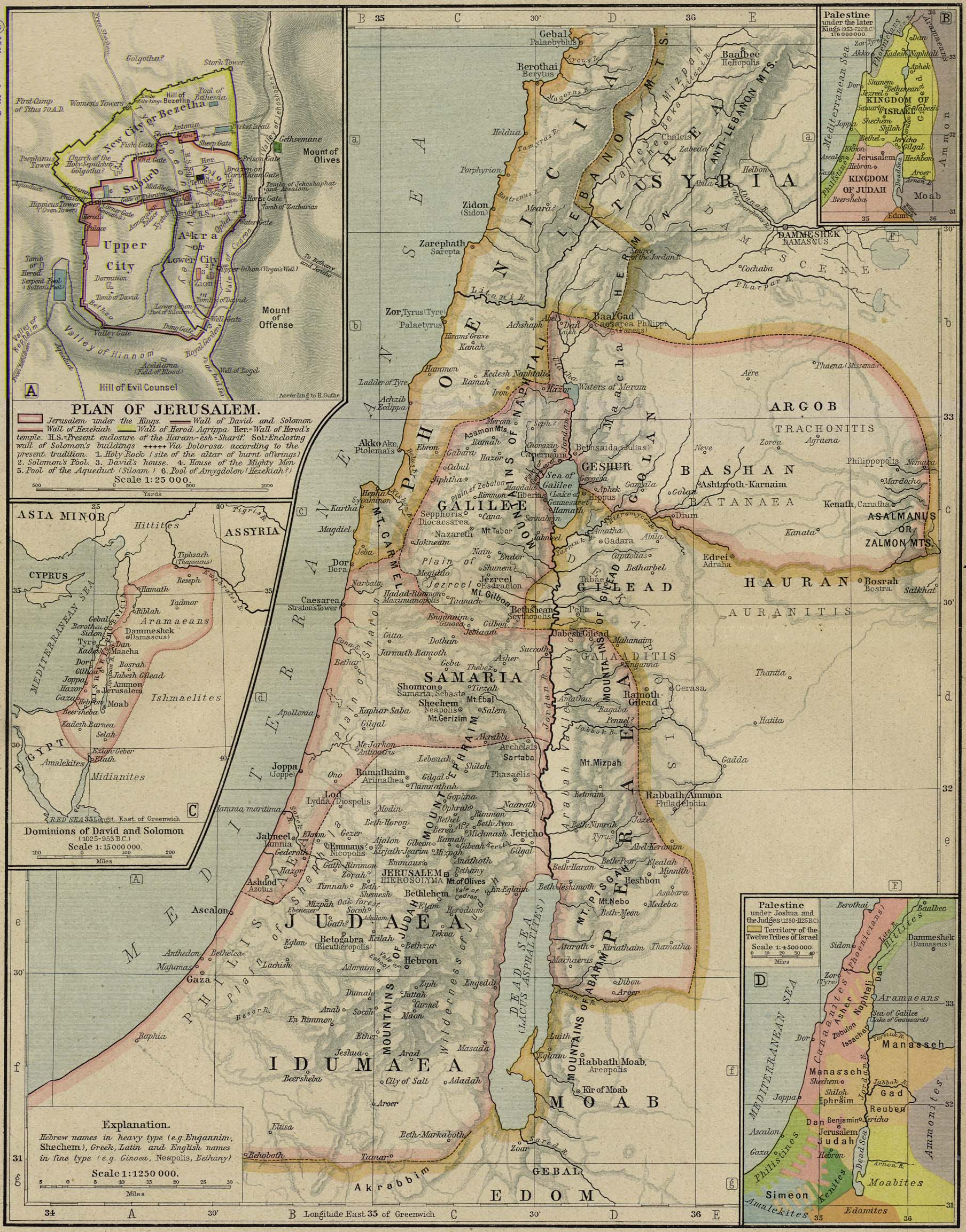
- George Adam Smith, Atlas of the Historical Geography of the Holy Land (1915)The map plates this site holds for the land of Judaea and the coastal plain. Public domain.
Keep studying
On this page
Books that name it1
Doorway2
Keep this page