

Jesus Christ · On Himself
He Told Them Three Times
Three times in Mark’s Gospel, Jesus tells the Twelve plainly that He is going to Jerusalem to suffer, be killed, and rise on the third day. Three times, they fail to receive it, a rebuke, a fearful silence, a request for the best seats. And three times, He answers the failure not with anger but with something deeper. Told once, His death could look like an accident He stumbled into. Told three times, on the record, it is the mission He named.
Andrea Mantegna, The Agony in the Garden, 1455-1456. Public domain.
Summary
The page lines up all three passion predictions side by side, each one paired with how the disciples failed to receive it and how Jesus answered that failure. It also tracks why the detail grows with each telling and notes the one round where Mark's own quote pool has no coverage.
- Round one follows Peter's confession and his rebuke, "get thee behind me, Satan."
- Round two is told in secret and met with silent fear, then an argument over who is greatest.
- Round three names the mockery and scourging directly, walked toward the city where it will happen.
- Each round pairs with its own deeper teaching: taking up the cross, welcoming a child, and paying a ransom.
- All three sayings use the same title, Son of Man, doored to its own page for the full claim behind it.
The Text
Mark 8:31 · 9:31 · 10:32-34, the same announcement, three times
Then He began to teach them that the Son of Man must suffer many things and be rejected by the elders, chief priests, and scribes, and that He must be killed and after three days rise again.The first plain word, right after Peter's confession that Jesus is the Christ.
because He was teaching His disciples. He told them, “The Son of Man will be delivered into the hands of men. They will kill Him, and after three days He will rise.” But they did not understand this statement, and they were afraid to ask Him about it.The second, told quietly, and met with fear, not questions.
As they were going up the road to Jerusalem, Jesus was walking ahead of them. The disciples were amazed, but those who followed were afraid. Again Jesus took the Twelve aside and began to tell them what was going to happen to Him: “Look, we are going up to Jerusalem, and the Son of Man will be delivered over to the chief priests and scribes. They will condemn Him to death and will deliver Him over to the Gentiles, who will mock Him and spit on Him and flog Him and kill Him. And after three days He will rise again.”The third and fullest, every stage of the passion, named in order.
Mark places these three announcements at three separate points on the road to Jerusalem, each one more detailed than the last. Matthew and Luke both keep the same three moments, in the same order, with their own small differences. This page reads Mark’s three as the spine, with Matthew’s and Luke’s versions of the first two as parallels.
Three Rounds
prediction, failure, and a deeper call, three times over
At Caesarea Philippi, right after Peter calls Him the Christ
THE PREDICTION
The Son of Man must suffer many things, be rejected, be killed, and after three days rise again.
Mark 8:31THE STUMBLE
Peter takes Him aside and rebukes Him for saying it. Jesus turns and rebukes Peter back, in front of the rest.
Mark 8:32–33HIS DEEPER ANSWER
Deny yourself, take up your cross, and follow Him, the cost named on purpose, before anyone is forced to pay it.
Mark 8:34, the full teaching →Passing quietly through Galilee, “he would not that any man should know it”
THE PREDICTION
The Son of Man is delivered into the hands of men, and they shall kill him, and after three days he shall rise.
Mark 9:31THE STUMBLE
They do not understand the saying, and are afraid to ask Him, then argue, on the same road, about which of them is greatest.
Mark 9:32–34HIS DEEPER ANSWER
He sets a child in the middle of them and redefines greatness as welcome, not rank.
Mark 9:36–37, the full teaching →On the road, going up to Jerusalem, “Jesus went before them”
THE PREDICTION
The fullest telling yet: delivered, condemned, mocked, spit upon, scourged, killed, and after three days He shall rise.
Mark 10:33–34THE STUMBLE
James and John ask for the two seats beside Him in His glory, the same argument as round two, back again.
Mark 10:35–37HIS DEEPER ANSWER
Whoever wants to be great must serve, because the Son of Man Himself came to serve, and to give His life as a ransom for many.
Mark 10:43–45, the full teaching →What He Is Saying
a word that leaves no room for accident
Each time, Mark records Jesus using the same word: the Son of Man mustsuffer. It is not a prediction of something that might happen to Him if events go badly. It is the word for something settled and necessary, the shape His mission was always going to take, named by Him before anyone forced it on Him. A man surprised by his own death does not calmly describe its stages in advance, three times, in growing detail, while still walking toward the city where it will happen.
Why does He tell them at all?Theophylact, on round three
Several of the church’s early readers ask this question directly: if the news only frightened and confused the Twelve, why keep repeating it? Their answer is that the telling itself was the preparation, so that when the worst happened, it would not look like defeat but like a plan arriving on schedule, and so that His willingness, not His helplessness, would be unmistakable. See Theophylact of Ohrid’s comment on round three, below.
Why does the detail grow each time?from 'suffer' to 'spit upon'
Round one names the outcome in outline: suffer, be rejected, be killed, rise. Round two adds betrayal into human hands. Round three names the mockery, the spitting, the scourging, the specific cruelties, not just the fact of death. The Twelve are told more, not less, the closer they get to Jerusalem, the opposite of what a gentler teacher, trying to keep them calm, would have done.
Round One: After the Confession
Matthew 16:21-23 · Mark 8:31-33 · Luke 9:22
From that time on Jesus began to show His disciples that He must go to Jerusalem and suffer many things at the hands of the elders, chief priests, and scribes, and that He must be killed and on the third day be raised to life.Matthew's version of the same first word.
Peter took Him aside and began to rebuke Him. “Far be it from You, Lord!” he said. “This shall never happen to You!” But Jesus turned and said to Peter, “Get behind Me, Satan! You are a stumbling block to Me. For you do not have in mind the things of God, but the things of men.”Peter's rebuke, and Jesus's answer: “Get thee behind me, Satan.”
“The Son of Man must suffer many things,” He said. “He must be rejected by the elders, chief priests, and scribes, and He must be killed and on the third day be raised to life.”Luke's own telling of the same moment.
This is the moment the pattern begins, and it begins at the highest possible point: Peter has just called Jesus the Christ, the Son of the living God. Jesus’s very next act is to tell them plainly what being that Christ will cost Him, and Peter, who just got it right, immediately gets the next part wrong.
From that time Jesus began to tell his disciples, that he must suffer many things - Perhaps this expression, began, always implied his entering on a set and solemn discourse. Hitherto he had mainly taught them only one point, That he was the Christ. From this time he taught them another, That Christ must through sufferings and death enter into his glory.
John Wesley · Explanatory Notes upon the New Testament (1755), Matt 16:21
Therefore, the rest being troubled and in perplexity, Peter again, in his ardor, alone ventures to discourse of these things; and not even he openly, but when he had taken Him apart; that is, having separated himself from the rest of the disciples; and he saith, "Be it far from Thee, Lord, this shall not be unto Thee." What ever is this? He that obtained a revelation, he that was blessed, hath he so soon fallen away, and suffered overthrow, so as to fear His passion? And what marvel, that one who had not on these points received any revelation, should have that feeling? Yea, to inform thee that not of himself did he speak those other things either, see in these matters that were not revealed to him how he is confounded and overthrown, and being told ten thousand times, knows not what the saying can mean. For that He is Son of God he had learnt, but what the mystery of the cross and of the resurrection might be, was not yet manifest to him: for "the saying," it is said, "was hid from them." Seest thou that with just cause He bade them not declare it to the rest? For if it so confounded them, who must needs be made aware of it, what would not all others have felt?
John Chrysostom · Homily on the Gospel of Matthew 54 (407), Matt 16:22
But he turned, and said--in the hearing of the rest; for Mark (Mr 8:33) expressly says, "When He had turned about and looked on His disciples, He rebuked Peter"; perceiving that he had but boldly uttered what others felt, and that the check was needed by them also.
Jamieson, Fausset & Brown · Commentary Critical and Explanatory on the Whole Bible (1871), Matt 16:23
The Lord Jesus Christ was at first unwilling to be extolled, lest any murmuring arise. He rebuked his disciples, lest they say this to anyone, because the Son of man must suffer many things, and be rejected by the elders and the chief priests and the scribes, and be slain, and be raised the third day. Perhaps he added this because the Lord knew that even the disciples would believe with difficulty in his passion and resurrection.
Ambrose of Milan · Commentary on Luke (397), Luke 9:21-22
Round Two: Passing Through Galilee, In Secret
Mark 9:31-32 · Luke 9:44-45
because He was teaching His disciples. He told them, “The Son of Man will be delivered into the hands of men. They will kill Him, and after three days He will rise.” But they did not understand this statement, and they were afraid to ask Him about it.Told quietly this time, and met with fear, not a rebuke.
“Let these words sink into your ears: The Son of Man is about to be delivered into the hands of men.” But they did not understand this statement. It was veiled from them so that they could not comprehend it, and they were afraid to ask Him about it.Luke's version: “it was hid from them, that they perceived it not.”
This time Jesus does not want anyone else to know where they are (Mark 9:30), this is a private word for the Twelve alone. The failure changes shape too: round one was open opposition; round two is silent incomprehension, followed almost immediately by an argument among themselves about which of them is the greatest (Mark 9:33-34), as if the words about His death had not registered at all.
Mark’s own quote pool has no coverage of chapter 9, this page states that gap honestly rather than inventing a commentator for it. Luke’s parallel telling of the same moment does have voices, quoted below.
Let these sayings sink down into your ears - Or, put these words into your ears. To other words, you may lend occasional attention, but to what concerns my sufferings and death you must ever listen. Let them constantly occupy a place in your most serious meditations and reflections.
Adam Clarke · Commentary on the Bible (1832), Luke 9:44
It was hid from them - They had imbibed the common notions of the Jews that he was to be a prince and a conqueror, to deliver the nation. They could not understand how that could be, if he was soon to be delivered into the hands of his enemies to die. In this way it was hid from them - not by God, but by their previous false belief.
Albert Barnes · Notes, Explanatory and Practical, on the Old and New Testaments (1832-1869), Luke 9:45
Now some one perhaps will say, How were the disciples ignorant of the mystery of the cross, seeing that it was touched upon in several places by the shadows of the Law? But as Paul relates, Even unto this day, when Moses is read, the vail is upon their hearts. (2 Cor. 3:15.) It becomes then those who approach Christ, to say, Open thou my eyes, that I may behold the wonderful things out of thy law. (Ps. 119:18.)
Cyril of Alexandria · Catena Aurea by Aquinas (1264), Luke 9:45
Round Three: On the Road Up to Jerusalem
Mark 10:32-34, 35-37, 45
As they were going up the road to Jerusalem, Jesus was walking ahead of them. The disciples were amazed, but those who followed were afraid. Again Jesus took the Twelve aside and began to tell them what was going to happen to Him: “Look, we are going up to Jerusalem, and the Son of Man will be delivered over to the chief priests and scribes. They will condemn Him to death and will deliver Him over to the Gentiles, who will mock Him and spit on Him and flog Him and kill Him. And after three days He will rise again.”The fullest telling, condemned, mocked, scourged, spit upon, killed, and risen.
Then James and John, the sons of Zebedee, came to Jesus and declared, “Teacher, we want You to do for us whatever we ask.” “What do you want Me to do for you?” He inquired. They answered, “Grant that one of us may sit at Your right hand and the other at Your left in Your glory.”James and John ask for the two best seats, moments after hearing this.
This is the most detailed of the three, spoken as they are literally walking up to the city where it will happen, Mark notes Jesus walking ahead of them, and the disciples following, amazed and afraid (10:32). Within a few verses, James and John ask for the two thrones at His right and left hand. It is the same status-seeking failure as round two, resurfacing in an even worse moment.
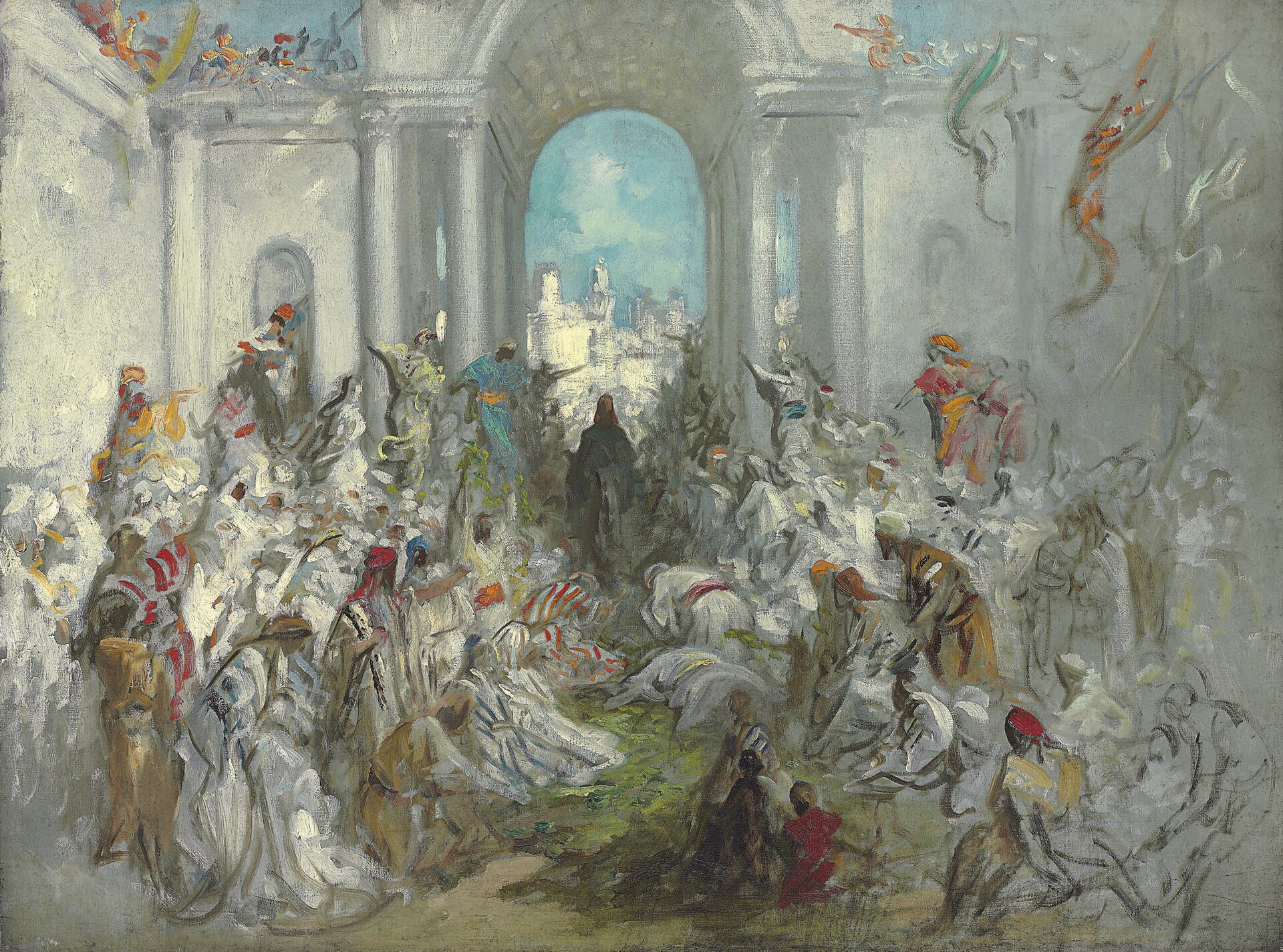
Jesus answers James and John’s request the same way He answered round two’s failure, with a reversal of what greatness means, and the plainest single statement in the Gospels of why He is walking this road at all: He came to give His life a ransom for many (Mark 10:45). That saying, and the whole servanthood teaching around it, has its own full page, see the doorway below rather than a fourth telling here.
He did this to confirm the hearts of the disciples, that from hearing these things beforehand, they might the better bear them afterwards, and might not be alarmed at their suddenness, and also in order to show them that He suffered voluntarily; for he who foreknows a danger, and flies not, though flight is in his power, evidently of his own will gives himself up to suffering. But He takes His disciples apart, because it was fitting that He should reveal the mystery of His Passion to those who were more closely connected with Him.
Theophylact of Ohrid · Catena Aurea by Aquinas (1264), Mark 10:33-34
Our Redeemer, foreseeing that the souls of the disciples would be troubled by His passion, foretold to them long beforehand both the suffering of that same passion and the glory of His resurrection, so that when they saw Him dying, as had been predicted, they would not doubt that He would also rise again. But because the disciples, still carnal, were by no means able to grasp the words of the mystery, a miracle is performed.
Gregory the Dialogist · Forty Gospel Homilies, Homily 2 (604), Mark 10:32-34
That they should have clung so tenaciously to the popular notion of an "unsuffering" Messiah, may surprise us; but it gives inexpressible weight to their after-testimony to a suffering and dying Saviour.
Jamieson, Fausset & Brown · Commentary Critical and Explanatory on the Whole Bible (1871), Mark 10:34
The thought was doubtless suggested to her sons by the recent promise to the Twelve of "thrones to sit on, when the Son of man should sit on the throne of His glory" (Mt 19:28); but after the reproof so lately given them (Mr 9:33, &c.) they get their mother to speak for them.
Jamieson, Fausset & Brown · Commentary Critical and Explanatory on the Whole Bible (1871), Mark 10:35
Where It Points
the title He used every time He said it
In all three announcements, Jesus calls Himself “the Son of Man”, the same title Daniel’s vision gives to the one who comes on the clouds of heaven and receives a kingdom and glory that will never pass away (Daniel 7:13-14). Jesus does not use a lesser title for the moment He talks about dying. He uses the title that claims the most, at the exact point where He describes giving the most away.
Closing
Three times He told them. Three times they missed it, a rebuke, a fearful silence, a request for thrones. And three times He answered, not by giving up on them, but by going deeper: a cross to carry, a child to welcome, a ransom to pay. The cross was never a surprise ending. It was the mission He named, on the record, before He ever reached it.
Keep studying
Read it1
On this page