
Luke 2:40-52 · Mark 6:1-6 · Featured Study
The Silent Years
Between the family’s return from Egypt and the day Jesus stood in the Jordan, Scripture gives two summary verses and one narrated story. Where the text stops, this page stops with it. The silence is named as silence, not filled with invention. What Luke and Mark actually give, the one narrated scene from those years, and why the legends of a hidden ministry abroad have no ancient source.
Summary
Between his return from Egypt as an infant and his baptism in the Jordan near age thirty, Scripture gives Jesus one narrated story: found in the temple at twelve. Everything else is a single line about growth and one line about a trade. The page names the silence and answers the legends that have tried to fill it.
- Luke 2:40 and 2:52 are the only summary lines Scripture gives for the whole span; the temple visit at twelve (Luke 2:41-52) is the only narrated scene.
- Mark 6:3 calls Jesus "the carpenter" and names his brothers and sisters; Luke 4:16 says synagogue attendance was already his custom.
- The claims that Jesus traveled to India, Tibet, or Britain during these years rest on no ancient source and no historical evidence.
- The Infancy Gospel of Thomas, written roughly a century after the events it describes, is late pious fiction the church never received as Scripture.
- Hebrews 5:8 and Philippians 2:7 read the ordinary years themselves as part of Christ's obedience, not a gap before the real story starts.
What Scripture Gives
Luke 2:40 and 2:52: two verses for the whole span before the Jordan
And the Child grew and became strong. He was filled with wisdom, and the grace of God was upon Him.The whole of early childhood, in one sentence: growth, strength, wisdom, grace.
And Jesus grew in wisdom and stature, and in favor with God and man.The whole span from twelve to roughly thirty, in one more sentence.
Luke frames the entire span between the family’s return to Nazareth and the start of Jesus’s public ministry with two short sentences, one before the temple story and one after it. No other Gospel adds a scene from these years. Matthew, Mark, and John move directly from the infancy accounts, or from no infancy account at all, to John the Baptist and the Jordan. The years are not lost. They were never narrated.
“The child grew - As to his body - being in perfect health. Waxed strong in spirit - His rational soul became strong and vigorous. Filled with wisdom - The divinity continuing to communicate itself more and more, in proportion to the increase of the rational principle. The reader should never forget that Jesus was perfect man, as well as God.”
Adam Clarke · Commentary on the Bible, 1832Methodist
Luke 2:40
The Boy in the Temple
Luke 2:41-52: the one story these years give
Every year His parents went to Jerusalem for the Feast of the Passover. And when He was twelve years old, they went up according to the custom of the Feast. When those days were over and they were returning home, the boy Jesus remained behind in Jerusalem, but His parents were unaware He had stayed. Assuming He was in their company, they traveled on for a day before they began to look for Him among their relatives and friends. When they could not find Him, they returned to Jerusalem to search for Him. Finally, after three days they found Him in the temple courts, sitting among the teachers, listening to them and asking them questions. And all who heard Him were astounded at His understanding and His answers.Twelve years old, three days lost, found sitting among the teachers, asking and answering.
When His parents saw Him, they were astonished. “Child, why have You done this to us?” His mother asked. “Your father and I have been anxiously searching for You.” “Why were you looking for Me?” He asked. “Did you not know that I had to be in My Father’s house?” But they did not understand the statement He was making to them. Then He went down to Nazareth with them and was obedient to them. But His mother treasured up all these things in her heart. And Jesus grew in wisdom and stature, and in favor with God and man.His mother's question, his answer, and the return to an ordinary, subject life at Nazareth.
Every family in Israel kept the Passover pilgrimage; Jesus at twelve is old enough to travel with the men rather than the women, which is likely why Joseph and Mary each supposed he was with the other. What is unusual is not the trip. It is what happens when he is found: sitting among the temple teachers, listening, asking questions, and answering them in a way that leaves everyone who hears him astonished.
His answer to Mary, “how is it that ye sought me? knew ye not that I must be in my Father’s house?”, is the first recorded sentence of Jesus in Scripture. It states a self-awareness of who his Father is, at twelve, years before his ministry opens. Then the story closes the way the surrounding years will: he goes down with them, and is subject to them.
“This would give full scope for all that ‘astonished them in His understanding and answers.’ Not that He assumed the office of teaching--‘His hour’ for that ‘was not yet come,’ and His equipment for that was not complete; for He had yet to ‘increase in wisdom’ as well as ‘stature’ (Lu 2:52).”
Jamieson, Fausset & Brown · Commentary Critical and Explanatory on the Whole Bible, 1871Reformed
Luke 2:46
“How is it ... - ‘Why’ have ye sought me with so much anxiety? ‘Mary’ should have known that the Son of God was safe; that his heavenly Father would take care of him, and that he could do nothing amiss. Wist ye not - ‘Know ye not.’ You had reason to know. You knew my design in coming into the world, and that design was ‘superior’ to the duty of obeying earthly parents, and they should be willing always to give me up to the proper business for which I live.”
Albert Barnes · Notes, Explanatory and Practical, on the Old and New Testaments, 1870Evangelical
Luke 2:49
- 12his age at the temple
- 3days he was missing
- 1narrated scene before the Jordan
- Luke 2:49his first recorded words
The Nazareth Years
Mark 6:3 and Luke 4:16: a trade, a family, a custom
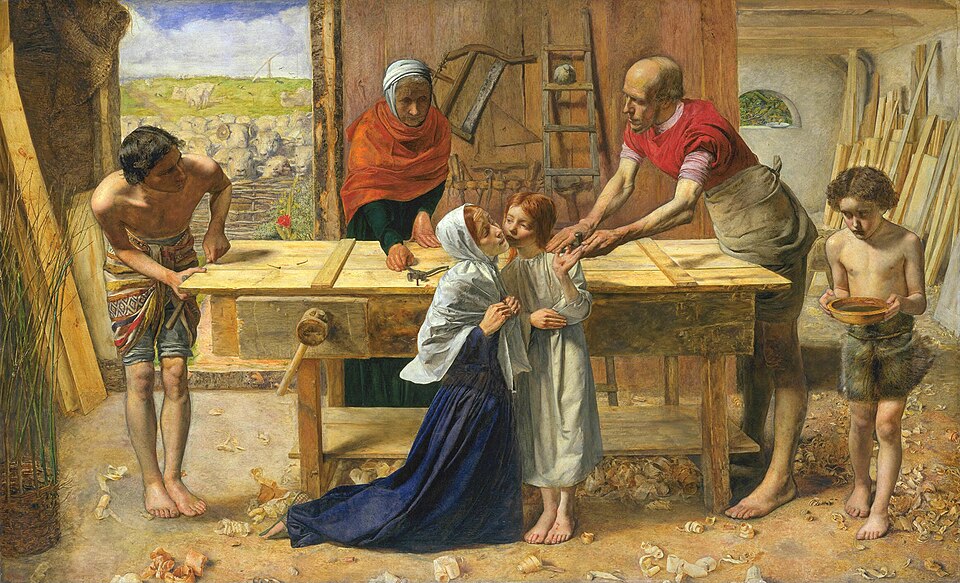
Isn’t this the carpenter, the son of Mary and the brother of James, Joses, Judas, and Simon? Aren’t His sisters here with us as well?” And they took offense at Him."Is not this the carpenter?" His trade, his mother, four brothers by name, and unnamed sisters.
Then Jesus came to Nazareth, where He had been brought up. As was His custom, He entered the synagogue on the Sabbath. And when He stood up to read,Synagogue attendance was already "his custom," a settled habit before his ministry began.
Four facts survive from the Nazareth years, dropped almost in passing by writers with other purposes. Mark 6:3 calls Jesus “the carpenter,” not merely the carpenter’s son, which every ancient reader would have heard as his own trade. The same verse names his mother and four brothers, James, Joses, Judas, and Simon, and mentions sisters without naming them. Luke 4:16 adds one more fact worth noting: attending the synagogue on the Sabbath was already “his custom” before he ever stood up to read from Isaiah.
“Went down with them - Down from Jerusalem, which was in a high, mountainous region. Was subject unto them - Performed the duty of a faithful and obedient child, and not improbably was engaged in the trade of Joseph - that of a carpenter. Every Jew was required to learn some trade, and there is every reason to think that our Saviour followed that of his reputed father. And from this we learn: 1. That obedience to parents is a duty. Jesus has set an example in this that all children should follow.”
Albert Barnes · Notes, Explanatory and Practical, on the Old and New Testaments, 1870Evangelical
Luke 2:51
“But from His very first years being obedient to His parents, He endured all bodily labours, humbly and reverently. For since His parents were honest and just, yet at the same time poor, and ill supplied with the necessaries of life, (as the stable which administered to the holy birth bears witness,) it is plain that they continually underwent bodily fatigue in providing for their daily wants. But Jesus being obedient to them, as the Scriptures testify, even in sustaining labours, submitted Himself to a complete subjection.”
Basil of Caesarea · Homily, preserved in the Catena Aurea, 379Church Father
Luke 2:51
Where Scripture Is Silent
what the text does not say, named as silence
Scripture never says what Jesus looked like. It never records a teacher who trained him, a rabbi he studied under, or a trip he took outside Israel and Egypt after the return recorded in Matthew 2. It never names a single event between age twelve and roughly age thirty. It does not say whether Joseph was still alive by the time Jesus began his ministry; the last mention of Joseph by name is at the temple, and he is absent from the wedding at Cana and every scene after it.
The Gospels are selective accounts, each writer choosing what serves the reader’s faith in Christ, and John says so directly of his own book’s far larger silences (John 20:30-31, 21:25). What is missing here is missing because no Gospel writer judged it necessary, not because it was lost.
“These verses should always be deeply interesting to a reader of the Bible. They record the only facts which we know about our Lord Jesus Christ during the first thirty years of His life on earth, after His infancy. How many things a Christian would like to know about the events of those thirty years, and the daily history of the house at Nazareth! But we need not doubt that there is wisdom in the silence of Scripture on the subject. If it had been good for us to know more — then more would have been revealed.”
J.C. Ryle · Expository Thoughts on the Gospels: Luke, 1858Anglican Evangelical
Luke 2:41
The Legend Industry, Answered
what has tried to fill the gap, and why none of it holds
A silence this long has always drawn writers who wanted to fill it. Two different kinds of claim have circulated for centuries, and both fail the same simple test: neither rests on a source close enough in time or place to the events it describes to carry any weight.
The apocryphal infancy gospels: late, fanciful, and never receivedInfancy Gospel of Thomas, roughly the mid-second century
The best known of these is the Infancy Gospel of Thomas, written roughly a hundred years after the events it claims to describe, far too late for eyewitness testimony. It portrays the child Jesus working small, often unsettling miracles, striking a playmate dead and then raising him, animating clay birds, cursing a teacher who corrected him. No church council, no ancient canon list, and no reputable early father ever treated it as Scripture. It survives today as a curiosity of early Christian literature, not as history.
A later work, the Arabic Infancy Gospel, extends similar legendary material into the family’s stay in Egypt already recorded briefly in Matthew 2. Both works belong to a genre scholars call pious fiction: stories written to satisfy curiosity the canonical Gospels deliberately left unsatisfied, not accounts drawn from memory or record.
The modern claims: India, an extended Egypt, and BritainNotovitch, 1894, and the Glastonbury legend
The claim that Jesus traveled to India and Tibet during these years traces to a single 1894 book, Nicolas Notovitch’s The Unknown Life of Jesus Christ, which claimed to translate an ancient Tibetan manuscript. No other traveler or scholar who visited the monastery he named was ever able to locate the document, and the monks there denied any knowledge of it. No manuscript, no corroborating source, and no mention in any ancient Christian, Jewish, Roman, or Indian record supports the claim.
The claim that Jesus visited Britain, often tied to a legend that Joseph of Arimathea brought him there as a boy, is a folk tradition centered on Glastonbury that cannot be traced to any source earlier than many centuries after the first century. It has no ancient attestation at all, Christian or otherwise. Both claims are named here for what they are: stories without a historical source, not readings of a text that says something different than commonly supposed.
What the Silence Preaches
Hebrews 5:8 and Philippians 2:7: eighteen years as part of the obedience
Although He was a Son, He learned obedience from what He suffered.Learning obedience through what he suffered was not confined to the cross.
but emptied Himself, taking the form of a servant, being made in human likeness.Emptied himself, took the form of a servant: a description that covers a carpenter's shop as much as a cross.
Hebrews does not confine Christ’s learned obedience to Good Friday, and Philippians describes the whole of his taking on flesh as a servant’s form, not only its final hour. Read against those two verses, eighteen years of an ordinary trade, an ordinary household, and a settled habit of worship were not wasted time before the real story. They were the form his obedience took before anyone was watching.
“Jesus increased in wisdom - As to his human nature, and in favour with God - In proportion to that increase. It plainly follows, that though a man were pure, even as Christ was pure, still he would have room to increase in holiness, and in consequence thereof to increase in the favour, as well as in the love of God.”
John Wesley · Explanatory Notes upon the New Testament, 1755Wesleyan
Luke 2:52
The Voices
with the work named
Expository Thoughts on the Gospels: Luke (1858) · public domain
States the silence plainly: these are the only facts we have from the first thirty years, and the silence itself carries wisdom.
Notes, Explanatory and Practical, on the Old and New Testaments (1832-1869) · public domain
Reads the temple answer as Christ's own design rather than a child's disobedience, and reads the Nazareth years as ordinary trade and obedience.
Commentary on the Bible (1832) · public domain
On Luke 2:40, insists the reader never forget Jesus was perfect man as well as God, growing in body and soul alike.
Commentary Critical and Explanatory on the Whole Bible (1871) · public domain
Reads the temple scene as a boy still under instruction, not yet teaching by office; his hour for that had not come.
Explanatory Notes upon the New Testament (1755) · public domain
On Luke 2:52, grounds the growth in wisdom and favor in the reality of Christ's human nature.
Homily preserved in the Catena Aurea, compiled by Thomas Aquinas (13th century) · public domain
Describes the ordinary bodily labor of the household years, borne in humble and reverent obedience.
Marcus Brown's own commentary leads above all; within a tier, all voices are equal. No modern approved voice on the roster carries a specific work on this exact question, so this page draws only from the church’s public-domain commentary.
Keep Studying
On this page
People and groups1