
Passage
The Suffering Servant
Isaiah 52:13 to 53:12
The fourth and last of Isaiah's Servant Songs, and the passage the apostles quote when they explain the death of Jesus.
Part of Isaiah · Passage · Revised 5 September 2026
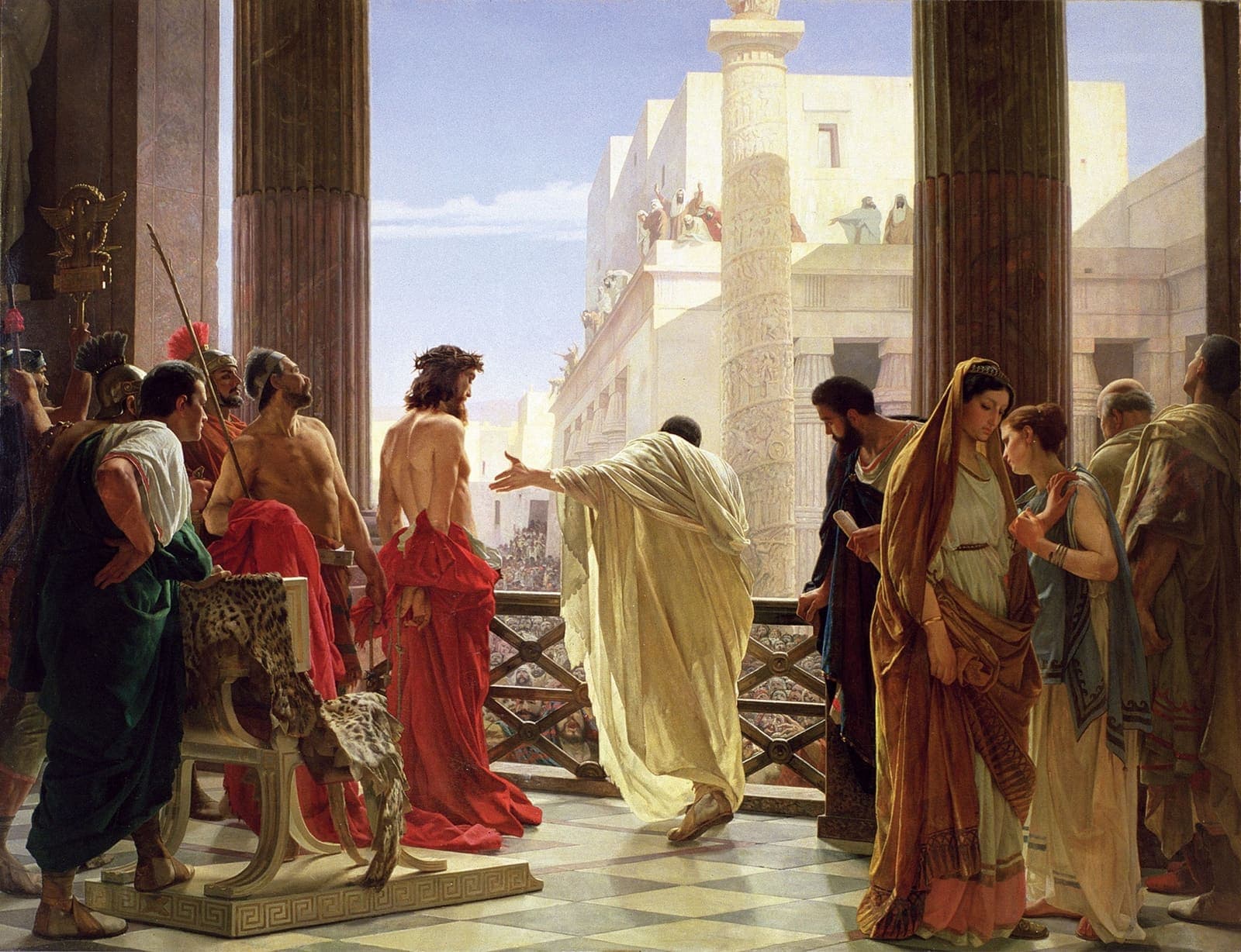
Antonio Ciseri, Ecce Homo, 1871. Public domain.
Summary
The song opens and ends with the servant lifted high, and between those ends it sets his death for the sin of others. The New Testament reads him as Jesus.
- It starts three verses before the chapter break. That opening is easy to miss.Isaiah 52:13…be raised and lifted up and highly exalted
- The middle of the song says he carried what belonged to others.Isaiah 53:5
- After the death the song gives him long days and a share with the great.Isaiah 53:10He will prolong His days
- Jesus applied the last verse to himself the night he was arrested.Luke 22:37…is written about Me is reaching its fulfillment
- Jewish readers have read the servant two ways: as the Messiah, and as Israel.
The song, whole
The chapters around it speak to people under judgment with an exile in Babylon in view, and promise a rescue the LORD works with his own arm. It is the last of four passages in Isaiah that speak of one servant.
52:13 to 15
13 Behold, My Servant will prosper; He will be raised and lifted up and highly exalted.
14 Just as many were appalled at Him—His appearance was disfigured beyond that of any man, and His form was marred beyond human likeness—
15 so He will sprinkle many nations. Kings will shut their mouths because of Him. For they will see what they have not been told, and they will understand what they have not heard.
53:1 to 3
1 Who has believed our message? And to whom has the arm of the LORD been revealed?
2 He grew up before Him like a tender shoot, and like a root out of dry ground. He had no stately form or majesty to attract us, no beauty that we should desire Him.
3 He was despised and rejected by men, a man of sorrows, acquainted with grief. Like one from whom men hide their faces, He was despised, and we esteemed Him not.
53:4 to 6
4 Surely He took on our infirmities and carried our sorrows; yet we considered Him stricken by God, struck down and afflicted.
5 But He was pierced for our transgressions, He was crushed for our iniquities; the punishment that brought us peace was upon Him, and by His stripes we are healed.
6 We all like sheep have gone astray, each one has turned to his own way; and the LORD has laid upon Him the iniquity of us all.
53:7 to 9
7 He was oppressed and afflicted, yet He did not open His mouth. He was led like a lamb to the slaughter, and as a sheep before her shearers is silent, so He did not open His mouth.
8 By oppression and judgment He was taken away, and who can recount His descendants? For He was cut off from the land of the living; He was stricken for the transgression of My people.
9 He was assigned a grave with the wicked, and with a rich man in His death, although He had done no violence, nor was any deceit in His mouth.
53:10 to 12
10 Yet it was the LORD’s will to crush Him and to cause Him to suffer; and when His soul is made a guilt offering, He will see His offspring, He will prolong His days, and the good pleasure of the LORD will prosper in His hand.
11 After the anguish of His soul, He will see the light of life and be satisfied. By His knowledge My righteous Servant will justify many, and He will bear their iniquities.
12 Therefore I will allot Him a portion with the great, and He will divide the spoils with the strong, because He has poured out His life unto death, and He was numbered with the transgressors. Yet He bore the sin of many and made intercession for the transgressors.
The text here is the American Standard Version. The same fifteen verses in the King James · the Berean Standard Bible
The passage at a glance
- Range
- Isaiah 52:13 to 53:12, fifteen verses
- Speaker
- The LORD, then a confessing “we”, then the prophet, then the LORD again
- Setting
- The song speaks into judgment and exile in Babylon, to people told that the LORD will bare his own arm and rescue them himselfIsaiah 52:10
- Position in the book
- After the herald of good news at 52:7 to 12, and before the barren woman's song of chapter 54Isaiah 52:7 · Isaiah 54:1
- Parallel passages
- The fourth of Isaiah's four servant songsIsaiah 42:1 · Isaiah 49:1 · Isaiah 50:4 · Isaiah 52:13
The shape of the song
The song starts high, goes down to a grave, and ends at the height it opened on.
Five stops in order. Isaiah 52:13 to 15 stands the servant high. Isaiah 53:1 to 3 brings him down to a man nobody wanted. Isaiah 53:4 to 6 puts other people's sin on him. Isaiah 53:7 to 9 carries him through an unjust trial to a grave. Isaiah 53:10 to 12 stands him high again, at the same height the song opened on.
- 52:13 to 15Lifted high
- 53:1 to 3Few believed
- 53:4 to 6Our load on him
- 53:7 to 9Silent to the grave
- 53:10 to 12High again
Who is speaking, and where the song says so.
- 52:13 to 15the LORDnamed: my servant
- 53:1 to 6a confessing wenot named
- 53:7 to 10a reporternot named
- 53:11 to 12the LORDnamed: my servant
The song names its speaker only where the first person stands in the text, at my servant. The two middle bands are unnamed, so any name given them is a proposal.
Who the “we” of 53:1 to 6 is
The prophet with the believing remnant, confessing what they had thought of him
The reading this site's Wesleyan-Pentecostal tradition takes, and the one the rest of this page follows. On this reading the confession is made by people who now see what the servant was doing, and it stands in the same book that calls Isaiah himself a man of unclean lips.
Israel as a nation, or the nations looking on at Israel
Holders of the national reading, from Rashi forward. Rashi takes the prophet to speak of all Israel as one man; most who follow him take the speakers of this stretch to be the astonished kings and nations of 52:15, confessing what they had done to Israel.
The kings of 52:15, whose mouths the song has just shut
Bernhard Duhm and the critics who follow him, carrying the pronoun straight across the chapter break from the kings who see what they had not been told.
52:13 to 15
Lifted high, and unrecognisable
The servant is raised as high as a person can be, then shown too disfigured to look at.
Isaiah 52:14and His form was marred beyond human likeness—
My Servant will prosper52:13 to 15
The fourth servant song opens, and its first word is exaltation: “He will be raised and lifted up and highly exalted”. Against that height verse 14 sets a form “marred beyond human likeness”. Paul quotes verse 15 at Romans 15:21, and the Targum of Jonathan names this servant the Messiah.
Drawn from Franz Delitzsch, Biblical Commentary on the Prophecies of Isaiah; Albert Barnes, Notes on the Book of Isaiah.
His form was marred beyond human likeness52:14
Clarke reads appalled at Him for at you, with the Syriac and Chaldee, as the Berean does. Jerome takes the marred form and appearance as the humility and poverty of His coming. Wesley finds the disfigured man worn by watchings, fastings and blows.
Drawn from Adam Clarke, Commentary on the Bible; Jerome, Commentary on Isaiah; John Wesley, Explanatory Notes upon the Old Testament.
so He will sprinkle many nations52:15
Clarke keeps sprinkle while doubting it, and Secker, whom he quotes, preferred the Septuagint's reading, many nations will marvel at Him. Jamieson, Fausset and Brown keep sprinkle. Jerome sees in it the blood of Christ and baptism, before which kings shut their mouths.
Drawn from Adam Clarke, Commentary on the Bible; Jamieson, Fausset & Brown, Commentary Critical and Explanatory on the Whole Bible; Jerome, Commentary on Isaiah.
Sprinkle, or startleIsaiah 52:15
He shall sprinkle many nations, which is what a priest does with blood at the altar, so that the nations are made clean.
The Hebrew text as the Masoretes preserved it, and the King James and American Standard translators who print it that way.
So shall many nations be startled at him.
The ancient Greek translators, who read the same consonants as astonishment.
The two readings do different work. The first makes the servant a priest and the nations the thing cleansed, which carries the song forward into the sacrifice named at 53:10. The second keeps the whole verse on the nations' reaction, so that the horror of 52:14 and the silence of 52:15 are one movement.
Paul quotes the second half of this verse at Romans 15:21, and that half reads the same either way, so his citation settles nothing about the disputed word.
How marredIsaiah 52:14
Scholars have proposed more than one way of reading one word of the Great Isaiah Scroll at this verse, and the proposals turn on a single consonant. The site prints no reading of the scroll here, because the reading itself is still argued.
The Hebrew text's own reading is the one shown above: his appearance was marred past any man's. That reading is not in dispute.
Albert Barnes reads the song as beginning here, not at the chapter break.
“The most important portion of Isaiah, and of the Old Testament, commences here, and here should have been the beginning of a new chapter.”
Albert Barnes · Notes, Explanatory and Practical, on the Old and New Testaments (1832-1869)
The rest of the passage
It is the description of the suffering Messiah, and is continued to the close of the next chapter. As the closing verses of this chapter are connected with the following chapter, and as it is of great importance to have just views of the design of this portion of Isaiah, it is proper in this place to give an analysis of this part of the prophecy.
53:1 to 3
Who believed the message?
The stanza opens on a question about widespread unbelief. Nothing about the servant would make a person want him.
Isaiah 53:1Who has believed our message? And to whom has the arm of the LORD been revealed?
Who has believed our message?53:1 to 3
The heart of the song opens with a question about who has believed the message, quoted at John 12:38 and Romans 10:16. There follows a man no one wanted to look at. The speakers tell a suffering still to come in the past tense, which Delitzsch calls the prophetic perfect.
Drawn from Franz Delitzsch, Biblical Commentary on the Prophecies of Isaiah; Albert Barnes, Notes on the Book of Isaiah.
He grew up before Him53:2
Barnes reads grew up as the rising of a shoot from dry ground, like the shoot from the stump of Jesse at 11:1. Jamieson, Fausset & Brown take the root as David's line in decay. Chrysostom sets His lack of beauty and stately form against the majesty of His Godhead.
Drawn from Albert Barnes, Notes, Explanatory and Practical, on the Old and New Testaments (1832-1869); Jamieson, Fausset & Brown, Commentary Critical and Explanatory on the Whole Bible; John Chrysostom, HOMILIES ON THE GOSPEL OF MATTHEW 27:2.
a man of sorrows53:3
Jamieson, Fausset & Brown give the Hebrew for grief as disease. Spurgeon sets out two readings of the faces men hide, a leper, or a man of sorrows whose face men could hardly bear to see. Clarke records that the Vulgate reads stricken in verse 4 as leprous.
Drawn from Jamieson, Fausset & Brown, Commentary Critical and Explanatory on the Whole Bible; Charles Spurgeon, The Metropolitan Tabernacle Pulpit, Sermon No. 3530: “A Sad Confession” (lightly modernized text, CCEL edition); Adam Clarke, Commentary on the Bible.
Charles Spurgeon says the expectation of a prince in splendour made a plain prophecy easy to miss.
“It is marvelous that with such plain prophecies concerning the Messiah the Jews should have made such a fatal mistake in reference to Him.”
Charles Spurgeon · The Metropolitan Tabernacle Pulpit, Sermon No. 1075: “A Root Out Of A Dry Ground” (lightly modernized text, CCEL edition), 1872
The rest of the passage
They looked for a temporal prince who would come in splendor, notwithstanding that this and other Scriptures speak of His humiliation in express terms.
The Hebrew here
The Hebrew behind Who believed the message?
makob: pain
Hebrew · H4341Strong's entry: anguish or (figuratively) affliction
The word behind sorrows at 53:3. It names pain, the kind a body feels.
16 times in the Old Testament · makob, in full →
choli: sickness
Hebrew · H2483Strong's entry: malady, anxiety, calamity
The word behind grief at 53:3. It names sickness, which is why Matthew reads the next stanza of the healings.
24 times in the Old Testament · choli, in full →
53:4 to 6
He bore what we owed
The servant carries what belonged to other people. The stanza says so by trading pronouns: our griefs, our transgressions, our iniquity laid on him.
Isaiah 53:6We all like sheep have gone astray
Surely He took on our infirmities53:4 to 6
The pronouns carry the exchange: “He was pierced for our transgressions, He was crushed for our iniquities”. Matthew 8:17 quotes verse 4 of the healings of Jesus, and 1 Peter 2:24 quotes verse 5. Verse 6 ends: “the LORD has laid upon Him the iniquity of us all”.
Drawn from Albert Barnes, Notes on the Book of Isaiah; Matthew Henry, Commentary on the Whole Bible.
He was pierced for our transgressions53:5
Jamieson, Fausset & Brown take pierced as a bodily wound, and set it beside the pierced hands and feet of Psalm 22:16. Clarke reads the punishment for peace as the penalty by which sinners are brought into peace with God. Jerome reads the stripes as one wound healing many wounds.
Drawn from Jamieson, Fausset & Brown, Commentary Critical and Explanatory on the Whole Bible; Adam Clarke, Commentary on the Bible; Jerome, Commentary on Isaiah.
We all like sheep have gone astray53:6
Barnes pictures a flock that has lost its shepherd, and sets it beside 1 Peter 2:25, where the sheep have turned back to their Shepherd. Theodoret reads each one's own way as the many idolatries of the nations. Spurgeon hears each sinner confessing a guilt all his own.
Drawn from Albert Barnes, Notes, Explanatory and Practical, on the Old and New Testaments (1832-1869); Theodoret of Cyrus, COMMENTARY ON ISAIAH 17:53.6; Charles Spurgeon, The Metropolitan Tabernacle Pulpit, Sermon No. 694: “Sin Laid on Jesus” (lightly modernized text, CCEL edition).
Athanasius reads the carrying as something done in a body of his own.
“Rather, he carries our infirmities, and he himself bears our sins, that it might be shown that he has become human for us, and that the body that in him bore them was his own body.”
Athanasius of Alexandria · Discourses Against the Arians 3.31, the fourth century
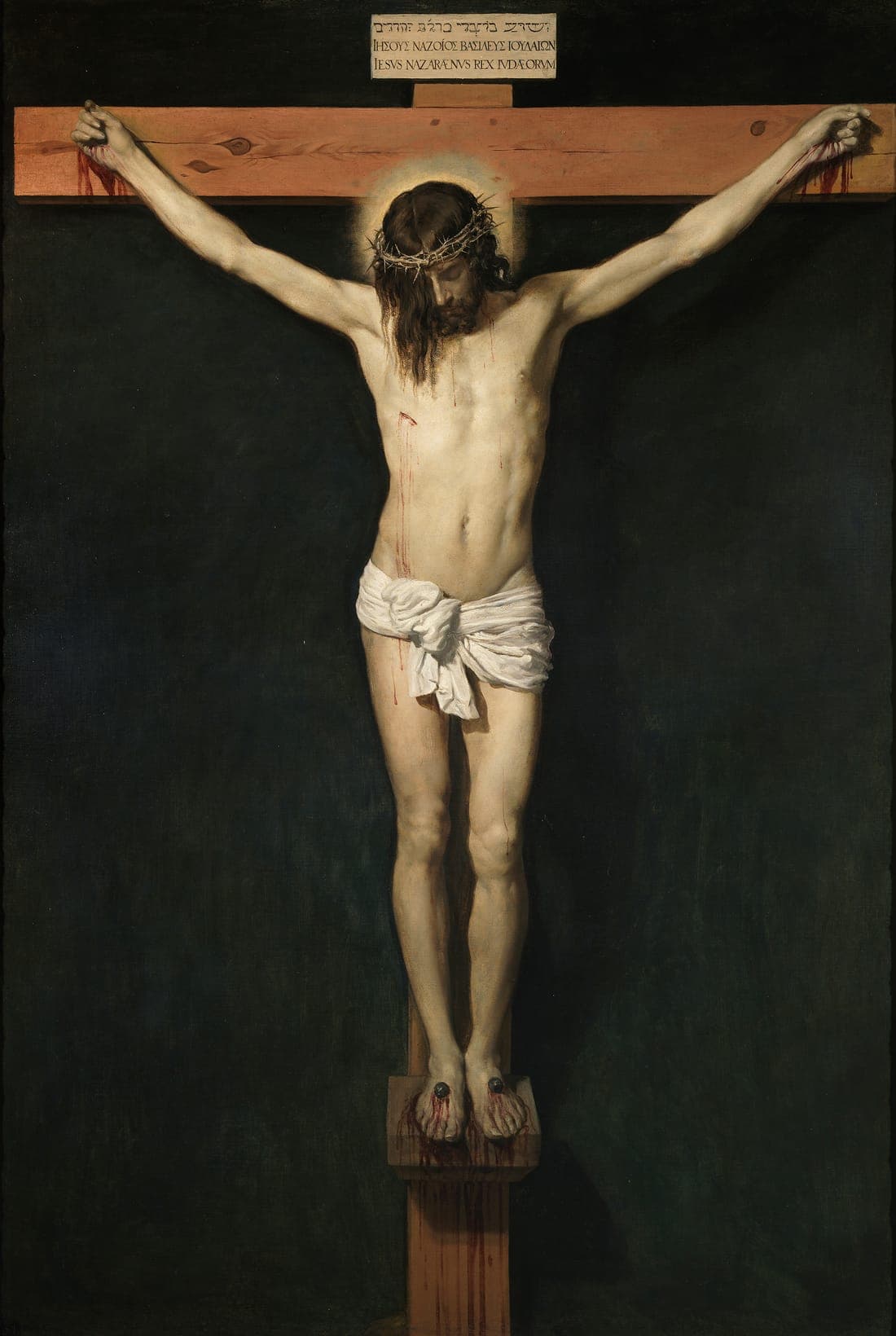
The line beside it is 53:5, he was wounded for our transgressions.
Diego Velazquez, Christ Crucified (1632). Public domain, held on this site.
The Hebrew here
The Hebrew behind He bore what we owed
nasa: to lift: raise
Hebrew · H5375Strong's entry: to lift, in a great variety of applications, literal and figurative, absolute and relative
The verb behind borne at 53:4. It is the word for lifting a load, and the law uses it of the goat that carries the people's guilt away.
656 times in the Old Testament · nasa, in full →
sabal: to bear
Hebrew · H5445Strong's entry: to carry (literally or figuratively), or (reflexively) be burdensome; specifically, to be gravid
The verb behind carried at 53:4, and behind bear at 53:11. It is the word for shouldering a burden.
9 times in the Old Testament · sabal, in full →
chabburah: wound
Hebrew · H2250Strong's entry: properly, bound (with stripes), i.e. a weal (or black-and-blue mark itself)
The word behind stripes at 53:5. It names the mark a blow leaves on skin.
7 times in the Old Testament · chabburah, in full →
53:7 to 9
Silent, and buried
He said nothing under oppression. A judgment cut his life short, and he was buried with a rich man though he had done no violence.
Isaiah 53:9He was assigned a grave with the wicked
He was led like a lamb to the slaughter53:7 to 8
He was “led like a lamb to the slaughter”, and “as a sheep before her shearers is silent, so He did not open His mouth”. The Ethiopian was reading this passage at Acts 8:32-35. Verse 8 makes the death judicial and substitutionary: “stricken for the transgression of My people”.
Drawn from Franz Delitzsch, Biblical Commentary on the Prophecies of Isaiah; John Gill, Exposition of the Old Testament.
By oppression and judgment He was taken away53:8
Barnes gives the Hebrew for oppression as a shutting up, and notes that Acts 8:33 quotes the Greek version, where His judgment was taken away. Athanasius reads the question about His descendants as His birth from a virgin. Leo the Great refers it to both His births.
Drawn from Albert Barnes, Notes, Explanatory and Practical, on the Old and New Testaments (1832-1869); Athanasius of Alexandria, On the Incarnation of the Word 37; Leo the Great, SERMON 30:1.
He was assigned a grave with the wicked53:9
He “was assigned a grave with the wicked, and with a rich man in His death”. The ground given is His innocence, “although He had done no violence, nor was any deceit in His mouth”. The Hebrew word for death is plural here, as Gill and Barnes note.
Drawn from John Gill, Exposition of the Old Testament; Albert Barnes, Notes on the Book of Isaiah.
Matthew Henry points out that the judge who condemned him found no fault in him.
“He never offended either in word or deed, nor could any of his enemies take up that challenge of his, Which of you convinceth me of sin?”
Matthew Henry · Commentary on the Whole Bible
The rest of the passage
The judge that condemned owned he found no fault in him, and the centurion that executed him professed that certainly he was a righteous man.
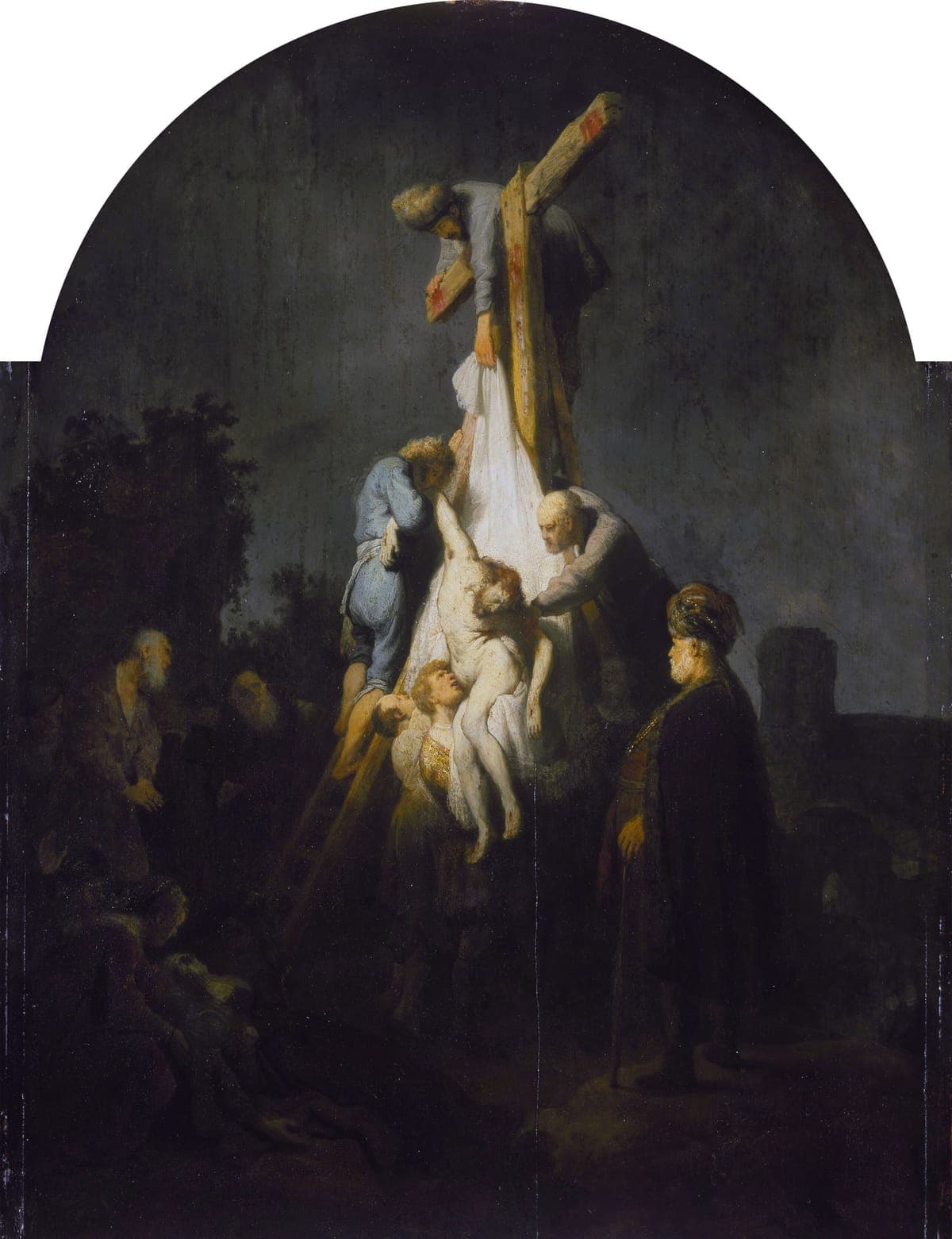
The body taken down from the cross, the moment before the burial 53:9 speaks of.
Rembrandt, The Descent from the Cross (1633). Public domain, held on this site.
53:10 to 12
The death was the LORD's own purpose
The death was the LORD's own purpose. Past it the servant is given offspring, long days, and a portion with the great.
Yet it was the LORD’s will to crush Him53:10 to 11
The suffering is appointed, since “it was the LORD’s will to crush Him”. His soul is “made a guilt offering”, the asham of Leviticus 5. Verse 11 joins justification and sin-bearing in one line: “My righteous Servant will justify many, and He will bear their iniquities”.
Drawn from Franz Delitzsch, Biblical Commentary on the Prophecies of Isaiah; Matthew Henry, Commentary on the Whole Bible.
After the anguish of His soul53:11
Barnes reads the anguish of His soul as toil to exhaustion, and He is satisfied to see so many saved. Chrysostom cites the Greek version, in which the LORD will show Him light, and reads it as His rising to life. Clarke records three manuscripts that omit righteous before Servant.
Drawn from Albert Barnes, Notes, Explanatory and Practical, on the Old and New Testaments (1832-1869); John Chrysostom, DEMONSTRATION AGAINST THE PAGANS 4:12-13; Adam Clarke, Commentary on the Bible.
numbered with the transgressors53:12
Jesus applies “He was numbered with the transgressors” to Himself at Luke 22:37. The Servant “made intercession for the transgressors”, praying for those He was counted among, as Luke 23:34 records. The Targum of Jonathan names the Servant of 52:13 the Messiah, and Rashi reads him as Israel.
Drawn from Franz Delitzsch, Biblical Commentary on the Prophecies of Isaiah; John Gill, Exposition of the Old Testament.
John Gill reads the travail of the servant's soul as the labour of childbirth.
“The travail of his soul’ is the toil and labour he endured, in working out the salvation of his people; his obedience and death, his sorrows and sufferings; particularly those birth throes of his soul, under a sense of divine wrath, for the allusion is to women in travail; and all the agonies and pains of death which he went through.”
The Hebrew here
The Hebrew behind The death was the LORD's own purpose
asham: guilt (offering)
Hebrew · H817Strong's entry: guilt; by implication, a fault; also a sin-offering
The word behind offering for sin at 53:10. It is the law's own term for the guilt offering of Leviticus 5, the sacrifice brought when guilt has to be dealt with. Where a wrong can be repaid the law asks for that as well, but the sacrifice is not the repayment.
46 times in the Old Testament · asham, in full →
zera: seed
Hebrew · H2233Strong's entry: seed; figuratively, fruit, plant, sowing-time, posterity
The word behind seed at 53:10. A man cut off out of the land of the living is given offspring to see.
229 times in the Old Testament · zera, in full →
One word at 53:11: the oldest copies carry a word the printed Hebrew does not, and the word is light.
The words used here
- Witness
- Any copy of the text that can be questioned about a reading: a manuscript, an ancient translation, or an early writer quoting it.
- Siglum
- The short label scholars give a manuscript. 1QIsa-a means the first Isaiah scroll from Cave 1 at Qumran.
- Masoretic Text
- The Hebrew Bible as the Masoretes copied and pointed it. It is the text behind the King James and the American Standard Version, so it is the reading in most English Bibles a reader already owns.
- Septuagint
- The Greek translation of the Hebrew Bible made by Jewish translators in the last centuries BC.
- Colophon
- The scribe's own note at the end of a manuscript, giving the date it was finished and often the name of the man who wrote it.
- The Jewish revisions
- Three later Greek translations, by Aquila, Symmachus and Theodotion, each known only from the writers who quote it and each dated on its own evidence.
One word at 53:11: the oldest copies carry a word the printed Hebrew does not, and the word is light.
When each witness was written
The Great Isaiah Scroll (1QIsa-a)
about 150 to 100 BC by the letter forms; radiocarbon gives 250 to 103 BC
The second Isaiah scroll (1QIsa-b)
first century BC, commonly dated about 50 to 25 BC on the handwriting
A third Isaiah copy from Cave 4 at Qumran
second to first century BC by the letter forms
Isaiah translated in the second century BC on the usual reckoning; the Greek copies that carry it are centuries later
complete Hebrew copies from about AD 920 to 1010, dated by their own colophons
Aquila, Symmachus and Theodotion
three separate works, each dated from the writers who quote it; Aquila is usually put at about AD 130, Symmachus later in the second century, and Theodotion's date is argued
What each witness reads at this verse
| Witness | What it reads here |
|---|---|
| The Great Isaiah Scroll (1QIsa-a)A complete Hebrew Isaiah from Cave 1 at Qumran.about 150 to 100 BC by the letter forms; radiocarbon gives 250 to 103 BC | What it reads hereHe shall see light |
| The second Isaiah scroll (1QIsa-b)A fragmentary Isaiah from the same cave, elsewhere almost letter for letter the Masoretic Text.first century BC, commonly dated about 50 to 25 BC on the handwriting | What it reads hereHe shall see light |
| A third Isaiah copy from Cave 4 at QumranA fragmentary Hebrew Isaiah carrying the same reading at this verse.second to first century BC by the letter forms | What it reads hereHe shall see light |
| The SeptuagintThe Greek translation, whose Hebrew source is inferred from the Greek rather than preserved.Isaiah translated in the second century BC on the usual reckoning; the Greek copies that carry it are centuries later | What it reads hereHe shall see light |
| The Masoretic TextThe Hebrew Bible as the Masoretes preserved it.complete Hebrew copies from about AD 920 to 1010, dated by their own colophons | What it reads hereHe shall see, and be satisfied |
| Aquila, Symmachus and TheodotionThree later Greek revisions, each made from a Hebrew text that lacks the word.three separate works, each dated from the writers who quote it; Aquila is usually put at about AD 130, Symmachus later in the second century, and Theodotion's date is argued | What it reads hereHe shall see, and be satisfied |
The two readings
He shall see, and be satisfied
The same clause without the word light, so that the verb has nothing to see.
After the anguish of His soul, He will see the light of life and be satisfied. By His knowledge My righteous Servant will justify many, and He will bear their iniquities.
How the two readings are weighed, and what does not change
The weight
Witnesses are weighed rather than counted, and the weight here rests on independence. Three Hebrew copies from Qumran agree with a Greek translation whose Hebrew source was a different copy, on a word the medieval Hebrew lacks. The second scroll carries extra force, because it agrees with the Masoretic Text nearly everywhere else, so its agreement with the Greek is not a habit of the scroll. John Meade weighs those factors and judges that they decide in favour of the longer reading. On the other side stand the Masoretic tradition, whose scribes counted letters, and the three Jewish revisions of the Greek, which lack the word as well.
Meade names a plain mechanism. A copyist's eye could lose a short word standing between two words that begin alike, which is one of the commonest ways a line loses a syllable.
What does not change
The word adds an image to the servant's vindication and changes no doctrine. Verse 10 has already said that he shall see his seed and shall prolong his days, and verse 12 gives him a portion with the great.
The King James and the American Standard Version both print the shorter Hebrew reading. The American Standard Version was published in 1901, more than forty years before the scrolls were found, so it could not have weighed them. The 1611 translators said in their own preface that marginal readings are necessary, which is exactly what a reader is doing here when he weighs two readings side by side. A phrase printed in some modern versions, the light of life, has the extra words in no manuscript at all.
- John Meade, “He will see light in Isaiah 53:11”, Evangelical Textual Criticism, 2020.
- Emanuel Tov, Textual Criticism of the Hebrew Bible, third edition, Fortress, 2012.
- The Israel Museum's digital facsimile of the Great Isaiah Scroll, and the Leon Levy Dead Sea Scrolls Digital Library.
What the apostles did with it
The New Testament writers quote this song by name and apply it to Jesus.
| The song's line | Quoted at | The use made of it |
|---|---|---|
| Isaiah 52:15…they have not been told | AtRomans 15:21 | Paul. Grounds his mission where the name was never heard. |
| Isaiah 53:1…of the LORD been revealed? | AtJohn 12:38Romans 10:16…arm of the Lord been revealed?” | John, then Paul. Unbelief at the signs, then at the gospel. |
| Isaiah 53:4 | AtMatthew 8:17…our infirmities and carried our diseases | Matthew. Reads the griefs as sicknesses, at an evening of healings. |
| Isaiah 53:5…His stripes we are healed | At1 Peter 2:24…“By His stripes you are healed | Peter. Carries the healing clause to the cross. |
| Isaiah 53:7…a lamb to the slaughter | AtActs 8:32Acts 8:33…like a sheep to the slaughter | Luke. Prints it as the text an official was reading. |
| Isaiah 53:9…any deceit in His mouth | At1 Peter 2:22 | Peter. Says the innocence clause of Jesus by name. |
| Isaiah 53:12…was numbered with the transgressors | AtLuke 22:37 | Jesus. Applies the closing verse to himself, the night of the arrest. |
The chariot on the Gaza road
An official of the Ethiopian court, riding home from Jerusalem and reading Isaiah aloud, asked Philip whether the prophet meant himself or some other man. Philip began at that same passage.
Acts 8:35Then Philip began with this very Scripture and told him the good news about Jesus.
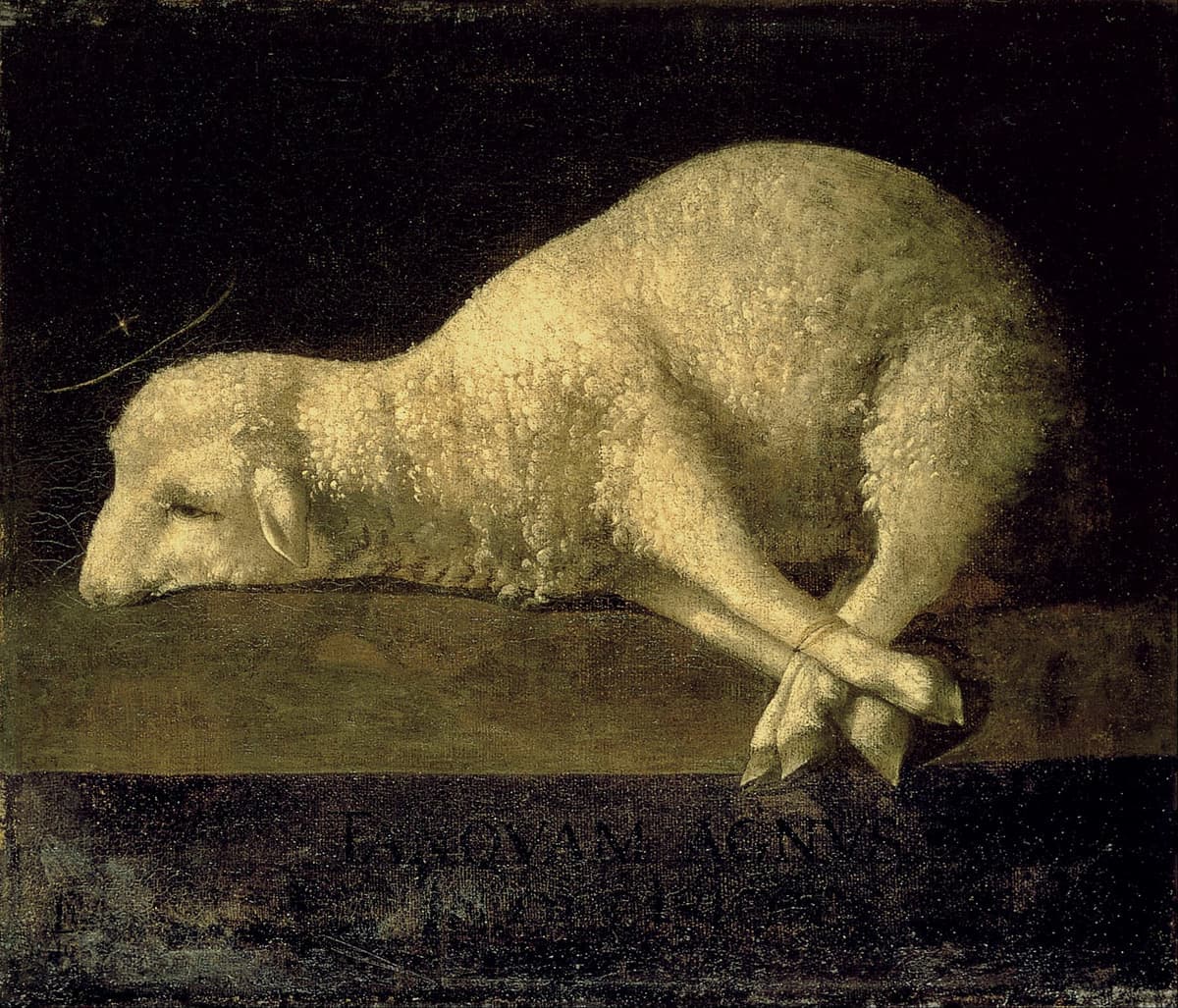
A bound lamb, the figure the official was reading.
Francisco de Zurbaran, Agnus Dei (about 1635 to 1640). Public domain, held on this site.
Whose servant?
Two old strands run through Jewish reading of this chapter. One takes the servant as the Messiah, the other as Israel, and a named holder of each stands below.
The messianic strand
The servant read as the Messiah
A Targum is an Aramaic rendering read aloud in the synagogue beside the Hebrew.
Targum Jonathan on Isaiah 52:13
core traditions from the first centuries AD · Aramaic, from the land of Israel
It names the servant at the head of the song as the messiah, then moves the suffering of the middle stanzas onto Israel and the nations.
“Behold, my servant the messiah shall prosper, he shall be exalted and extolled, and he shall be very strong.”
On Sefaria, translated by C. W. H. Pauli (1871); dated in Bruce Chilton, The Isaiah Targum (1987).
The national reading
The servant read as Israel
Its strongest ground is that Isaiah names the servant as Israel in the chapters around this one. Christian readers answer that 53:8 sets the servant over against my people.
Isaiah 41:8“But you, O Israel, My servant, Jacob, whom I have chosen…
Rashi on Isaiah 53:3
1040 to 1105 · Troyes
He says it is this prophet's custom to speak of all Israel as one man, and this has been the mainstream synagogue reading ever since.
“So is the custom of this prophet: he mentions all Israel as one man.”
Judaica Press Complete Tanach, translated by A. J. Rosenberg, on Sefaria, CC BY.
The hinge: one rabbi holding both
Ramban, Rabbi Moses ben Nahman
1194 to 1270 · Girona
He held both readings at once, arguing at Barcelona in 1263 that the true sense is Israel and also expounding the passage of the Messiah. Parashah below is the synagogue reading portion, Midrash the older rabbinic teaching.
“The right view respecting this Parashah is to suppose that by the phrase 'my servant' the whole of Israel is meant... As a different opinion, however, is adopted by the Midrash, which refers it to the Messiah, it is necessary for us to explain it in conformity with the view there maintained.”
Driver and Neubauer, The Fifty-Third Chapter of Isaiah According to the Jewish Interpreters (1877), pages 78 to 85; the Barcelona account in Hyam Maccoby, Judaism on Trial (1982).
The full roster of readings
Origen, Against Celsus 1.55
about AD 248 · Alexandria and Caesarea
He records the answer Jewish teachers gave him when he quoted this chapter at a disputation, which makes this the earliest dated record of the national reading.
“these predictions bore reference to the whole people, regarded as one individual, and as being in a state of dispersion and suffering, in order that many proselytes might be gained”
Ante-Nicene Fathers volume 4, at the Christian Classics Ethereal Library, public domain.
Sanhedrin 98b
the Babylonian Talmud, redacted about the sixth century from older material · The discussion record of the rabbinic academies of Babylonia
In a discussion of the Messiah's name, the Rabbis apply Isaiah 53:4 to him.
“And the Rabbis say: The leper of the house of Rabbi Yehuda HaNasi is his name, as it is stated: 'Indeed our illnesses he did bear and our pains he endured'”
Babylonian Talmud, Sanhedrin 98b, on Sefaria.
Ruth Rabbah 5:6
about the sixth century or later · A midrash on the book of Ruth, meaning a rabbinic commentary that teaches by story rather than by law
Reading Boaz's words to Ruth it hears the King Messiah, and takes the loaf dipped in vinegar as his afflictions.
“these are the afflictions, as it is stated: 'He was pained by our transgressions'”
Ruth Rabbah 5:6, on Sefaria.
A piyyut of the Day of Atonement
the older printed rite of the Jews of central and eastern Europe · A liturgical poem in the additional service of the Day of Atonement
A piyyut is a poem woven into the synagogue service. This one prays the chapter's sin-bearing of the Messiah, inside the prayer book itself. Many prayer books in use today do not carry it.
“Messiah, our righteousness, hath turned from us... Our iniquities and the yoke of our transgressions he will bear, for he was wounded for our transgressions”
Driver and Neubauer (1877), page 399, printed there anonymously from the rite. The attribution to Eleazar ha-Kalir that circulates elsewhere has no primary source and is not made here.
Ibn Ezra
1089 to 1164 · Spain, and then wandering
He reads the servant as Israel in exile, and records that Saadiah Gaon referred the passage to Jeremiah. His commentary is named here as a holder of both reports; the site prints no clause of it, because the clause that circulates in English does not carry either reading.
Ibn Ezra on Isaiah 52:13, on Sefaria.
Radak, Rabbi David Kimhi
about 1160 to 1235 · Provence
He reads the passage of the captivity of Israel.
“This Parashah refers to the captivity of Israel, who are here called 'my servant,' as in xli. 8.”
Driver and Neubauer (1877), page 49.
Moshe Kohen ibn Crispin
fourteenth century · Cordova, later Toledo
Writing after Rashi and Ibn Ezra, he argues the messianic reading as the plain sense of the passage.
“I am pleased to interpret it, in accordance with the teaching of our Rabbis, of the King Messiah, and will be careful, so far as I am able, to adhere to the literal sense.”
Driver and Neubauer (1877), pages 99 to 100.
Moshe Alshich
sixteenth century · Safed
He follows the midrashic tradition and says so in strong terms. His phrase is his own account of that tradition rather than a census, since Rashi, Ibn Ezra and Radak before him read the passage of Israel. His commentary works by homily rather than by grammar.
“our Rabbis with one voice accept and affirm the opinion that the prophet is speaking of the King Messiah, and we shall ourselves also adhere to the same view”
Driver and Neubauer (1877), section XXXVII, pages 258 to 259.
Why the national reading works for its holders
in the book's own words · Isaiah 41 to 54
Isaiah names the servant as Israel in the surrounding chapters, at 41:8, at 44:1 and 2, and at 49:3. After chapter 53 the word goes plural, the servants of the LORD at 54:17. Holders take the speakers of 53:1 to 9 as the astonished kings and nations of 52:15.
Isaiah 41:8; 44:1 and 2; 49:3; 54:17, American Standard Version.
Who holds it today
the present · Jewish teaching, Orthodox and non-Orthodox alike
The servant as Israel is the mainstream reading of Jewish interpretation today, and Jewish educators teach it as their own tradition's plain sense.
Aish and Outreach Judaism both present the chapter this way in their own teaching materials.
Scholars have proposed other identifications as well, among them the prophet himself, Jeremiah, Hezekiah, Moses, a humiliated Davidic heir, and the faithful remnant within the nation. Christopher R. North works through them one by one in The Suffering Servant in Deutero-Isaiah (Oxford, 1948).
Where this parts from Christ.
Neither strand reads this chapter as the death and resurrection of Jesus taking sin away. Two things the Christian faith cannot do without stand on that difference: whether Jesus is the promised Messiah, and whether his death takes sin away.
This site's tradition is Wesleyan-Pentecostal. It reads the servant as one person who dies for others and lives again, on the warrant of the index above.
Read more at Isaiah 53 and the rabbis, Every Jewish source on this chapter, named and dated..
The text behind the page
The song survives in a copy written before Christ, and who wrote these chapters is an old question.
The Great Isaiah Scroll came out of Cave 1 at Qumran in 1947, all sixty-six chapters on seventeen stitched sheets. Set beside the medieval Hebrew a thousand years younger it agrees across the book, and this song stands in it whole.
Most of what differs is spelling. Emanuel Tov counts the great majority of its roughly 2,600 differences as that kind, and the one that matters here is the word at 53:11.
About 150 to 100 BC by the letter forms; radiocarbon gives 250 to 103 BC.
The scroll's own page · The Israel Museum's digital facsimile
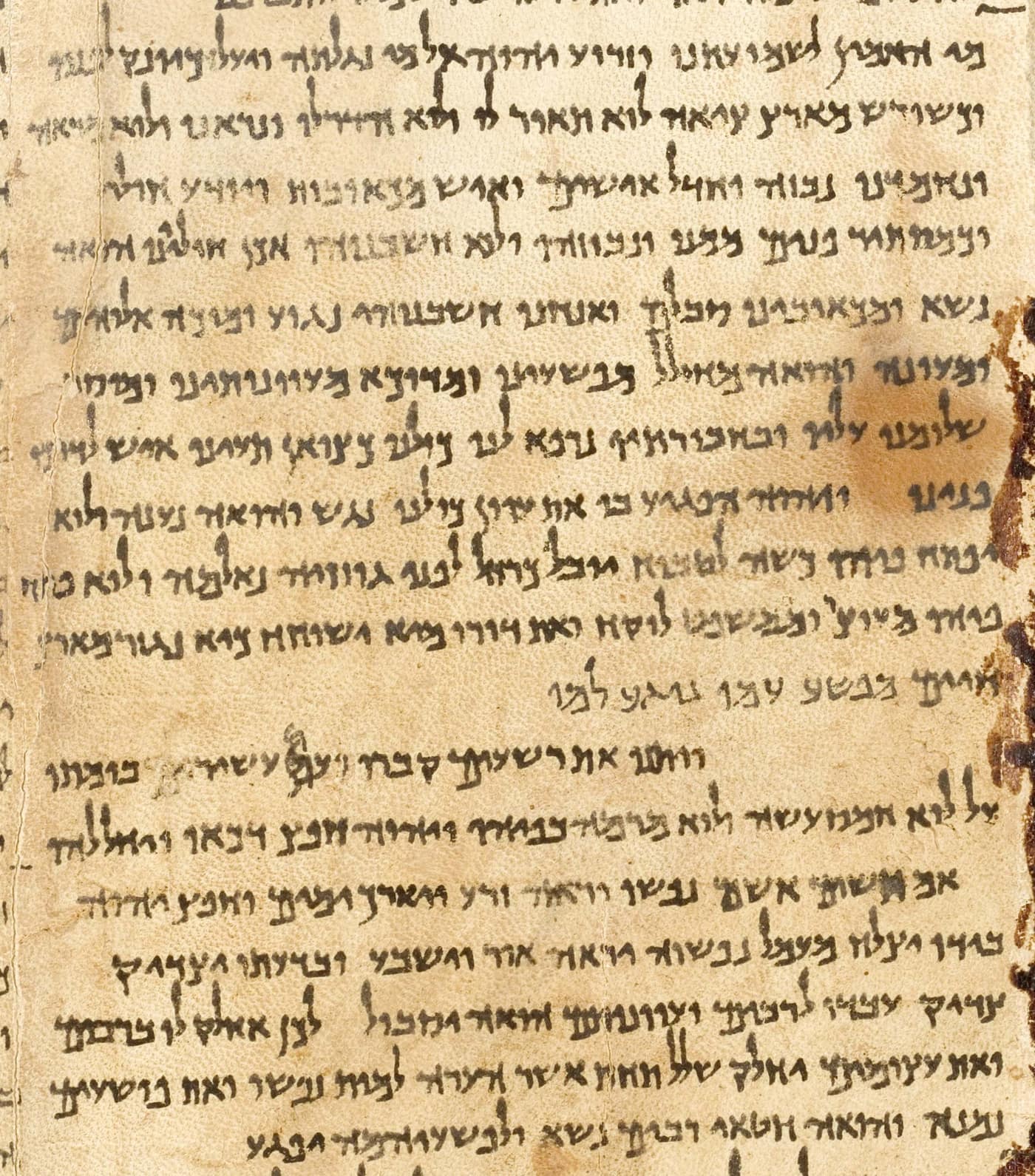
The column of the scroll that carries this song.
Photograph by Ardon Bar-Hama. Public domain, held on this site.
Who wrote these chapters
The traditional reading holds that Isaiah of Jerusalem wrote the whole book, and the New Testament quotes chapters from both halves of it under his name.
Most scholars in the field today read chapters 40 to 66 as the work of a later hand or hands writing in his line.
Read more at Isaiah, chapter by chapter, The whole book, and the authorship question at length..
Where it leads
On this page
Doctrines1
Manuscript1
Passage1
Story1
Sources
The works behind this page
- Scripture
- American Standard Version (1901), public domain, from the site's own verse store. The King James Version (1611) and the Berean Standard Bible (2023) are one click away in the reader.
- The exposition notes
- Written for this site and published in its exposition layer. Each note is shown here under its own anchor phrase with its own sources line, fetched at render.
- The voices quoted
- Albert Barnes, Notes, Explanatory and Practical, on the Old and New Testaments (1832 to 1869). Charles Spurgeon, The Metropolitan Tabernacle Pulpit, sermon 1075, A Root Out Of A Dry Ground (1872). Athanasius, Discourses Against the Arians 3.31 (fourth century). Matthew Henry, Commentary on the Whole Bible (1710). John Gill, Exposition of the Old Testament (1748 to 1763). All are public domain.
- The Jewish sources
- Targum Jonathan, Sanhedrin 98b, Ruth Rabbah 5:6, Rashi and Ibn Ezra as Sefaria prints them; Radak, Ibn Crispin, Alshich, Ramban's exposition and the Yom Kippur liturgical poem in S. R. Driver and A. Neubauer, The Fifty-Third Chapter of Isaiah According to the Jewish Interpreters (Oxford, 1877); Origen, Against Celsus 1.55, in the Ante-Nicene Fathers translation; the Barcelona account in Hyam Maccoby, Judaism on Trial (1982); Bruce Chilton, The Isaiah Targum (1987); Joel E. Rembaum, The Development of a Jewish Exegetical Tradition Regarding Isaiah 53, Harvard Theological Review 75 (1982).
- The text of 53:11
- John Meade, He will see light in Isaiah 53:11, Evangelical Textual Criticism (2020); Emanuel Tov, Textual Criticism of the Hebrew Bible, third edition (2012); the Israel Museum's digital facsimile of the Great Isaiah Scroll.
- The other identifications
- Christopher R. North, The Suffering Servant in Deutero-Isaiah (Oxford, 1948), cited and not quoted.
- The Hebrew
- Lemmas, transliterations, meanings and occurrence counts from the site's lexicon floor: STEP Bible's tagged Hebrew text (Tyndale House, CC BY 4.0), with Strong's Exhaustive Concordance (1890, public domain) labelled where it is the only entry.
- The paintings and the photograph
- Antonio Ciseri, Ecce Homo (1871); Diego Velazquez, Christ Crucified (1632); Francisco de Zurbaran, Agnus Dei (about 1635 to 1640); Rembrandt, The Descent from the Cross (1633); the Great Isaiah Scroll photographed by Ardon Bar-Hama. All public domain, taken from Wikimedia Commons and held on this site.
How this page is built
The song's verses, the New Testament verses and the clauses quoted in the Summary are fetched from the site's verse store at render, in the American Standard Version. Nothing on this page is typed from a Bible.
The exposition notes under each stanza are the published notes for that verse range, fetched at render and shown under their own anchor phrases with their own sources.
Each commentator's quotation is fetched from the quotation pool by its row id, so a row that is later withdrawn stops appearing without a change to this page. The pool's year field carries an author's death year on most early rows, so a Father is given his century and never a year.
The Hebrew words are read from the lexicon floor by Strong's key. No Hebrew is typed into this page.
The Jewish and patristic clauses in the readings section come from the public-domain translations named beside them, through the research brief that verified each one.
Dates for manuscripts are printed as ranges with the method that produced them, and never as a single year.