
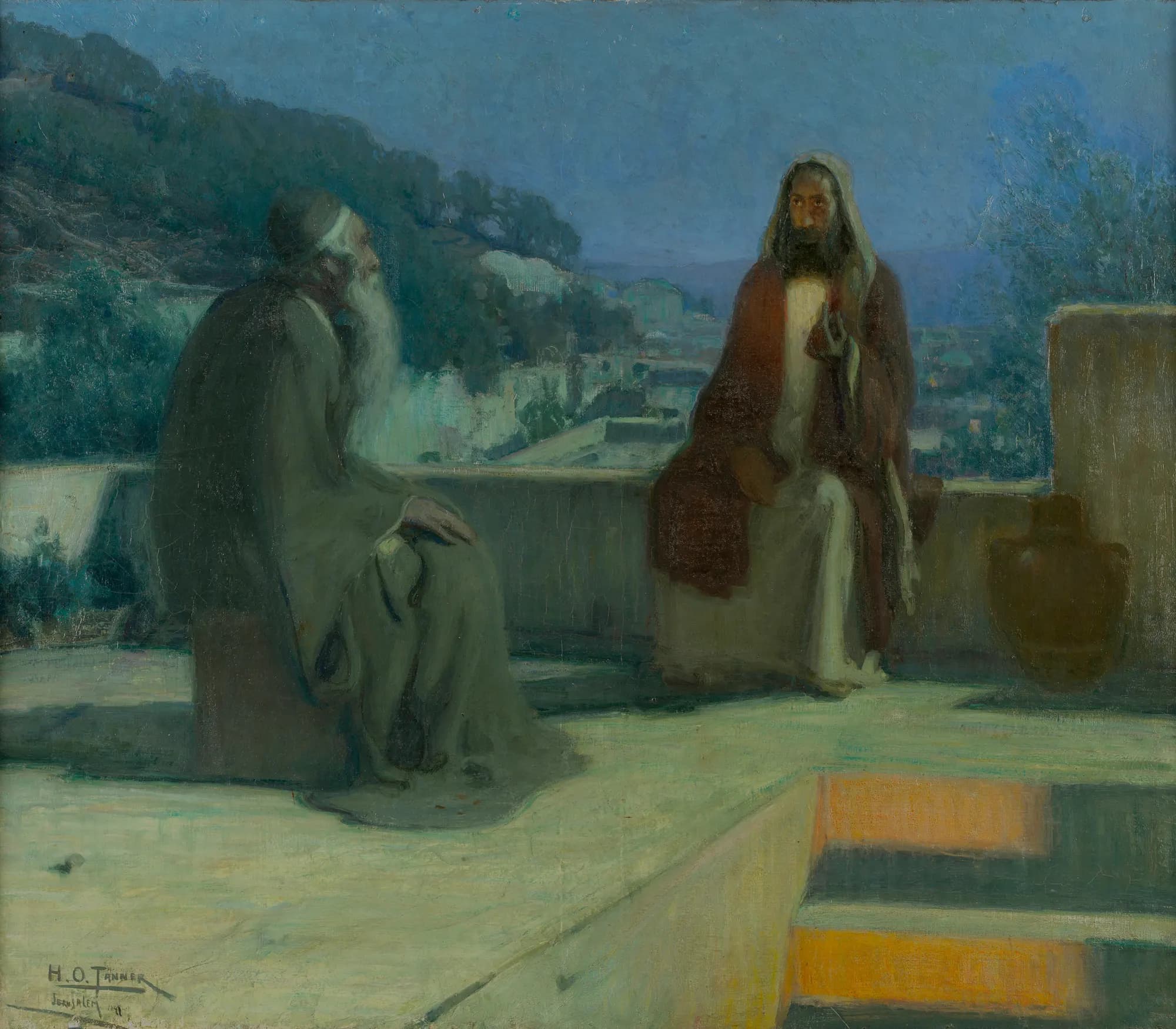
Nicodemus Visiting Jesus, Henry Ossawa Tanner, 1899. Public domain.
New Testament · Book 43 of 66
John
John tells the life of Jesus through seven signs and seven sayings that begin with I am. The writer says he wrote so that readers may believe that Jesus is the Christ, the Son of God.
John tells the life of Jesus through seven signs and seven sayings that begin with I am. The writer says he wrote so that readers may believe that Jesus is the Christ, the Son of God.
What is John about?
John tells of the Word who was with God in the beginning and became flesh. John the Baptist points to him, disciples follow, and his signs begin at Cana. At the feasts in Jerusalem he heals, feeds and names himself the bread, the light and the shepherd, and the people divide over him. He raises Lazarus, and the council resolves on his death. In an upper room he washes his disciples' feet and promises the Spirit. He is crucified, rises, and restores Peter by the sea. The book says it was written “that you may believe that Jesus is the Christ, the Son of God” (20:31).
All 21 chapters
Every chapter of the book, in one grid. Each cell opens that chapter.
- The Word and the first signsChapters 1 to 4
- The feasts and the divisionChapters 5 to 10
- Lazarus and the hour comeChapters 11 to 12
- The upper roomChapters 13 to 17
- The passionChapters 18 to 19
- The risen LordChapters 20 to 21
The colour is the movement of the book the chapter stands in, and every cell opens that chapter's Study level.
Who wrote it, where, when, for whom, and why?
The book closes by naming the disciple whom Jesus loved as the one who testifies to these things and has written them down (21:20 to 24). That disciple reclines at Jesus' side at the supper (13:23), stands at the cross (19:26), and runs to the empty tomb (20:2 to 8). The one who saw the side pierced is said to have testified, so that the reader may believe (19:35).
This is the disciple who testifies to these things and who has written them down. And we know that his testimony is true.
John 21:24, Berean Standard Bible.
The story moves between Galilee and Jerusalem. It names Bethany beyond the Jordan (1:28), Cana and Capernaum, Sychar in Samaria (4:5), the pool of Bethesda by the Sheep Gate (5:2), Bethany less than two miles from Jerusalem (11:18), a town called Ephraim (11:54), and the Sea of Tiberias (21:1).
The story is set by the feasts: three Passovers (2:13, 6:4, 11:55), an unnamed feast (5:1), Tabernacles (7:2) and Dedication in winter (10:22), with Caiaphas high priest that year (11:49). The last chapter answers a rumour that spread among the brothers that the beloved disciple would not die (21:23), which places the writing late in his life or after it.
The book explains Hebrew words and Jewish customs to its readers: Rabbi means Teacher (1:38), Messiah is translated Christ (1:41), and Jews do not associate with Samaritans (4:9). It addresses the reader directly as you, so that you also may believe (19:35).
The book states its purpose in its own words after Thomas's confession: these signs are written so that the reader may believe that Jesus is the Christ, the Son of God, and by believing have life in his name (20:30 to 31).
But these are written so that you may believe that Jesus is the Christ, the Son of God, and that by believing you may have life in His name.
John 20:31, Berean Standard Bible.
Sources. John 1:28, 1:38, 1:41, 2:13, 4:5, 4:9, 5:1, 5:2, 6:4, 7:2, 10:22, 11:18, 11:49, 11:54, 11:55, 13:23, 19:26, 19:35, 20:2 to 8, 20:30 to 31, 21:1 and 21:20 to 24. Every verse is read in the Berean Standard Bible.
How is John arranged, and what is it for?
The six movements the book falls into, then what it teaches and what it was written to do.
- The Word and the first signsChapters 1 to 4, 166 verses
The Word comes into the world, John bears witness, and the first signs are done.
- The feasts and the divisionChapters 5 to 10, 313 verses
At four feasts Jesus heals, feeds and speaks of himself, and the people divide.
- Lazarus and the hour comeChapters 11 to 12, 107 verses
Lazarus raised, the council's resolve, and the entry as the hour arrives.
- The upper roomChapters 13 to 17, 155 verses
The feet washed, the new commandment, the Spirit promised, and the prayer.
- The passionChapters 18 to 19, 82 verses
The arrest, the hearings before the priests and Pilate, the cross and the burial.
- The risen LordChapters 20 to 21, 56 verses
The empty tomb, Mary, Thomas, the purpose stated, and Peter restored.
The theme
The Word who was with God in the beginning and was God became flesh, and in him the Father is seen. His signs show his glory, and his sayings name what he is to those who come to him: bread, light, the gate, the shepherd, the resurrection, the way and the vine. Some believe and some refuse, and the refusal ends at the cross, which John calls the hour of his glory. The risen Lord gives his disciples the Spirit, sends them as the Father sent him, and gives life to all who believe.
The purpose
John was written so that its readers would believe that Jesus is the Christ, the Son of God, and by believing have life in his name. It chooses its signs and records its witnesses to that end, and it names the disciple whom Jesus loved as the one whose testimony stands behind it (21:24). It leaves the church with his peace, his Spirit and his command to love one another.
Seven signs and seven sayings
The seven signs
- 1Water made wine2:1 to 11
“He thus revealed His glory” (2:11)
- 2The official's son4:46 to 54
“Your son will live.” (4:50)
- 3The man at Bethesda5:1 to 15
“Get up, pick up your mat, and walk.” (5:8)
- 4Five thousand fed6:1 to 14
“Truly this is the Prophet who is to come into the world.” (6:14)
- 5The walk on the sea6:16 to 21
“It is I; do not be afraid.” (6:20)
- 6The man born blind9:1 to 41
“I was blind, but now I see!” (9:25)
- 7Lazarus raised11:1 to 44
“Lazarus, come out!” (11:43)
The seven I am sayings
The Word and the first signs, John 1 to 4
What the text says in these 166 verses, and the pages they open on.
John opens before creation: the Word was with God and was God, all things were made through him, and he came into a world that did not know him (1:1 to 11). John the Baptist says he is not the Christ and points his own disciples to the Lamb of God (1:29). At a wedding in Cana water becomes wine, the first sign, and the disciples believe (2:11). In Jerusalem Jesus drives the traders from the temple. He tells Nicodemus that a man must be born again (3:3), speaks with a Samaritan woman at Jacob's well, and at Cana heals an official's son at Capernaum by a word (4:50).
The Word became flesh and made His dwelling among us. We have seen His glory, the glory of the one and only Son from the Father, full of grace and truth.
- Study
John 1the Word, John's witness, and the first disciplesShow the summary and 5 pagesShow summary, 5 pagesHide the summary
John 1 says the Word was with God, was God, made everything, and then became a man and lived among us. The rest of the chapter is John the Baptist's testimony and the first men who followed Jesus.
- The three clauses of verse 1 answer Genesis 1:1 with a person.
- Verse 12 says those who received him were given the right to become children of God.
- Dwelt in verse 14 is the word for pitching a tent, the picture the tabernacle came from.
- John the Baptist calls him the Lamb of God, which gathers the whole sacrificial system into one title.
- The chapter ends on heaven open and angels going up and down, which is Jacob's dream at Bethel.
On this chapter (5)
- The prologue
The Word made flesh, John 1:1 to 18.
- The incarnation
The eternal Word who became a man.
- The Lamb
The Lamb of God who takes away the sin of the world.
- What is the Word of 1:1, and how did the church read it?
Answered under Where do readers disagree, lower on this page, with each reading and who holds it.
- John 1:29
The verse on its own page, with the commentators on it by era.
- Study
John 2water made wine at Cana, and the temple clearedShow the summary and 4 pagesShow summary, 4 pagesHide the summary
First sign at Cana. Water to wine. Jesus cleanses the temple (John places it at the opening of the ministry, not the end). 'Destroy this temple, and in three days I will raise it up'. He spake of the temple of his body. Many believed in his name when they saw the miracles which he did.
On this chapter (4)
- The seven signs
The signs John chose, and what each reveals.
- The cleansing of the temple
The traders driven out, and the temple of his body.
- Why does John place the temple cleared at the start?
Answered under Where do readers disagree, lower on this page, with each reading and who holds it.
- John 2:19
The verse on its own page, with the commentators on it by era.
- The seven signs
- Study
John 3Nicodemus at night, and John's last witnessShow the summary and 3 pagesShow summary, 3 pagesHide the summary
Nicodemus by night: 'no one can see the kingdom of God unless he is born again.' The bronze-serpent typology; 'God so loved the world' (3:16). John the Baptist's final testimony: 'He must increase; I must decrease.' 'Whoever believes in the Son has eternal life.'
On this chapter (3)
- Nicodemus at night
The ruler who came by night and was told of the new birth.
- Born of the Spirit
Born of water and the Spirit.
- John 3:16
The verse on its own page, with the commentators on it by era.
- Nicodemus at night
- Study
John 4the woman at the well, and the official's sonShow the summary and 3 pagesShow summary, 3 pagesHide the summary
Samaritan woman at the well: 'God is Spirit, and His worshipers must worship Him in spirit and in truth.' The fields white for harvest. Nobleman's son healed at Cana, the second sign in Galilee.
On this chapter (3)
- The woman at the well
Living water offered at Sychar.
- The Samaritans
The people between Judea and Galilee.
- John 4:24
The verse on its own page, with the commentators on it by era.
- The woman at the well
In the beginning, twice
In the beginning was the Word, and the Word was with God, and the Word was God. He was with God in the beginning. Through Him all things were made, and without Him nothing was made that has been made. In Him was life, and that life was the light of men. The Light shines in the darkness, and the darkness has not overcome it.
In the beginning God created the heavens and the earth. Now the earth was formless and void, and darkness was over the surface of the deep. And the Spirit of God was hovering over the surface of the waters. And God said, “Let there be light,” and there was light. And God saw that the light was good, and He separated the light from the darkness. God called the light “day,” and the darkness He called “night.” And there was evening, and there was morning—the first day.
- 1The Word with God1:1 to 3
“the Word was with God” (1:1)
- 2The light1:4 to 5
“The Light shines in the darkness” (1:5)
- 3The witness1:6 to 8
“He came as a witness to testify about the Light” (1:7)
- 4The Word made flesh1:9 to 14
“The Word became flesh and made His dwelling among us.” (1:14)
- 5Grace and truth1:15 to 18
“grace and truth came through Jesus Christ.” (1:17)
Characters (4)
Who the text names. A name with a page carries its door.
- Jesus
The Word made flesh and the Lamb of God (1:29).
- John the Baptist
Sent from God to testify about the Light (1:6 to 8).
- Andrew, Peter, Philip and Nathanael
The first disciples, each brought by another (1:41 to 45).
- The woman of Samaria
Brings her town to the man at the well (4:29).
Places (4)
Where the chapters stand.
- Bethany beyond the Jordan
Where John was baptizing (1:28).
- Cana
The first sign and the second (2:11, 4:46).
- Jerusalem and the temple
Where Jesus drives out the traders (2:15).
- Sychar and Jacob's well
A town of Samaria by Jacob's well (4:5).
Themes (4)
What these chapters raise, each on its own page where one stands.
- The Word made flesh
The eternal Word who became a man.
- Signs and belief
Signs that reveal his glory and call for faith.
- Born of the Spirit
The new birth Jesus tells Nicodemus of.
- The prologue
The eighteen verses that open the book.
Where these chapters take up the Old Testament (4)each marked as a quotation or an allusion, with the evidence
- Probable allusionGenesis 1:1 to 5 at John 1:1 to 5. In the beginning, God, light and darkness: the prologue opens with the first words of Genesis. The opening words are the same, and the figure sets the two passages side by side.
- Explicit quotationIsaiah 40:3 at John 1:23. John the Baptist names himself the voice calling in the wilderness. Introduced with in the words of Isaiah the prophet.
- Explicit quotationPsalm 69:9 at John 2:17. Zeal for your house will consume me, remembered by the disciples at the temple. Introduced with his disciples remembered that it is written.
- Probable allusionNumbers 21:8 to 9 at John 3:14. The Son of Man must be lifted up as Moses lifted up the snake in the wilderness. Jesus names Moses and the snake himself.
Parallels: the Baptist at Matthew 3, Mark 1:1 to 11 and Luke 3:1 to 22; the temple cleared at Matthew 21:12 to 13, Mark 11:15 to 17 and Luke 19:45 to 46, where it stands in the last week.
The feasts and the division, John 5 to 10
What the text says in these 313 verses, and the pages they open on.
At a feast in Jerusalem Jesus heals a man lame thirty-eight years on the Sabbath and answers that he works as his Father works (5:17). By the sea of Galilee he feeds five thousand and walks on the water, then calls himself the bread of life; many turn back, and Peter answers that he has the words of eternal life (6:68). At the Feast of Tabernacles he offers living water and names himself the light of the world, and the crowd is divided (7:43). He opens the eyes of a man born blind and calls himself the good shepherd. At the Feast of Dedication the leaders take up stones again (10:31).
Jesus answered, “I am the bread of life. Whoever comes to Me will never hunger, and whoever believes in Me will never thirst.
- Study
John 5the man at Bethesda, and the Son's work with the FatherShow the summary and 2 pagesShow summary, 2 pagesHide the summary
Third sign. The lame man at Bethesda. Sabbath controversy. 'To this very day My Father is at His work, and I too am working.' Jesus' discourse on the Son who does nothing of himself. The four witnesses. John, the works, the Father, the Scriptures. 'You pore over the Scriptures … These are the very words that testify about Me, yet you refuse to come to Me to have life.'
On this chapter (2)
- The seven signs
The signs John chose, and what each reveals.
- John 5:24
The verse on its own page, with the commentators on it by era.
- The seven signs
- Study
John 6five thousand fed, the walk on the sea, the bread of lifeShow the summary and 4 pagesShow summary, 4 pagesHide the summary
Feeding the five thousand. Fourth sign. Walking on the sea. Fifth sign. The Bread of Life discourse: 'I am the bread of life.' Hard saying; 'From that time on many of His disciples turned back and no longer walked with Him.' Peter's confession: 'You have the words of eternal life.'
On this chapter (4)
- The I am sayings
The seven sayings with a predicate, and the I am of 8:58.
- Bread
Manna in the wilderness and the bread of life.
- Walking on water
It is I; do not be afraid.
- John 6:35
The verse on its own page, with the commentators on it by era.
- The I am sayings
- Study
John 7Tabernacles, and the living waterShow the summary and 2 pagesShow summary, 2 pagesHide the summary
Feast of Tabernacles; brethren's unbelief. 'My time is not yet come.' Rivers of living water on the last day of the feast: 'this spake he of the Spirit.' Division among the people; officers sent to arrest him return saying 'never man spake like this man.'
On this chapter (2)
- Tabernacles
The feast of booths, water and light.
- John 7:38
The verse on its own page, with the commentators on it by era.
- Tabernacles
- Study
John 8the woman taken in adultery, and before Abraham wasShow the summary and 4 pagesShow summary, 4 pagesHide the summary
Pericope adulterae (textually disputed; commonly printed here) ('he that is without sin among you, let him first cast a stone at her.' 'I am the light of the world.' Abraham-seed controversy. 'Before Abraham was, I am') stones taken up; Jesus hides himself and escapes.
On this chapter (4)
- The light of the world
The second saying, spoken at Tabernacles.
- The I am sayings
The seven sayings with a predicate, and the I am of 8:58.
- Is 7:53 to 8:11 original, and where do the manuscripts place it?
Answered under Where do readers disagree, lower on this page, with each reading and who holds it.
- John 8:58
The verse on its own page, with the commentators on it by era.
- The light of the world
- Study
John 9the man born blind, and the Pharisees' verdictShow the summary and 3 pagesShow summary, 3 pagesHide the summary
Sixth sign. The man born blind. Sabbath controversy; clay and the pool of Siloam. Pharisees' interrogation. 'One thing I know, that, whereas I was blind, now I see.' 'For judgment I am come into this world, that they which see not might see; and that they which see might be made blind.'
On this chapter (3)
- The seven signs
The signs John chose, and what each reveals.
- The light
Light and darkness through Scripture.
- John 9:25
The verse on its own page, with the commentators on it by era.
- The seven signs
- Study
John 10the good shepherd, and the Feast of DedicationShow the summary and 3 pagesShow summary, 3 pagesHide the summary
The Good Shepherd discourse: 'I am the door … I am the good shepherd.' Other sheep not of this fold. 'My sheep hear my voice … and they shall never perish.' Feast of Dedication; the Jews attempt to stone him. 'I and my Father are one.'
On this chapter (3)
- The good shepherd
The shepherd who lays down his life.
- The deity of Christ
I and the Father are one.
- John 10:11
The verse on its own page, with the commentators on it by era.
- The good shepherd
Four feasts, and what Jesus says at each
- 1A feast of the Jews
“there was a feast of the Jews” (5:1)
The Son does what he sees the Father doing, and gives life. (5:19 to 47)
- 2Passover
“the Jewish Feast of the Passover was near” (6:4)
The bread of life, come down from heaven. (6:25 to 59)
- 3Tabernacles
“the Jewish Feast of Tabernacles was near” (7:2)
Living water on the last day, and the light of the world. (7:37 to 8:59)
- 4Dedication
“the Feast of Dedication took place in Jerusalem” (10:22)
My sheep hear my voice; the Father and I are one. (10:22 to 39)
Characters (4)
Who the text names. A name with a page carries its door.
- The man at Bethesda
Lame thirty-eight years, healed on the Sabbath.
- The crowd at Capernaum
Fed by the sea, then offended at his words (6:66).
- The man born blind
Washes at Siloam, sees, and worships (9:38).
- The Pharisees
Divided over the signs, and they cast the man out (9:34).
Places (4)
Where the chapters stand.
- Bethesda
A pool with five colonnades near the Sheep Gate (5:2).
- The Sea of Galilee
Where the five thousand are fed (6:1).
- Capernaum
The synagogue of the bread of life discourse (6:59).
- The pool of Siloam
Where the man born blind washes (9:7).
Themes (4)
What these chapters raise, each on its own page where one stands.
- Light and darkness
The light of the world, and those who refuse it.
- Eternal life
Life given now to the one who believes.
- The I am sayings
Seven sayings that name what Jesus is.
- The good shepherd
The shepherd who lays down his life for the sheep.
Where these chapters take up the Old Testament (3)each marked as a quotation or an allusion, with the evidence
- Explicit quotationPsalm 78:24 at John 6:31. The crowd cites the bread from heaven their fathers ate in the wilderness. Introduced with as it is written.
- Explicit quotationIsaiah 54:13 at John 6:45. They will all be taught by God, given as the reason those the Father draws come to Jesus. Introduced with it is written in the Prophets.
- Explicit quotationPsalm 82:6 at John 10:34. I have said you are gods, the answer to the charge of blasphemy at Dedication. Introduced with is it not written in your Law.
Parallels: the five thousand and the walk on the sea at Matthew 14:13 to 33, Mark 6:30 to 52 and Luke 9:10 to 17; Peter's answer at 6:68 to 69 beside Matthew 16:16, Mark 8:29 and Luke 9:20.
Lazarus and the hour come, John 11 to 12
What the text says in these 107 verses, and the pages they open on.
Word comes from Bethany that Lazarus is sick, and Jesus stays two days before he goes (11:6). Martha confesses him the Christ, Mary falls at his feet, and Jesus weeps and calls Lazarus out of the tomb. The chief priests and Pharisees meet, and Caiaphas says one man should die for the people (11:50). Mary anoints his feet at Bethany. The crowd meets him with palm branches, some Greeks ask to see him, and Jesus says the hour has come and speaks of a grain of wheat that dies (12:24). John ends the public ministry by summing up the unbelief Isaiah foretold (12:37 to 41).
But Jesus replied, “The hour has come for the Son of Man to be glorified.
- Study
John 11Lazarus raised, and the council's decisionShow the summary and 3 pagesShow summary, 3 pagesHide the summary
Seventh sign. Lazarus of Bethany raised. 'I am the resurrection, and the life.' 'Jesus wept.' 'Loose him, and let him go.' Caiaphas's prophecy; from that day they took counsel to put him to death. Jesus walks no more openly.
On this chapter (3)
- The raising of Lazarus
The seventh sign.
- The resurrection and the life
The fifth saying, spoken to Martha.
- John 11:25
The verse on its own page, with the commentators on it by era.
- The raising of Lazarus
- Study
John 12the anointing, the entry, the Greeks, the hourShow the summary and 2 pagesShow summary, 2 pagesHide the summary
Mary anoints Jesus at Bethany. Triumphal entry: 'Hosanna! … Blessed is the King of Israel!' Greeks ask to see Jesus. 'Truly, truly, I tell you, unless a kernel of wheat falls to the ground and dies, it remains only a seed; but if it dies, it bears much fruit.' 'And I, when I am lifted up from the earth, will draw everyone to Myself.' Closing of the Book of Signs.
On this chapter (2)
- The hour
The hour of the Son of Man's glory.
- John 12:24
The verse on its own page, with the commentators on it by era.
- The hour
The raising of Lazarus in seven stations
- 1The message11:1 to 4
“Lord, the one You love is sick.” (11:3)
- 2The two days11:5 to 16
“He stayed where He was for two days” (11:6)
- 3Martha11:17 to 27
“I believe that You are the Christ, the Son of God” (11:27)
- 4Mary11:28 to 32
“she fell at His feet” (11:32)
- 5The tears11:33 to 37
“Jesus wept.” (11:35)
- 6The tomb11:38 to 42
“Take away the stone” (11:39)
- 7The call11:43 to 44
“Unwrap him and let him go” (11:44)
Characters (3)
Who the text names. A name with a page carries its door.
- Martha, Mary and Lazarus
The family at Bethany whom Jesus loved (11:5).
- Caiaphas
High priest that year, who counsels one man's death (11:50).
- The Greeks
Visitors at the feast who ask to see Jesus.
Places (3)
Where the chapters stand.
Themes (3)
What these chapters raise, each on its own page where one stands.
- The resurrection and the life
The fifth saying, spoken to Martha.
- The raising of Lazarus
The seventh sign, and the council's answer to it.
- The hour
The hour of his glory, held back and then announced.
Where these chapters take up the Old Testament (4)each marked as a quotation or an allusion, with the evidence
- Explicit quotationPsalm 118:25 to 26 at John 12:13. Hosanna, and blessed is he who comes in the name of the Lord, shouted by the crowd. The psalm's own words, as the crowd shouts them.
- Explicit quotationZechariah 9:9 at John 12:15. Your King is coming, seated on the colt of a donkey. Introduced with as it is written (12:14).
- Explicit quotationIsaiah 53:1 at John 12:38. Lord, who has believed our message, read of the crowds who did not believe the signs. Introduced with this was to fulfill the word of Isaiah the prophet.
- Explicit quotationIsaiah 6:10 at John 12:40. He has blinded their eyes and hardened their hearts. Introduced with Isaiah says (12:39).
Parallels: the anointing at Matthew 26:6 to 13 and Mark 14:3 to 9; the entry at Matthew 21:1 to 11, Mark 11:1 to 10 and Luke 19:28 to 40; Martha and Mary at Luke 10:38 to 42.
The upper room, John 13 to 17
What the text says in these 155 verses, and the pages they open on.
Before the Passover Jesus loves his own to the end and washes their feet (13:1 to 5). He names the betrayer, Judas goes out into the night, and Jesus gives a new commandment: love one another as I have loved you. He tells the troubled disciples that he goes to prepare a place and is the way to the Father, and he promises another Advocate, the Spirit of truth. He is the vine and they the branches, and their sorrow will turn to joy (16:20). He prays for himself, for the eleven and for those who will believe through their word, that they may be one (17:21).
A new commandment I give you: Love one another. As I have loved you, so you also must love one another.
- Study
John 13the feet washed, the betrayer, the new commandmentShow the summary and 4 pagesShow summary, 4 pagesHide the summary
Upper-room begins. Jesus washes the disciples' feet: 'you also should wash one another’s feet. … I have set you an example so that you should do as I have done for you.' The betrayer identified by the sop; Judas goes out, 'into the night.' The new commandment: 'Love one another.'
On this chapter (4)
- The foot washing
The teacher who washes his disciples' feet.
- Love one another
The new commandment.
- The upper room
The farewell of John 13 to 17.
- John 13:34
The verse on its own page, with the commentators on it by era.
- The foot washing
- Study
John 14the Father's house, the way, the Spirit promisedShow the summary and 3 pagesShow summary, 3 pagesHide the summary
'Do not let your hearts be troubled.' 'In My Father’s house are many rooms.' 'I am the way and the truth and the life. No one comes to the Father except through Me.' Promise of the Comforter, the Spirit of truth. 'Peace I leave with you; My peace I give to you.'
On this chapter (3)
- The Paraclete
The Advocate, the Spirit of truth.
- Jesus on the Holy Spirit
What Jesus taught of the Spirit.
- John 14:6
The verse on its own page, with the commentators on it by era.
- The Paraclete
- Study
John 15the vine and the branches, and the world's hatredShow the summary and 3 pagesShow summary, 3 pagesHide the summary
'I am the true vine, and My Father is the keeper of the vineyard.' Abiding; fruitfulness; pruning. 'Greater love has no one than this, that he lay down his life for his friends.' The world's hatred; the coming Comforter shall testify.
On this chapter (3)
- Abide in me
The branches that remain in the vine.
- The vine and the vineyard
Israel the vine, and the true vine.
- John 15:5
The verse on its own page, with the commentators on it by era.
- Abide in me
- Study
John 16the Spirit's work, and sorrow turned to joyShow the summary and 2 pagesShow summary, 2 pagesHide the summary
Sorrow turned to joy. It is expedient that I go away. The Comforter will come. He will reprove the world of sin, of righteousness, and of judgment; he will guide you into all truth; he will glorify me. 'In the world you will have tribulation. But take courage; I have overcome the world!'
On this chapter (2)
- Who the Holy Spirit is
The person and work of the Spirit.
- John 16:13
The verse on its own page, with the commentators on it by era.
- Who the Holy Spirit is
- Study
John 17the prayer for himself, the eleven and the churchShow the summary and 2 pagesShow summary, 2 pagesHide the summary
High-priestly prayer. Jesus prays for himself, for the Eleven ('protect them by Your name, the name You gave Me'), and for all who will believe through their word. 'that all of them may be one, as You, Father, are in Me, and I am in You.' Sanctified by the truth.
On this chapter (2)
- The prayer for unity
That they may all be one.
- John 17:21
The verse on its own page, with the commentators on it by era.
- The prayer for unity
Five sayings on the Spirit
- 1With you forever14:16 to 17
“He abides with you and will be in you” (14:17)
- 2Teaches and reminds14:26
“will teach you all things and will remind you of everything I have told you” (14:26)
- 3Testifies15:26
“He will testify about Me” (15:26)
- 4Convicts the world16:7 to 11
“He will convict the world in regard to sin and righteousness and judgment” (16:8)
- 5Guides into truth16:13 to 15
“He will guide you into all truth” (16:13)
Characters (3)
Who the text names. A name with a page carries its door.
- Judas
Takes the morsel and goes out into the night (13:30).
- Peter
Refuses the washing, then asks for all of it (13:9).
- Thomas, Philip and Judas
Three questions that draw the answers of chapter 14.
Places (2)
Where the chapters stand.
- The room of the supper
Where the supper and the discourses stand.
- Jerusalem
The city of the Passover (13:1).
Themes (4)
What these chapters raise, each on its own page where one stands.
- The foot washing
The example the teacher gives his disciples.
- Love one another
The new commandment and its measure.
- The Spirit
The Advocate, the Spirit of truth, promised five times.
- Abiding
The branches that remain in the vine.
Where these chapters take up the Old Testament (2)each marked as a quotation or an allusion, with the evidence
- Explicit quotationPsalm 41:9 at John 13:18. The one who shares my bread has lifted up his heel against me, said of the betrayer. Introduced with this is to fulfill the Scripture.
- Explicit quotationPsalm 69:4 at John 15:25. They hated me without reason. Introduced with this is to fulfill what is written in their Law; the words stand at Psalm 35:19 as well.
Parallels: the betrayer named at Matthew 26:20 to 25, Mark 14:17 to 21 and Luke 22:21 to 23; Peter's denial foretold at Matthew 26:33 to 35, Mark 14:29 to 31 and Luke 22:31 to 34. The washing of the feet and chapters 14 to 17 stand in John alone.
The passion, John 18 to 19
What the text says in these 82 verses, and the pages they open on.
Jesus crosses the Kidron to a garden, where Judas brings soldiers and officers; Jesus answers I am, and they fall to the ground (18:6). Annas and Caiaphas question him, and Peter denies him three times. Before Pilate he says his kingdom is not of this world, and Pilate asks what truth is (18:38). Pilate has him flogged and hands him over to be crucified. At Golgotha the soldiers cast lots for his tunic woven in one piece, he gives his mother to the disciple he loved, and he says it is finished. A soldier pierces his side, and Joseph and Nicodemus lay him in a new tomb in a garden (19:41).
When Jesus had received the sour wine, He said, “It is finished.” And bowing His head, He yielded up His spirit.
- Study
John 18the arrest, Annas and Caiaphas, Peter, PilateShow the summary and 3 pagesShow summary, 3 pagesHide the summary
Gethsemane garden; the band of officers falls backward at 'I am He.' Peter's sword; 'Shall I not drink the cup the Father has given Me?' Annas, then Caiaphas. Peter's three denials. Trial before Pilate: 'My kingdom is not of this world; if it were, My servants would fight to prevent My arrest by the Jews.'
On this chapter (3)
- The trial of Jesus
The hearings before the priests and Pilate.
- Peter's denial
Three denials in the courtyard.
- John 18:37
The verse on its own page, with the commentators on it by era.
- The trial of Jesus
- Study
John 19the scourging, the cross, the pierced side, the burialShow the summary and 3 pagesShow summary, 3 pagesHide the summary
Scourging; thorn crown; 'Here is the man!' Pilate's attempts to release him fail: 'We have no king but Caesar'. Golgotha; the three-language title; the seamless garment; 'Woman, here is your son.' 'I am thirsty.' 'It is finished.' The pierced side. Blood and water. Joseph and Nicodemus bury Jesus in the garden tomb.
On this chapter (3)
- The passion in John
The cross as the hour of glory.
- Does John's day of the crucifixion differ from the other Gospels', and how have readers reconciled it?
Answered under Where do readers disagree, lower on this page, with each reading and who holds it.
- John 19:30
The verse on its own page, with the commentators on it by era.
- The passion in John
Pilate goes out and in: seven scenes
- Outside
- 1The accusers at the door18:28 to 32
“What accusation are you bringing against this man?” (18:29)
- 1The accusers at the door18:28 to 32
- Inside
- 2The king and the truth18:33 to 38
“What is truth?” (18:38)
- 2The king and the truth18:33 to 38
- Outside
- 3No basis, and Barabbas18:38 to 40
“Not this man” (18:40)
- 3No basis, and Barabbas18:38 to 40
- Inside
- 4The scourging and the crown19:1 to 3
“Then Pilate took Jesus and had Him flogged.” (19:1)
- 4The scourging and the crown19:1 to 3
- Outside
- 5The man presented19:4 to 8
“Here is the man!” (19:5)
- 5The man presented19:4 to 8
- Inside
- 6Authority from above19:9 to 11
“Where are You from?” (19:9)
- 6Authority from above19:9 to 11
- Outside
- 7The king handed over19:12 to 16
“Here is your King!” (19:14)
- 7The king handed over19:12 to 16
Characters (4)
Who the text names. A name with a page carries its door.
- Annas and Caiaphas
The two high priests who question Jesus (18:13, 18:24).
- Pilate
Finds no basis for a charge, and hands him over (19:16).
- Mary his mother
Given at the cross to the disciple he loved (19:27).
- Joseph and Nicodemus
They wrap the body with spices and bury it.
Places (4)
Where the chapters stand.
- The Kidron
The valley Jesus crosses to the garden (18:1).
- The praetorium
Pilate's headquarters, which the accusers will not enter.
- Golgotha
The Place of the Skull, near the city (19:17, 19:20).
- The garden tomb
A new tomb where no one had been laid (19:41).
Themes (3)
What these chapters raise, each on its own page where one stands.
- The glory of the cross
The Son of Man lifted up and glorified.
- The trial of Jesus
The hearings before the priests and the governor.
- The Lamb
The Lamb of God, whose bones are not broken.
Where these chapters take up the Old Testament (3)each marked as a quotation or an allusion, with the evidence
- Explicit quotationPsalm 22:18 at John 19:24. The soldiers divide his garments and cast lots for his clothing. Introduced with this was to fulfill the Scripture.
- Explicit quotationExodus 12:46; Psalm 34:20 at John 19:36. Not one of his bones will be broken, the law of the Passover lamb and the psalm's promise. Introduced with so that the Scripture would be fulfilled.
- Explicit quotationZechariah 12:10 at John 19:37. They will look on the one they have pierced. Introduced with as another Scripture says.
Parallels: Matthew 26:47 to 27:61, Mark 14:43 to 15:47 and Luke 22:47 to 23:56.
The risen Lord, John 20 to 21
What the text says in these 56 verses, and the pages they open on.
Early on the first day Mary Magdalene finds the stone taken away, and Peter and the other disciple run to the tomb and find the linen lying there (20:6 to 7). Jesus meets Mary in the garden and calls her by name. That evening he stands among the disciples behind locked doors, shows his hands and side, and breathes on them the Holy Spirit (20:22). A week later Thomas sees and confesses him Lord and God. The book states its purpose. At the Sea of Tiberias the risen Lord gives a great catch, asks Peter three times whether he loves him, and speaks of the beloved disciple who wrote these things (21:24).
But these are written so that you may believe that Jesus is the Christ, the Son of God, and that by believing you may have life in His name.
- Study
John 20the empty tomb, Mary, the locked room, ThomasShow the summary and 3 pagesShow summary, 3 pagesHide the summary
Resurrection morning. Mary Magdalene at the tomb. The disciple whom Jesus loved outruns Peter to the sepulchre. 'Rabboni!' Appearance to the disciples in the upper room that evening: 'Peace be with you!' Thomas: 'My Lord and my God!' The purpose statement (20:30–31): 'written so that you may believe that Jesus is the Christ, the Son of God, and that by believing you may have life in His name.'
On this chapter (3)
- Thomas believes
My Lord and my God.
- The ascension
I am ascending to my Father.
- John 20:28
The verse on its own page, with the commentators on it by era.
- Thomas believes
- Study
John 21the catch by the sea, and Peter restoredShow the summary and 4 pagesShow summary, 4 pagesHide the summary
Epilogue by the Sea of Tiberias. The second miraculous catch (153 fish). 'Feed my lambs … feed my sheep'. Peter's threefold restoration. 'Follow me.' The beloved disciple's testimony sealed: 'we know that his testimony is true.' See the textual-evidence panel on this chapter.
On this chapter (4)
- Shepherd the flock
The charge given to Peter and to the elders.
- Who is the beloved disciple, and who wrote the Gospel?
Answered under Where do readers disagree, lower on this page, with each reading and who holds it.
- Is chapter 21 an epilogue by another hand?
Answered under Where do readers disagree, lower on this page, with each reading and who holds it.
- John 21:17
The verse on its own page, with the commentators on it by era.
- Shepherd the flock
Three questions by the sea
Characters (4)
Who the text names. A name with a page carries its door.
- Mary Magdalene
First to see the risen Lord (20:16).
- Thomas
Doubts, then confesses him Lord and God (20:28).
- The beloved disciple
Sees the linen and believes (20:8).
- Simon Peter
Asked three times whether he loves the Lord.
Places (2)
Where the chapters stand.
- The tomb in the garden
The stone rolled away, the linen left (20:5).
- The Sea of Tiberias
Where the risen Lord gives the great catch (21:1).
Themes (3)
What these chapters raise, each on its own page where one stands.
- The risen Lord
The resurrection appearances in John.
- Thomas believes
The last confession of the book.
- Whoever believes
Belief and the life it receives.
Where these chapters take up the Old Testament (0)each marked as a quotation or an allusion, with the evidence
These chapters quote no Old Testament passage.
Parallels: the empty tomb at Matthew 28:1 to 10, Mark 16:1 to 8 and Luke 24:1 to 12; the risen Lord among the disciples at Luke 24:36 to 49; a great catch of fish at Luke 5:1 to 11.
- Author
- John the Apostle (2nd-century patristic attribution + internal claims)
- Date
- c. AD 85–95
- Audience
- Believers across the Asian churches; a summary Gospel
Where do readers disagree?
One list: the readings with their holders, and what the evidence does not settle.
Who is the beloved disciple, and who wrote the Gospel?
John→- John the son of Zebedee, the apostle. Held by Irenaeus, Against Heresies (about 180), 3.1.1, and by B. F. Westcott, The Gospel According to St. John (1880).
- John the Elder, a disciple outside the twelve. Held by Richard Bauckham, Jesus and the Eyewitnesses (2006).
- Lazarus. Held by Floyd V. Filson, Who Was the Beloved Disciple?, Journal of Biblical Literature 68 (1949).
What the evidence does not settle: The book never gives the beloved disciple's name, and the son of Zebedee is never named in it; each reading rests on who is absent from the text and on the witness of the second century.
The argument in full
John the son of Zebedee, the apostle. Irenaeus writes that John, the disciple of the Lord who leaned on his breast, published the Gospel at Ephesus. Westcott argues from the book's knowledge of Jewish custom and Jerusalem that the writer was a Palestinian Jew, an eyewitness, and an apostle.
John the Elder, a disciple outside the twelve. Papias names a John the Elder among the Lord's disciples beside the apostles, and the beloved disciple appears only in Jerusalem scenes, so he may be a Jerusalem follower who was not one of the twelve.
Lazarus. Lazarus is the one man the book says Jesus loved by name (11:3, 11:5), and the phrase the disciple whom Jesus loved first appears after his raising.
When was John written, and what does the Rylands papyrus show?
- Late in the first century, at Ephesus. Held by Irenaeus in Against Heresies, 3.3.4, and by Eusebius in the Ecclesiastical History, 3.23.
- Before the fall of Jerusalem in 70. Held by John A. T. Robinson, Redating the New Testament (1976) and The Priority of John (1985).
- The papyrus sets a latest date. Held by C. H. Roberts, An Unpublished Fragment of the Fourth Gospel in the John Rylands Library (1935), and questioned by Brent Nongbri, The Use and Abuse of P52, Harvard Theological Review 98 (2005).
What the evidence does not settle: A date from handwriting gives a range of decades and not a year, and the present tense of 5:2 can describe a place as it was; the year is argued from these two lines of evidence.
The argument in full
Late in the first century, at Ephesus. Irenaeus says John lived at Ephesus until the time of Trajan, and the church writers after him place the Gospel last of the four.
Before the fall of Jerusalem in 70. The book says there is in Jerusalem a pool with five colonnades (5:2), in the present tense, and says nothing of the temple's fall.
The papyrus sets a latest date. Papyrus 52, a scrap of 18:31 to 33 and 37 to 38 found in Egypt, was dated by its handwriting to the first half of the second century, so the Gospel had been copied and carried there by then; Nongbri argues the handwriting allows a later date.
Is 7:53 to 8:11 original, and where do the manuscripts place it?
- Not part of the Gospel as first written. Held by Bruce M. Metzger, A Textual Commentary on the Greek New Testament (1971).
- A true account the church kept. Held by Augustine, On Adulterous Marriages (about 420), book 2, and by Jerome, who kept it in the Vulgate (405).
- Original to John. Held by Zane C. Hodges and Arthur L. Farstad, The Greek New Testament According to the Majority Text (1982).
What the evidence does not settle: Where the passage came from before it entered the manuscripts; the store's Berean text carries it in its place, as 7:53 and 8:1 to 11.
The argument in full
Not part of the Gospel as first written. The passage is absent from the earliest papyri and from Codex Sinaiticus and Codex Vaticanus, and where it does appear it stands after 7:36, after 7:44, after 21:25, or after Luke 21:38.
A true account the church kept. Augustine says some removed the passage from their copies for fear it would seem to permit adultery, which would explain its absence from some manuscripts.
Original to John. The great majority of the later Greek manuscripts carry the passage at this place, and the majority of the copies is read as the best witness to the original.
Does John's day of the crucifixion differ from the other Gospels', and how have readers reconciled it?
The Passion in John→- Two calendars. Held by Annie Jaubert, The Date of the Last Supper (1957).
- The Preparation of the Passover week. Held by D. A. Carson, The Gospel According to John (1991).
- Galilean and Judean reckoning. Held by Harold W. Hoehner, Chronological Aspects of the Life of Christ (1977).
What the evidence does not settle: Which calendar or custom lies behind each Gospel's words, since none of them explains its reckoning; all four agree that Jesus died on the day before a Sabbath.
The argument in full
Two calendars. Jesus kept the Passover by the priestly calendar found in Jubilees and at Qumran, days before the temple's Passover, so both accounts hold.
The Preparation of the Passover week. The day of Preparation for the Passover (19:14) means the Friday of Passover week, and to eat the Passover (18:28) means the feast's later meals, so John agrees with the supper of Mark 14:12.
Galilean and Judean reckoning. Galileans counted the day from sunrise and Judeans from sunset, so Jesus and his disciples ate the Passover a day before the priests in Jerusalem.
Why does John place the temple cleared at the start?
The Cleansing of the Temple→- Jesus cleared the temple twice. Held by Augustine in The Harmony of the Gospels, 2.67, and by D. A. Carson, on 2:13 to 22.
- The order serves the book's meaning. Held by Origen in his Commentary on John, book 10.
What the evidence does not settle: Whether one act or two stands behind the accounts; John's own reason for it is the saying about the temple of his body (2:21).
The argument in full
Jesus cleared the temple twice. John's account differs in its words and its setting, three years before the others', so it records an earlier act.
The order serves the book's meaning. The Gospels cannot all be read as a sequence of events at this point, and John sets the clearing first to show the body that will be raised in place of the temple (2:19 to 21).
What is the Word of 1:1, and how did the church read it?
The Deity of Christ→- The eternal Son, God with God. Held by the Council of Nicaea in its creed of 325, and by Athanasius in Orations Against the Arians.
- The first of God's creatures. Held by Arius, as Athanasius quotes him in Orations Against the Arians, 1.5; condemned at Nicaea.
- The word of Genesis and the wisdom of God. Held by C. H. Dodd, The Interpretation of the Fourth Gospel (1953).
What the evidence does not settle: Where John's first readers heard the term from, the Hebrew Scriptures or the Greek philosophers; the verse itself says the Word was God, and the prologue ends with the one and only Son, himself God (1:18).
The argument in full
The eternal Son, God with God. The Word was in the beginning, was with God and was God, and all things were made through him (1:1 to 3), so he is uncreated and of one substance with the Father. The council confessed this in 325 against Arius.
The first of God's creatures. Arius taught that the Son was made before the ages and that there was a time when he was not.
The word of Genesis and the wisdom of God. The Word takes up the word by which God made the world (Genesis 1:3) and the wisdom beside him at creation (Proverbs 8:22 to 30), in a term the Greek world also knew.
Is chapter 21 an epilogue by another hand?
- Added by those who knew the writer. Held by Rudolf Bultmann, The Gospel of John (1941), and by Raymond E. Brown, on 21:1.
- The writer's own last chapter. Held by Paul S. Minear, The Original Functions of John 21, Journal of Biblical Literature 102 (1983), and by D. A. Carson, on 21:1.
What the evidence does not settle: Whether the we of 21:24 are other hands or the writer's own manner of speech; no copy of John ends at 20:31.
The argument in full
Added by those who knew the writer. The book reads as ending at 20:30 to 31, and 21:24 speaks of the disciple in the third person with a we who vouch for him.
The writer's own last chapter. Every manuscript of John carries chapter 21, its style matches the book, and it finishes what the book leaves open: Peter after his denial and the beloved disciple's end.
Textual evidence
On the integrity of John 21
Manuscript census, patristic witnesses, heptatic analysis, and a theological integration argument, read the full textual-evidence panel in the chapter reader.
The pages John opens on
Studies274
- The Prologue
- The Seven Signs
- The Seven I Am Sayings
- The Upper Room and the Farewell
- The Passion and Resurrection in John
- The Incarnation
Show the next 6 titles
- The Deity of Christ
- Nicodemus at Night
- The Woman at the Well
- The Raising of Lazarus
- The Hour
- The Foot Washing
Show the next 6 titles
Show the next 6 titles
- 2 John, the Study Guide
- 3 John, the Study Guide
- The Gospels
- Colossians, the Study Guide
- Ezekiel, the Study Guide
- Jesus
Show the next 6 titles
- Jesus on Salvation
- Peace
- The Beloved Disciple and the elder
- The Lord Is My Shepherd: Psalm 23
- The Tests of Life: 1 John's Three Tests
- Zechariah, the Study Guide
Show the next 6 titles
- Christ Our Wisdom: Proverbs 8 and the Wisdom of God
- Creation to New Creation
- Jacob's Ladder: Genesis 28
- Lamb of God
- The Word / Logos
- The Scarlet Thread
Show the next 6 titles
- The Tabernacle
- The Lamb: Revelation's Christology
- The God Who Sings: Zephaniah 3:17
- The Messianic Psalms
- Predestination and Election
- Names of God
Show the next 6 titles
- I AM
- The Burning Bush: the Name Revealed
- Good Shepherd
- The Suffering Servant
- The Fruit of the Spirit
- The Rapture: the Blessed Hope and the Four Timings
Show the next 6 titles
- Trees: Eden, Cross, New Jerusalem
- Taw: The Mark of God
- Christ / Messiah
- The Ending of Mark: 16:9-20
- The Angel of YHWH
- The Binding of Isaac
Show the next 6 titles
- Wisdom Seen on Earth
- Bethel
- The Designer's Fingerprint
- Christophany
- Creation and Evolution
- Elijah the Tishbite
Show the next 6 titles
- Ezekiel's Temple, Ezekiel 40-48
- Follow Me
- Gematria and Its Limits
- God Dwelling with His People, from Eden to the New Jerusalem
- Thanks for Who He Is
- How Greek Works
Show the next 6 titles
- Immanuel
- Irony in Scripture: More Than the Speaker Knows
- Jacob Wrestles the Angel
- Jesus: Titles & Roles
- John the Baptist
- The Jordan
Show the next 6 titles
- Theological Words
- Mary of Nazareth
- Mount Moriah
- Mouth to Mouth: How God Spoke with Moses
- Peter
- Reading Rabbinic Sources as a Christian
Show the next 6 titles
- Born Again
- The Sacrificial System
- The Baptism of Jesus: Matthew 3
- The Burnt Offering
- The Dove
- The Exodus, Redemption's Master-Type
Show the next 6 titles
- The Flesh
- The Gap Reading at Genesis 1:2
- The Glory That Filled the House
- Light
- The prophet like Moses
- Thirty-Seven and Seventy-Three
Show the next 6 titles
- The Trinity
- When God relents, and the gracious and compassionate formula
- Who the Holy Spirit Is
- Wordplay: the Puns of the Prophets
- Jesus at Twelve (Luke 2)
- The Covenant of Phinehas
Show the next 6 titles
- Solomon's Temple
- The Cleansing of the Temple: John 2 · Matthew 21
- The Imprecatory Psalms
- The Second Temple
- The Seven Days of a Jewish Wedding
- The Three Pilgrim Feasts
Show the next 6 titles
- Entering the Kingdom
- Grumbling, the Opposite of Thanks
- Hard Questions in the Old Testament
- God Is Love
- The Words Agape, Philia, Chesed and Ahavah
- Scribes and the Sanhedrin
Show the next 6 titles
- The Bride & the Jewish Wedding
- The Heavens
- The Love Chapter: 1 Corinthians 13
- The New Heart and the New Spirit
- The Serpent
- Type-Scenes: the Stories Scripture Tells Twice
Show the next 6 titles
Show the next 6 titles
- The high places
- The Sects of Second Temple Judaism
- Water
- Words of Knowledge & Wisdom
- Worship
- The Son of Man in 1 Enoch
Show the next 6 titles
- Afterlife Vocabulary
- The Great White Throne
- Hell and the Final State of the Lost
- His Authority
- Moses
- Moses Wrote of Me
Show the next 6 titles
- The Son of God
- The Judge
- The Questions Jesus Asked
- The Road to Emmaus: Luke 24:13-35
- The Two Resurrections
- Who Wrote the Pentateuch
Show the next 6 titles
- Work and Vocation
- Bread
- Cut Off from Among His People
- Eternal Security, and the Five Warnings of Hebrews
- Feeding the Five Thousand, John 6:1-15
- Generosity
Show the next 6 titles
- Why He Said He Came
- The Words Qadosh and Hagios
- Jesus on Himself
- Manna
- Prophet, Priest and King: The Threefold Office of Christ
- The blood rule after the cross
Show the next 6 titles
- The Father's Will
- The Kingdom and Culture: Dominion, Transformation and Separation
- The Lord's Supper
- The Quail at Kibroth-hattaavah
- The Seal & the Signet
- The Showbread
Show the next 6 titles
- The Feast of Unleavened Bread
- Walking on Water: Matthew 14:22-33
- Bethlehem
- Brit milah: circumcision on the eighth day
- The Words Chazaq, Amats and Parrhesia
- The Fall Feasts
Show the next 6 titles
- The Feast of Tabernacles
- The Appointed Times Read as a Calendar of Prophecy
- The Promise of the Father
- The Rock in the Wilderness
- The Ruler from Bethlehem
- The Origin of Evil
Show the next 6 titles
- The Names of Satan
- The Death Penalty in the Law of Moses
- The Lampstand
- The Light of the World
- The Name of the LORD Given at the Bush
- The Sevens of Scripture
Show the next 6 titles
- Two or three witnesses
- Generational Curses
- The Goodness of God and the Problem of Evil
- The Retribution Teaching and Its Limits
- The Animal Apocalypse
- Hanukkah: the Feast the Revolt Made
Show the next 6 titles
Show the next 6 titles
- The Door & the Gate
- The Dynastic-Ruler Reading of the Sons of God
- The Fall of Samaria and the Indictment of 2 Kings 17
- The Good Shepherd
- The Intertestamental Period
- The Maccabean Revolt
Show the next 6 titles
- The Sheep and the Flock
- The Shepherd
- The Shepherd's Life: Psalm 23
- The Trial of Jesus
- The Valley of Dry Bones: Ezekiel 37
- The Righteous One Condemned
Show the next 6 titles
- Prayers, Merits, and the Dead
- The High-Priestly Line
- Jesus Wept
- Mary and Martha: Luke 10:38-42
- Mourning and Burial in Israel
- The Ascension: Acts 1:1-11 · Luke 24:50-53
Show the next 6 titles
- The Jewish Day and the Watches of the Night
- The Resurrection and the Life
- Isaiah in the Temple
- Satan
- Satan Across the Testaments
- The Entry into Jerusalem
Show the next 6 titles
- The Hardening of the Heart
- The Humanity of Christ
- The Passover and the First Month
- The Seed
- The Throne Room
- Hospitality in Israel and the Early Church
Show the next 6 titles
- Love
- Love One Another
- See How They Love One Another
- If You Love Me, You Will Keep My Commandments
- The Bronze Laver
- “Great Is Truth.” The Three Guardsmen
Show the next 6 titles
- Asking in His Name
- Enoch Walked With God
- The Words Emunah and Pistis
- How Scripture Shapes Christian Ethics
- Knowing the Father
- The Marriage Supper of the Lamb
Show the next 6 titles
- My Peace I Give to You
- Peace and the Nervous System
- The House
- The Name
- The Way, the Truth, and the Life
- Truth-Telling and the Hard Cases of Deception
Show the next 6 titles
- Unto Us a Child Is Born
- Joy in the Spirit
- Mercy in the Plague Years
- The Vine & the Vineyard
- The World's Hatred
- Joy in Suffering
Show the next 6 titles
- The Joy Set Before Him
- The Words Simchah and Chara
- Philip and the Ethiopian: Acts 8
- Antichrist, the Word and the Figure
- In the World, Not of It
- Made Holy
Show the next 6 titles
People and groups13
Show the next 6 titles
Show the next 1 title
Places10
Words10
Sources for this page
The movements, the chapter entries, the figures and the Context are read off the text of John. The works behind the readings under Where do readers disagree and the figures are Irenaeus, Against Heresies (about 180); Origen, Commentary on John (about 230); Eusebius, Ecclesiastical History (about 325); the Council of Nicaea, its creed (325); Athanasius, Orations against the Arians (about 340); Augustine, The Harmony of the Gospels (about 400) and On Adulterous Marriages (about 420); Jerome, the Vulgate (405); B. F. Westcott, The Gospel According to St. John (1880); C. H. Roberts, An Unpublished Fragment of the Fourth Gospel in the John Rylands Library (1935); Rudolf Bultmann, The Gospel of John (1941); Merrill C. Tenney, John: The Gospel of Belief (1948); Floyd V. Filson, Who Was the Beloved Disciple?, Journal of Biblical Literature 68 (1949); C. H. Dodd, The Interpretation of the Fourth Gospel (1953); Annie Jaubert, The Date of the Last Supper (1957); Raymond E. Brown, The Gospel According to John XIII to XXI (1970); Bruce M. Metzger, A Textual Commentary on the Greek New Testament (1971); John A. T. Robinson, Redating the New Testament (1976); Harold W. Hoehner, Chronological Aspects of the Life of Christ (1977); Zane C. Hodges and Arthur L. Farstad, The Greek New Testament According to the Majority Text (1982); Paul S. Minear, The Original Functions of John 21, Journal of Biblical Literature 102 (1983); D. A. Carson, The Gospel According to John (1991); Brent Nongbri, The Use and Abuse of P52, Harvard Theological Review 98 (2005); Richard Bauckham, Jesus and the Eyewitnesses (2006); and Andreas J. Köstenberger, A Theology of John's Gospel and Letters (2009). Every verse quoted on this page is the Berean Standard Bible, read from the store.