
The Fourfold Gospel · Four Books
The Gospels
The New Testament opens not with one life of Jesus but with four (three seen together, one seen on its own) and the early church defended the number rather than smoothing it away. Irenaeus argued that there could be neither more nor fewer Gospels than these four (Against Heresies 3.11.8), and Jerome fixed the pairing Christian art still uses: the man, the lion, the ox, the eagle. Four portraits, one Christ.
Summary
Four portrait cards lay out each evangelist's audience, distinctive material, and opening move side by side, and the man-lion-ox-eagle tradition is traced back to Irenaeus and Jerome. Four seriously held answers to who copied whom are named without settling the question, and Luke's own prologue explains why four accounts exist at all.
- Four portrait cards lay out each evangelist's audience, distinctive material, and opening move side by side.
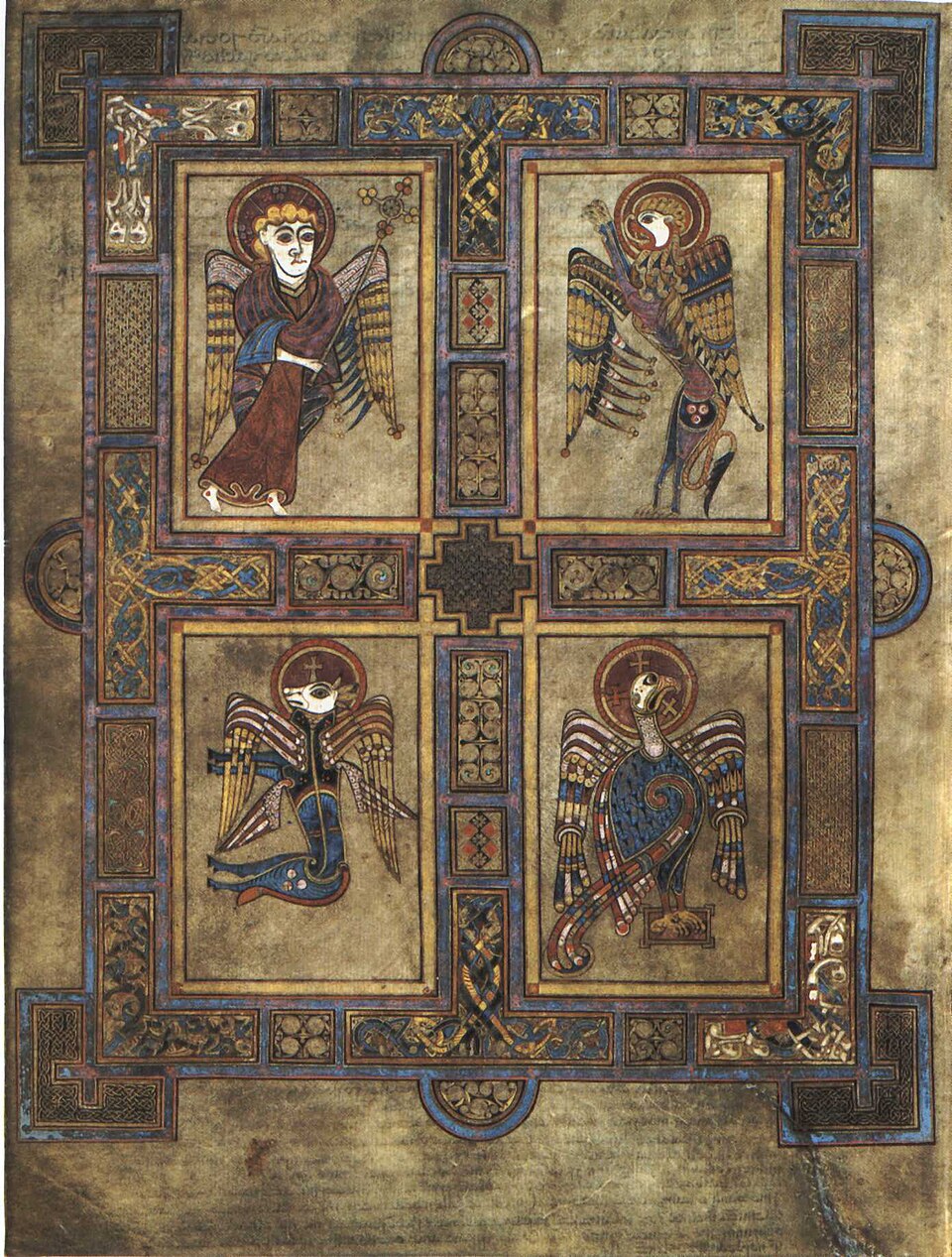
- The man, lion, ox, and eagle tradition is traced to Irenaeus and Jerome, and shown in the Book of Kells.
- Four seriously held answers to the Synoptic Problem, who copied whom, are named without settling it.
- Luke's own prologue is used to explain why four accounts of one life exist at all.
- A closing rail links each Gospel to its own signature study, like the Sermon on the Mount or the Seven Signs.
Four Portraits, One Life
one subject, four angles: each a real difference in emphasis
Matthew
the King to Israel
- Audience
- Jewish-Christian readers, argued from Israel's own Scriptures
- Distinctive material
- a royal genealogy, roughly a dozen fulfillment formulas, five great discourses, and "the kingdom of heaven" where the others say "kingdom of God"
- Opening move
- opens with a genealogy tracing kingship from Abraham through David (Matt 1:1–17)
Mark
the Servant in motion
- Audience
- a Gentile readership, shown authority rather than argued into it
- Distinctive material
- no birth narrative at all; euthys, "immediately," over forty times
- Opening move
- opens with no genealogy: straight to John the Baptist and "the beginning of the gospel" (Mark 1:1)
Luke
the Son of man to the nations
- Audience
- Theophilus, and through him the widest reach: women, the poor, the Gentile world
- Distinctive material
- an ordered, physician's account that continues into Acts as one two-volume work
- Opening move
- opens with a formal prologue naming his method: eyewitness testimony traced and set "in order" (Luke 1:1–4)
John
the Son of God believed on
- Audience
- the church at large, written to a stated purpose
- Distinctive material
- seven signs, seven "I am" sayings: over ninety percent unique to this Gospel
- Opening move
- opens before Genesis itself: "In the beginning was the Word" (John 1:1)
Four portraits, one subject. The differences are not contradictions to be smoothed away but angles to be received: Matthew traces a King's right to a throne, Mark races to a cross, Luke widens the door to every nation, John lifts the eyes to the Word made flesh.
“was with God—having a conscious personal existence distinct from God (as one is from the person he is "with"), but inseparable from Him and associated with Him”
Jamieson, Fausset & Brown, Commentary Critical and Explanatory on the Whole Bible (1871), on John 1:1 — public domain.
Acts: Luke's second volume, the other half of the one two-volume work →
Why Four
the man, the lion, the ox, the eagle: and where the pairing came from

The creature names above, man, lion, ox, eagle, are not given to the evangelists anywhere in Scripture. They come from a reading the early church made: Irenaeus, arguing against those who wanted one Gospel or many, tied the number four to the four living creatures around the throne in Ezekiel's vision (Eze 1:5–10) and John's (Rev 4:6–7), reasoning that the shape of the created order and the shape of the witness to Christ answer each other.
Which creature belongs to which evangelist was never settled by that argument; Irenaeus assigned them one way and Jerome, in the prologue to his Commentary on Matthew, another, and it is Jerome's arrangement that Christian art has used ever since, and it is worth keeping, because it remembers something true: four distinct portraits of one Christ, the King, the Servant, the Son of Man, the Son of God.
The Synoptic Question
seen together: and the question of who wrote first
Matthew, Mark, and Luke can be laid side by side: the Greek called them synoptic, “seen together” (syn + opsis), a term made concrete when J. J. Griesbach printed the first parallel-column synopsis in 1776. Roughly ninety percent of Mark's content reappears in Matthew, and Luke carries much of it as well, the same events, often the same wording, in the same order. John reads its own way: over ninety percent of its material is unique, with no parables and no exorcisms, but extended discourses, seven numbered signs, and a purpose stated outright, “these are written, that ye may believe that Jesus is the Christ” (John 20:31).
If three Gospels share so much wording, who wrote first, and who read whom? This is the Synoptic Problem: a literary question, not a doctrinal one. Several answers are seriously held.
Two-Source (the academic majority)
Markan priority plus a lost sayings source, "Q": Mark wrote first, and Matthew and Luke independently drew on Mark plus Q. Best explains the shared order and wording; its weakness is that Q has never been found.
Farrer
Keeps Markan priority but drops Q: Luke used both Mark and Matthew directly. Simpler on sources; harder to explain why Luke would rearrange Matthew's sermons the way he does.
Two-Gospel (Griesbach)
Reverses the order: Matthew wrote first, Luke used Matthew, and Mark abridged both. Fits some patristic testimony; strains on why Mark would shorten his two predecessors rather than add to them.
Augustinian
Follows the traditional canonical sequence, Matthew, then Mark, then Luke, each writer building on the last (Augustine, De Consensu Evangelistarum).
The tension: Papias, preserved in Eusebius (Ecclesiastical History 3.39.15–16), remembered Mark as Peter's interpreter, writing accurately but not in sequence, and Matthew as the one who arranged the sayings: testimony every hypothesis has to reckon with.
Where the literary and the canonical meet: All four Gospels stand as independently inspired, historical, and complementary. Whichever hand moved first, that holds. The literary question is genuinely open and does not touch it.
Reading the Four Together
Luke states the reason four accounts exist
“Many have undertaken to compose an account of the things that have been fulfilled among us, just as they were handed down to us by the initial eyewitnesses and servants of the word. Therefore, having carefully investigated everything from the beginning, it seemed good also to me to write an orderly account for you, most excellent Theophilus, so that you may know the certainty of the things you have been taught.”
— Luke 1:1–4 (BSB)
Luke knows of the other accounts. He writes not to replace them but to add certainty, the plainest window in the New Testament onto how a Gospel was composed: from eyewitness testimony, carefully traced, set in order for a reader who needs solid ground. The same paralytic is lowered through the same roof in Matthew 9, Mark 2, and Luke 5, and the small differences in each telling are the fingerprints of real witnesses, not the seams of a fabrication. The four voices do not compete. They surround one life, and the reader who listens to all four hears it whole.
The Four Books
each evangelist's workbench, reader, and own ground
Notable art
— click a piece to enlargeKeep Studying
By subject
On this page
Studies9
People and groups5
Places1