

Jesus Christ · On Himself
The Son of God
Three times, in three settings, over roughly the last year of His ministry, Jesus makes essentially the same claim about who He is in relation to the Father — and three times the reaction escalates. Words, in Jerusalem. Stones already in hand, at the temple. And finally, under oath before the court that can pronounce a death sentence, He says it one more time and does not take it back.
Raphael, The Transfiguration, 1516-1520. Public domain.
Summary
This page follows three scenes where Jesus claims equality with the Father, each with the church's commentary, ending with what His own hearers understood Him to mean.
- Scene one: healing on the Sabbath, He claims His work matches the Father's own unceasing work (John 5)
- Scene two: 'I and my Father are one' draws stones at the temple (John 10)
- Scene three: under oath before the Sanhedrin, His direct answer earns a death sentence (Mark 14)
- Twice the crowd reaches for stones and once a court condemns Him: their own reaction is the evidence of what they heard
- A separate section explains why the trial answer specifically counted as blasphemy under Jewish law
Words, Stones, Verdict
the same claim, three times, escalating
SETTING
Jerusalem, just after healing a lame man at Bethesda: on the Sabbath
WHAT HE SAID
His own work, He says, continues His Father's own unceasing work, the plain claim of verse 17.
WHAT THEY DID John records that the hearers move immediately toward killing Him, reading the claim as an assertion of equality with God (5:18).
SETTING
Solomon's Porch, the Feast of Dedication, months later
WHAT HE SAID
One sentence: His Father's work and His own are undivided: the claim named at 10:30.
WHAT THEY DID Stones are picked up on the spot; the charge named at 10:33 is that a man has made himself God.
SETTING
Before the Sanhedrin, under oath, the night of His arrest
WHAT HE SAID
Asked directly, He answers plainly, then adds Daniel's Son of Man riding the clouds, enthroned at the Father's right hand, the claim of 14:62.
WHAT THEY DID The high priest tears his robes and names it blasphemy; the council's death sentence follows at once (14:63–64).
Scene One: “My Father Worketh Hitherto, and I Work”
John 5:17-23
Jesus has just healed a man lame for thirty-eight years — on the Sabbath. Defending Himself, He does not simply say God is His Father the way any Israelite might. He claims His own work is continuous with, and identical in kind to, the Father’s own ceaseless work. His accusers hear it correctly: He is making Himself equal with God.
But Jesus answered them, “To this very day My Father is at His work, and I too am working.”Not a defense that backs down: a claim to share the Father's own unceasing work.
Because of this, the Jews tried all the harder to kill Him. Not only was He breaking the Sabbath, but He was even calling God His own Father, making Himself equal with God.The hearers name what they heard: He was making Himself equal with God.
Jesus does not correct their reading. He goes on to say the Father’s own purpose is that the Son receive undivided honor — a claim about how the Father Himself relates to the Son’s identity, not only a claim the Son makes about Himself.
so that all may honor the Son just as they honor the Father. Whoever does not honor the Son does not honor the Father who sent Him.That all men should honour the Son, even as they honour the Father, no lesser honor will do.
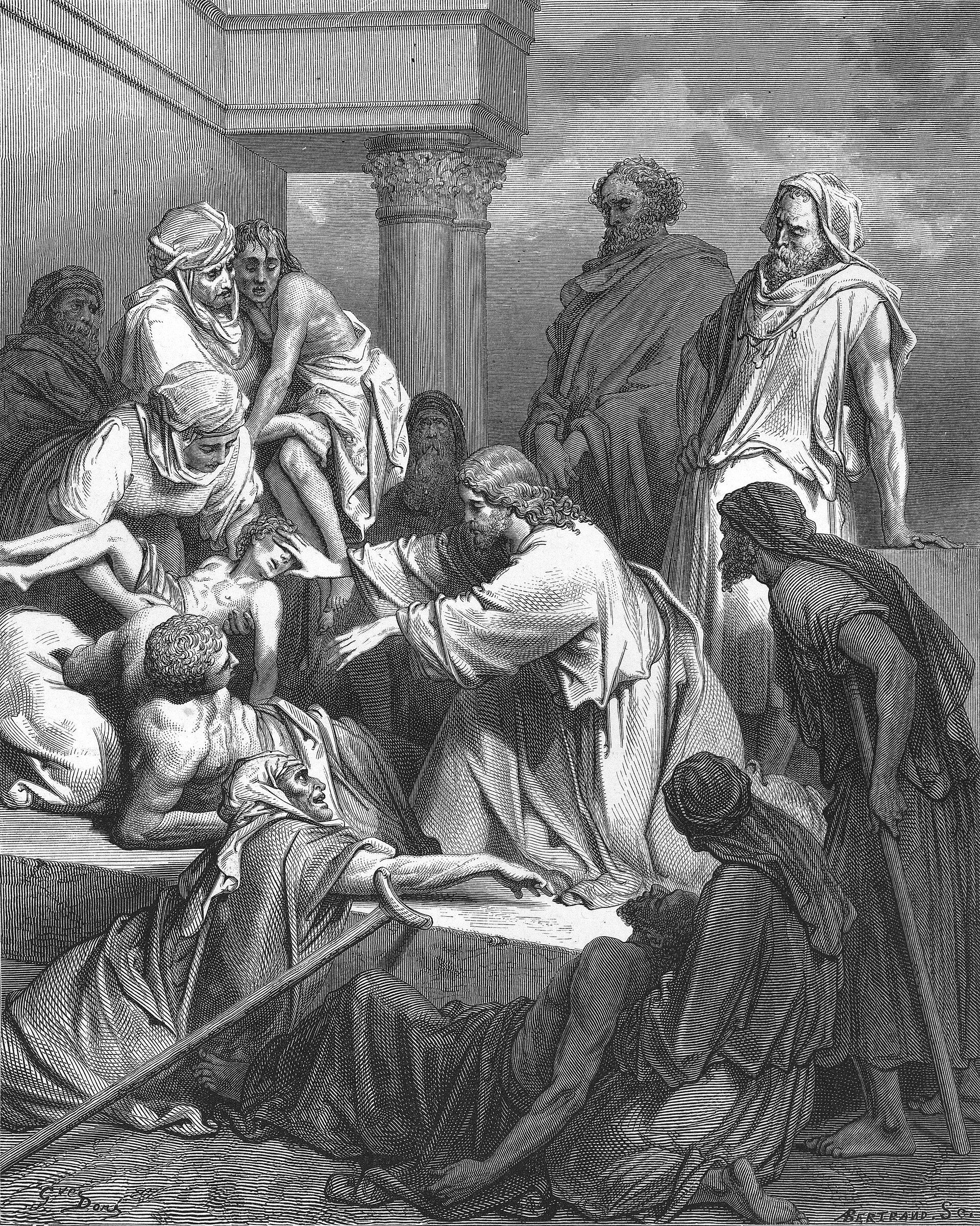
The Voices on Scene One
the church hears John 5:17-23
Making himself equal with God - This the Jews understood from the preceding verse: nor did they take a wrong meaning out of our Lords words; for he plainly stated that, whatever was the Fathers work, his was the same; thus showing that He and the Father were One. They had now found out two pretenses to take away his life: one was that he had broken the Sabbath - ελυε, dissolved, as they pretended, the obligation of keeping it holy.
Adam Clarke · Commentary on the Bible (1832), John 5:18
And as, instead of instantly disclaiming any such meaning--as He must have done if it was false--He positively sets His seal to it in the following verses, merely explaining how consistent such claim was with the prerogatives of His Father, it is beyond all doubt that we have here an assumption of peculiar personal Sonship, or participation in the Father's essential nature.
Jamieson, Fausset & Brown · Commentary Critical and Explanatory on the Whole Bible (1871), John 5:18
The Son can do nothing of himself - This is not his imperfection, but his glory, resulting from his eternal, intimate, indissoluble unity with the Father.
John Wesley · Explanatory Notes upon the New Testament (1755), John 5:19
That all men may honour the Son, even as they honour the Father - Either willingly, and so escaping condemnation, by faith: or unwillingly, when feeling the wrath of the Judge.
John Wesley · Explanatory Notes upon the New Testament (1755), John 5:23
Scene Two: “I and My Father Are One”
John 10:31-39
Months later, at the Feast of Dedication, Jesus says it again — shorter this time, and harder to soften: “I and my Father are one” (10:30). The reaction is immediate. The crowd doesn’t argue theology first. They reach for stones.
I and the Father are one.”One sentence: and it is the second time He has said something like it.
At this, the Jews again picked up stones to stone Him.Not a debate. Stones, already in hand, ready to be thrown.
Jesus's own defenseJohn 10:34-36
Jesus does not retract the claim; He defends His right to make it, arguing from the lesser to the greater. Quoting Psalm 82:6 (“I said, you are gods”), He points out that if Scripture can call mere human judges “gods” because the word of God came to them, how much more the One the Father “sanctified and sent into the world.” He does not walk the claim back. He shows it is not, by their own Scripture’s own logic, an unreasonable one.
“We are not stoning You for any good work,” said the Jews, “but for blasphemy, because You, who are a man, declare Yourself to be God.”Their own words name the charge exactly: a man, making himself God.
The Voices on Scene Two
the church hears John 10:31-39
I and the Father are one - Not by consent of will only, but by unity of power, and consequently of nature. Are - This word confutes Sabellius, proving the plurality of persons: one - This word confutes Arius, proving the unity of nature in God.
John Wesley · Explanatory Notes upon the New Testament (1755), John 10:30
I and my Father are one - If Jesus Christ were not God, could he have said these words without being guilty of blasphemy?
Adam Clarke · Commentary on the Bible (1832), John 10:30
For blasphemy - See the notes at Mat 9:3. Makest thyself God - See the notes at Joh 5:18. This shows how they understood what he had said. Makest thyself - Dost claim to be God, or thy language implies this.
Albert Barnes · Notes, Explanatory and Practical (1832-1869), John 10:33
But this also we must understand, in opposition to the Arians, that in His saying: I and the Father are One, there is signified, not the proof of sameness of will, but the Oneness of their Essence. For indeed the Jews understood that in saying this, He said that Himself was God and equal to the Father; and Christ did not deny that He had said this as they understood it.
Cyril of Alexandria · Commentary on the Gospel of John, Book 7 (444), John 10:33
Scene Three: The Trial
Mark 14:61-64
Under oath before the Sanhedrin, the high priest asks the question directly: “Art thou the Christ, the Son of the Blessed?” Jesus does not deflect, and He does not soften His answer for the room He is standing in. He says, plainly, “I am” — and then adds a claim built from two Old Testament texts fused together: He will sit at the right hand of Power and come with the clouds of heaven.
But Jesus remained silent and made no reply. Again the high priest questioned Him, “Are You the Christ, the Son of the Blessed One?” “I am,” said Jesus, “and you will see the Son of Man sitting at the right hand of Power and coming with the clouds of heaven.”The direct question, and the direct answer: no hedge, no parable this time.
The high priest tears his own robes and pronounces it blasphemy on the spot.
At this, the high priest tore his clothes and declared, “Why do we need any more witnesses? You have heard the blasphemy. What is your verdict?” And they all condemned Him as deserving of death.From claim to verdict in three verses: the council condemns Him to death.
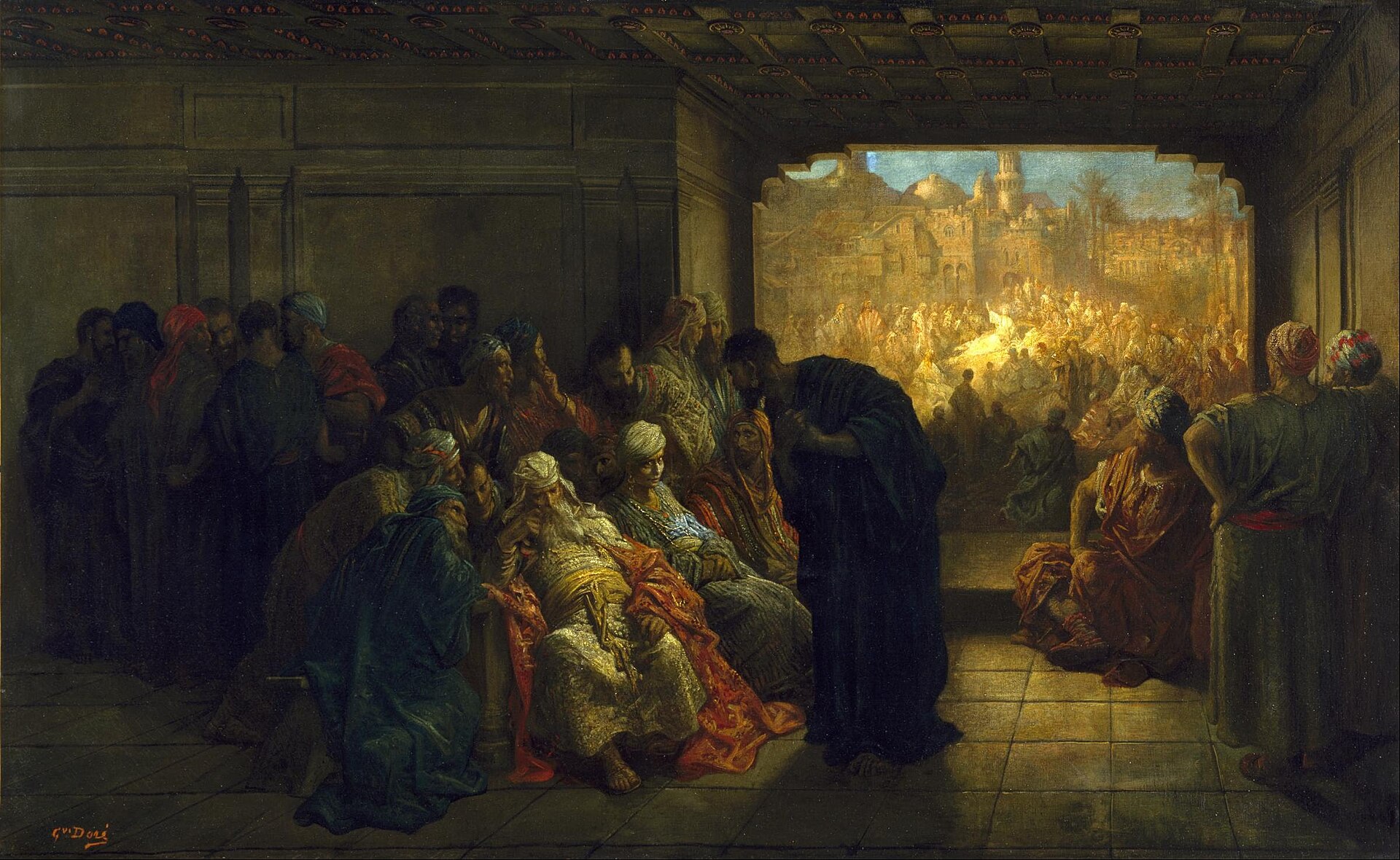
Why blasphemy, specificallynot a false-messiah charge
A false messianic claim, on its own, was not a capital blasphemy charge under Jewish law, men who falsely claimed to be the Messiah were executed by Rome as political rebels, not stoned by their own people as blasphemers. What tips this answer from “false messianic claimant” to blasphemy is the specific content: riding the clouds of heaven, in the reading of Daniel 7 and Psalm 110 current in that setting, was a divine prerogative. Jesus is not merely saying He is the Messiah. He is saying He will sit where God sits, and come the way God comes. That is what the high priest hears as blasphemy, and it is why the verdict follows immediately, without further witnesses called.
The Voices on the Trial
the church hears Mark 14:61-64
If you will not learn Who Christ is from those that know Him, learn it at least from those that know Him not. So shall the confession, which their ignorance is forced to make, rebuke your blasphemy. The Jews did not recognise Christ, come in the body, though they knew that the true Christ must be the Son of God. And so, when they were employing false witnesses, without one word of truth in their testimony, against Him, their priest asked Him, Art Thou the Christ, the Son of the Blessed?
Hilary of Poitiers · On the Trinity 6.50 (367), Mark 14:61
And Jesus said, I am,.... That is, the Son of God; in proof of which he adds, and ye shall see the son of man sitting on the right hand of power; that is, of God, who is all power, the Lord God Almighty: and coming in the clouds of heaven; either at the destruction of Jerusalem, or at the last day, referring to the prophecy in Dan 7:13; See Gill on Mat 26:64.
John Gill · Exposition of the New Testament (1746-1748), Mark 14:62
(Serm. 5. de Pass.) But Caiaphas, to increase the odiousness of what they had heard rent his clothes, and without knowing what his frantic action meant, by his madness, deprived himself of the honour of the priesthood, forgetting that command, by which it is said of the High Priest, He shall not uncover his head or rend his clothes. For there follows: Then the High Priest rent his clothes, and saith, What need we any further witnesses? Ye have heard the blasphemy: what think ye?
Leo the Great · Catena Aurea by Aquinas (1264), Mark 14:63-64
They condemned Him to be guilty of death, that by His guiltiness He might absolve our guilt.
Pseudo-Jerome · Catena Aurea by Aquinas, Mark 14:64-65
What Did the Listeners Hear?
their own reaction is the evidence
None of Jesus’s hearers in these three scenes were confused about what He was claiming. Twice they reach for stones: the legal penalty for blasphemy. Once they pronounce a death sentence. Hostile, technically trained readers of the Torah, motivated to convict Him if they honestly could, heard something more than a royal title or a figure of speech. Jesus never corrects the inference. He is crucified on His own self-identification, not on a misunderstanding of it.
Where It Points
the claim that cost Him everything
A man on trial for his life has every reason to walk back a dangerous claim if it is false, or merely misunderstood. Jesus does neither. Three times, in three settings, He says essentially the same thing about His own sonship, and the third time He says it, it is the last thing He says before the sentence that sends Him to the cross.
Closing
Words in Jerusalem. Stones at the temple. A death sentence before the Sanhedrin. Jesus said the same thing about Himself in every setting, and He never took it back, not when it cost Him nothing, and not when it cost Him everything.
Keep studying
Read it1
On this page
Studies6
Places1
Doctrines8