
John's Gospel · Featured Study
The Hour of John
Four times before the last week of his life, John records Jesus saying his hour has not yet come. Then, in one chapter, the word flips. The hour is come, and it never turns back. This page tracks one word across the whole Gospel: the cross John shows is not an accident that catches Jesus off guard. It is an appointment he keeps on schedule, and nobody takes his life from him.
Summary
John marks the whole story of Jesus with one recurring word: the hour. Four times it has not yet come, and no one can touch him. Then, when some Greeks ask to see him, John records the turn: the hour is come. From that point the word never looks back.
- At Cana, Jesus tells his mother his hour is not yet come (2:4), the first of four "not yet" markers
- Twice more people try to seize him and cannot, "because his hour was not yet come" (7:30, 8:20)
- The turn happens at 12:23, when Greeks ask to see him: "the hour is come, that the Son of man should be glorified"
- The trouble of his soul (12:27) does not cancel the appointment; he asks to be saved from the hour, then affirms he came for it
- By 13:1 and 17:1 the hour is simply a fact John states, the frame the rest of the story stands inside
Not Yet
2:4, 7:30, 8:20: the word that keeps everyone at arm's length
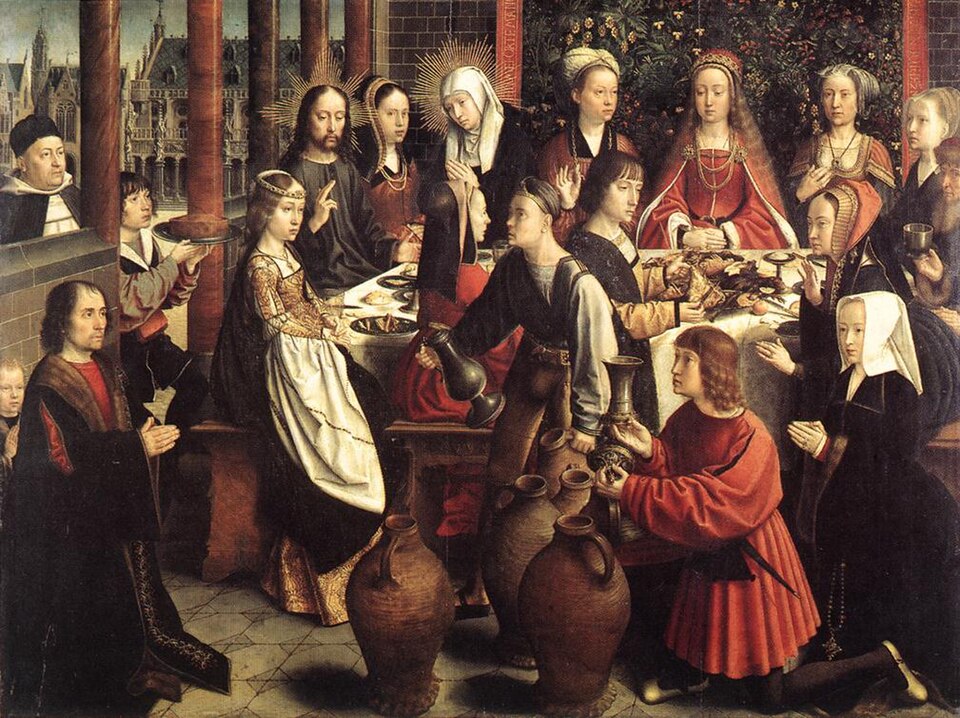
“Woman, why does this concern us?” Jesus replied. “My hour has not yet come.”The first mention, at Cana, before any conflict has begun.
So they tried to seize Him, but no one laid a hand on Him, because His hour had not yet come.They sought to take him, and no man laid a hand on him.
He spoke these words while teaching in the temple courts, near the treasury. Yet no one seized Him, because His hour had not yet come.Spoken in the temple treasury itself, in the middle of hostile crowds.
The first time John uses the word, nothing dangerous is happening. Jesus is at a wedding, and his mother has asked him to help with the wine. The other two times the stakes are much higher: crowds try to arrest him in the middle of a public confrontation, and John says plainly why they fail. It is not that the crowd hesitates or that Jesus escapes through some trick. Their hands simply cannot close on him, because the hour has not arrived. The word is doing the same work each time, whether the setting is a wedding or a near-riot: nothing happens to Jesus before its appointed time, and nothing can.
The Hour Is Come
12:23: the turn, prompted by a request from outside Israel
But Jesus replied, “The hour has come for the Son of Man to be glorified.Some Greeks had just asked Philip, "Sir, we would see Jesus." This is Jesus' answer.
The trigger is small: a handful of Greek worshipers at the feast ask to see Jesus. John records no dramatic threat, no crowd with stones. Instead the request itself seems to mark the moment. The word that had held everyone off for three chapters now releases. What follows is not language of defeat. It is glory, a grain of wheat that must die to bear fruit, and a soul troubled but not turned aside.
“Seeing therefore that Gentiles are hastening in eager desire to see Him and to turn towards Him, on this account He says: The hour is come. For near at hand was the time of His Passion, after which the calling of the Gentiles immediately followed. And He calls the time now present ‘the hour,’ with the intention of showing that no other occasion can bring Him to the necessity of suffering, save only this season marked out by His own appointed limitations.”
Cyril of Alexandria · Commentary on the Gospel of John, Book 8, 444Patristic
John 12:23
“The hour is come - The time is come. The word ‘hour’ commonly means a definite part or a division of a day; but it also is used to denote a brief period, and a fixed, definite, determined time. It is used in this sense here. The appointed, fixed time is come - that is, is so near at hand that it may be said to be come. The Son of man - This is the favorite title which Jesus gives to himself, denoting his union with man, and the interest he felt in his welfare.”
Albert Barnes · Notes, Explanatory and Practical, on the Old and New Testaments, 1870Evangelical
John 12:23
Troubled, Yet Not Turned Aside
12:27-28: the appointment felt in full, and kept anyway
Now My soul is troubled, and what shall I say? ‘Father, save Me from this hour’? No, it is for this purpose that I have come to this hour. Father, glorify Your name!” Then a voice came from heaven: “I have glorified it, and I will glorify it again.”Save me from this hour... but for this cause came I unto this hour.
John does not hide the cost of the appointment. Jesus names his own trouble of soul in the same breath he affirms the hour's purpose. Asking to be saved from the hour and knowing he came for it are not presented as a contradiction resolved by force of will. Both stand together, and the answer from heaven, a voice confirming glory already given and glory yet to come, answers the trouble without erasing it.
“What He recoils from is not subjection to His Father's will: but to show how tremendous a self-sacrifice that obedience involved, He first asks the Father to save Him from it, and then signifies how perfectly He knows that He is there for the very purpose of enduring it.”
Jamieson, Fausset & Brown · Commentary Critical and Explanatory on the Whole Bible, 1871Reformed
John 12:27
“Now is my soul troubled - The mention of his death brought before him its approaching horrors, its pains, its darkness, its unparalleled woes. Jesus was full of acute sensibility, and his human nature shrunk from the scenes through which he was to pass. See Luk 23:41-44. What shall I say? - This is an expression denoting intense anxiety and perplexity. As if it were a subject of debate whether he could bear those sufferings; or whether the work of man’s redemption should be abandoned, and he should call upon God to save him.”
Albert Barnes · Notes, Explanatory and Practical, on the Old and New Testaments, 1870Evangelical
John 12:27
- 3"not yet" markers before the turn
- 12:23the hinge verse
- John 10:18no man takes his life from him
The Hour Wraps the Cross
13:1, 17:1: the word becomes the frame, not the drama
It was now just before the Passover Feast, and Jesus knew that His hour had come to leave this world and return to the Father. Having loved His own who were in the world, He loved them to the very end.Jesus knowing that his hour was come that he should depart out of this world unto the Father.
When Jesus had spoken these things, He lifted up His eyes to heaven and said, “Father, the hour has come. Glorify Your Son, that Your Son may glorify You.Father, the hour is come; glorify thy Son, that the Son may glorify thee.
By the last supper the word has stopped announcing a coming crisis and become simple narration. John states it as a fact Jesus already knows, the frame the footwashing, the final discourse, and the great prayer all stand inside. The same word that once held danger at bay now opens straight onto the cross, and John never lets a reader mistake what is coming for something that happens to Jesus rather than something he keeps. The claim John records elsewhere states it plainly: no one takes his life from him. He lays it down of himself.
The Voices
with the work named
Commentary on the Gospel of John, Book 8 (444) · public domain
Reads 12:23's hour as fixed by Christ's own appointed limitations, not by the Greeks' request or any outside pressure.
Notes, Explanatory and Practical, on the Old and New Testaments (1832-1869) · public domain
Names "the hour" a technical term in John for a fixed, determined time, not a literal sixty minutes.
Commentary Critical and Explanatory on the Whole Bible (1871) · public domain
Ties 12:27's trouble of soul to 12:28's "glorify it again," reading the whole motif as one continuous appointment kept.
Marcus Brown's own commentary leads above all; within a tier, all voices are equal. This page draws quotes only from the chapter 12 quote pool per its assignment; the earlier “not yet” verses and the closing frame verses are carried by Scripture and the page's own exposition.
Word studies
The Hebrew and Greek under this study, each word in its own room.
Keep Studying
Read it1
On this page