
Mark 4:38
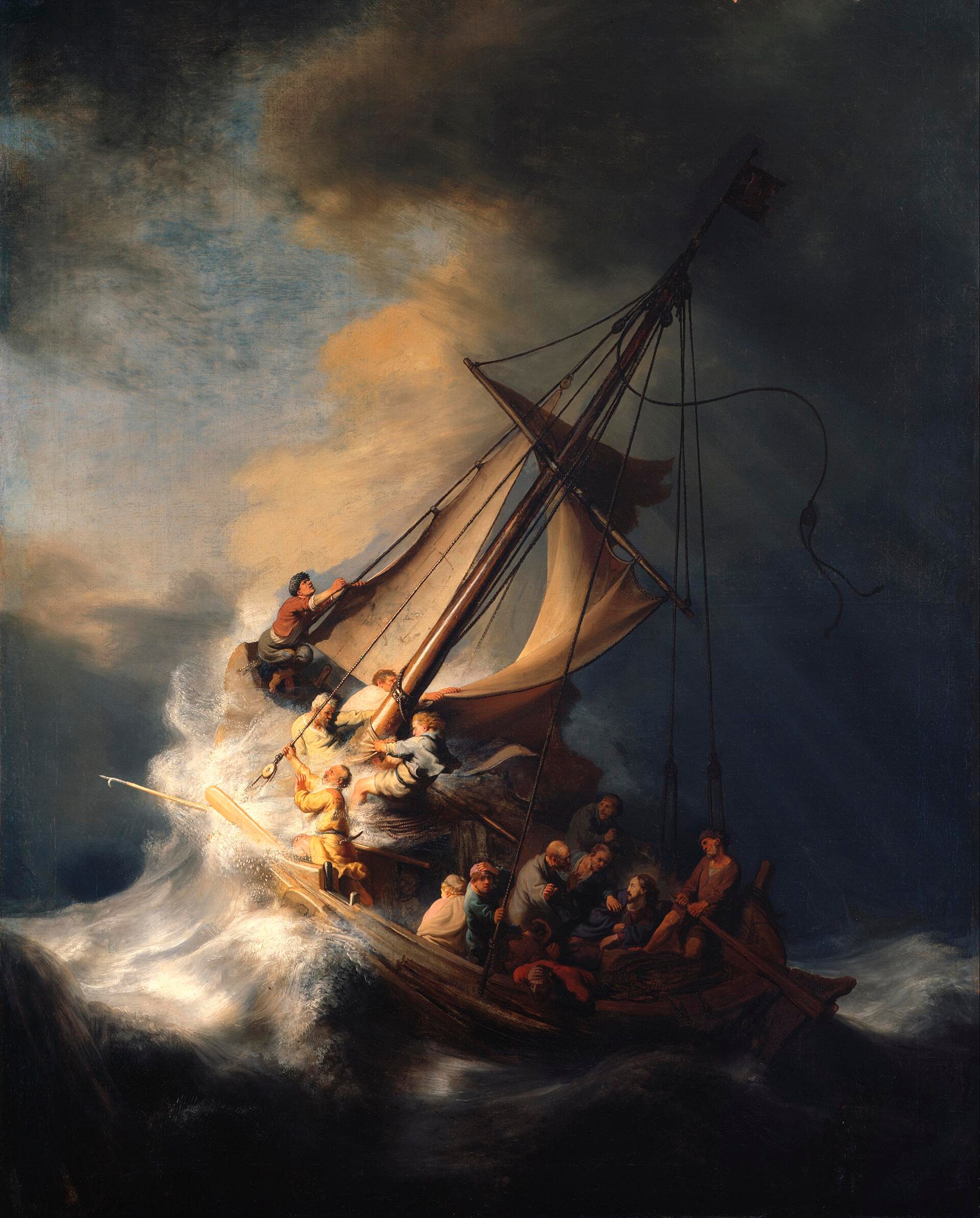
in Mark 4But Jesus was in the stern, sleeping on the cushion. So they woke Him and said, “Teacher, don’t You care that we are perishing?”
BSB
The same verse in ASV and KJV ▾
ASV
And he himself was in the stern, asleep on the cushion: and they awake him, and say unto him, Teacher, carest thou not that we perish?
KJV
And he was in the hinder part of the ship, asleep on a pillow: and they awake him, and say unto him, Master, carest thou not that we perish?
⋯
This verse in Mark 4
Commentary
20 notes on this verseHe was wearied, but He is the Rest of them that are weary and heavy laden. He was heavy with sleep, but He walked lightly over the sea. He rebuked the winds, He made Peter light as he began to sink.
This site's exposition
a violent windstorm came up
on Mark 4:37-38
Soon a violent windstorm came up, and the waves were breaking over the boat, the kind of sudden squall the basin of the Sea of Galilee produces. Jesus was in the stern, sleeping on the cushion, a detail Mark alone keeps. The disciples wake Him with a charge of neglect, Teacher, don’t You care that we are perishing, fear reading indifference into His rest.
This site's exposition
sleeping on the cushion
Gregory of Nazianzus sets this sleep beside the power that follows. He who grew tired is the rest of the weary, and He who slept walked on the sea. Jamieson, Fausset and Brown note that seasoned fishermen feared for their lives, so the danger was real.
The record, by era
The Church Fathers4 voices
For as many as are in the little ship of faith are sailing with the Lord; as many as are in the bark of holy church will voyage with the Lord across this wave-tossed life; though the Lord himself may sleep in holy quiet, he is but watching your patience and endurance: looking forward to the repentance, and to the conversion of those who have sinned. Come then to him eagerly, instant in prayer.
A commentator
Cyril of AlexandriaCommentary on the Gospel of Luke, Sermon 43 · Written before 444.
proposed
But inasmuch as the greatness of the clangor made their terror now unendurable, as having no other hope of safety except Him only Who is the Lord of powers even Christ, they arouse Him, saying, Master, Master, save us, we perish: for the Evangelist says that He was asleep. With most wise purpose, as it seems to me, was this also done. For some one, I imagine, may say, Why did He fall asleep at all? To which we reply, that the event was so arranged as to be good and profitable. For that they might not ask aid of Him immediately when the tempest began to dash upon the ship, but when, so to speak, the evil was at its height, and the terrors of death were troubling the disciples; that so the might of His godlike sovereignty might be more manifest, in calming the raging sea, and rebuking the savage blasts of the wind, and changing the tempest to a calm, and that the event might thus become a means of improvement to them that were sailing with Him, He purposely fell asleep.
(Hom. in Matt. 28) The Lord took the disciples indeed, that they might be spectators of the miracle which was coming, but He took them alone, that no others might see that they were of such little faith. Wherefore, to show that others went across separately, it is said, And there were also with him other ships. Lest again the disciples might be proud of being alone taken, He permits them to be in danger; and besides this, in order that they might learn to bear temptations manfully. Wherefore it goes on, And there arose a great storm of wind; and that He might impress upon them a greater sense of the miracle which was to be done, He gives time for their fear, by sleeping. Wherefore there follows, And he was himself in the hinder part of the ship, &c. For if He had been awake, they would either not have feared, nor have asked Him to save them when the storm arose, or they would not have thought that He could do any such things. (Hom. in Matt. 28) showing His humility, and thus teaching us many lessons of wisdom. But not yet did the disciples who remained about Him know His glory; they thought indeed that if He arose He could command the winds, but could by no means do so reposing or asleep. And therefore there follows, And they awake him, and say unto him, Master, carest thou not that we perish?
A commentator
Victorinus of PettauVictorinus On the Creation of the World · Written before 304.
proposed
Now, therefore, you may see that it is being told you of the unerring glory of God in providence; yet, as far as my small capacity shall be able, I will endeavour to set it forth. That He might re-create that Adam by means of the week, and bring aid to His entire creation, was accomplished by the nativity of His Son Jesus Christ our Lord. Who, then, that is taught in the law of God, who that is filled with the Holy Spirit, does not see in his heart, that on the same day on which the dragon seduced Eve, the angel Gabriel brought the glad tidings to the Virgin Mary; that on the same day the Holy Spirit overflowed the Virgin Mary, on which He made light; that on that day He was incarnate in flesh, in which He made the land and water; that on the same day He was put to the breast, on which He made the stars; that on the same day He was circumcised, on which the land and water brought forth their offspring; that on the same day He was incarnated, on which He formed man out of the ground; that on the same day Christ was born, on which He formed man; that on that day He suffered, on which Adam fell; that on the same day He rose again from the dead, on which He created light? He, moreover, consummates His humanity in the number seven: of His nativity, His infancy, His boyhood, His youth, His young-manhood, His mature age, His death. I have also set forth His humanity to the Jews in these manners: since He is hungry, is thirsty; since He gave food and drink; since He walks, and retired; since He slept upon a pillow; since, moreover, He walks upon the stormy seas with His feet, He commands the winds, He cures the sick and restores the lame, He raises the blind by His speech, -see ye that He declares Himself to them to be the Lord.
The Medieval Church1 voice
(ubi sup.) Or else the ship into which He embarked, is taken to mean the tree of His passion, by which the faithful attain to the security of the safe shore. The other ships which are said to have been with the Lord, signify those, who are imbued with faith in the cross of Christ, and are not beaten about by the whirlwind of tribulation; or who, after the storms of temptation, are enjoying the serenity of peace.
12 more voices on this verse
The Medieval Church4 voices
And they woke him up and said to him: Teacher, do you not care that we are perishing? And the disciples woke the Lord, so that they would not perish by the savagery of the waves while he slept, because they most eagerly sought his …
After His teaching, they come from that place to the sea, and are tossed by the waves. Wherefore it is said, And the same day, when the even was come, &c. Mystically, however, the hinder part of the ship is the beginning of the Church, in which the Lord sleeps in the body only, for He never sleepeth who keepeth Israel; for the ship with its skins of dead animals keeps in the living, and keeps out the waves, and is bound together by wood, that is, by the cross and the death of the Lord the Church is saved. The pillow is the body of the Lord, on which His Divinity, which is as His head, has come down. But the wind and the sea are devils and persecutors, to whom He says Peace, when He restrains the edicts of impious kings, as He will. The great calm is the peace of the Church after oppression, or a contemplative after an active life.
And He sleeps during this with the purpose that the miracle would seem all the more important to them, after they had become frightened. Otherwise, if the storm had occurred while Christ was awake, they would not have been frightened or would not have turned …
But He was sleeping upon the pillow of the ship, that is, on a wooden one.
The Puritans and the Awakening2 voices
And he was in the hinder part of the ship,.... That is, Christ was in the stern of the ship: the Persic version renders it, "he was in the bottom of the ship, in a corner", but very wrongly; here he was asleep on a pillow, which some say was a wooden one, framed at the stern: however, he was fast asleep on it, being greatly fatigued with the work of the day; See Gill on Mat 8:24. And they awake him, and say unto him, Master, carest thou not that we perish?
11 And he said unto them, Unto you it is given to know the mystery of the kingdom of God: but unto them that are without, all these things are done in parables: 12 That seeing they may see, and not perceive; and hearing they may hear, and not understand; lest at any time they should be converted, and their sins should be forgiven them.
quarantine:scripture (2026-07-29) — verbatim-scripture
The Nineteenth Century6 voices
On a pillow - Προσκεφαλαιον probably means a little bed, or hammock, such as are common in small vessels. I have seen several in small packets, or passage boats, not a great deal larger than a bolster.
A commentator
J.C. Ryle1816–1900
Expository Thoughts on the Gospels: Mark (lightly modernized text, Grace Gems edition) (1857)
These verses describe a storm on the sea of Galilee, when our Lord and His disciples were crossing it, and a miracle performed by our Lord in calming the storm in a moment. Few miracles recorded in the Gospel were so likely to strike the minds of the apostles as this. Four of them at least were fishermen. Peter, Andrew, James, and John, had probably known the sea of Galilee, and its storms, from their youth. Few events in our Lord's journeyings to and fro upon earth, contain more rich instruction than the one related in this passage.
A commentator
Jamieson, Fausset & Brown1802–1910
Commentary Critical and Explanatory on the Whole Bible (1871)
Matthew (Mt 8:25) has it, "Lord, save us, we perish." When those accustomed to fish upon that deep thus spake, the danger must have been imminent. They say nothing of what would become of Him, if they perished; nor think, whether, if He could not perish, it was likely He would let this happen to them; but they hardly knew what they said.
A commentator
J.C. Ryle1816–1900
Expository Thoughts on the Gospels: Mark (lightly modernized text, Grace Gems edition) (1857)
proposed
These verses describe a storm on the sea of Galilee, when our Lord and His disciples were crossing it, and a miracle performed by our Lord in calming the storm in a moment. Few miracles recorded in the Gospel were so likely to strike the minds of the apostles as this. Four of them at least were fishermen. Peter, Andrew, James, and John, had probably known the sea of Galilee, and its storms, from their youth. Few events in our Lord's journeyings to and fro upon earth, contain more rich instruction than the one related in this passage. Let us learn, in the first place, that Christ's service does not exempt His servants from storms . Here were the twelve disciples in the path of duty. They were obediently following Jesus, wherever He went. They were daily attending on His ministry, and hearkening to His word. They were daily testifying to the world, that, whatever Scribes and Pharisees might think, they believed on Jesus, loved Jesus, and were not ashamed to give up all for His sake. Yet here we see these men in trouble, tossed up and down by a tempest, and in danger of being drowned. Let us mark well this lesson. If we are true Christians, we must not expect everything smooth in our journey to heaven. We must count it no strange thing, if we have to endure sicknesses, losses, bereavements, and disappointments, just like other men. Free pardon and full forgiveness, grace along the way, and glory at the end — all this our Savior has promised to give. But He has never promised that we shall have no affliction. He loves us too well to promise that. By affliction He teaches us many precious lessons, which without it we should never learn. By affliction He shows us our emptiness and weakness, draws us to the throne of grace, purifies our affections, weans us from the world, makes us long for heaven.
THE day had been a very illustrious one. Our Lord had remarkably displayed His teaching and healing powers. Great crowds had been attracted and He had both delivered to them most precious parables and worked among them most marvelous cures. Grand as the day was, it could not come to a close without a storm. After the same manner you will find it in the history of the Church of God, that intermingled with great successes will be great afflictions. Pentecost is followed by persecution—Peter's sermon by Peter's imprisonment. Though today a Church may flourish abundantly, in a very short time it may be visited with stern adversities. It may be tried, none the less, but all the more, because God is in its midst and is blessing it. When our Lord took ship the weather appears to have been very fair and many little boats which scarcely would have tempted the sea had its surface been ruffled, put out upon the lake under the convoy of the great Teacher's vessel. His was the admiral's flag ship and they were the happy fleet. They made a gay flotilla sailing softly like sea birds when the ocean is in a gentle mood. All hearts were happy, all spirits were serene and the sleep of the disaster was but a type of the general peace. Nature reposed. The lake was as a molten looking glass, everything was quiet. And yet all of a sudden, as is the custom with these deep-lying inland seas, the Storm-Fiend rushed from his haunt among the mountains, sweeping everything before it. The little vessel was hard put to it, she was well-near filled with water and ready to sink through the force of the driving hurricane. Thus may our loveliest calms be succeeded by overwhelming storms. A Christian man is seldom long at ease.
THE day had been a very illustrious one. Our Lord had remarkably displayed His teaching and healing powers. Great crowds had been attracted and He had both delivered to them most precious parables and worked among them most marvelous cures. Grand as the day was, it could not come to a close without a storm. After the same manner you will find it in the history of the Church of God, that intermingled with great successes will be great afflictions. Pentecost is followed by persecution—Peter's sermon by Peter's imprisonment.
The words behind it
22 Greek wordsEvery Greek word of this verse in the order it stands, with what it means and the door to its own study. The last column counts the times a word stands in the whole Bible: the rarer the word, the more the places it appears belong together.
| Greek | Sound | Meaning | Word study | In the Bible |
|---|---|---|---|---|
| καὶ | kai | And | G2532 → | 9120 times |
| αὐτὸς | autos | He himself | G846 → | 5565 times |
| ἦν | en | was | G1510 → | 2333 times |
| ἐν | en | in | G1722 → | 2738 times |
| τῇ | tea | the | G3588 → | 19766 times |
| πρύμνῃ | prumne | stern | G4403 → | |
| ἐπὶ | epi | on | G1909 → | 883 times |
| τὸ | to | the | G3588 → | 19766 times |
| προσκεφάλαιον | proskephalaion | cushion | G4344 → | |
| καθεύδων. | katheudon | sleeping. | G2518 → | 22 times |
| καὶ | kai | And | G2532 → | 9120 times |
| ἐγείρουσιν | egeirousin | they wake | G1453 → | 142 times |
| αὐτὸν | auton | Him | G846 → | 5565 times |
| καὶ | kai | and | G2532 → | 9120 times |
| λέγουσιν | legousin | say | G3004 → | 1325 times |
| αὐτῷ· | auto | to Him; | G846 → | 5565 times |
| διδάσκαλε, | didaskale | Teacher, | G1320 → | 58 times |
| οὐ | ou | not | G3756 → | 1664 times |
| μέλει | melei | is it concern | G3199 → | |
| σοι | soi | to You | G4771 → | 2973 times |
| ὅτι | hoti | that | G3754 → | 1292 times |
| ἀπολλύμεθα; | apollumetha | we perish? | G622 → | 90 times |
καὶAnd
kaiG2532 →9120 times
αὐτὸςHe himself
autosG846 →5565 times
ἦνwas
enG1510 →2333 times
ἐνin
enG1722 →2738 times
τῇthe
teaG3588 →19766 times
πρύμνῃstern
prumneG4403 →
ἐπὶon
epiG1909 →883 times
τὸthe
toG3588 →19766 times
προσκεφάλαιονcushion
proskephalaionG4344 →
καθεύδων.sleeping.
katheudonG2518 →22 times
καὶAnd
kaiG2532 →9120 times
ἐγείρουσινthey wake
egeirousinG1453 →142 times
αὐτὸνHim
autonG846 →5565 times
καὶand
kaiG2532 →9120 times
λέγουσινsay
legousinG3004 →1325 times
αὐτῷ·to Him;
autoG846 →5565 times
διδάσκαλε,Teacher,
didaskaleG1320 →58 times
οὐnot
ouG3756 →1664 times
μέλειis it concern
meleiG3199 →
σοιto You
soiG4771 →2973 times
ὅτιthat
hotiG3754 →1292 times
ἀπολλύμεθα;we perish?
apollumethaG622 →90 times
A shaded row is a word that stands 400 times or fewer in the Bible.
The walk
8 stopsEach card is a verse this one points to, and under it the verses that one points to in turn. Where several paths arrive at the same place, that place is listed first: the text keeps returning to it.
Through
1 Peter 5:7Cast all your anxiety on Him, because He cares for you.
it leads to
- Psalms 55:22
Cast your burden upon the LORD and He will sustain you; He will never let the righteous be shaken.
- Philippians 4:6
Be anxious for nothing, but in everything, by prayer and petition, with thanksgiving, present your requests to God.
- Psalms 37:5
Commit your way to the LORD; trust in Him, and He will do it.
- Psalms 56:3–4
When I am afraid, I put my trust in You.
- Matthew 6:25–26
Therefore I tell you, do not worry about your life, what you will eat or drink; or about your body, what you will wear. Is not life more than food, and the body more…
- Psalms 55:22
Through
Hebrews 4:15For we do not have a high priest who is unable to sympathize with our weaknesses, but we have one who was tempted in every way that we are, yet was without sin.
it leads to
- Hebrews 2:17–18
For this reason He had to be made like His brothers in every way, so that He might become a merciful and faithful high priest in service to God, in order to make atonement…
- 2 Corinthians 5:21
God made Him who knew no sin to be sin on our behalf, so that in Him we might become the righteousness of God.
- Isaiah 53:4–5
Surely He took on our infirmities and carried our sorrows; yet we considered Him stricken by God, struck down and afflicted.
- Hebrews 2:17–18
Where this verse is studied
On this page
Studies5
About Mark
This page draws on 18 works. Open the list of works
This page draws on Adam Clarke, Commentary on the Bible; Albert Barnes, Notes, Explanatory and Practical, on the Gospels; Bede, Catena Aurea by Aquinas; Bede, On the Gospel of Mark; Charles Spurgeon, The Metropolitan Tabernacle Pulpit, Sermon No. 1121: “Christ Asleep in the Vessel” (lightly modernized text, CCEL edition); Cyril of Alexandria, Commentary on the Gospel of Luke, Sermon 43; Gregory of Nazianzus, Oration 29, On the Son; J. C. Ryle, Expository Thoughts on the Gospels, Mark; J.C. Ryle, Expository Thoughts on the Gospels: Mark (lightly modernized text, Grace Gems edition); Jamieson, Fausset & Brown, Commentary Critical and Explanatory on the Whole Bible; John Chrysostom, Catena Aurea by Aquinas; John Gill, Exposition of the New Testament (1746-1748); Matthew Henry, Commentary on the Whole Bible; Origen of Alexandria, FRAGMENTS ON MATTHEW 3.3; Pseudo-Jerome, Catena Aurea by Aquinas; Theophylact of Ohrid, Commentary on Mark; Theophylact of Ohrid, Catena Aurea by Aquinas and Victorinus of Pettau, Victorinus On the Creation of the World.