
Jesus Christ · On Discipleship
Count the Cost
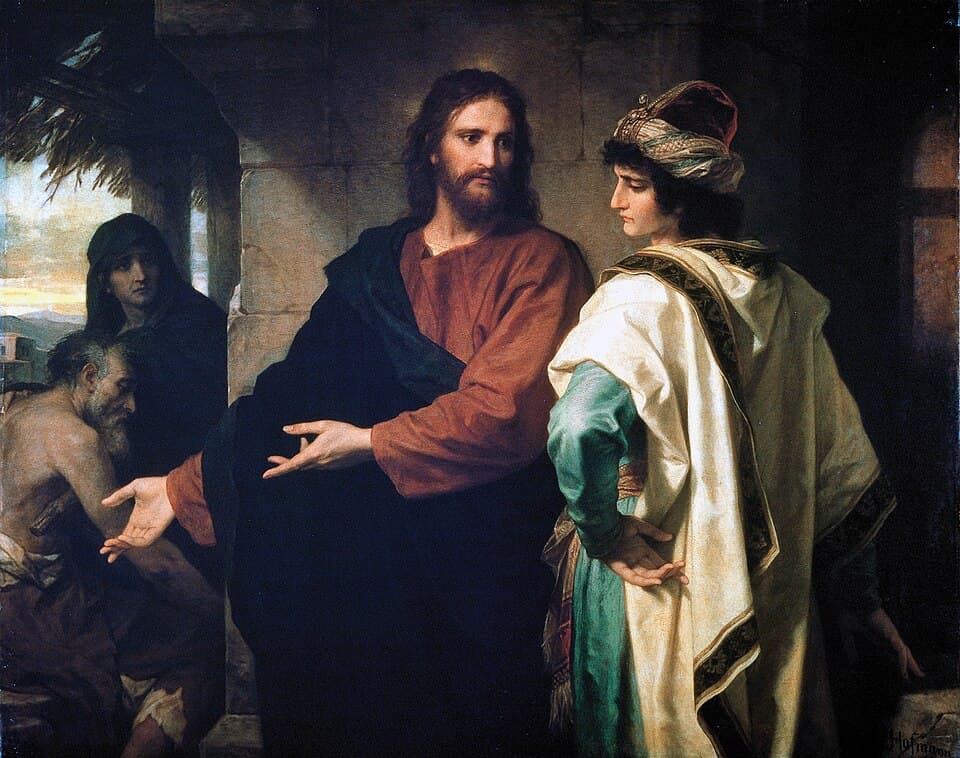
Christ and the Rich Young Ruler, Heinrich Hofmann, 1889. Public domain.
THE ARTWORKHofmann paints the one man in the Gospels we watch count the cost and walk away: the rich young ruler, whom Jesus loved, told to sell all, and who “went away sorrowful” (Mark 10:17–22). Christ's open hand still invites; the young man's face is already turning. The painting hangs at Riverside Church, New York.
Summary
Summary
This page works out the arithmetic of the tower and the king, the two parables that carry Jesus's warning, then unpacks the Semitic 'hate' language of verse 26 and traces the passage to the church's own voices and to Bonhoeffer.
- The unfinished tower and the outmatched king in Luke 14:28-32 both make the same point: count the cost before you commit.
- "Hate not his father" is Semitic idiom for loving less, not literal hatred, backed by Genesis 29:30-31 and Malachi 1:2-3.
- This tower is not the house built on rock in The Two Builders; different question, same Teacher.
- The church's voices on the passage span Clement of Alexandria, Gregory the Great, Cyril of Alexandria, Augustine, Basil, and Wesley.
- Bonhoeffer's The Cost of Discipleship and Thomas à Kempis's Imitation of Christ close the page.
The Text
Luke 14:25–33
“If anyone comes to Me and does not hate his father and mother and wife and children and brothers and sisters—yes, even his own life—he cannot be My disciple. And whoever does not carry his cross and follow Me cannot be My disciple.The cost named here runs to father, mother, wife, children, brothers, sisters and his own life, and to the cross carried behind Him.
Which of you, wishing to build a tower, does not first sit down and count the cost to see if he has the resources to complete it? Otherwise, if he lays the foundation and is unable to finish the work, everyone who sees it will ridicule him, saying, ‘This man could not finish what he started to build.’The unfinished tower, a foundation laid, and nothing more.
Or what king on his way to war with another king will not first sit down and consider whether he can engage with ten thousand men the one coming against him with twenty thousand? And if he is unable, he will send a delegation while the other king is still far off, to ask for terms of peace. In the same way, any one of you who does not give up everything he has cannot be My disciple.The outmatched king, and the total forsaking the parables were about.
What He Is Saying
a warning, not a recruiting pitch
THE MAIN POINT
- Great crowds follow, many for the wrong reasons
- He turns and names the price instead of welcoming the numbers
- Two parables, one point: count before you commit
- The total, stated without exception: forsake all
“And there went great multitudes with him: and he turned, and said unto them”, Jesus does not court the crowd following Him toward Jerusalem. He turns and speaks straight at it, and what He says is built to thin it, not swell it. A tower left half-built invites mockery; a king who marches outmatched is destroyed. Count first. And the count is total: “whosoever he be of you that forsaketh not all that he hath, he cannot be my disciple.”
And there went great multitudes with him,.... From Galilee, as he journeyed from thence to Jerusalem; some for one thing, and some another, and all perhaps were in expectation of his setting up a temporal kingdom when he came there; and hoped they should share, more or less, the worldly advantages of it; for the whole nation was big with such carnal notions of the Messiah.
John Gill · Exposition of the New Testament (1746–1748), Luke 14:25
The Reckoning
both parables are arithmetic, so here is the arithmetic
THE FIRST RECKONING · LUKE 14:28–30
A man building a tower
- SITS DOWN FIRST
- “counteth the cost, whether he have sufficient to finish it”
- THE RISK IF HE DOES NOT
- a foundation laid, a work abandoned, and everyone can see it
- THE PRICE OF HALF-BUILT
- “all that behold it begin to mock him”
THE SECOND RECKONING · LUKE 14:31–32
A king going to war
HIS MEN, TEN THOUSAND
AGAINST, TWENTY THOUSAND
one mark per thousand men, every mark of his faces two
“sitteth not down first, and consulteth whether he be able”, and if not, sends an embassy while the other is yet a great way off and asks conditions of peace.
Go Deeper
the hard word, the other tower, and the church's voices, each opens in place
“Hate not his father”, held at full strength
Read as flat English, “hate” collides with the fifth commandment and with Jesus’s own rebuke of those who dodged caring for aging parents (Mark 7:9–13). The standard resolution, held across a wide range of commentators, is that Hebrew and Aramaic idiom regularly uses “love” and “hate” as a comparative pair, “prefer” and “prefer less,” not affection versus animosity. Two Old Testament parallels carry the same grammar: Genesis 29:30–31, where the narrator calls Leah “hated” simply because Jacob loved Rachel more; and Malachi 1:2–3 (“Jacob have I loved, but Esau have I hated”), which Paul quotes in Romans 9:13 about election, not personal animosity. Matthew states the same claim directly, without the Semitic shock:
Anyone who loves his father or mother more than Me is not worthy of Me; anyone who loves his son or daughter more than Me is not worthy of Me;Jesus's own gloss on Luke 14:26, “more than me,” not raw hatred.
This reading is held at full strength, not defensively: allegiance to Jesus must outrank every other loyalty a person has, stated with the shock of hyperbole, never softened into something less total.
A different tower from the one you may know
This tower is not the parable at the Two Builders , Matthew 7:24–27, the house built on rock versus sand. That parable asks what your life is founded on. This one asks whether you have counted what finishing costs. Different question, different builder, same Teacher.
The church on “hate not”
This is not a command to hate one's family. For he says: "Honour thy father and thy mother that it may be well with thee." But what he means is this: Do not let yourself be led astray by irrational impulses and have nothing to do with the city customs.
Clement of Alexandria · The Stromata, Book 3 (215), on Luke 14:26
And hate not - Matthew, Mat 10:37, expresses the true meaning of this word, when he says, He who loveth his father and mother More than me. In Mat 6:24, he uses the word hate in the same sense.
Adam Clarke · Commentary on the Bible (1832), Luke 14:26
Every good man loves his relations; and yet, if he be a disciple of Christ, he must comparatively hate them, must love them less than Christ, as Leah is said to be hated when Rachel was better loved.
Matthew Henry · Commentary on the Whole Bible (1710), Luke 14:26
If any man come to me, and hate not his father - Comparatively to Christ: yea, so as actually to renounce his field, oxen, wife, all things, and act as if he hated them, when they stand in competition with him. And which of you intending to build a tower - That is, and whoever of you intends to follow me, let him first seriously weigh these things.
John Wesley · Explanatory Notes upon the New Testament (1755), Luke 14:26
Hence Truth says to those coming to him: "If anyone comes to me and does not hate his father and mother, and wife and children, and brothers and sisters, and even his own soul as well, he cannot be my disciple." But it is fitting to inquire how we are commanded to hate our parents and blood relatives, when we are ordered to love even our enemies?
Gregory the Dialogist (Gregory the Great) · Forty Gospel Homilies, Homily 37 (604), on Luke 14:26
The church on the tower
Because lofty precepts have been given, a comparison of building something lofty is immediately added, when it is said: "For which of you, wishing to build a tower, does not first sit down and count the costs that are necessary, whether he has enough to complete it?" Everything we do, we ought to anticipate through careful consideration.
Gregory the Dialogist (Gregory the Great) · Forty Gospel Homilies, Homily 37 (604), on Luke 14:28
Intending to build a tower - See Mat 21:33. A tower was a place of defense or observation, erected on high places or in vineyards, to guard against enemies. It was made high, so as to enable one to see an enemy when he approached; and strong, so that it could not be easily taken. Counteth the cost - Makes a calculation how much it will cost to build it.
Albert Barnes · Notes, Explanatory and Practical, Luke 14:28
The church on the king
"Or what king, He says, wishing to make war with another king, does not consider with himself, whether with his ten thousand he can prevail over one who is more mighty than himself?" And what does this mean? "Our wrestle is not against blood and flesh, but against governments; against empires; against the worldholders of this darkness; against wicked spirits in the heavenly regions."
Cyril of Alexandria · Commentary on the Gospel of Luke, Sermon 105 (444), on Luke 14:31–32
Now to what these comparisons refer, He on the same occasion sufficiently explained, when he said, So likewise whosoever he be of you that forsaketh not all that he hath, he cannot be my disciple. The cost therefore of building the tower, and the strength of the ten thousand against the king who has twenty thousand, mean nothing else than that each one should forsake all that he hath.
Augustine of Hippo · Catena Aurea by Aquinas (1264), on Luke 14:33
Whoever would truly be a follower of God must break the bonds of attachment to this life. This is done through complete separation from and forgetfulness of old habits. It is impossible for us to achieve our goal of pleasing God unless we snatch ourselves away from fleshly ties and worldly society.
Basil of Caesarea · The Long Rules 5 (379), on Luke 14:33
By withdrawing his affections from all the creatures; By enjoying them only in and for God, only in such a measure and manner as leads to him; By hating them all, in the sense above mentioned, cannot be my disciple - But will surely desist from building that tower, neither can he persevere in fighting the good fight of faith.
John Wesley · Explanatory Notes upon the New Testament (1755), Luke 14:33
The tower answers the question of a man building alone; the king answers the question of a man facing an army twice his size. Both close the same way, the only wise move is to count first, and Jesus names what the count actually costs: “forsaketh not all that he hath.”
Where It Points
the same demand, a different setting
Matthew 10:37 states in direct words what Luke 14:26 states in Semitic hyperbole, the same allegiance, the same ranking of loves. And Romans 9:13, quoting Malachi 1:2–3 on Jacob and Esau, shows the church’s oldest reading of “love/hate” language: a comparative ranking, not an emotion.
Read the Great Books
the works that have carried this teaching: go further than this page
The Cost of Discipleship
Dietrich Bonhoeffer · 1937
The book this page's title now evokes for the whole church, written under the Third Reich by a pastor who would die resisting it. Costly grace against cheap grace: “cheap grace is the deadly enemy of our Church.” No modern work has pressed Luke 14 harder.
In print: find it wherever books are sold.
The Imitation of Christ
Thomas à Kempis · c. 1418
Six centuries of disciples have counted the cost with this small book in hand, the most-read devotional work in Christian history, on following Christ when following is not convenient.
READ IT FREE AT CCEL →Closing
Jesus never talked anyone into following Him. To the largest crowds He ever drew, He turned and named the price in full, a tower not begun until the cost is counted, a war not entered until the odds are weighed, and a discipleship that keeps nothing back. He did not lower the price to keep the crowd. He named it, so that whoever stayed, stayed knowing.
Notable art
— click a piece to enlargeKeep studying
Read it1
On this page
By subject
Wisdom7 pages
The Gospels68 pages