
John 18–21 · The Passion & Resurrection · Featured Study
It Is Finished
John's Jesus is never a victim of events: He walks into them, cup in hand, on His own timetable. At the arrest His bare “I am he” drops the soldiers to the ground; before Pilate the prisoner is the true King; on the cross the last word is not defeat but a receipt: tetelestai, “paid in full.” Then the folded grave-cloth, the risen body, and the confession the whole book was written to draw: “My Lord and my God.”
Summary
The page traces John's Passion and Resurrection account, chapters 18 through 21, through the trial's own irony, the cross's fulfilled Old Testament prophecies, and the resurrection's three defining scenes. It closes with Peter's threefold restoration at a second charcoal fire.
- A table lines up all six of Pilate's exchanges with Jesus, from "My kingdom is not of this world" to "We have no king but Caesar."
- Four Old Testament prophecies are matched to their fulfillment at the cross: the seamless tunic, the unbroken bones, the pierced side, and "I thirst."
- Three resurrection scenes are traced in order: the folded grave-cloth, Mary at the tomb, and Thomas's confession.
- Peter's restoration in John 21 is tied verse for verse to his three denials, at a second charcoal fire.
The Arrest, a Theophany
John 18:1–27
“I am he”, and they fell
John omits the agony-sweat and gives instead the theophany of the arrest: the bare egō eimi (18:6) drops the arresting band to the ground: “declared to be more than a man, even when he was trampled upon as a worm” (Henry; cf. Exod 3:14). He shields the Eleven, and drinks the cup “which the Father hath given me.”
egō eimi vs. ouk eimi
John interweaves the trial with Peter's denials to build one contrast: Jesus' “I am he” (vv. 5, 6, 8) against Peter's “I am not” (vv. 17, 25). The charcoal fire (anthrakia) of Peter's denial (18:18) will reappear only once more, on the shore of the restoration (21:9).
Before Pilate, the King Enthroned in Irony
John 18:28–19:16
Real, but not a present political threat, not established by the sword.
Cynicism from the judge, spoken beside Rome's own verdict of innocence.
Three times the governor formally clears Him, a judicial murder proceeds anyway.
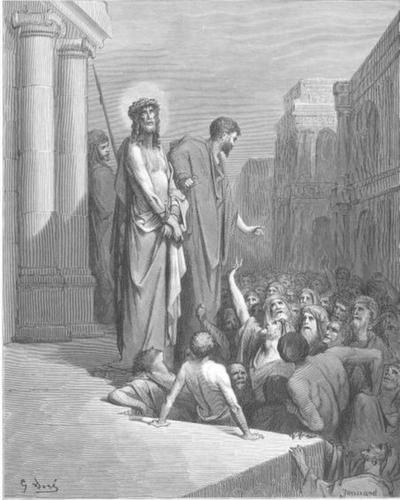
The thorn-crowned prisoner IS the King they refuse to see; the mockery states the truth.
An unwitting coronation-announcement over the crowned sufferer.
Covenant Israel, awaiting Shiloh's scepter (Gen 49:10), publicly renouncing its Messiah.
The Cross, a Receipt Stamped Paid
John 19:17–37
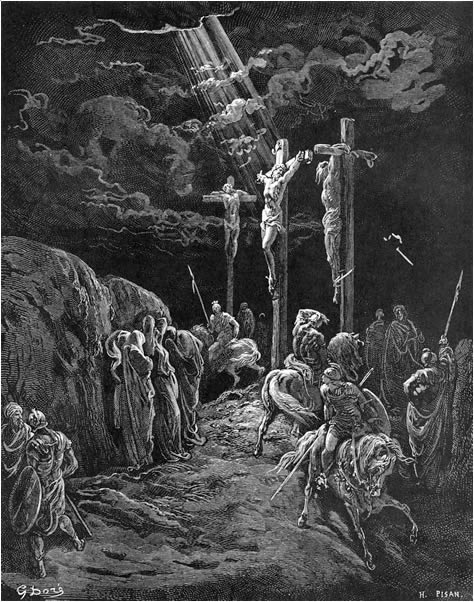
John reports three of the seven last words, each load-bearing: “Woman, behold thy son” (filial provision, the fifth commandment kept to the last breath); “I thirst” (fulfilling Ps 69:21); and “It is finished”, tetelestai, a legal-commercial term for a debt paid in full, a receipt stamped paid. Not “I am finished” (defeat) but “it is accomplished.” And He does not have His spirit taken: He gives it up (10:18).
The pierced side runs “blood and water” (19:34): the physiological mark of a real, complete death, against the swoon theory. Joseph of Arimathea and Nicodemus (who first came “by night,” now openly) give the King a rich man's grave (Isa 53:9), in a garden (19:41): Eden held the fall; this garden holds its reversal.
The Resurrection
John 20, the hinge of the Gospel
- 1The folded clothJohn 20:1–10
The soudarion (face-cloth) “rolled up in a place by itself” (20:7), grave-robbers do not pause to refold a corpse's wrappings. The beloved disciple “saw, and believed.”
- 2“Mary”John 20:11–18
The risen body is His own yet not instantly known, until one word undoes grief, “Mary”, the Good Shepherd calling His own sheep by name. “Touch me not” = stop clinging.
- 3“My Lord and my God”John 20:24–28
Bodily, wound-marked, no vision or ghost. Thomas's demand is met word for word, and resolves into the Gospel's highest confession, spoken to Jesus, closing the inclusio opened at 1:1.
The stated purpose, 20:30–31
“These are written, that ye may believe that Jesus is the Christ, the Son of God; and that believing ye may have life in his name.” The Gospel's own reason for being, and the reason MannaFest exists to walk readers through it.
The Epilogue, Peter Restored
John 21, a charcoal fire on the shore
A night of empty nets, then a catch too great to draw, 153 fish, and “the net was not rent” (21:11): fullness held secure, echoing Peter's first call. At a charcoal fire (the only other in the Gospel is the denial-fire, 18:18), three questions answer three denials, verse for verse. (The agapaō / phileō verb-shift is genuinely contested; the load-bearing point is the threefold public restoration to office, not a sermon on the verbs.) “Feed my sheep,” a veiled prophecy of Peter's own cross, and the first word of his first call, now the last: “Follow me.”
Keep studying
Read it1
On this page
Studies6
Symbols6
Go further1
By subject
Stories11 pages