
Mark 8:27 to 9:1 · Story · Featured Study
Peter's Confession
Peter's answer to the question Jesus put to the Twelve near Caesarea Philippi, as Matthew, Mark and Luke record it.
The disciple who named Jesus the Christ was called Satan a few verses later.
- Where
- Caesarea Philippi
- Who
- Jesus of Nazareth, Peter
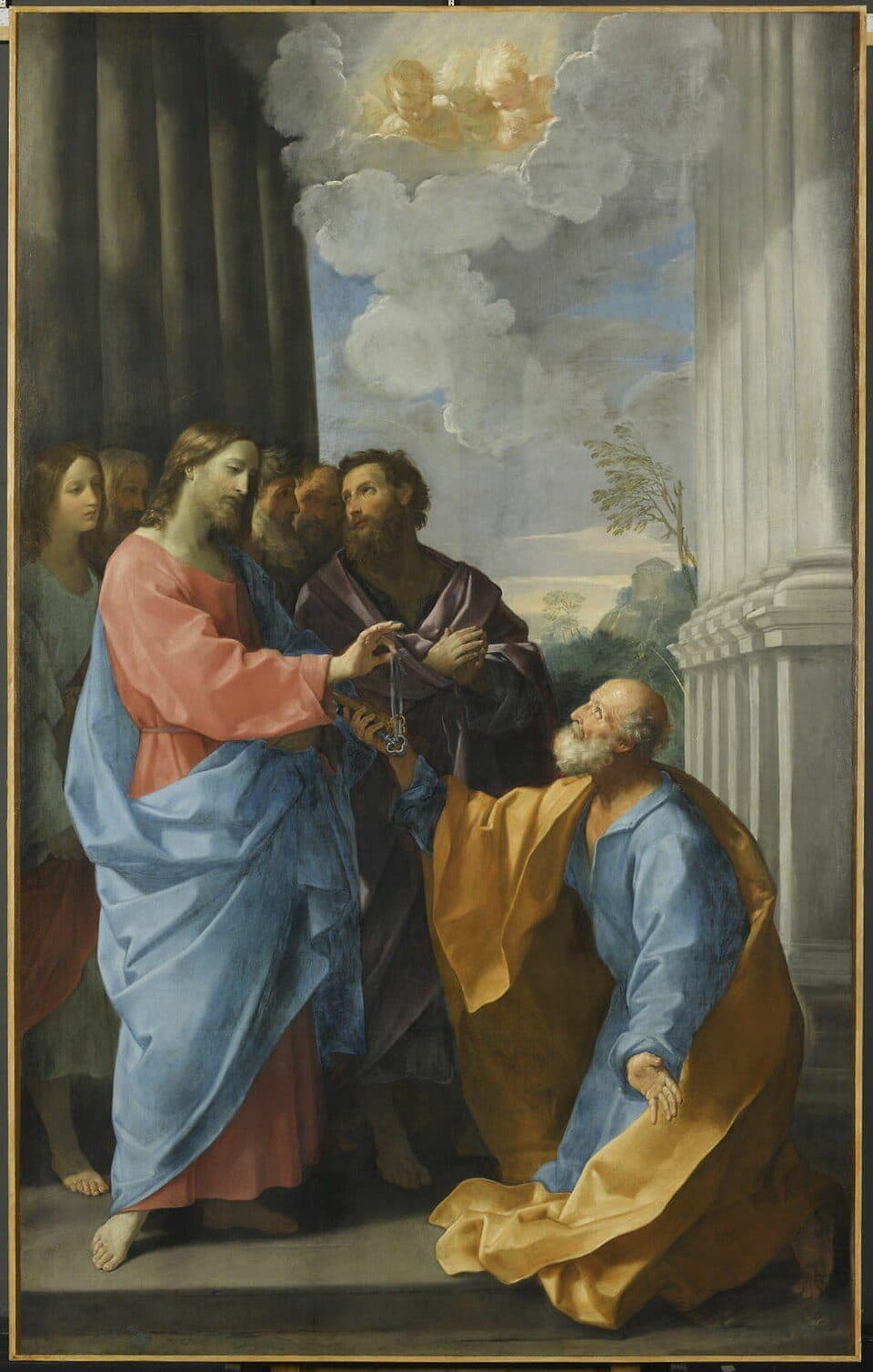
Guido Reni, Christ Giving the Keys to Saint Peter, about 1624 to 1626, Musée du Louvre. Public domain, via Wikimedia Commons.
THE ARTWORKReni paints the moment of Matthew 16:19, when Jesus gives Peter the keys of the kingdom of heaven.
Summary
Peter's answer that Jesus is the Christ turns Mark's Gospel from the question of who He is to the road to the cross.
- The crowds took Jesus for John the Baptist, Elijah or one of the prophets.
- Jesus warns the Twelve not to tell anyone about Him, and at once begins to teach that He must be killed and rise.
- Peter takes Jesus aside and rebukes Him for speaking of His death.
- The promise that closes the scene, Mark 9:1, is read three ways.
The Question on the Road
The scene in Mark, step by step.
Mark tells the scene in thirteen verses, Mark 8:27 to 9:1, from the question on the road to the promise of the kingdom.
- On the roadJesus asks who people say He is, Mark 8:27
- The crowd's answersJohn the Baptist, Elijah, one of the prophets, Mark 8:28
- Peter's answerYou are the Christ, Mark 8:29
- The warningNot to tell anyone about Him, Mark 8:30
- The first predictionSuffering, death and rising, Mark 8:31
- Peter rebukes JesusHe takes Jesus aside, Mark 8:32
- Jesus rebukes PeterGet behind Me, Satan, Mark 8:33
- The costDeny himself, take up his cross and follow Me, Mark 8:34
- The promiseSome will see the kingdom of God arrive with power, Mark 9:1
Nine numbered steps.
The four verses that carry the sceneMark 8:27, 8:29, 8:31 and 8:33 in the Berean text
Then Jesus and His disciples went on to the villages around Caesarea Philippi. On the way, He questioned His disciples: “Who do people say I am?”“But what about you?” Jesus asked. “Who do you say I am?” Peter answered, “You are the Christ.”Then He began to teach them that the Son of Man must suffer many things and be rejected by the elders, chief priests, and scribes, and that He must be killed and after three days rise again.Jesus speaks of the cross as soon as Peter has given the title.
But Jesus, turning and looking at His disciples, rebuked Peter and said, “Get behind Me, Satan! For you do not have in mind the things of God, but the things of men.”One verb three timesMark 8:30, 8:32 and 8:33, the Greek epitimao
Within four verses Jesus warns the disciples with epitimao, Peter rebukes Jesus with it, and Jesus rebukes Peter with it.
Strong's Greek dictionary gives its sense as to censure or admonish, and by implication to forbid.
The healing at Bethsaida just beforeMark 8:22 to 26
Of all the healings in Mark, the one at Bethsaida alone comes in two stages, and Mark sets it straight before the question on the road.
The man looked up and said, “I can see the people, but they look like trees walking around.” Once again Jesus placed His hands on the man’s eyes, and when he opened them his sight was restored, and he could see everything clearly.Three Tellings of One Answer
Matthew 16, Mark 8 and Luke 9.
| Gospel | Where | Peter's answer | Only here |
|---|---|---|---|
| Matthew 16:13 to 23 | The region of Caesarea Philippi | The Christ, the Son of the living God | Jeremiah among the crowd's answers; the blessing, the name Peter, the rock and the keys |
| Mark 8:27 to 33 | The villages around Caesarea Philippi | The Christ | Mark alone says Jesus spoke this message quite frankly |
| Luke 9:18 to 22 | No place named; after the feeding of the five thousand | The Christ of God | Jesus praying in private before He asks |
- Gospel
- Matthew 16:13 to 23
- Where
- The region of Caesarea Philippi
- Peter's answer
- The Christ, the Son of the living God
- Only here
- Jeremiah among the crowd's answers; the blessing, the name Peter, the rock and the keys
- Gospel
- Mark 8:27 to 33
- Where
- The villages around Caesarea Philippi
- Peter's answer
- The Christ
- Only here
- Mark alone says Jesus spoke this message quite frankly
- Gospel
- Luke 9:18 to 22
- Where
- No place named; after the feeding of the five thousand
- Peter's answer
- The Christ of God
- Only here
- Jesus praying in private before He asks
The rock and the keysMatthew 16:17 to 19
The three historic readings of the rock and the keys, each with its holders, stand on the page Upon This Rock.
Caesarea Philippi at the Springs of the Jordan
The city's place, its names and its builders.
Caesarea Philippi stood where the Jordan rises from a cave at the southern foot of Mount Hermon. Its older name was Paneas, from the god Pan, who was worshipped in the cavern.
Augustus gave the district to Herod the Great, and Herod built a temple of white marble beside the cave and dedicated it to Caesar.
Herod's son Philip, tetrarch of the region, rebuilt Paneas and named it Caesarea. The added name of Philip set it apart from Caesarea on the coast.
Philip also raised Bethsaida to the rank of a city and named it Julias.
The cave and the spring in JosephusAntiquities 15.10.3 and War 3.10.7
Josephus describes the water inside the cave as deep and still.
He also reports that Philip tested where the Jordan rose by throwing chaff into a round pool called Phiala and finding it again at Panium.
The city after the GospelsAntiquities 20.9.4, War 7.2.1 and Eusebius
Agrippa II enlarged the city and renamed it Neronias in honour of Nero. After Jerusalem fell in AD 70, Titus stayed there and held shows in which many captives died.
Eusebius, in his Church History, still calls it Caesarea Philippi and says the Phoenicians call it Paneas.
Why Mark Turns Here
The question of the first half and the teaching of the second.
Mark's first line calls Jesus the Christ, the Son of God. Between that line and Peter's answer, the word Christ does not occur again in Mark.
Meanwhile the question of who He is keeps rising. After the storm on the lake the disciples ask one another who this is, that even the wind and the sea obey Him.
From Peter's answer on, Jesus foretells His passion to the Twelve three times before they reach Jerusalem.
The crowd's answers were the answers Herod heardMark 6:14 to 15 and Luke 9:9
Now King Herod heard about this, for Jesus’ name had become well known, and people were saying, “John the Baptist has risen from the dead! That is why miraculous powers are at work in him.” Others were saying, “He is Elijah,” and still others, “He is a prophet, like one of the prophets of old.”Luke sets Herod's question at Luke 9:9 and the question to the Twelve at Luke 9:18.
“I beheaded John,” Herod said, “but who is this man I hear such things about?” And he kept trying to see Jesus.Peter's answer and the centurion'sMark 1:1 and 15:39
Peter gives the first of the two names in Mark's first line, the Christ, and at the cross a Roman centurion gives the second, the Son of God.
When the centurion standing there in front of Jesus saw how He had breathed His last, he said, “Truly this man was the Son of God!”The three predictions on the roadMark 8:31, 9:31 and 10:33 to 34
Each prediction ends with His death and His rising after three days. The page The Passion Predictions sets the three side by side.
because He was teaching His disciples. He told them, “The Son of Man will be delivered into the hands of men. They will kill Him, and after three days He will rise.”Jesus repeats the prediction away from the crowds, so this teaching was for the disciples alone.
What the Text Leaves Unsaid
Four things the accounts do not tell.
No Gospel gives the year or the season of the scene.
Neither Mark nor Matthew places Jesus in the city itself or at the cave of Pan, so the cave as the setting of the scene is an inference.
Luke records no rebuke of Peter.
The Gospels do not record what the other disciples answered.
The Christ Who Must Suffer
The Greek words behind the title, the must and the rebuke.
Christ is the Greek christos, the anointed one, the Messiah. Peter gave the right title.
The word must in Mark 8:31 is the Greek dei, it is necessary, and it governs every verb that follows: suffer, be rejected, be killed and rise.
The rebuke of Mark 8:33 shows where the fault lay: Peter took the title and refused the must that came with it.
Chrysostom's lesson from the rebukeMark 8:33, with John Chrysostom
If the chief apostle could be called Satan for drawing back from the cross, John Chrysostom concluded, no one has an excuse to be ashamed of it.
Get behind MeMark 8:33 and 8:34, the Greek opiso mou and the Hebrew satan
The words behind Me in Mark 8:33 are the same Greek words, opiso mou, that Mark 8:34 uses for anyone who wants to come after Him.
The name Satan comes from the Hebrew satan, which Strong's Hebrew dictionary glosses as an opponent.
Four Voices on the Confession
Four teachers from the fourth century to the nineteenth.
John Chrysostom answers why it is Peter who speaks.
“What then saith the mouth of the apostles, Peter, the ever fervent, the leader of the apostolic choir? When all are asked, he answers. And whereas when He asked the opinion of the people, all replied to the question; when He asked their own, Peter springs forward, and anticipates them, and saith, ‘Thou art the Christ, the Son of the living God.’”
John Chrysostom · Homily on the Gospel of Matthew 54 · on Matthew 16:16Patristic
Bede answers why Jesus asked about the crowds before He asked the Twelve.
“Now the disciples were with the Lord, but He alone prayed to the Father, since the saints may be joined to the Lord in the bond of faith and love, but the Son alone is able to penetrate the incomprehensible secrets of the Father's will. Every where then He prays alone, for human wishes comprehend not the counsel of God, nor can any one be a partaker with Christ of the deep things of God. Rightly does our Lord, when about to enquire into the faith of the disciples, first inquire into the opinion of the multitudes, lest their confession should appear not to be determined by their knowledge, but to be formed by the opinion of the generality, and they should be considered not to believe from experience, but like Herod to be perplexed by different reports which they heard.”
Bede · Catena Aurea by Aquinas · on Luke 9:18Patristic
John Wesley names the one point Jesus taught the Twelve before this day and the second He taught after it.
“From that time Jesus began to tell his disciples, that he must suffer many things - Perhaps this expression, began, always implied his entering on a set and solemn discourse. Hitherto he had mainly taught them only one point, That he was the Christ. From this time he taught them another, That Christ must through sufferings and death enter into his glory.”
John Wesley · Explanatory Notes upon the New Testament · on Matthew 16:21Evangelical
Jamieson, Fausset and Brown answer why the rebuke was given in front of the others.
“But he turned, and said--in the hearing of the rest; for Mark (Mr 8:33) expressly says, ‘When He had turned about and looked on His disciples, He rebuked Peter’; perceiving that he had but boldly uttered what others felt, and that the check was needed by them also.”
Jamieson, Fausset & Brown · Commentary Critical and Explanatory on the Whole Bible · on Matthew 16:23Reformed
Two Questions Still Asked
Why Jesus commanded silence, and what Mark 9:1 promised.
John Chrysostom, in the fifty-fourth homily quoted above, answered that the right belief about Him had to wait until the cross and the rest of His sufferings were past, so that nothing would disturb it.
William Wrede, in Das Messiasgeheimnis in den Evangelien, held that the oldest belief dated the messiahship of Jesus from the resurrection. He argued that Mark did not mean the confession at Caesarea Philippi as the goal of a development or an epoch in the life of Jesus.
Mark 9:9 gives the silence an end: until the Son of Man had risen from the dead. The page The Messianic Secret sets out both readings with their holders.
Chrysostom, in his fifty-sixth homily, read Mark 9:1 of the Transfiguration. John Charles Ryle, in Expository Thoughts on the Gospels, read it the same way.
John Wesley, in the Explanatory Notes quoted above, read it of the kingdom set up with power through the growth of the church and the destruction of the temple and the city.
Albert Schweitzer, in The Quest of the Historical Jesus, held that Jesus expected the kingdom within the lifetime of His hearers and that the expectation failed. He argued it from Matthew 10:23.
All three Gospels set the Transfiguration straight after the saying; Mark dates it six days later.
Books to Read Next
Three works, each free to read.
The Training of the Twelve
A. B. Bruce · 1877
Its eleventh chapter walks through the crowd's opinions, Peter's answer and the truth it confessed.
Read it at the Internet ArchiveHomilies on the Gospel of Matthew
John Chrysostom · fourth century
Homilies 54 to 56 were preached on Matthew 16 and the Transfiguration.
Read Homily 54 at New AdventThe Antiquities of the Jews
Flavius Josephus · first century
Josephus gives much of the history of the city told above in its fifteenth, eighteenth and twentieth books.
Read it at Project GutenbergThe Question Put to Every Reader
Jesus put the question to the Twelve alone, yet the cost He named next is laid on every follower.
So the question asks every reader for Peter's confession with the cross Jesus joined to it.
Then Jesus called the crowd to Him along with His disciples, and He told them, “If anyone wants to come after Me, he must deny himself and take up his cross and follow Me.Keep studying
Read it1