
Matthew 3:16
in Matthew 3As soon as Jesus was baptized, He went up out of the water. Suddenly the heavens were opened, and He saw the Spirit of God descending like a dove and resting on Him.
BSB
The same verse in ASV and KJV ▾
ASV
And Jesus, when he was baptized, went up straightway from the water: and lo, the heavens were opened unto him, and he saw the Spirit of God descending as a dove, and coming upon him;
KJV
And Jesus, when he was baptized, went up straightway out of the water: and, lo, the heavens were opened unto him, and he saw the Spirit of God descending like a dove, and lighting upon him:
⋯
This verse in Matthew 3
Commentary
34 notes on this verseNot by an actual cleaving of the visible element, but to the spiritual eye, as Ezekiel also in the beginning of his book relates that he saw them. It sate on the head of Jesus, that none might suppose the voice of the Father spoken to John, and not to the Lord.
This site's exposition
the Spirit of God descending like a dove
on Matthew 3:16-17
All three persons of the Godhead appear together in one scene, the Son baptized in the water, the Spirit descending like a dove and lighting on him, and the Father's voice from heaven naming him. This is my beloved Son, in whom I am well pleased, draws together Psalm 2:7's royal decree and Isaiah 42:1's chosen servant, the king and the suffering servant identified as one person at the very start of his ministry. The dove's bodily descent, which Luke also records, marks a moment the church has long read as the clearest trinitarian scene in the Gospels.
The record, by era
The Church Fathers5 voices
(Ambrosiaster. Serm. xii. 4.) For, as we have said, when the Saviour was washed, then the water was cleansed for our baptism, that a laver might be ministered to the people who were to come. Moreover, it behoved that in Christ's baptism should be signified those things which the faithful obtain by baptism.
(App. Serm. 135. 1.) Christ after He had been once born among men, is born a second time in the sacraments, that as we adore Him then born of a pure mother, so we may now receive Him immersed in pure water. His mother brought forth her Son, and is yet virgin; the wave washed Christ, and is holy. Lastly, that Holy Spirit which was present to Him in the womb, now shone round Him in the water, He who then made Mary pure, now sanctifies the waters. (de Trin. ii. 5.) It is easy to understand how the Holy Ghost should be said to be sent, when as it were a dove in visible shape descended on the Lord; that is, there was created a certain appearance for the time in which the Holy Spirit might be visibly shewn. And this operation thus made visible and offered to mortal view, is called the mission of the Holy Spirit, not that His invisible substance was seen, but that the hearts of men might be roused by the external appearance to contemplate the unseen eternity. Yet this creature in the shape of which the Spirit appeared, was not taken into unity of person, as was that human shape taken of the Virgin. For neither did the Spirit bless the dove, nor unite it with Himself for all eternity, in unity of person. Further, though that dove is called the Spirit, so far as to show that in this dove was a manifestation of the Spirit, yet can we not say of the Holy Spirit that He is God and dove, as we say of the Son that He is God and man; and yet it is not as we say of the Son that He is the Lamb of God, as not only has John Baptist declared, but as John the Evangelist saw the vision of the Lamb slain in the Apocalypse. For this was a prophetic vision, not put before the bodily eyes in bodily shape, but seen in the Spirit in spiritual images. […]
Christ was baptized for our sake, in order to sanctify the waters. The Spirit descended in the form of a dove, since wherever there is reconciliation with God there is a dove, as in the case of Noah's ark … announcing God's mercy to the world and at the same time making clear that what is spiritual should be meek and without wickedness, simple and without guile.
The Holy Spirit appeared in the form of a dove, being kindly, affectionate and a lover of humanity. Although frequently pushed aside, the dove nevertheless comes again to be possessed by us and does us good according to its own goodness. For the dove is …
Or thus; It becometh us to fulfil all righteousness, that is, to give an example of perfect justification in baptism, without which the gate of the kingdom of heaven is not opened. Hence let the proud take an example of humility, and not scorn to be baptized by My humble members when they see Me baptized by John My servant. That is true humility which obedience accompanies; as it continues, then he suffered Him, that is, at last consented to baptize Him. But was this then the first time that the heavens were opened to Him according to His human nature? The faith of the Church both believes and holds that the heavens were no less open to Him before than after. It is therefore said here, that the heavens were opened, because to all them who are born again the door of the kingdom of heaven is opened. As to all those who by baptism are born again, the door of the kingdom of heaven is opened, so all in baptism receive the gifts of the Holy Spirit.
27 more voices on this verse
The Church Fathers9 voices
Accordingly the Spirit, admiring such as soar up to the celestial realms by these ascensions, says, "They fly, as if they were kites; they fly as clouds, and as young doves, unto me" -that is, simply like a dove. For we shall, according to the apostle, be caught up into the clouds to meet the Lord (even the Son of man, who shall come in the clouds, according to Daniel ) and so shall we ever be with the Lord, so long as He remains both on the earth and in heaven, who, against such as are thankless for both one promise and the other, calls the elements themselves to witness: "Hear, O heaven, and give ear, O earth.
If you had not purposely rejected in some instances, and corrupter in others, the Scriptures which are opposed to your opinion, you would have been confuted in this matter by the Gospel of John, when it declares that the Spirit descended in the body of a dove, and sat upon the Lord. When the said Spirit was in this condition, He was as truly a dove as He was also a spirit; nor did He destroy His own proper substance by the assumption of an extraneous substance.
Over the waters of baptism, recognising as it were His primeval seat, He reposes: (He who) glided down on the Lord "in the shape of a dove," in order that the nature of the Holy Spirit might be declared by means of the creature (the emblem) of simplicity and innocence, because even in her bodily structure the dove is without literal gall.
[Daniel 10:4] "And in the twenty-fourth day of the first month, I was beside the great river which is the Tigris." Ezekiel also had seen a great vision beside a river, the Chebar (Ezekiel 1:1). And it was by the stream of the Jordan that the heavens were opened to the gaze of our Lord and Savior and also to John the Baptist (Matthew 3:1-17). Therefore those critics should leave off their foolish objections who raise questions about the presence of shadows and symbols in a matter of historical truth and attempt to destroy the truth itself by imagining that they should employ allegorical methods to destroy the historicity of rivers and trees and of Paradise.
This action of Christ's has a figurative meaning pertaining to all who were after Him to be baptized; and therefore he says, straightway He ascended, and not simply He ascended, for all who are worthily baptized in Christ, straightway ascend from the water; that is, make progress in virtues, and are carried on towards a heavenly dignity. They who had gone down to the water carnal and sinful sons of Adam, straightway ascend from the water spiritual sons of God. But if some by their own faults make no progress after baptism, what is that to the baptism? For had the actual creation of the heavens been opened, he would not have said were opened to Him, for a physical opening would have been open to all. But some one will say, What, are the heavens then closed to the eye of the Son of God, who even when on earth is present in heaven? But it must be known, that as He was baptized according to the ordinance of humanity that He had taken on Him, so the heavens were opened to His sight as to His human nature, though as to His divine He was in heaven. Perhaps there were before some unseen obstacles which hindered the souls of the dead from entering the skies. I suppose that since Adam's sin no soul had mounted the skies, but the heavens were continually closed. When, lo! on Christ's baptism they were again opened; after He had overcome by the Cross the great tyrant death, henceforward the heaven, never more to be closed, needed not gates, so that the Angels say not, 'Open ye gates,' for they were open, but take away the gates. (Ps. 24:7.) Or the heavens are opened to the baptized, and they see those things which are in heaven, not by seeing them with the bodily eye, but by believing with the spiritual eye of faith. Or thus; The heavens are the divine Scriptures, which all read but all do not understand, except they who have been so baptized as to receive the Holy Spirit. […]
In the times before Christ's coming, those being baptized were held down in the water a longer time for the confession of sin. But Christ, being sinless, "came up immediately." For Christ was not baptized as one repenting but as one cleansing sins and sanctifying the waters.
A commentator
John ChrysostomHomily on the Gospel of Matthew 12 · Written in the 5th century.
proposed
"Then he suffereth Him. And Jesus, when He was baptized, went up straightway out of the water; and, lo, the heavens were opened unto Him, and he saw the Spirit of God descending like a dove, and lighting upon Him." For inasmuch as many supposed that John was greater than He, because John had been brought up all his time in the wilderness, and was son of a chief priest, and was clothed with such raiment, and was calling all men unto his baptism, and had been born of a barren mother; while Jesus, first of all, was of a damsel of ordinary rank (for the virgin birth was not yet manifest to all); and besides, He had been brought up in an house, and held converse with all men, and wore this common raiment; they suspected Him to be less than John, knowing as yet nothing of those secret things; and it fell out moreover that He was baptized of John, which thing added support to this surmise, even if none of those mentioned before had existed; for it would come into their mind that this man was one of the many (for were He not one of the many, He would not have come with the many to the baptism), but that John was greater than He and far more admirable: in order therefore that this opinion might not prevail, the heavens are opened, when He is baptized, and the Spirit comes down, and a voice with the Spirit, proclaiming the dignity of the Only Begotten. […]
A commentator
John ChrysostomHomily on the Gospel of Matthew 12 · Written in the 5th century.
proposed
"And Jesus, when He was baptized, went up straightway out of the water; and lo! the heavens were opened unto Him." Wherefore were the heavens opened? To inform thee that at thy baptism also this is done, God calling thee to thy country on high, and persuading thee to have nothing to do with earth. And if thou see not, yet never doubt it. For so evermore at the beginnings of all wonderful and spiritual transactions, sensible visions appear, and such-like signs, for the sake of them that are somewhat dull in disposition, and who have need of outward sight, and who cannot at all conceive an incorporeal nature, but are excited only by the things that are seen: that so, though afterward no such thing occur, what hath been declared by them once for all at the first may be received by thy faith. For in the case of the apostles too, there was a "sound of a mighty wind," and visions of fiery tongues appeared, but not for the apostles' sake, but because of the Jews who were then present. Nevertheless, even though no sensible signs take place, we receive the things that have been once manifested by them. Since the dove itself at that time therefore appeared, that as in place of a finger (so to say) it might point out to them that were present, and to John, the Son of God. Not however merely on this account, but to teach thee also, that upon thee no less at thy baptism the Spirit comes. But since then we have no need of sensible vision, faith sufficing instead of all. For signs are "not for them that believe, but for them that believe not." But why in the fashion of a dove? Gentle is that creature, and pure. Forasmuch then as the Spirit too is "a Spirit of meekness," He therefore appears in this sort. And besides, He is reminding us of an ancient history. […]
(Verse 16) For thus it is fitting for us to fulfill all righteousness. Then he let him go. And Jesus, having been baptized, immediately came up from the water. He did not add the righteousness of the Law or of nature, so that we may understand both: if God accepted baptism from a man, let no one refuse to accept it from a servant.
The Medieval Church6 voices
To appear denotes a sensible effect with express signification, as the Holy Spirit appeared in a dove. And since, just as the divine persons are distinct, so they can be distinctly signified both by signs and by names, therefore any person can appear by itself, …
Then when he says, "When Jesus was baptized, he went up immediately from the water," four things that followed the baptism are mentioned. And it should be noted that as Christ in his baptism gave to others the example of being baptized, so in the …
As by the immersion of His body He dedicated the laver of baptism, He has shown that to us also after baptism received the entrance to heaven is open, and the Holy Spirit is given, as it follows, and the heavens were opened. (ap. Anselm.) Seven excellencies in the baptized are figured by the dove. The dove has her abode near the rivers, that when the hawk is seen, she may dive under water and escape; she chooses the better grains of corn; she feeds the young of other birds; she does not tear with her beak; she lacks a gall; she has her rest in the caverns of the rocks; for her song she has a plaint. Thus the saints dwell beside the streams of Divine Scripture, that they may escape the assaults of the Devil; they choose wholesome doctrine, and not heretical for their food; they nourish by teaching and example, men who have been the children of the Devil, i. e. the imitators; they do not pervert good doctrine by tearing it to pieces as the heretics do; they are without hate irreconcileable; they build their nest in the wounds of Christ's death, which is to them a firm rock, that is their refuge and hope; as others delight in song, so do they in groaning for their sin.
(non occ.) Or, so bright a glory shone round about Christ, that the blue concave seemed to be actually cloven.
And he saw the Spirit of God descending like a dove, and lighting upon Him; and, lo, a voice from heaven, saying. The Spirit came down to bear witness that He Who is baptized is greater than he who baptizes. For the Jews held John …
Then he permitted Him; and Jesus, when He was baptized. He was baptized at the age of thirty; for by this age one has experienced all the sins. In the first ten years, there is great foolishness; in the second, during adolescence, the great flame …
The Puritans and the Awakening3 voices
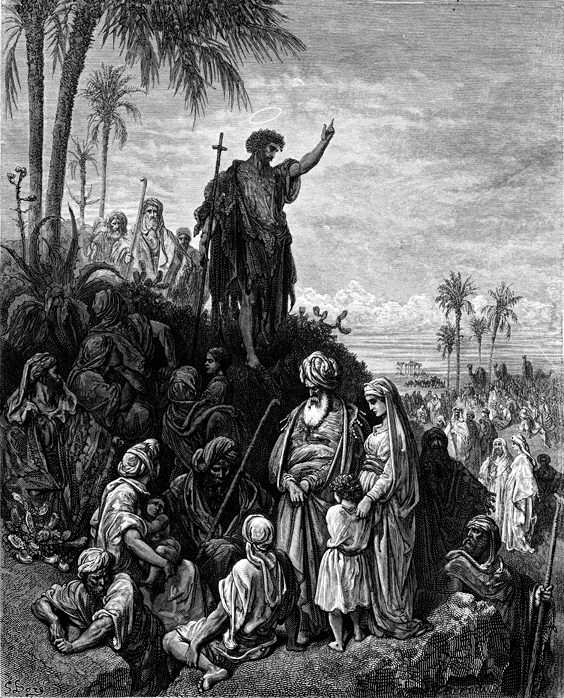
The Preaching of John the Baptist. 1 In those days came John the Baptist, preaching in the wilderness of Judea, 2 And saying, Repent ye: for the kingdom of heaven is at hand. 3 For this is he that was spoken of by the prophet Esaias, saying, The voice of one crying in the wilderness, Prepare ye the way of the Lord, make his paths straight.
quarantine:scripture (2026-07-29) — scripture-overlap:90%@v1-3
And Jesus being baptized - Let our Lord's submitting to baptism teach us a holy exactness in the observance of those institutions which owe their obligation merely to a Divine command. Surely thus it becometh all his followers to fulfil all righteousness. Jesus had no sin to wash away.
And Jesus, when he was baptized,.... Christ, when he was baptized by John in the river Jordan, the place where he was baptizing, went up straightway out of the water. One would be at a loss at first sight for a reason why the Evangelist should relate this circumstance; for after the ordinance was administered, why should he stay in the water? what should he do there? Everyone would naturally and reasonably conclude, without the mention of such a circumstance, that as soon as his baptism was over, he would immediately come up out of the water.
The Nineteenth Century9 voices
The heavens were opened unto him - That is, to John the Baptist - and he, John, saw the Spirit of God - lighting upon him, i.e. Jesus. There has been some controversy about the manner and form in which the Spirit of God rendered itself visible on this occasion.
We have here the account of our Lord Jesus Christ’s baptism. This was his first step when he entered on his ministry. When the Jewish priests took up their office they were washed with water ( Exodus 29:4 ), and when our great High Priest begins the great work he came into the world to accomplish he is publicly baptized. We should notice firstly in these verses the honour placed upon the sacrament of baptism . An ordinance of which the Lord Jesus himself partook is not to be lightly esteemed.
A commentator
Jamieson, Fausset & Brown1802–1910
Commentary Critical and Explanatory on the Whole Bible (1871)
"My dove, my undefiled is one," says the Song of Solomon (So 6:9). Again, "Be ye harmless as doves," says Christ Himself (Mt 10:16). This is the same thing, in the form of inoffensiveness towards men.
A commentator
Charles Spurgeon1834–1892
The Metropolitan Tabernacle Pulpit, Sermon No. 3298: “Lessons From Christ's Baptism” (lightly modernized text, CCEL edition) · Written before 1892.
proposed
[Another Sermon by Mr. Spurgeon upon verse 17 is #2409, Volume 41—A GREAT SERMON BY THE GREATEST PREACHER.] I WANT to teach two lessons tonight. The first will be a most necessary one for the unconverted. The second will be more suitable to believers in the Lord Jesus Christ. I. Without any preface, let us at once try to learn the first lesson from the text which relates to THE CO-WORKING OF THE TRINITY IN THE MATTER OF OUR SALVATION.
We have here the account of our Lord Jesus Christ’s baptism. This was his first step when he entered on his ministry. When the Jewish priests took up their office they were washed with water ( Exodus 29:4 ), and when our great High Priest begins the great work he came into the world to accomplish he is publicly baptized. We should notice firstly in these verses the honour placed upon the sacrament of baptism . An ordinance of which the Lord Jesus himself partook is not to be lightly esteemed. An ordinance to which the great head of the church submitted ought to be ever honourable in the eyes of professing Christians. There are few subjects in religion on which greater mistakes have arisen than baptism. There are few which require so much fencing and guarding. Let us arm our minds with two general cautions. Let us beware, on the one hand, that we do not attach a superstitious importance to the water of baptism. We must not expect that water to act as a charm. We must not suppose that all baptized persons as a matter of course, receive the grace of God in the moment that they are baptized. To say that all who come to baptism obtain like an equal benefit, and that it matters not a jot whether they come with faith and prayer or in utter carelessness—to say such things appears to contradict the plainest lessons of Scripture. Let us beware, on the other hand, that we do not dishonour the sacrament of baptism. It is dishonoured when it is hastily slurred over as a mere form, or thrust out of sight and never publicly noticed in the congregation. A sacrament ordained by Christ himself ought not be treated in this way. The admission of every new member into the visible church, whether young or grown up, is an event which ought to excite a lively interest in a Christian assembly. It is an event that ought to call forth the fervent prayers of all praying people.
THAT our Lord was the true Messiah of God was proved by His answering to all those prophecies which described the promised Messenger of the Covenant. His miracles also proved that God was with Him, and from their character they marked Him out as the ordained Deliverer. To open blind eyes and unstop deaf ears were works foretold as denoting the Messiah. His teachings were equally clear proofs of His mission—there is about them an authority found nowhere else. The words which He spoke are Spirit and Life. They are self-evidencing in their elevation, purity, perfection.
THAT our Lord was the true Messiah of God was proved by His answering to all those prophecies which described the promised Messenger of the Covenant. His miracles also proved that God was with Him, and from their character they marked Him out as the ordained Deliverer. To open blind eyes and unstop deaf ears were works foretold as denoting the Messiah. His teachings were equally clear proofs of His mission—there is about them an authority found nowhere else. The words which He spoke are Spirit and Life. They are self-evidencing in their elevation, purity, perfection. "Never man spoke like this Man." His Testimony is unique and bears a majesty of Deity about it which bespeaks itself. His resurrection also was a clear proof that he was sent of God. He was "declared to be the Son of God with power, by the resurrection from the dead." But in addition to all this and a great deal more, the Divine Father was pleased, also, to speak out of Heaven with an audible voice to declare that Jesus of Nazareth was no other than the Son of God and the promised Christ for whom the faithful were watching. Thrice did the majesty of Heaven break its sublime silence and bear witness to the Incarnate God. The three occasions, as mentioned in our texts, are most instructive, and shall command our attention this morning. May the Holy Spirit instruct us. Without any further preface, let us consider the three Testimonies given to our Lord by the voice of the Most High. If time permits we will then notice one or two instructive circumstances connected with them. And we will close by drawing a great practical lesson from them. I. In endeavoring to bring before your attentive minds THE THREE OCCASIONS ON WHICH THE FATHER, BY A VOICE FROM HEAVEN, BORE WITNESS TO HIS SON, I would invite you to observe, first, when these voices were heard.
A commentator
Charles Spurgeon1834–1892
The Metropolitan Tabernacle Pulpit, Sermon No. 3298: “Lessons From Christ's Baptism” (lightly modernized text, CCEL edition) · Written before 1892.
proposed
[Another Sermon by Mr. Spurgeon upon verse 17 is #2409, Volume 41—A GREAT SERMON BY THE GREATEST PREACHER.] I WANT to teach two lessons tonight. The first will be a most necessary one for the unconverted. The second will be more suitable to believers in the Lord Jesus Christ. I. Without any preface, let us at once try to learn the first lesson from the text which relates to THE CO-WORKING OF THE TRINITY IN THE MATTER OF OUR SALVATION. There are some who seem to suppose that Jesus Christ is our Savior to the exclusion of God the Father and of God the Holy Spirit, but this is a most erroneous idea. It is true that we are saved by the precious blood of Christ, but it is equally true that God the Father and God the Holy Spirit have had their share in the great work of our salvation. In order that we might not fall into the error in which some have been entangled, it pleased God to give us, at the very beginning of Christ's public ministry, a very distinct intimation that He did not come alone and that He did not undertake the work of our redemption apart from the other adorable Persons of the ever-blessed Trinity. Try to picture to yourselves the scene that our text describes. There is Jesus Christ who has just been baptized in Jordan by John. And John bears witness that He is the Son of God because the sign from Heaven for which he had been told to look for had been given. As Jesus comes up out of the water, the Spirit of God descends upon Him in a visible shape— in appearance like a dove—and rests upon Him. John says that "it abode upon Him," as though the Spirit was thenceforth to be His continual Companion and, truly, it was so.
A commentator
Albert Barnes1798–1870
Notes, Explanatory and Practical, on the Old and New Testaments (1832-1869)
proposed
Out of the water - This shows that he had descended to the river. It literally means, “he went up directly from the water.” The original does not imply that they had descended into the river, and it cannot be proved, therefore, from this passage, that his baptism was by immersion; nor can it be proved that even, if his baptism was by immersion, that therefore the same mode is binding on people now. In order to demonstrate from this passage that immersion is essential, it is necessary to demonstrate: (a) that he went into the river; (b) that, being there, he was wholly immersed; (c) that the fact that he was immersed, if he was, proves that all others must be, in order that there could be a valid baptism. Neither of these three things has ever been demonstrated from this passage, nor can they be. The heavens were opened unto him - This was done while he was praying, Luk 3:21. The ordinances of religion will be commonly ineffectual without prayer. If in those ordinances we look to God, we may expect that he will bless us; the heavens will be opened, light will shine upon our path, and we shall meet with the approbation of God. The expression, “the heavens were opened,” is one that commonly denotes the appearance of the clouds when it lightens. The heavens appear to open or give way. Something of this kind probably appeared to John at this time. The same appearance took place at Stephen’s death, Act 7:56. The expression means that he was permitted to see far into the heavens beyond what the natural vision would allow. To him - Some have referred this to Jesus, others to John. It probably refers to John. See Joh 1:33. It was a testimony given to John that this was the Messiah. He saw - John saw. The Spirit of God - See Mat 3:11. This was the third person of the Trinity, descending upon him in the form of a dove, Luk 3:22. […]
The words behind it
28 Greek wordsEvery Greek word of this verse in the order it stands, with what it means and the door to its own study. The last column counts the times a word stands in the whole Bible: the rarer the word, the more the places it appears belong together.
| Greek | Sound | Meaning | Word study | In the Bible |
|---|---|---|---|---|
| Βαπτισθεὶς | baptistheis | Having been baptized | G907 → | 76 times |
| δὲ | de | now | G1161 → | 2765 times |
| ὁ | ho | <the> | G3588 → | 19766 times |
| Ἰησοῦς | iesous | Jesus | G2424 → | 908 times |
| εὐθὺς | euthus | immediately | G2112 → | 87 times |
| ἀνέβη | anebe | went up | G305 → | 82 times |
| ἀπὸ | apo | from | G575 → | 640 times |
| τοῦ | tou | the | G3588 → | 19766 times |
| ὕδατος. | hudatos | water. | G5204 → | 76 times |
| καὶ | kai | and | G2532 → | 9120 times |
| ἰδοὺ | idou | behold | G2400 → | 200 times |
| ἠνεῴχθησαν | eneochthesan | were opened | G455 → | 77 times |
| αὐτῷ | auto | to Him | G846 → | 5565 times |
| οἱ | hoi | the | G3588 → | 19766 times |
| οὐρανοί, | ouranoi | heavens, | G3772 → | 272 times |
| καὶ | kai | and | G2532 → | 9120 times |
| εἶδεν | eiden | he saw | G1492 → | 374 times |
| τὸ | to | the | G3588 → | 19766 times |
| πνεῦμα | pneuma | Spirit | G4151 → | 378 times |
| τοῦ | tou | <the> | G3588 → | 19766 times |
| θεοῦ | theou | of God | G2316 → | 1312 times |
| καταβαῖνον | katabainon | descending | G2597 → | 81 times |
| ὡσεὶ | hosei | as | G5616 → | 21 times |
| περιστερὰν | peristeran | a dove | G4058 → | 10 times |
| καὶ | kai | and | G2532 → | 9120 times |
| ἐρχόμενον | erchomenon | alighting | G2064 → | 628 times |
| ἐπ᾽ | ep᾽ | upon | G1909 → | 883 times |
| αὐτόν. | auton | Him. | G846 → | 5565 times |
ΒαπτισθεὶςHaving been baptized
baptistheisG907 →76 times
δὲnow
deG1161 →2765 times
ὁ<the>
hoG3588 →19766 times
ἸησοῦςJesus
iesousG2424 →908 times
εὐθὺςimmediately
euthusG2112 →87 times
ἀνέβηwent up
anebeG305 →82 times
ἀπὸfrom
apoG575 →640 times
τοῦthe
touG3588 →19766 times
ὕδατος.water.
hudatosG5204 →76 times
καὶand
kaiG2532 →9120 times
ἰδοὺbehold
idouG2400 →200 times
ἠνεῴχθησανwere opened
eneochthesanG455 →77 times
αὐτῷto Him
autoG846 →5565 times
οἱthe
hoiG3588 →19766 times
οὐρανοί,heavens,
ouranoiG3772 →272 times
καὶand
kaiG2532 →9120 times
εἶδενhe saw
eidenG1492 →374 times
τὸthe
toG3588 →19766 times
πνεῦμαSpirit
pneumaG4151 →378 times
τοῦ<the>
touG3588 →19766 times
θεοῦof God
theouG2316 →1312 times
καταβαῖνονdescending
katabainonG2597 →81 times
ὡσεὶas
hoseiG5616 →21 times
περιστερὰνa dove
peristeranG4058 →10 times
καὶand
kaiG2532 →9120 times
ἐρχόμενονalighting
erchomenonG2064 →628 times
ἐπ᾽upon
ep᾽G1909 →883 times
αὐτόν.Him.
autonG846 →5565 times
A shaded row is a word that stands 400 times or fewer in the Bible.
The walk
8 stopsEach card is a verse this one points to, and under it the verses that one points to in turn. Where several paths arrive at the same place, that place is listed first: the text keeps returning to it.
Through
Isaiah 11:2The Spirit of the LORD will rest on Him—the Spirit of wisdom and understanding, the Spirit of counsel and strength, the Spirit of knowledge and fear of the LORD.
it leads to
- Isaiah 61:1
The Spirit of the Lord GOD is on Me, because the LORD has anointed Me to preach good news to the poor. He has sent Me to bind up the brokenhearted, to proclaim liberty…
Reached by 2 separate paths from here.
- Isaiah 42:1
“Here is My Servant, whom I uphold, My Chosen One, in whom My soul delights. I will put My Spirit on Him, and He will bring justice to the nations.
Reached by 2 separate paths from here.
- John 16:13
However, when the Spirit of truth comes, He will guide you into all truth. For He will not speak on His own, but He will speak what He hears, and He will declare to…
- Ephesians 1:17–18
that the God of our Lord Jesus Christ, the glorious Father, may give you a spirit of wisdom and revelation in your knowledge of Him.
- 2 Timothy 1:7
For God has not given us a spirit of fear, but of power, love, and self-control.
- Isaiah 61:1
Through
Isaiah 42:1“Here is My Servant, whom I uphold, My Chosen One, in whom My soul delights. I will put My Spirit on Him, and He will bring justice to the nations.
it leads to
- Luke 3:22
and the Holy Spirit descended on Him in a bodily form like a dove. And a voice came from heaven: “You are My beloved Son; in You I am well pleased.”
Reached by 2 separate paths from here.
- Matthew 12:18–21
“Here is My Servant, whom I have chosen, My beloved, in whom My soul delights. I will put My Spirit on Him, and He will proclaim justice to the nations.
- Isaiah 52:13
Behold, My Servant will prosper; He will be raised and lifted up and highly exalted.
- Luke 3:22
Where this verse is studied
On this page
Studies5
On this verse
About Matthew
This page draws on 28 works. Open the list of works
This page draws on Adam Clarke, Commentary on the Bible; Albert Barnes, Notes, Explanatory and Practical, on the Old and New Testaments (1832-1869); Ambrose of Milan, Catena Aurea by Aquinas; Augustine of Hippo, Catena Aurea by Aquinas; Bonaventure, Breviloquium; Charles Spurgeon, The Metropolitan Tabernacle Pulpit, Sermon No. 3298: “Lessons From Christ's Baptism” (lightly modernized text, CCEL edition); Charles Spurgeon, The Metropolitan Tabernacle Pulpit, Sermon No. 909: “Voices from the Excellent Glory” (lightly modernized text, CCEL edition); Cyril of Alexandria, FRAGMENT 29; Glossa Ordinaria, Catena Aurea by Aquinas; J.C. Ryle, Expository Thoughts on the Gospels: Matthew; Jamieson, Fausset & Brown, Commentary Critical and Explanatory on the Whole Bible; Jerome, Catena Aurea by Aquinas; Jerome, St. Jerome, Commentary on Daniel, CHAPTER TEN; Jerome, Commentary on Matthew; John Chrysostom, Homily on the Gospel of Matthew 12; John Gill, Exposition of the New Testament (1746-1748); John Wesley, Explanatory Notes upon the New Testament; Matthew Henry, Commentary on the Whole Bible; Origen of Alexandria, FRAGMENT 56.30; Pseudo-Chrysostom, Catena Aurea by Aquinas; Rabanus Maurus, Catena Aurea by Aquinas; Remigius of Rheims, Catena Aurea by Aquinas; Tertullian, Against Marcion Book III; Tertullian, On the Flesh of Christ; Tertullian, On Baptism; Theodore of Mopsuestia, FRAGMENT 15.32; Theophylact of Ohrid, Commentary on Matthew and Thomas Aquinas, Commentary on Matthew.