
Joel 2:28-32 · Acts 2:16-21 · Passage · Featured Study
Joel 2:28-32 in Acts 2
Peter quoted Joel's promise of the Spirit to explain what the crowd in Jerusalem saw and heard at Pentecost.
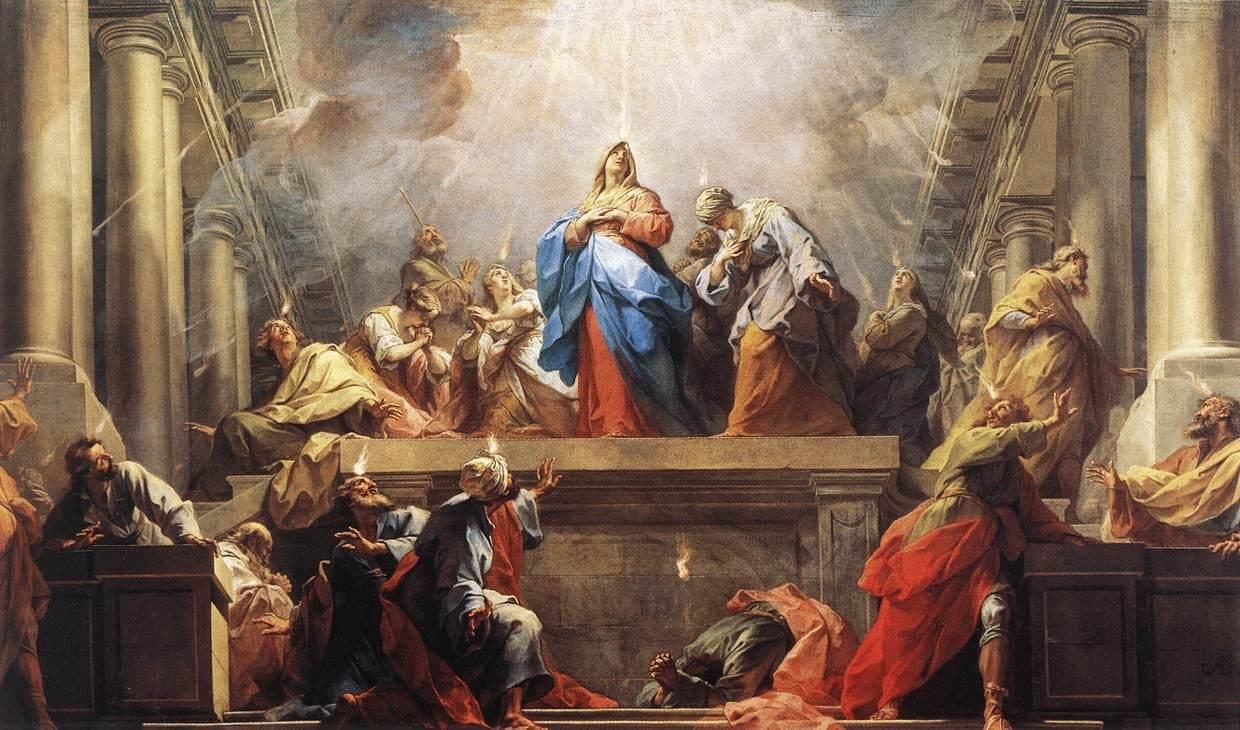
Jean II Restout, Pentecost, 1732. Public domain, via Wikimedia Commons.
THE ARTWORKRestout painted the morning of Acts 2, when the Spirit came on the disciples in Jerusalem. Peter explained that morning by quoting Joel.
Some in the crowd said the disciples were drunk, and Peter answered them with a prophet.
Summary
Joel promised that the LORD would pour out His Spirit on all people before the great Day of the LORD, and at Pentecost Peter said the crowd in Jerusalem was seeing that promise kept.
- Peter's quotation follows Joel closely and differs from his words in seven places.
- Peter names Jesus as the one who poured out the Spirit and as the Lord to be called on.
- Paul quotes the same line in Romans 10:13 of those who call on Jesus as Lord.
- Readers divide over whether the signs in sun and moon came in the apostles' day or are still to come.
Joel and Peter, Side by Side
Joel's promise and Peter's quotation are set verse by verse in the Berean text.
Each verse of Joel is set beside Peter's quotation of it.
And afterward, I will pour out My Spirit on all people. Your sons and daughters will prophesy, your old men will dream dreams, your young men will see visions.Joel opens the promise with "afterward."
‘In the last days, God says, I will pour out My Spirit on all people. Your sons and daughters will prophesy, your young men will see visions, your old men will dream dreams.Peter opens it with "in the last days."
Even on My menservants and maidservants, I will pour out My Spirit in those days.Joel gives the Spirit to servants, men and women.
Even on My menservants and maidservants I will pour out My Spirit in those days, and they will prophesy.Peter adds "and they will prophesy."
I will show wonders in the heavens and on the earth, blood and fire and columns of smoke.Joel sets wonders in the heavens and on the earth.
I will show wonders in the heavens above and signs on the earth below, blood and fire and billows of smoke.Peter sets wonders "above" and signs "below."
The sun will be turned to darkness and the moon to blood before the coming of the great and awesome Day of the LORD.Joel calls the Day "great and awesome."
The sun will be turned to darkness, and the moon to blood, before the coming of the great and glorious Day of the Lord.Peter calls the Day "great and glorious."
And everyone who calls on the name of the LORD will be saved; for on Mount Zion and in Jerusalem there will be deliverance, as the LORD has promised, among the remnant called by the LORD.Joel goes on to deliverance for the remnant.
And everyone who calls on the name of the Lord will be saved.’Peter ends the quotation at calling on the Lord.
What the Quotation Changes
Peter's quotation differs from Joel's words in seven places.
| The question | Joel | Peter in Acts |
|---|---|---|
| When does it happen? | And afterward (2:28) | In the last days (2:17) |
| Who is named as speaking? | No speaker in the verse | God says (2:17) |
| Which comes first? | Old men dream dreams, then young men see visions | Young men see visions, then old men dream dreams |
| What do the servants do? | Receive the Spirit (2:29) | Receive the Spirit, and they will prophesy (2:18) |
| Where are the wonders? | In the heavens and on the earth (2:30) | In the heavens above, and signs on the earth below (2:19) |
| What is the Day called? | Great and awesome (2:31) | Great and glorious (2:20) |
| Where does it end? | Deliverance on Mount Zion and in Jerusalem, among the remnant called by the LORD (2:32) | Everyone who calls on the name of the Lord will be saved (2:21) |
- The question
- When does it happen?
- Joel
- And afterward (2:28)
- Peter in Acts
- In the last days (2:17)
- The question
- Who is named as speaking?
- Joel
- No speaker in the verse
- Peter in Acts
- God says (2:17)
- The question
- Which comes first?
- Joel
- Old men dream dreams, then young men see visions
- Peter in Acts
- Young men see visions, then old men dream dreams
- The question
- What do the servants do?
- Joel
- Receive the Spirit (2:29)
- Peter in Acts
- Receive the Spirit, and they will prophesy (2:18)
- The question
- Where are the wonders?
- Joel
- In the heavens and on the earth (2:30)
- Peter in Acts
- In the heavens above, and signs on the earth below (2:19)
- The question
- What is the Day called?
- Joel
- Great and awesome (2:31)
- Peter in Acts
- Great and glorious (2:20)
- The question
- Where does it end?
- Joel
- Deliverance on Mount Zion and in Jerusalem, among the remnant called by the LORD (2:32)
- Peter in Acts
- Everyone who calls on the name of the Lord will be saved (2:21)
How the Changes Are Read
Commentators explain the last days, the servants, the glorious Day and the end of the quotation.
Albert Barnes notes that the Hebrew, the Aramaic, the Syriac and the Arabic all read "afterward" at this place. John Gill holds that the sense is the same, and he cites the Jewish commentator David Kimhi, who reads the last days as the days of the Messiah.
And it shall come to pass in the last days,.... In Joel it is, "afterwards"; instead of which Peter puts, "in the last days"; the sense is the same: and so R. David Kimchi, a celebrated commentator with the Jews, observes, that "afterwards" is the same "as in the last days", and which design the times of the Messiah; for according to a rule given by the same writer on Isa 2:2 wherever the last days are mentioned, the days of the Messiah are intended, Saith God, or "the Lord", as the Vulgate Latin and Ethiopic versions read.
John Gill · Exposition of the New Testament (1746-1748) · on Acts 2:17Reformed
Adam Clarke reads the menservants and maidservants as people of the lowest rank, slaves both male and female. He and Matthew Henry both report a Jewish teaching that the Spirit came only on the wise and the rich, and both read the line as setting that teaching aside.
On my servants and on my handmaidens - This properly means persons of the lowest condition, such as male and female slaves. As the Jews asserted that the spirit of prophecy never rested upon a poor man, these words are quoted to show that, under the Gospel dispensation, neither bond nor free, male nor female, is excluded from sharing in the gifts and graces of the Divine Spirit.
Adam Clarke · Commentary on the Bible · on Acts 2:18Evangelical
Henry adds that Peter's word for the Day follows the Septuagint, the Greek translation of the Old Testament, which reads "glorious" where the Hebrew reads "terrible".
It was a little day of judgment; it was a notable day: in Joel it is called a terrible day, for so it was to men on earth; but here epiphane (after the Septuagint), a glorious, illustrious day, for so it was to Christ in heaven; it was the epiphany, his appearing, so he himself spoke of it, Matt. xxiv.
Matthew Henry · Commentary on the Whole Bible · on Acts 2:20Puritan
Peter ends the quotation before Joel's words on deliverance for the remnant called by the LORD. His sermon ends on the same word, with a promise to all whom the Lord our God will call.
This promise belongs to you and your children and to all who are far off—to all whom the Lord our God will call to Himself.”The close of the sermon takes up the word call from Joel's last line.
The Day of the LORD in Joel
The Day of the LORD stands at Joel 1:15, 2:1, 2:11, 2:31 and 3:14.
Joel names the Day of the LORD in every part of his book. He first speaks of it after a plague of locusts has stripped the land.
Alas for the day! For the Day of the LORD is near, and it will come as destruction from the Almighty.Joel says the Day is near.
In chapter 2 the ram's horn sounds in Zion, and the LORD leads a great army before the Day. Joel asks who can endure it.
The LORD raises His voice in the presence of His army. Indeed, His camp is very large, for mighty are those who obey His command. For the Day of the LORD is great and very dreadful. Who can endure it?Joel calls the Day great and very dreadful.
The promise of the Spirit stands between that army and the judgment of the nations in chapter 3, where the Day comes near in the valley of decision.
Multitudes, multitudes in the valley of decision! For the Day of the LORD is near in the valley of decision.The multitudes gather, and the Day comes near.
What Acts 2 Leaves Unsaid
The signs in the heavens stand in Peter's quotation and nowhere else in Acts 2.
Luke's account of that morning reports a sound like wind, tongues like fire and speech in other tongues. It reports nothing of the sun turned to darkness or the moon to blood.
Peter quotes the signs in the heavens whole and then turns to Jesus of Nazareth. He leaves open when the sun and the moon are darkened.
Suddenly a sound like a mighty rushing wind came from heaven and filled the whole house where they were sitting. They saw tongues like flames of fire that separated and came to rest on each of them. And they were all filled with the Holy Spirit and began to speak in other tongues as the Spirit enabled them.Luke records the wind, the fire and the tongues on the day of Pentecost.
The Lord Who Is Called On
Peter and Paul both name Jesus as the Lord of Joel's last line.
In Joel the one called on is the LORD. Peter's sermon names Jesus as the one who poured out the Spirit and ends with God making Jesus both Lord and Christ.
Exalted, then, to the right hand of God, He has received from the Father the promised Holy Spirit and has poured out what you now see and hear.The exalted Jesus has poured out what the crowd sees and hears.
Therefore let all Israel know with certainty that God has made this Jesus, whom you crucified, both Lord and Christ!”The Lord of the quotation is Jesus, whom they crucified.
Paul quotes Joel 2:32 in Romans 10 after saying that whoever confesses Jesus is Lord will be saved. He sets Jew and Greek under the same Lord.
For there is no difference between Jew and Greek: The same Lord is Lord of all, and gives richly to all who call on Him, for, “Everyone who calls on the name of the Lord will be saved.”Paul applies Joel's line to all who call on the Lord, Jew and Greek alike.
The commentary of Jamieson, Fausset and Brown reads Paul's use of the verse as applied to Christ.
For--saith the scripture whosoever--The expression is emphatic, "Everyone whosoever" shall call upon the name of the Lord shall be saved-- (Joe 2:32); quoted also by Peter, in his great Pentecostal sermon (Ac 2:21), with evident application to Christ.
Jamieson, Fausset & Brown · Commentary Critical and Explanatory on the Whole Bible · on Romans 10:13Reformed
Three Voices on the Passage
Three teachers of the fourth, eighteenth and nineteenth centuries read the promise.
Ambrose of Milan, in his work On the Holy Spirit, reads the words of My Spirit as a measure given to each believer.
"I will pour out of My Spirit": He said not Spirit, but "of My Spirit," for we are not able to receive the fulness of the Holy Spirit, but we receive as much as our Master divides to us of His own according to His will.
Ambrose of Milan · On the Holy Spirit, Book 1 · on Acts 2:17Patristic
John Wesley, in his notes on Joel 2:28, says the promise was fulfilled in part according to the letter in the first days of the gospel.
Shall prophesy - This was in part fulfilled according to the letter in the first days of the gospel; but the promise means farther, by pouring out of the spirit on your sons and your daughters, they shall have as full a knowledge of the mysteries of God's law, as prophets before time had. Shalt dream dreams - This also was literally fulfilled in the apostles days.
John Wesley · Explanatory Notes upon the Old Testament · on Joel 2:28Evangelical
Jamieson, Fausset and Brown read prophesying as all speaking under the light of the Spirit, and look for a further gift before the Lord's return.
"Prophesying" in the New Testament is applied to all speaking under the enlightenment of the Holy Spirit, and not merely to foretelling events. All true Christians are "priests" and "ministers" of our God (Isa 61:6), and have the Spirit (Eze 36:26, 27). Besides this, probably, a special gift of prophecy and miracle-working is to be given at or before Messiah's coming again.
Jamieson, Fausset & Brown · Commentary Critical and Explanatory on the Whole Bible · on Joel 2:28Reformed
When the Signs Come
Three readings of the fulfilment are held, each by named commentators.
Peter says the outpouring is what Joel spoke of, and he quotes the signs before the Day with it. Readers divide over when those signs come.
Fulfilled in the apostles' generation
Adam Clarke reads the darkened sun and the blood moon as figures for the fall of the Jewish state in Judea. Oecumenius, in his commentary on Acts, reads the signs most fittingly of Jerusalem and its captivity.
The sun shall be turned into darkness, and the moon into blood - These are figurative representations of eclipses, intended most probably to point out the fall of the civil and ecclesiastical state in Judea: see the notes on Mat 24:29. That the Sun is darkened when a total eclipse takes place, and that the Moon appears of a bloody hue in such circumstances, every person knows.
Adam Clarke · Commentary on the Bible · on Acts 2:20Evangelical
The objection: Peter's next sermon places the restoration of all things at the return of Jesus from heaven, still ahead of his hearers.
that times of refreshing may come from the presence of the Lord, and that He may send Jesus, the Christ, who has been appointed for you. Heaven must take Him in until the time comes for the restoration of all things, which God announced long ago through His holy prophets.Heaven takes Jesus in until the restoration.
Begun at Pentecost, finished at the end
Matthew Henry gives the signs their full accomplishment at the day of judgment, at the end of time. John Wesley, in his notes on Acts 2:20, reads the day of the Lord as the last day above all, without shutting out other days of judgment.
The objection: Peter says this is what was spoken by Joel and marks no break between the lines fulfilled and the lines still ahead.
The moon shall be turned into blood - A bloody colour: before the day of the Lord - Eminently the last day; though not excluding any other day or season, wherein the Lord shall manifest his glory, in taking vengeance of his adversaries.
John Wesley · Explanatory Notes upon the New Testament · on Acts 2:20Evangelical
Belonging to the days of the Messiah still to come
John Gill reports that Jewish commentators place this prophecy in the world to come, the times of the Messiah. For readers who await the Messiah, the whole promise lies ahead.
The objection: Peter, a Jew speaking to Jews in Jerusalem, names what they saw and heard as the outpouring and names Jesus as the one who poured it out.
Here this reading parts from the Christian confession that Jesus is the Messiah.
But this is that which was spoken by the prophet Joel. This affair, which is a matter of wonder and amazement with some, and of speculation with others, and of ridicule and contempt with the most, not the effect of wine, but the fulfilment of a prophecy in Joe 2:28 and is that effusion of the Spirit there foretold; and this prophecy is by the Jews themselves allowed to belong to the world to come, or to the times of the Messiah.
John Gill · Exposition of the New Testament (1746-1748) · on Acts 2:16Reformed
This site's tradition, Wesleyan-Pentecostal, holds the second reading: the outpouring began at Pentecost and continues now, and the signs and the Day of the LORD come in full at the end.
Everyone Who Calls
Joel's promise ends with a way of escape before the great Day, open to all who call on the LORD. When the crowd asked what they should do, Peter told them to repent and be baptized in the name of Jesus Christ.
The promise of the Spirit reaches the hearers, their children and all who are far off. The passage asks each reader to call on the Lord Jesus.
Peter replied, “Repent and be baptized, every one of you, in the name of Jesus Christ for the forgiveness of your sins, and you will receive the gift of the Holy Spirit.Peter answers the question the crowd asked him.