

Jesus Christ · The Word Made Flesh
The Incarnation
Not “is Jesus God” that is answered elsewhere, and answered fully. The question this page holds is harder to sit with: how does the eternal, unchanging God become, without ceasing to be God for one instant, an actual human being: a baby who needed to be fed, a boy who grew, a man who slept and wept and bled? Scripture states this as fact more often than it explains it as mechanism. The church spent four centuries doing the hard work of naming what the mystery is not, without ever claiming to diagram what it is. This page follows that same discipline: Scripture first, then the honest readings, then the fence the church drew around them, then why it was ever worth drawing.
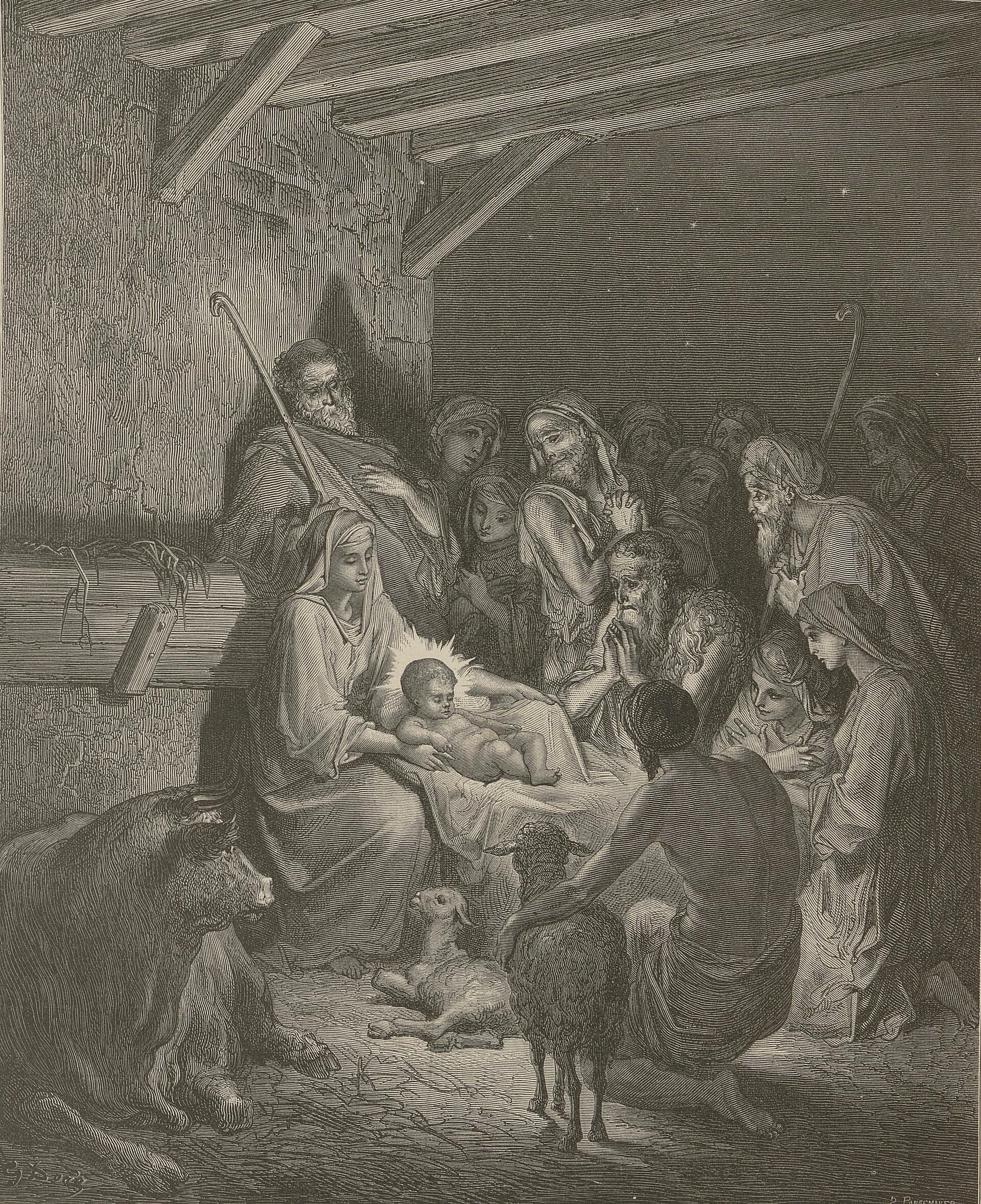
Antonio da Correggio, The Holy Night, c. 1522-1530. Public domain.
Summary
This page is the deep dive on how the eternal God became an actual human being, not a re-argument that Jesus is God. It walks ten passages from John's prologue to Chalcedon, then closes with why the doctrine matters for salvation and the voices who have written on it.
- The case that Jesus is God is already made at /featured/deity-of-christ; this page cross-links it rather than repeating it
- Ten passages are walked in turn, from John 1's Word made flesh through the kenosis of Philippians 2 to the virgin conception
- The Chalcedonian Definition is covered as the church's fence around the mystery, quoted in full on /doctrine/christ
- A dedicated section shows why the doctrine matters for salvation, not just for correct belief
Not a Re-Argument
the case that Jesus is God is already made, elsewhere
This page's job is different from its sibling pages' use of the same texts: not to prove the Word is God, that case is shipped in full, but to unpack the ACT of enfleshment itself: what it meant, what it cost, and what the church fenced off around it once heretics started drawing the wrong diagram.
The Descent and the Name
Philippians 2:5–11: the classic V, katabasis and anabasis
THE DESCENT AND THE NAME
Philippians 2:5–11, katabasis and anabasis, the mind of Christ traced as one line
KATABASIS, THE DESCENT
- v. 6 existing in the form of God
- v. 7 emptied Himselfκενόω, kenosis, "to empty"
- v. 7 taking the form of a servant
- v. 8 found in appearance as a man
- v. 8 obedient to death
EVEN DEATH ON A CROSS
v. 8: the floor of the hymn
ANABASIS, THE EXALTATION
JESUS CHRIST IS LORD
v. 11, to the glory of God the Father
1. John 1:1-14
the Word made flesh, tabernacling among us
In the beginning was the Word, and the Word was with God, and the Word was God.The Word became flesh and made His dwelling among us. We have seen His glory, the glory of the one and only Son from the Father, full of grace and truth.What “Logos” carried to Greek ears. By the time John wrote, logosalready carried centuries of philosophical freight: the rational ordering-principle behind the visible world, a concept Greek readers would have recognized as the universe's reasoning principle, personified.
What it carried to Hebrew and Jewish ears. The “word of the LORD” is God's active, effective agent throughout the Old Testament: the word that created (Ps 33:6), that cannot return void (Isa 55:11). John's readers (Greek and Jewish both) met “Logos” as a term already loaded with the sense of God's own rational, self-revealing activity, personified. John's shock is not the noun. It is the verb two verses later: this Logos became flesh.
“Dwelt among us”: the tabernacle echo. The Greek verb behind “dwelt” is eskēnōsen: literally “pitched his tent,” “tabernacled.” The ancient commentators already read the verse this way, in their own words.
In order to explain the word was, the Evangelist added kai eskēnōsen en hēmin, and "tabernacled in us," that is, in this sense he became flesh: he lived in our nature. Evidently the words stand for "lived among us," as also the apostle said about …
Theodore of Mopsuestia · Commentary on John 1.1.14 (428)
John 1:14
Flesh sometimes signifies corrupt nature; sometimes the body; sometimes, as here, the whole man. We beheld his glory - We his apostles, particularly Peter, James, and John, Luke ix, 32. Grace and truth - We are all by nature liars and children of wrath, to whom both grace and truth are unknown.
John Wesley · Explanatory Notes upon the New Testament (1755)
John 1:14
He was made man that we might be made god. He manifested himself by a body that we might receive a conception of the unseen Father. He endured the hubris of humanity that we might inherit incorruptibility. For on the one hand, he himself was in no way injured, being impassible and incorruptible and very Word and God; but on the other hand, in his own impassibility he maintained and preserved those human beings who were suffering and for whose sakes he endured all this.
Athanasius of Alexandria · On the Incarnation of the Word 54.3 (373)
John 1:14
How can the Godhead be in the flesh? In the same way as fire can be in iron: not by moving from place to place but by the one imparting to the other its own properties. Fire does not speed toward iron, but without itself undergoing any change it causes the iron to share in its own natural attributes. The fire is not diminished, and yet it completely fills whatever shares in its nature. So is it also with God the Word. He did not relinquish his own nature, and yet "he dwelt among us." He did not undergo any change, and yet "the Word became flesh."
Basil of Caesarea · Homily on Christ's Ancestry 2.6 (379)
John 1:14
That which was "in the beginning" is not comprehended in time, is not preceded by any beginning. Let Arius, therefore, hold his peace. Moreover, that which was "with God" is not confounded and mingled with him but is distinguished by the perfection unblemished that it has as the Word abiding with God; and so let Sabellius keep silence. And "the Word was God." This Word, therefore, consists not in uttered speech but in the designation of celestial excellence, so that Photinus's teaching is refuted. Furthermore, by the fact that in the beginning he was with God is proven the indivisible unity of eternal Godhead in Father and Son, to the shame and confusion of Eunomius.
Ambrose of Milan · Exposition of the Christian Faith 1.8.57 (397)
John 1:1
The Word's own eternity, named against the earliest denialsJohn 1:1
Ambrose's line above (“Let Arius, therefore, hold his peace”) answers three of the earliest Christological errors in one breath, Arius's denial of full deity, Sabellius's collapse of the Persons into one, and Photinus's denial of Christ's pre-existence. The Chalcedonian errors named further down this page are the fourth- and fifth-century sequel to this same fight.
2. Philippians 2:5-11
the kenosis question
The hymn's own V-shaped structure and Greek word study (morphē, harpagmos, kenoō, schēma, hyperypsoō) is already built at its own page, not re-derived here. This section's job is the theological content behind “emptied himself”: three readings, named with their holders, presented at full strength before any guardrail is stated: an evidence-based or historical reading is never used to erase a serious one.
Let this mind be in you which was also in Christ Jesus: Who, existing in the form of God, did not consider equality with God something to be grasped, but emptied Himself, taking the form of a servant, being made in human likeness. And being found in appearance as a man, He humbled Himself and became obedient to death—even death on a cross.Therefore God exalted Him to the highest place and gave Him the name above all names, that at the name of Jesus every knee should bow, in heaven and on earth and under the earth, and every tongue confess that Jesus Christ is Lord, to the glory of God the Father.What did he empty himself OF? Three readings, named:
- Emptied of nothing essential: the emptying is described BY the taking-on, not a subtraction. Paul's own grammar never says what Christ emptied himself of; it says how: “taking the form of a servant, being made in the likeness of men” (v. 7). The patristic-orthodox default, documented further at /doctrine/christ.
- Emptied of the independent, self-directed USE of divine attributes, not the attributes themselves: the classical “veiling” reading: the Son remained omniscient, omnipresent, omnipotent in his divine nature throughout the incarnation but voluntarily declined to exercise those prerogatives unilaterally, living instead in dependence on the Father and the Spirit as a man. Mark 13:32 is read this way.
- Emptied of certain divine attributes in fact: 19th-century kenotic Christology. Named holders: Gottfried Thomasius (Erlangen, 1850s, originator of the Kenosistheologie movement), Charles Gore (Lux Mundi, 1889), P. T. Forsyth (The Person and Place of Jesus Christ, 1909), H. R. Mackintosh (The Doctrine of the Person of Jesus Christ, 1912): a genuinely serious 19th-century Protestant movement, not a fringe heresy, and presented here at strength.
The orthodox guardrail, stated honestly:
Reading 3 struggles with Col 1:17 (“in him all things hold together,” present tense, spoken of the incarnate period) and risks dividing God's attributes into essential-vs-expendable in a way Scripture never does: the ground Chalcedon (below) was drawn to hold.
On “the form of God” and “counted it not a thing to be grasped”: the majority patristic-orthodox reading:
Translate, "Who subsisting (or existing, namely, originally: the Greek is not the simple substantive verb, 'to be') in the form of God (the divine essence is not meant: but the external self-manifesting characteristics of God, the form shining forth from His glorious essence)."
Jamieson, Fausset & Brown · Commentary Critical and Explanatory on the Whole Bible (1871)
Phil 2:6
Who being in the essential form - The incommunicable nature. Of God - From eternity, as he was afterward in the form of man; real God, as real man. Counted it no act of robbery - That is the precise meaning of the words, - no invasion of another's prerogative, but his own strict and unquestionable right.
John Wesley · Explanatory Notes upon the New Testament (1755)
Phil 2:6
Being God, and God by nature, and having equality with God, he thought this no great thing, as is the way of those who have received some honor beyond their merits, but, hiding his merit, he elected the utmost humility and took the shape of …
Theodoret of Cyrus · Epistle to the Philippians 2.6-7 (458)
Phil 2:6
"Being in the form of God." If "in the form" how sayest thou, O wicked one, that He took His origin from Mary, and was not before? and how dost thou say that He was an energy? For it is written, "The form of God took the form of a servant." "The form of a servant," is it the energy of a servant, or the nature of a servant? By all means, I fancy, the nature of a servant. Thus too the form of God, is the nature of God, and therefore not an energy.
John Chrysostom · Homily on Philippians 6 (407)
Phil 2:6
The harpagmos question (already carried with its word-study card on The Mind of Christ) is not re-derived here. This section's only job is naming that the reading has real theological stakes: the majority reading (something already possessed, not selfishly exploited) sits against a minority reading closer to the terms the 4th-century Arian controversy fought over.
3. Colossians 1:15-19 and 2:9
the fulness of the Godhead bodily
The full “cosmic hymn” reading of Col 1:15-20 is already built at its own page: not re-derived here. Col 2:9 is open territory that page does not cover: “For in Christ all the fullness of the Deity dwells in bodily form” (BSB). The word bodily (Gk. sōmatikōs) is this verse's own contribution beyond 1:19: not merely that Christ possesses the fulness of deity, but that this fulness dwells bodily: in a real, physical human body, present tense, decades after the resurrection and ascension, at the moment Paul is writing. A strong text for “fully God, fully man, permanently.”
The Son is the image of the invisible God, the firstborn over all creation. For in Him all things were created, things in heaven and on earth, visible and invisible, whether thrones or dominions or rulers or authorities. All things were created through Him and for Him. He is before all things, and in Him all things hold together.For in Christ all the fullness of the Deity dwells in bodily form.In regard of His Godhead, therefore, the Son of God so hath His own glory, that the glory of Father and Son is one: He is not, therefore, inferior in splendour, for the glory is one, nor lower in Godhead, for the fulness of the Godhead is in Christ.
Ambrose of Milan · Exposition of the Christian Faith, Book 2 (397)
Col 1:19
Greek, "(God) was well pleased," &c. in him--that is, in the Son (Mt 3:17). all fulness--rather as Greek, "all the fulness," namely, of God, whatever divine excellence is in God the Father (Col 2:9;
Jamieson, Fausset & Brown · Commentary Critical and Explanatory on the Whole Bible (1871)
Col 1:19
Joh 14:10). of the Godhead--The Greek (theotes) means the ESSENCE and NATURE of the Godhead, not merely the divine perfections and attributes of Divinity (Greek, "theiotes"). He, as man, was not merely God-like, but in the fullest sense, God. bodily--not merely as before His incarnation, but now "bodily in Him" as the incarnate word (Joh 1:14, 18).
Jamieson, Fausset & Brown · Commentary Critical and Explanatory on the Whole Bible (1871)
Col 2:9
Oneness in Godhead the Law hath proved, which speaks of one God, as also the Apostle, by saying of Christ; "In Whom dwelleth all the fulness of the Godhead bodily." For if, as the Apostle saith, all the fulness of the Godhead, bodily, is in Christ, then must the Father and the Son be confessed to be of one Godhead; or if it is desired to sunder the Godhead of the Son from the Godhead of the Father, whilst the Son possesses all the fulness of the Godhead bodily, what is supposed to be further reserved, seeing that nothing remains over and above the fulness of perfection? Therefore the Godhead is one.
Ambrose of Milan · Exposition of the Christian Faith, Book 3 (397)
Col 2:9
For in him dwelleth all the fullness - This is opposed to the vain or empty doctrine of the Gentile and Jewish philosophers: there is a fullness in Christ suited to the empty, destitute state of the human soul, but in the philosophy of the Jews and Gentiles nothing like this was found; nor indeed in the more refined and correct philosophy of the present day. No substitute has ever been found for the grace of the Lord Jesus, and those who have sought for one have disquieted themselves in vain. By the Godhead or Deity, Θεοτης, we are to understand the state or being of the Divine nature; and by the fullness of that Deity, the infinite attributes essential to such a nature. Bodily - Συματικως signifies truly, really; in opposition to typically, figuratively. There was a symbol of the Divine presence in the Hebrew tabernacle, and in the Jewish temple; but in the body of Christ the Deity, with all its plenitude of attributes, dwelt really and substantially: for so the word σωματικως means; and so it was understood by the ancient Greek fathers, as is fully shown by Suicer, in his Thesaurus, under the word. The fullness of the Godhead dwelt in Christ bodily, as opposed to the Jewish tabernacle, or temple; truly and really, in opposition to types and figures; not only effectively, as God dwells in good men, but substantially or personally, by the strictest union, as the soul dwells in the body; so that God and man are one Christ. See Parkhurst.
Adam Clarke · Commentary on the Bible (1832)
Col 2:9
4. Hebrews 1:1-3 and 2:14-18
why he had to share flesh and blood
“The radiance of the glory of God and the exact imprint of his nature” is already quoted and sourced as deity evidence at The Deity of Christ. Two more readings on the same verses add the incarnation angle: the radiance entering the world it always upheld.
On many past occasions and in many different ways, God spoke to our fathers through the prophets. But in these last days He has spoken to us by His Son, whom He appointed heir of all things, and through whom He made the universe. The Son is the radiance of God’s glory and the exact representation of His nature, upholding all things by His powerful word. After He had provided purification for sins, He sat down at the right hand of the Majesty on high.Then, using degrees of ascent, he uttered that which is far greater than all this, saying, "Who, being the brightness of His glory, and the express image of His person, and upholding all things by the word of His power, when He had by Himself purged our sins, sat down on the right hand of the Majesty on high." O! the wisdom of the Apostle! or rather, not the wisdom of Paul, but the grace of the Spirit is the thing to wonder at.
John Chrysostom · Homily on Hebrews 1 (407)
Heb 1:3
His word is God's word (Heb 11:3). of his power--"The word" is the utterance which comes from His (the Son's) power, and gives expression to it. by himself--omitted in the oldest manuscripts. purged--Greek, "made purification of . . . sins," namely, in His atonement, which graciously covers the guilt of sin.
Jamieson, Fausset & Brown · Commentary Critical and Explanatory on the Whole Bible (1871)
Heb 1:3
Hebrews 2:14-18 is the incarnation-necessity text: not built anywhere else on the site. Two distinct reasons are given, in the text's own order, and both belong here.
1. Death's defeat requires a shared nature
Now since the children have flesh and blood, He too shared in their humanity, so that by His death He might destroy him who holds the power of death, that is, the devil, and free those who all their lives were held in slavery by their fear of death.Since then these children partake of flesh and blood - Of human nature with all its infirmities. He also in like manner took part of the same; that through his own death he might destroy the tyranny of him that had, by God's permission, the power of death with regard to the ungodly. Death is the devil's servant and serjeant, delivering to him those whom he seizes in sin.
John Wesley · Explanatory Notes upon the New Testament (1755)
Heb 2:14
And again he indicates the superiority and the great interval between us, by what follows: "Since then the children," he saith, "are partakers of flesh and blood" (thou seest where he saith the likeness is? in reference to the flesh), "in like manner He also Himself took part of the same." Let all the Heretics be ashamed, let those hide their faces who say that He came in appearance and not in reality.
John Chrysostom · Homily on Hebrews 4 (407)
Heb 2:14
It was not otherwise possible for man, forasmuch as he was of a nature that was perishing, to escape death, save by recovering that ancient grace, and partaking once more in God Who holdeth all things together in being and preserveth them in life through the Son in the Spirit. Therefore He hath become partaker of blood and flesh, i.e. He hath become man, being by nature Life, and begotten of the Life that is by nature, i.e. of God the Father—to wit, His Only-begotten Word.
Cyril of Alexandria · Commentary on the Gospel of John, Book 9 (444)
Heb 2:14
Contrast with this bondage, the glory of the "sons" (Heb 2:10). "Bondage" is defined by Aristotle, "The living not as one chooses"; "liberty," "the living as one chooses." Christ by delivering us from the curse of God against our sin, has taken from death all that made it formidable. Death, viewed apart from Christ, can only fill with horror, if the sinner dares to think.
Jamieson, Fausset & Brown · Commentary Critical and Explanatory on the Whole Bible (1871)
Heb 2:15
2. A merciful high priest requires shared experience
“For because he himself has suffered when tempted, he is able to help those who are being tempted” (v. 18). The incarnation is not incidental to Christ's priestly office; it is the qualification for it. Ties to /doctrine/christ's existing prophet/priest/king affirmation, cross-link there for the priesthood material already built.
For this reason He had to be made like His brothers in every way, so that He might become a merciful and faithful high priest in service to God, in order to make atonement for the sins of the people. Because He Himself suffered when He was tempted, He is able to help those who are being tempted.That he might be a merciful and faithful High Priest-Merciful toward sinners; faithful toward God. A priest or high priest is one who has a right of approaching God, and of bringing others to him. Faithful is treated of, chap. iii, 2, &c., with its use; merciful, chap. iv, 14, &c., with the use also;
John Wesley · Explanatory Notes upon the New Testament (1755)
Heb 2:17
Here observe, [1.] Christ's passion: He suffered being tempted; and his temptations were not the least part of his sufferings. He was in all things tempted as we are, yet without sin, ch. iv. 15 . [2.] Christ's compassion: He is able to succour those that are tempted.
Matthew Henry · Commentary on the Whole Bible (1710)
Heb 2:18
5. Galatians 4:4-5
the fulness of the time
Two points worth its own beat.“Born of a woman, born under the law” is Paul's own compact statement of full humanity (a real, ordinary human birth) plus covenant particularity (a real first-century Jew, subject to Torah): the incarnation was never incarnation-in-general. And “the fulness of the time” makes a historical-providential argument: the Pax Romana's stability, the Roman road network, Koine Greek as a common trade language, and the Jewish diaspora's synagogue network all converged in the first century in ways that made the gospel's rapid spread possible.
But when the time had fully come, God sent His Son, born of a woman, born under the law, to redeem those under the law, that we might receive our adoption as sons.But when the fulness of the time - Appointed by the Father, ver. 2. Was come, God sent forth - From his own bosom. His Son, miraculously made of the substance of a woman - A virgin, without the concurrence of a man.
John Wesley · Explanatory Notes upon the New Testament (1755)
Gal 4:4
But Paul, too, silences these critics when he says, "God sent forth His Son, made of a woman." Does he mean through a woman, or in a woman? Nay more, for the sake of greater emphasis, he uses the word "made" rather than born, although the use of the latter expression would have been simpler.
Tertullian · On the Flesh of Christ (220)
Gal 4:4
He is God in that "all things were made through him and nothing was made without him." He is human in that he was "made from a woman, made under the law." The nativity of his flesh shows his human nature. The virgin birth is an indicator of his divine nature.
Leo the Great · Letter 28, To Flavian 4 (461)
Gal 4:4
"The fullness of time" is the completed time which had been foreordained by God the Father for the sending of his Son, so that, made from a virgin, he might be born like a man, subjecting himself to the law up to the time of …
Ambrosiaster · Epistle to the Galatians 4.5.1 (384)
Gal 4:4
6. 1 Timothy 3:16
great is the mystery of godliness
Fully built at its own page: the six-beat hymn structure, and the theos/hosmanuscript question, with its history intact. This page's job is only to point there, with the textual note carried honestly for readers who land here first: the Byzantine/majority text behind the KJV reads theos(“God was manifest in the flesh”); the earliest uncials read hos/ho (“He who was manifest…”), the reading behind most modern translations. The doctrine does not depend on the variant: either way the verse describes the incarnation of a divine subject.
By common confession, the mystery of godliness is great: He appeared in the flesh, was vindicated by the Spirit, was seen by angels, was proclaimed among the nations, was believed in throughout the world, was taken up in glory.And confessedly, great is the mystery of godliness: God was revealed in the flesh, justified in the Spirit, seen by angels, preached among the nations, believed on in the world, received up in glory. confessedly. For no one doubts this. And faith which is in …
Oecumenius · Commentary on 1 Timothy (550)
1 Tim 3:16
God was manifest in the flesh - In the form of a servant, the fashion of a man, for three and thirty years. Justified by the Spirit - Publicly "declared to be the Son of God," by his resurrection from the dead. Seen - Chiefly after his resurrection.
John Wesley · Explanatory Notes upon the New Testament (1755)
1 Tim 3:16
He was made sin for us, and was delivered for our offences; but, being raised again, he was justified in the Spirit; that is, it was made to appear that his sacrifice was accepted, and so he rose again for our justification, as he was delivered for our offences, Rom. iv.
Matthew Henry · Commentary on the Whole Bible (1710)
1 Tim 3:16
7. Luke 1-2 and Matthew 1
the virgin conception
What the texts actually claim.Matthew and Luke report the virgin conception independently, from different angles, Matthew from Joseph's side (Matt 1:18-25, tied explicitly to Isa 7:14), Luke from Mary's side (Gabriel's announcement, Mary's own question, and the angel's answer, Luke 1:26-38).
The angel replied, “The Holy Spirit will come upon you, and the power of the Most High will overshadow you. So the Holy One to be born will be called the Son of God.The Holy Ghost shall come upon thee, and the power of the Highest shall overshadow thee - The power of God was put forth by the Holy Ghost, as the immediate Divine agent in this work: and so he exerted the power of the Highest as his own power, who together with the Father and the Son is the most high God.
John Wesley · Explanatory Notes upon the New Testament (1755)
Luke 1:35
Son of God--That Christ is the Son of God in His divine and eternal nature is clear from all the New Testament; yet here we see that Sonship efflorescing into human and palpable manifestation by His being born, through "the power of the Highest," an Infant of days.
Jamieson, Fausset & Brown · Commentary Critical and Explanatory on the Whole Bible (1871)
Luke 1:35
For the one and the same Spirit of God, who proclaimed by the prophets what and of what sort the advent of the Lord should be, did by these elders give a just interpretation of what had been truly prophesied; and He did Himself, by the apostles, announce that the fulness of the times of the adoption had arrived, that the kingdom of heaven had drawn nigh, and that He was dwelling within those that believe on Him who was born Emmanuel of the Virgin.
Irenaeus · Against Heresies, Book III, Chapter 21, Section 4 (202)
Luke 1:35
Isaiah 7:14 and the almah/parthenos question
Presented honestly, the traditional reading not erased. The Hebrew almahmeans “young woman of marriageable age” its semantic range centers on age, not virginity specifically (Hebrew has a more specific word, bethulah, which Isaiah does not use here). That is the honest linguistic starting point. But the Septuagint, translated by Jewish scholars roughly 200+ years before Christ, rendered almah here with parthenos, the standard Greek word for virgin specifically: the earliest known Jewish interpretive tradition of this verse, centuries before any Christian stake in the question, already read it as “virgin.” Matthew is citing an already-existing Jewish translation tradition, not inventing one.
Therefore the Lord Himself will give you a sign: Behold, the virgin will be with child and will give birth to a son, and will call Him Immanuel.All this took place to fulfill what the Lord had said through the prophet: “Behold, the virgin will be with child and will give birth to a son, and they will call Him Immanuel” (which means, “God with us”).Behold, a virgin shall be with child,.... These words are rightly applied to the virgin Mary and her son Jesus, for of no other can they be understood; not of Ahaz's wife and his son Hezekiah, who was already born, and must be eleven or twelve years of age when these words were spoken; nor of any other son of Ahaz by her or any other person since no other was Lord of Judea; nor of the wife of Isaiah, and any son of his, who never had any that was king of Judah.
John Gill · Exposition of the New Testament (1746-1748)
Matt 1:23
Behold, the Virgin shall be with child. The Jews say that it is not written in the prophecy "virgin" but "young woman." To which it may be answered that "young woman" and "virgin" mean the same thing in Scripture, for in Scripture "young woman" refers …
Theophylact of Ohrid · Commentary on Matthew (1107)
Matt 1:23
He beheld her to be with child, whom he knew to be chaste; and because he had read, There shall come a Rod out of the stem of Jesse, (Is. 11:1.) of which he knew that Mary was comes, and had also read, Behold, a virgin shall conceive, (Is. 7:14.) he did not doubt that this prophecy should be fulfilled in her.
Rabanus Maurus · Catena Aurea by Aquinas (1264)
Matt 1:19
The manger, briefly
A real, humble birth, held beside its own glory without either erasing the other.
The ancient tradition, that our Lord was born in a grotto or cave, is quite consistent with this, the country being rocky. In Mary's condition the journey would be a slow one, and ere they arrived, the inn would be fully occupied--affecting anticipation of the reception He was throughout to meet with (Joh 1:11). But some "guests went and came" not "rudely," but reverently.
Jamieson, Fausset & Brown · Commentary Critical and Explanatory on the Whole Bible (1871)
Luke 2:7
He dwelt in the womb-but He was recognized by the Prophet, himself still in the womb, leaping before the Word, for Whose sake He came into being. He was wrapped in swaddling clothes-but He took off the swathing bands of the grave by His rising again. He was laid in a manger-but He was glorified by Angels, and proclaimed by a star, and worshipped by the Magi. Why are you offended by that which is presented to your sight, because you will not look at that which is presented to your mind?
Gregory of Nazianzus · Oration 29, On the Son (390)
Luke 2:7
The virgin birth “is where the two natures meet”: already stated at /doctrine/christ in the site's own prose; not restated here as a quote, only pointed to.
8. From the NT to Chalcedon
the fence the church drew
The four classic errors, each in one sentence, named plainly:
- Docetism (Gk. dokeō, “to seem”), Christ's body and suffering were only an appearance; he only seemedhuman. Opposed already by 1 John's insistence on Christ “come in the flesh” (1 John 4:2-3).
- Arianism(Arius, condemned at Nicaea, 325): the Son was the first and highest created being, not eternally God; denies full deity, not full humanity. (See Ambrose's line above, “Let Arius, therefore, hold his peace.”)
- Nestorianism(Nestorius, condemned at Ephesus, 431): the divine and human natures were so distinct they amounted to two persons loosely joined; the flashpoint was Nestorius's discomfort calling Mary Theotokos(“God-bearer”).
- Eutychianism / Monophysitism (Eutyches, condemned at Chalcedon, 451): after the union, the human nature was absorbed into the divine, producing one blended nature rather than two coexisting.
A single row in the pool answers three of these at once, arguing directly against both Apollinarianism (a related error: the Logos replacing Christ's human mind) and Nestorianism from the same verse, and against the docetic/gnostic denial that the Word ever truly took flesh at all:
Apollinarius of Laodicea raised a heresy upon this text; saying, that Christ had flesh only, not a rational soul; in the place of which His divinity directed and controlled His body. (in loc.) The Evangelist intends by making mention of the flesh, to show the unspeakable condescension of God, and lead us to admire His compassion, in assuming for our salvation, what was so opposite and incongenial to His nature, as the flesh: for the soul has some propinquity to God. If the Word, however, was made flesh, and assumed not at the same time a human soul, our souls, it would follow, would not be yet restored: for what He did not assume, He could not sanctify. What a mockery then, when the soul first sinned, to assume and sanctify the flesh only, leaving the weakest part untouched! This text overthrows Nestorius, who asserted that it was not the very Word, even God, Who the Self-same was made man, being conceived of the sacred blood of the Virgin: but that the Virgin brought forth a man endowed with every kind of virtue, and that the Word of God was united to him: thus making out two sons, one born of the Virgin, i. e. man, the other born of God, that is, the Son of God, united to that man by grace, and relation, and lover. In opposition to him the Evangelist declares, that the very Word was made Man, not that the Word fixing upon a righteous man united Himself to him.
Theophylact of Ohrid · Catena Aurea by Aquinas (1264)
John 1:14
But, according to these men, neither was the Word made flesh, nor Christ, nor the Saviour, who was produced from [the joint contributions of] all [the Aeons]. For they will have it, that the Word and Christ never came into this world; that the Saviour, too, never became incarnate, nor suffered, but that He descended like a dove upon the dispensational Jesus; and that, as soon as He had declared the unknown Father, He did again ascend into the Pleroma.
Irenaeus · Against Heresies, Book III (202)
John 1:14
The Chalcedonian Definition (451)
Already quoted verbatim and gate-verified at /doctrine/christ. It is not retyped here. The council names four things the union may never be and does not explain the mechanism; it draws a fence, not a diagram.
9. Why It Matters
the soteriology
The classic Anselm/Athanasius mediator logic, already sourced at /doctrine/christ (Anselm, Cur Deus Homo, 1098, PD): only one who is both fully God and fully man can mediate. Sin is an offense against infinite God and requires infinite satisfaction, which only God can render, but the debt is owed byhumanity, so only a human can rightly pay it on humanity's behalf. The mediator must be both.
Hebrews 2:14-18 (section 4 above) supplies the sharpest single soteriological payoff text: death's defeat and a merciful high priest both required the incarnation specifically, not divine power exercised from a distance.
A parallel line on Col 2:9's “fulness… bodily,” applied to salvation
Since then it was impossible that our life, which had been estranged from God, should of itself return to the high and heavenly place, for this cause, as saith the Apostle, He Who knew no sin is made sin for us, and frees us from the curse by taking on Him our curse as His own, and having taken up, and, in the language of the Apostle, "slain" in Himself "the enmity" which by means of sin had come between us and God,—(in fact sin was "the enmity")—and having become what we were, He through Himself again united humanity to God.
Gregory of Nyssa · Against Eunomius, Book 12.1 (395)
Col 2:9
The Wesleyan emphasis
Given the site's Wesleyan-Pentecostal home, worth drawing out specifically: Wesley's stress on prevenient and transforming grace reaching every believer rests on the incarnation's completeness in the same way the “what is not assumed is not healed” principle does, if Christ did not assume a full, ordinary human nature, there is no guarantee grace can reach and transform a full, ordinary human nature.
One modern voice, cite-only, on the same theme: the incarnation as the central miracle
There is an activity of God displayed throughout creation, a wholesale activity let us say which men refuse to recognize. The miracles done by God incarnate, living as a man in Palestine, perform the very same things as this wholesale activity, but at a different …
C. S. Lewis · "Miracles," in God in the Dock (1963 collection)
Luke 1:35
10. The Voices, Relevance-Gated
◈Which roster voices actually earn a place on this pagecontested
This site's voice index covers this topic thinly, two matches, both cite-only: on Christ's sonship and the incarnation, Harold R. Eberle: the believer's adopted sonship grounded in Christ's own eternal Sonship, a discipleship application, cited. And on the kenosis question, Bill Johnson, whose entry carries no located quote and so is not rendered here.
Missler, considered, OUT for now, despite the founder's own formation weight. His recorded teaching shows no position on Logos Christology, kenosis, or the virgin birth specifically; a voice earns its place here by having taught something on the actual subject, not by being a favorite (“this is about Jesus, not any other man”), so he does not appear without a specific, located citation.
Charles Wesley: a genuine find, PD, full quote once verified. “Hark! The Herald Angels Sing” (1739) states the veiling/kenosis theme directly: “Veiled in flesh the Godhead see, / Hail the incarnate Deity, / Pleased as man with man to dwell, / Jesus, our Emmanuel.”
C. S. Lewis: see “Why It Matters” above; this site holds 77 further Lewis excerpts tagged to this topic's verses, most matched by keyword rather than curated for relevance. Only the one excerpt used above has been checked against its verse for genuine on-topic fit; the rest still need that same check before use.
Voices considered and set aside entirely (no on-topic incarnation-specific teaching located for any of these): Derek Prince, Dutch Sheets, John Bevere, Smith Wigglesworth, Kenneth Hagin, Leonard Ravenhill, Lee Strobel, Michael Behe, Jonathan Cahn, Timothy Alberino, Gary Wayne, Spurgeon, and Tozer. Michael Heiser's Unseen Realm material belongs to the pre-incarnate Angel-of-YHWH question, covered by a separate page once built, cross-link there, not pulled onto this page directly.
Keep studying
On this page
Studies7
Symbols1
Go further1