

Jesus Christ · On the Holy Spirit
The Paraclete
On His last night with the disciples, Jesus names the one who is coming after Him: parakletos, a Greek word no single English word quite holds: Comforter, Advocate, Helper, Counsellor, each catching part of it and missing the rest. Then He does something surprising: He tells them He has to leave before this Helper can come, and calls His own departure “expedient”, genuinely better for them. What follows is Jesus's fullest teaching on the Holy Spirit anywhere in the Gospels: five things this Helper will do that Jesus, standing bodily in one room at a time, could not.
Titian, Pentecost, c. 1545. Public domain.
Summary
The page walks five things Jesus says the Paraclete will do, teach, testify, convict, guide, and glorify, each with its own verse and church voices. It also explains why Jesus calls His own departure 'expedient' and points to the fuller grammar of 'another Comforter' on the Upper Room page.
- No single English word holds parakletos; Comforter, Advocate, Helper, and Counsellor each catch only part of it.
- Five distinct works are named: teaching and reminding, testifying, convicting the world, guiding into truth, and glorifying Christ.
- The "another Comforter of the same kind" grammar (allos, not heteros) is cited from the Upper Room page rather than re-argued here.
- Ten church voices, from Gregory of Nazianzus to Albert Barnes, are quoted on the five sayings.
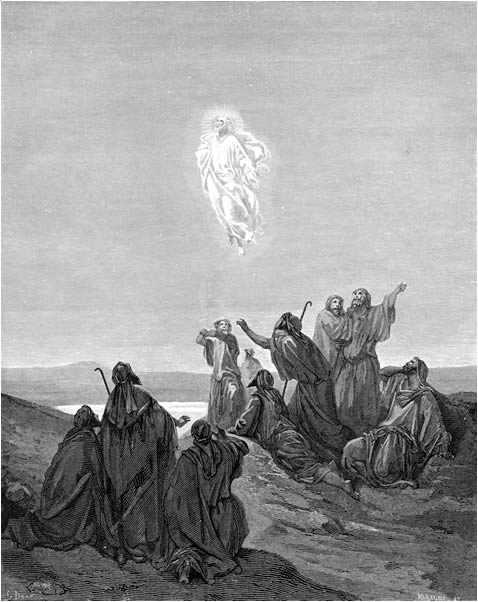
- John 16:7's hard claim, that Jesus leaving was better for the disciples, gets its own section with an Ascension engraving.
The Text
John 14:16–17, 26; 15:26; 16:7–15
And I will ask the Father, and He will give you another Advocate to be with you forever— the Spirit of truth. The world cannot receive Him, because it neither sees Him nor knows Him. But you do know Him, for He abides with you and will be in you.“Another Comforter”, of the same kind as Jesus, sent to remain forever.
But the Advocate, the Holy Spirit, whom the Father will send in My name, will teach you all things and will remind you of everything I have told you.Sent “in my name”, to teach, and to bring His own words back to mind.
When the Advocate comes, whom I will send to you from the Father—the Spirit of truth who proceeds from the Father—He will testify about Me.Sent to testify of Christ, and the disciples testify alongside Him.
But I tell you the truth, it is for your benefit that I am going away. Unless I go away, the Advocate will not come to you; but if I go, I will send Him to you.“It is expedient for you that I go away”, the hard, counter-intuitive claim.
And when He comes, He will convict the world in regard to sin and righteousness and judgment: in regard to sin, because they do not believe in Me; in regard to righteousness, because I am going to the Father and you will no longer see Me; and in regard to judgment, because the prince of this world has been condemned.Convicts the world, of sin, of righteousness, of judgment.
However, when the Spirit of truth comes, He will guide you into all truth. For He will not speak on His own, but He will speak what He hears, and He will declare to you what is to come. He will glorify Me by taking from what is Mine and disclosing it to you.Guides into all truth, and glorifies Christ, His whole ministry is Christ-centered.
Every one of these sayings comes from the same night, the same room, the same discourse, the Farewell Discourse of John 14–16, spoken hours before the cross. Jesus is not offering a stray comment on the Spirit; He is giving His disciples, in one sitting, the fullest teaching on the Holy Spirit anywhere in His own recorded words.
The Five Sayings
one night's teaching, stood side by side
FIVE SAYINGS · ONE NIGHT · ONE HELPER
Everything Jesus teaches about the Spirit on His last night, in the order He said it
- abide with you for ever
- dwell in you
- teach you all things
- bring all things to your remembrance
- testify of me
- convict the world
- of sin, of righteousness, of judgment
- guide you into all truth
- shew you things to come
- glorify me
What He Is Saying
a word with no single English equal
paraklētos
“One called to your side”, which is why no single English word holds it: Comforter, Advocate, Helper, Counsellor are each one face of it.
THE WORD TOOL →Parakletos(literally “called alongside”) is the Greek word behind “Comforter,” and every English translation of it is a compromise: Comforter catches the consolation but loses the legal sense; Advocate catches the legal sense (the same word is used of Jesus Himself in 1 John 2:1) but sounds cold; Helper and Counsellor each hold a piece. No single word in English holds what the Greek word held for its first hearers, someone called to your side to help your case.
“Another” Comforter, of the same kind
Already established at strength on the Upper Room page: allon paraklēton (14:16), “another” of the same kind (Greek allos), not “another” of a different kind (Greek heteros), the same distinction Paul uses in Galatians 1:6–7. The grammar itself says the Spirit is qualitatively like Jesus: not a lesser substitute but an Advocate like Jesus Himself. That grammar is cited here, not re-derived, the full case lives on the Upper Room page.
And he will give you another Comforter - The Greek word signifies also an advocate, instructer, or encourager. Another - For Christ himself was one. To remain with you forever - With you, and your followers in faith, to the end of the world.
John Wesley · Explanatory Notes upon the New Testament, John 14:16
The Spirit came after Christ so that we would not lack a Comforter. But he is called "another" Comforter so that you might acknowledge his co-equality. For this word another defines an alter ego, a name of equal lordship, not of inequality. We do not use the word another for different kinds of things but for those that are consubstantial.
Gregory of Nazianzus · On Pentecost, Oration 41.12, John 14:16
Another Comforter - The word παρακλητος signifies not only a comforter, but also an advocate, a defender of a cause, a counsellor, patron, mediator. Christ is thus termed, 1Jn 2:1, where the common translation renders the word advocate.
Adam Clarke · Commentary on the Bible (1832), John 14:16
It was good that he said "another" so that you might not think that the Son is the Spirit, for there is a unity of the name and no Sabellian confusion of the Son and of the Spirit.
Ambrose of Milan · On the Holy Spirit 1.13.136 (397), John 14:16
It is promised that they shall have another comforter. This is the great New-Testament promise ( Acts i. 4 ), as that of the Messiah was of the Old Testament; a promise adapted to the present distress of the disciples, who were in sorrow, and needed a comforter.
Matthew Henry · Commentary on the Whole Bible (1710), John 14:16–17
“The Spirit of truth, whom the world cannot receive”John 14:17
Right after naming the Comforter, Jesus names Him again, “the Spirit of truth”, the same title He will use twice more in this discourse (15:26; 16:13). It is not a new title so much as a preview: everything this Helper does, from teaching to convicting to guiding, is truth-work.
The Spirit of truth - He is thus called here because he would teach them the truth, or would guide them into all truth, Joh 16:13. He would keep them from all error, and teach them the truth, which, either by writing or preaching, they were to communicate to others.
Albert Barnes · Notes, Explanatory and Practical, John 14:17
The Voices
the Spirit's ministries, as Jesus Himself names them
Across these three chapters Jesus names five distinct things the Comforter will do, not a vague presence, but a work with edges.
1. Teach, and bring to remembrance (John 14:26)
“The Comforter, which is the Holy Ghost, whom the Father will send in my name, he shall teach you all things, and bring all things to your remembrance, whatsoever I have said unto you.” This is the text standing behind the doctrine of inspired apostolic memory, the Gospels are not late, faded recollection but Spirit-assisted recall.
In my name - For my sake, in my room, and as my agent. He will teach you all things - Necessary for you to know. Here is a clear promise to the apostles, and their successors in the faith, that the Holy Ghost will teach them all that truth which is needful for their salvation.
John Wesley · Explanatory Notes upon the New Testament, John 14:26
Paraclete is Advocate, or Comforter. The Advocate then intercedes with the Father for sinners, when by His inward power He moves the sinner to pray for himself. The Comforter relieves the sorrow of penitents, and cheers them with the hope of pardon.
Gregory the Dialogist · Catena Aurea by Aquinas, John 14:26
2. Testify of Christ (John 15:26)
“proceedeth from the Father” is the exact clause behind the filioquedispute, named, not re-litigated here. The Spirit's testimony and the disciples' own witness run together: “he shall testify of me: and ye also shall bear witness, because ye have been with me from the beginning.”
But when the Comforter is come - See on Joh 14:16 (note). 15:26-27He shall testify and ye also shall bear witness - He shall bear his testimony in your souls, and ye shall bear this testimony to the world. And so they did, by their miracles, their preaching, their writings, their lives, and by their deaths. Our Lord appears to reason thus: In every respect the unbelief of the Jews is inexcusable. They believe not my doctrine, notwithstanding its purity and holiness.
Adam Clarke · Commentary on the Bible, John 15:26
ye also shall bear witness--rather, "are witnesses"; with reference indeed to their future witness-bearing, but putting the emphasis upon their present ample opportunities for acquiring their qualifications for that great office, inasmuch as they had been "with Him from the beginning." (See on Lu 1:2).
Jamieson, Fausset & Brown · Commentary Critical and Explanatory on the Whole Bible (1871), John 15:27
3. Convict the world (John 16:8–11)
The fullest single statement of the Spirit's mission to those outside the church:
- “of sin, because they believe not on me” : the root sin the Spirit exposes is not this or that transgression but unbelief in Christ specifically;
- “of righteousness, because I go to my Father, and ye see me no more” : Christ's departure to the Father (the ascension, vindicating His claims) is itself the proof of a righteousness the world could not see while He stood in front of it;
- “of judgment, because the prince of this world is judged” : Satan's judgment, secured at the cross (John 12:31), is the Spirit's ongoing evidence that judgment is real and has already fallen on the ruler of this age.
He - Observe his twofold office; toward the world, ver. 8, &c.; toward believers, ver. 12, &c.: will convince - All of the world - Who do not obstinately resist, by your preaching and miracles, of sin, and of righteousness, and of judgment - He who is convinced of sin either accepts the righteousness of Christ, or is judged with Satan.
John Wesley · Explanatory Notes upon the New Testament, John 16:8
Reproof is indeed implied in the term employed, and doubtless the word begins with it. But convict or convince is the thing intended; and as the one expresses the work of the Spirit on the unbelieving portion of mankind, and the other on the believing, it is better not to restrict it to either.
Jamieson, Fausset & Brown · Commentary Critical and Explanatory on the Whole Bible (1871), John 16:8
And when he is come, elthon ekeinos . He that is sent is willing of himself to come, and at his first coming he will do this, he will reprove, or, as the margin reads it, he will convince the world, by your ministry, concerning sin, righteousness, and judgment.
Matthew Henry · Commentary on the Whole Bible (1710), John 16:8
When He has shown that His departure to His Father is the fitting occasion of the descent and mission of the Spirit, and has by this means sufficiently allayed the pangs of grief in His holy disciples, He rightly proceeds to show what the work of the Holy Spirit will be. For when He is come, He says, He will convict the world in respect of sin, and of righteousness, and of judgment. And He has clearly pointed out what form the reproof in each of these cases will take.
Cyril of Alexandria · Commentary on the Gospel of John, Book 10 (444), John 16:8
4. Guide into all truth (John 16:13)
“He will guide you into all truth: for he shall not speak of himself; but whatsoever he shall hear, that shall he speak: and he will shew you things to come.” The Spirit's authority is explicitly derivative and relational, genuinely paralleling how Jesus described His own relationship to the Father in the same discourse (John 5:19, 30; 8:28). A Trinitarian pattern worth naming without turning this page into a second Trinity argument.
The Spirit of truth - So called because he would teach them all necessary truth. Will guide you into all truth - That is, truth which pertained to the establishment of the Christian system, which they were not then prepared to hear. We may here remark that this is a full promise that they would be inspired and guided in founding the new church; and we may observe that the plan of the Saviour was replete with wisdom.
Albert Barnes · Notes, Explanatory and Practical, John 16:13
5. Glorify Christ (John 16:14)
“He shall glorify me: for he shall receive of mine, and shall shew it unto you.” The single best one-line answer to “what is the Holy Spirit for?” His whole ministry, from teaching to convicting to guiding, bends back toward one center.
The subjective nature of the Spirit's teaching--the discovery to the souls of men of what is Christ outwardly--is here very clearly expressed; and, at the same time, the vanity of looking for revelations of the Spirit which shall do anything beyond throwing light in the soul upon what Christ Himself is, and taught, and did upon earth.
Jamieson, Fausset & Brown · Commentary Critical and Explanatory on the Whole Bible (1871), John 16:14
“It Is Expedient for You That I Go Away”
John 16:7, a genuine upgrade, not a consolation prize
The hard, deliberately counter-intuitive claim sits at the hinge of the whole discourse: the disciples are better off with the ascended Christ sending the Spirit than with the physically present, geographically limited earthly Jesus. Not because Jesus leaving is a lesser thing than Jesus staying, but because a Helper who indwells every believer everywhere is a genuine expansion of access to God that a Jesus confined to one body in one place could never have given them.
"But I tell you the truth." Observe how He consoleth them again. "I speak not," He saith, "to please you, and although you be grieved ten thousand fold, yet must ye hear what is for your good; it is indeed to your liking that I should be with you, but what is expedient for you is different. And it is the part of one caring for others, not to be over gentle with his friends in matters which concern their interests, or to lead them away from what is good for them." "For if I go not away, the Comforter will not come." What here say those who hold not the fitting opinion concerning the Spirit? Is it "expedient" that the master depart, and the servant come? Seest thou how great is the honor of the Spirit? "But if I depart, I will send Him unto you."
John Chrysostom · Homily on the Gospel of John 78 (407), John 16:7
It was therefore expedient because it was in order to the sending of the Spirit. Now observe, (1.) That Christ's going was in order to the Comforter's coming. [1.] This is expressed negatively: If I go not away, the Comforter will not come.
Matthew Henry · Commentary on the Whole Bible (1710), John 16:7
It is expedient - that I go away - In other places he had showed them the absolute necessity of his death for the salvation of men: see Mat 20:19; Mat 26:2; Mar 9:31; Mar 10:33, Luk 9:44; Luk 18:32. This he does not repeat here, but shows them that, by the order of God, the Holy Spirit cannot come to them, nor to the world, unless he first die; and consequently men cannot be saved but in this way.
Adam Clarke · Commentary on the Bible (1832), John 16:7
Where It Points
the rest of the teaching
The Paraclete sayings are one section of a much larger teaching. Jesus said more about the Holy Spirit than these three chapters alone, before this discourse, at a well and in a temple courtyard; after it, in His last words before the ascension.
Closing
A comforter, an advocate, a helper, none of the English words alone hold what Jesus promised. What He promised was a person: one who would teach, testify, convict, guide, and glorify Him, sent not because Jesus was leaving them short, but because His leaving was, in His own word, expedient, better for them than His staying could ever have been.
Keep studying
Read it1
On this page
By subject
The Holy Spirit14 pages
The Gospels68 pages