
John 4:6
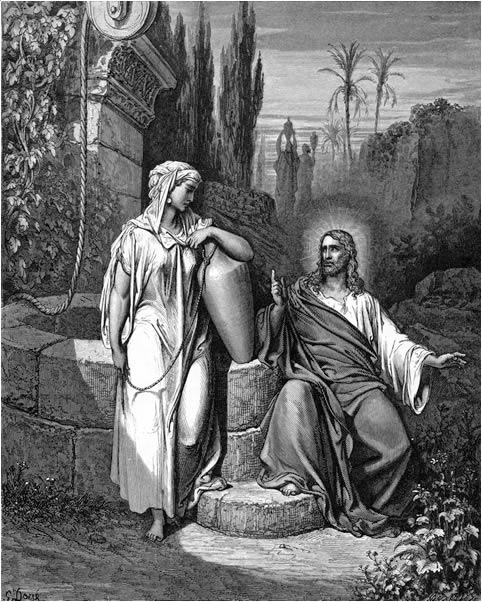
in John 4Since Jacob’s well was there, Jesus, weary from His journey, sat down by the well. It was about the sixth hour.
BSB
The same verse in ASV and KJV ▾
ASV
and Jacob’s well was there. Jesus therefore, being wearied with his journey, sat thus by the well. It was about the sixth hour.
KJV
Now Jacob’s well was there. Jesus therefore, being wearied with his journey, sat thus on the well: and it was about the sixth hour.
⋯
This verse in John 4
Commentary
34 notes on this verseJacob’s well was there - Of this well Mr. Maundrell gives the following account. “About one-third of an hour from Naplosa, the ancient Sychar and Sychem, stood Jacob’s well.
This site's exposition
a town of Samaria called Sychar
on John 4:5-6
Sychar stood beside the ground Jacob bought at Shechem and left to his son Joseph, at Genesis 33:19 and 48:22. Jacob's well was there, and Jesus sat down by it, worn out from the walk. The sixth hour is about noon.
This site's exposition
weary from His journey
Jamieson, Fausset and Brown see the human and the divine joined here, a tired traveler about to give light and life to a stranger. Noon counts six hours from six in the morning. Adam Clarke cites the traveler Maundrell, who placed Jacob's well about a third of an hour from Naplosa, the ancient Sychar.
The record, by era
The Church Fathers5 voices
Such is our Instructor, righteously good. "I came not," He says, "to be ministered unto, but to minister." Wherefore He is introduced in the Gospel "wearied," because toiling for us, and promising "to give His life a ransom for many." For him alone who does so He owns to be the good shepherd.
Many things we read and believe, in the light of the sacrament of the incarnation. Even in the very affections of our human nature we behold the divine majesty. Jesus is wearied with his journey, that he may refresh the weary. He desires to drink when about to give spiritual drink to the thirsty; he was hungry, when about to supply the food of salvation to the hungry.
"And He must needs pass through Samaria. He cometh then to a city of Samaria which is called Sychar, near to the parcel of ground which Jacob gave to his son Joseph. Now Jacob's fountain was there." It was a well; but every well is a fountain, yet not every fountain a well. For where the water flows from the earth, and offers itself for use to them that draw it, it is called a fountain; but if accessible, and on the surface, it is called only a fountain: if, however, it be deep and far down, it is called a well, but in such wise as not to lose the name of fountain.
"Jesus therefore, being wearied with His journey, sat thus on the well. It was about the sixth hour." Now begin the mysteries. For it is not without a purpose that Jesus is weary; not indeed without a purpose that the strength of God is weary; not without a purpose that He is weary, by whom the wearied are refreshed; not without a purpose is He weary, by whose absence we are wearied, by whose presence we are strengthened. Nevertheless Jesus is weary, and weary with His journey; and He sits down, and that, too, near a well; and it is at the sixth hour that, being wearied, He sits down. All these things hint something, are intended to intimate something, they make us eager, and encourage us to knock. May Himself open to us and to you; He who has deigned to exhort us, so as to say, "Knock, and it shall be opened to you." It was for thee that Jesus was wearied with His journey. We find Jesus to be strength, and we find Jesus to be weak: we find a strong and a weak Jesus: strong, because "in the beginning was the Word, and the Word was with God, and the Word was God: the same was in the beginning with God." Wouldest thou see how this Son of God is strong? "All things were made by Him, and without Him was nothing made:" and without labor, too, were they made. Then what can be stronger than He, by whom all things were made without labor? Wouldest thou know Him weak? "The Word was made flesh, and dwelt among us." The strength of Christ created thee, the weakness of Christ created thee anew. The strength of Christ caused that to be which was not: the weakness of Christ caused that what was should not perish. He fashioned us by His strength, He sought us by His weakness.
As weak, then, He nourishes the weak, as a hen her chickens; for He likened Himself to a hen: "How often," He saith to Jerusalem, "would I have gathered thy children under my wings, as a hen her chickens; but thou wouldest not!" And you see, brethren, how a hen becomes weak with her chickens. No other bird, when it is a mother, is recognized at once to be so. We see all kinds of sparrows building their nests before our eyes; we see swallows, storks, doves, every day building their nests; but we do not know them to be parents, except when we see them on their nests. But the hen is so enfeebled over her brood, that even if the chickens are not following her, if thou see not the young ones, yet thou knowest her at once to be a mother. With her wings drooping, her feathers ruffled, her note hoarse, in all her limbs she becomes so sunken and abject, that, as I have said, even though thou seest not her young, yet thou perceivest her to be a mother. In such manner was Jesus weak, wearied with His journey. His journey is the flesh assumed for us. For how can He, who is present everywhere, have a journey, He who is nowhere absent? Whither does He go, or whence, but that He could not come to us, except He had assumed the form of visible flesh? Therefore, as He deigned to come to us in such manner, that He appeared in the form of a servant by the flesh assumed, that same assumption of flesh is His journey. Thus, "wearied with His journey," what else is it but wearied in the flesh? Jesus was weak in the flesh: but do not thou become weak; but in His weakness be strong, because what is "the weakness of God is stronger than men."
26 more voices on this verse
The Church Fathers14 voices
Under this image of things, Adam, who was the figure of Him that was to be, afforded us a great indication of this mystery; rather, God afforded it in him. For he was deemed worthy to receive a wife while he slept, and that wife was made for him of his own rib: since from Christ, sleeping on the cross, was the Church to come,-from His side, namely, as He slept; for it was from His side, pierced with the spear, as He hung on the cross, that the sacraments of the Church flowed forth. But why have I chosen to say this, brethren? Because it is the weakness of Christ that makes us strong. A remarkable figure of this went before in the case of Adam. God could have taken flesh from the man to make of it a woman, and it seems that this might have been the more suitable. For it was the weaker sex that was being made, and weakness ought to have been made of flesh rather than of bone; for the bones are the stronger parts it the flesh. He took not flesh to make of it a woman; but took a bone, and of the bone was the woman shaped, and flesh was filled in into the place of the bone. He could have restored bone for bone; He could have taken, not a rib, but flesh, for the making of the woman. What, then, did this signify? Woman was made, as it were, strong, from the rib; Adam was made, as it were, weak, from the flesh. It is Christ and the Church; His weakness is our strength.
But why at the sixth hour? Because at the sixth age of the world. In the Gospel, count up as an hour each, the first age from Adam to Noah; the second, from Noah to Abraham; the third, from Abraham to David; the fourth, from David to the removing to Babylon; the fifth, from the removing to Babylon to the baptism of John: thence is the sixth being enacted. Why dost thou marvel? Jesus came, and, by humbling Himself, came to a well. He came wearied, because He carried weak flesh. At the sixth hour, because in the sixth age of the world. To a well, because to the depth of this our habitation. For which reason it is said in the psalm: "From the depth have I cried unto Thee, O Lord." He sat, as I said, because He was humbled.
(Tr. xv. c. 5) It was a well. Every well is a spring, but every spring is not a well. Any water that rises from the ground, and can be drawn for use, is a spring: but where it is ready at hand, and on the surface, it is called a spring only; where it is deep and low down, it is called a well, not a spring. (Tr. xv, c. 6) Jesus, we see, is strong and weak: strong, because in the beginning was the Word; weak, because the Word was made flesh. Jesus thus weak, being wearied with his journey, sat on the well. (Tr. xv. c. 7) His journey is His assumption of the flesh for our sake. For whither doth He go, Who is every where present? What is this, except that it was necessary for Him, in order to come to us, to take upon Him visibly a form of flesh? So then His being wearied with His journey, what meaneth it, but that He is wearied with the flesh? And wherefore is it the sixth hour? Because it is the sixth age of the world. Reckon severally as hours, the first age from Adam to Noah, the second from Noah to Abraham, the third from Abraham to David, the fourth from David unto the carrying away into Babylon, the fifth from thence to the baptism of John; on this calculation the present age is the sixth hour. (1. lxxxiii. Quaest. qu. 64) At the sixth hour then our Lord comes to the well. The black abyss of the well, methinks, represents the lowest parts of this universe, i. e. the earth, to which Jesus came at the sixth hour, that is, in the sixth age of mankind, the old age, as it were, of the old man, which we are bidden to put off, (Col. 3:9.) that we may put on the new. For so do we reckon the different ages of man's life: the first age is infancy, the second childhood, the third boyhood, the fourth youth, the fifth manhood, the sixth old age. […]
Our Lord Jesus Christ came to the field that holy Jacob had left to his son, Joseph. I do not think that this field was left to Joseph as much as to Christ, whom holy Joseph the patriarch prefigured, for truly the sun and moon …
Could the power of God be exhausted? Certainly not. But he was wearied because he could not find the people faithful. Christ was wearied, then, because he recognized no virtue in his people. Today, too, our disobedience wearies him, as does also our weakness. For …
It may perhaps be said, "We find Him giving way to weeping, to hunger and thirst: must we not suppose Him liable to all the other affections of human nature?" But if we do not understand the mystery of His tears, hunger, and thirst, let us remember that He Who wept also raised the dead to life: that He did not weep for the death of Lazarus, but rejoiced; that He Who thirsted, gave from Himself rivers of living water. He could not be parched with thirst, if He was able to give the thirsty drink. Again, He Who hungered could condemn the tree which offered no fruit for His hunger: but how could His nature be overcome by hunger if He could strike the green tree barren by His word? And if, beside the mystery of weeping, hunger and thirst, the flesh He assumed, that is His entire manhood, was exposed to our weaknesses: even then it was not left to suffer from their indignities. His weeping was not for Himself; His thirst needed no water to quench it; His hunger no food to stay it. It is never said that the Lord ate or drank or wept when He was hungry, or thirsty, or sorrowful. He conformed to the habits of the body to prove the reality of His own body, to satisfy the custom of human bodies by doing as our nature does. When He ate and drank, it was a concession, not to His own necessities, but to our habits.
A commentator
Romanos the MelodistKONTAKION ON THE WOMAN OF SAMARIA 9.4 · Written before 555.
proposed
Christ, … the source of the breath of life for all, when He was Weary from a journey, sat down near a spring of Samaria. And it was the season of burning heat. It was the sixth hour, as the Scripture says, It was the …
Never is Christ without water: if, that is, He is Himself baptized in water; inaugurates in water the first rudimentary displays of His power, when invited to the nuptials; invites the thirsty, when He makes a discourse, to His own sempiternal water; approves, when teaching concerning love, among works of charity, the cup of water offered to a poor (child); recruits His strength at a well; walks over the water; willingly crosses the sea; ministers water to His disciples. Onward even to the passion does the witness of baptism last: while He is being surrendered to the cross, water intervenes; witness Pilate's hands: when He is wounded, forth from His side bursts water; witness the soldier's lance!
Of the divine nature the prophet Isaiah said, "He shall neither be hungry nor weary" and so on. But the Evangelist says "Jesus being weary with his journey sat thus on the well;" and "shall not be weary" is contrary to "being weary." Therefore the …
Since therefore He is at once both God and man He is proved to be both by His works, and this cannot escape the notice of the spectators. For, that He is by nature God, is shown both by His works and His signs, cleansing …
A commentator
Cyril of AlexandriaCommentary on the Gospel of John, Book 2 · Written before 444.
proposed
He shows that opportunely did Jesus rest upon the well. For the sun pouring down its strongest rays from the mid-vault on those upon the earth, and consuming bodies with its unmitigated strokes, it would not have been without hurt to have gone further, but was more convenient to rest a little, especially when He would easily have thrust away the charge of luxuriousness, if the fitness of the season had agreed thereto. He does not say that it was the sixth hour precisely, but about the sixth hour, that we too may learn not to be indifferent even about the least things, but rather to try and practise truth in common things.
A commentator
Cyril of AlexandriaCommentary on the Gospel of John, Book 2 · Written before 444.
proposed
Having crossed the borders of Judea and being now among strangers, the Savior rests at Jacob's well. He shows us again as in a type and darkly that the preaching of the gospel should depart from Jerusalem and the divine word in time would extend to the Gentiles. However, this does not signify that the patriarchs are to be any less revered. Christ shall embrace them again and shall again be refreshed and rest, as in his saints, preserving to them the pristine unfading grace.
"Jesus therefore, being wearied with His journey, sat thus by the well; and it was about the sixth hour." He sat "thus." What meaneth "thus"? Not upon a throne, not upon a cushion, but simply, and as He was, upon the ground.
Superfluous, too, in that case is His descent into Mary; for why did He come down into her if He were to take nothing of her?
The Medieval Church5 voices
But after the sons of Jacob had desolated the city, by the slaughter of the Sychemites, Jacob annexed it to the portion of his son Joseph, as we read in Genesis, I have given to thee one portion above thy brethren, which I took out of the hand of the Amorite with my sword, and with my bow. (Gen. 48:22) This is referred to in what follows, Near to the place of ground which Jacob gave to his son Joseph. Now Jacob's well was there. But why does the Evangelist make mention of the parcel of ground, and the well? First, to explain what the woman says, Our father Jacob gave us this well: secondly, to remind you that what the Patriarchs obtained by their faith in God, the Jews had lost by their impiety. They had been supplanted to make room for Gentiles. And therefore there is nothing new in what has now taken place, i. e. in the Gentiles succeeding to the kingdom of heaven in the place of the Jews. He mentions our Lord's sitting and resting from His journey, that none might blame Him for going to Samaria Himself, after He had forbidden the disciples going.
The Evangelist, by saying that the Lord grew weary from the journey, shows us His humility and moderation, for He did not use beasts of burden for traveling, but went on foot, teaching us also not to require much. He also shows that He made …
A commentator
BonaventureCollations on the Hexaemeron, Collation 17 · Written in the 13th century.
proposed
Scripture enlightens from nearby by means of the gifts of graces which supplement what is lacking in human activity. For many scientists came as guests: they came to our house and to our activity. But in these matters, activity must reach a limit. Wherefore Scripture …
Now Jacob's well was there, that is, which Jacob had found, according to what is said below in the same chapter. And Christ was in need of rest: therefore it says: "Jesus, being wearied from the journey, sat thus upon the well:" because the place …
Then when he says, This was the site of Jacob's well, the Evangelist gives the material setting for the spiritual doctrine about to be taught. And this was most fitting: for the doctrine about to be taught was about water and a spiritual font, and …
The Puritans and the Awakening1 voice
Now Jacob's well was there,....
The Nineteenth Century6 voices
A commentator
Jamieson, Fausset & Brown1802–1910
Commentary Critical and Explanatory on the Whole Bible (1871)
But with all that is human, how much also of the divine have we here, both blended in one glorious manifestation of the majesty, grace, pity, patience with which "the Lord" imparts light and life to this unlikeliest of strangers, standing midway between Jews and heathens. the sixth hour--noonday, reckoning from six A.M.
A commentator
Charles Spurgeon1834–1892
The Metropolitan Tabernacle Pulpit, Sermon No. 2570: “Jesus Sitting on the Well” (lightly modernized text, CCEL edition) · Written before 1892.
proposed
IF we were wise, dear Friends, we would find a thousand things in the world to remind us of our blessed Lord. It is well to form the habit of connecting things that are seen with Him, "whom, having not seen, we love." If we do so, there will not be an hour in the day when we shall not be helped to think of Him and scarcely anything that we see in our trade, or in the street, or in the field, or in our house which will not be the means of reminding us of Him.
A commentator
J.C. Ryle1816–1900
Expository Thoughts on the Gospels: John (lightly modernized text, Grace Gems edition) (1869)
proposed
There are two sayings in these verses which deserve particular notice. They throw light on two subjects in religion, on which clear and well defined opinions are of great importance. We should observe, for one thing, what is said about baptism. We read that "Jesus himself baptized not, but his disciples." The expression here used is a very remarkable one. In reading it we seem irresistibly led to one instructive conclusion. That conclusion is, that baptism is not the principal part of Christianity, and that to baptize is not the principal work for which Christian ministers are ordained.
A commentator
J.C. Ryle1816–1900
Expository Thoughts on the Gospels: John (lightly modernized text, Grace Gems edition) (1869)
proposed
There are two sayings in these verses which deserve particular notice. They throw light on two subjects in religion, on which clear and well defined opinions are of great importance. We should observe, for one thing, what is said about baptism. We read that "Jesus himself baptized not, but his disciples." The expression here used is a very remarkable one. In reading it we seem irresistibly led to one instructive conclusion. That conclusion is, that baptism is not the principal part of Christianity, and that to baptize is not the principal work for which Christian ministers are ordained. Frequently we read of our Lord preaching and praying. Once we read of His administering the Lord's supper. But we have not a single instance recorded of His ever baptizing any one. And here we are distinctly told, that it was a subordinate work, which He left to others. Jesus "himself baptized not, but his disciples." The lesson is one of peculiar importance in the present day. Baptism, as a sacrament ordained by Christ Himself, is an honorable ordinance, and ought never to be lightly esteemed in the churches. It cannot be neglected or despised without great sin. When rightly used, with faith and prayer, it is calculated to convey the highest blessings. But baptism was never meant to be exalted to the position which many now-a-days assign to it in religion. It does not act as a charm . It does not necessarily convey the grace of the Holy Spirit. The benefit of it depends greatly on the manner in which it is used. The doctrine taught, and the language employed about it, in some quarters, are utterly inconsistent with the fact announced in the text. If baptism was all that some say it is, we would never have been told, that "Jesus himself baptized not." Let it be a settled principle in our minds that the first and chief business of the Church of Christ is to preach the Gospel.
A commentator
Charles Spurgeon1834–1892
The Metropolitan Tabernacle Pulpit, Sermon No. 2570: “Jesus Sitting on the Well” (lightly modernized text, CCEL edition) · Written before 1892.
proposed
IF we were wise, dear Friends, we would find a thousand things in the world to remind us of our blessed Lord. It is well to form the habit of connecting things that are seen with Him, "whom, having not seen, we love." If we do so, there will not be an hour in the day when we shall not be helped to think of Him and scarcely anything that we see in our trade, or in the street, or in the field, or in our house which will not be the means of reminding us of Him. When we rise in the morning, would it not be well to think of how He rose a great while before day that He might have time for private prayer? He had a hard day's work before Him and, therefore, He needed strength with which to do it. And He gained it, not by a longer sleep, but by stealing time from sleep in which to draw near the strengthening Father in prayer! Even when the morning is ended and we come to the middle of the day, if we are hot and weary and the sun scorches us, we shall do well to think of our text, "Jesus therefore, being wearied with His journey, sat thus on the well." When the clock strikes three, Christians should not forget that it was about that hour when He yielded up the ghost and passed away. When it comes to eventide and we go to our comfortable bed, or to our hard pallet, as the case may be, would it not be sweet to remember Him who said, "Foxes have holes, and the birds of the air have nests, but the Son of Man has not where to lay His head"? The whole world might constitute a system of helps to memory if we were but wise enough to use it so. The stars speak of Him to those who have but ears to hear. The morning sun reveals Him and even the setting of the sun is not without instruction concerning Him. As God is everywhere, so are the footprints of the Only-Begotten.
A commentator
Albert Barnes1798–1870
Notes, Explanatory and Practical, on the Old and New Testaments (1832-1869)
proposed
Jacob’s well - This is not mentioned in the Old Testament. It was called “Jacob’s well,” probably, either because it was handed down by tradition that he dug it, or because it was near to the land which he gave to Joseph. There is still a well a few miles to the east of Nablus, which is said by the people there to be the same. Eli Smith, missionary to Syria, stated to me that he had visited this well. It is about 100 feet deep. It is cut through solid rock of limestone. It is now dry, probably from having been partly filled with rubbish, or perhaps because the water has been diverted by earthquakes. The well is covered with a large stone, which has a hole in the center large enough to admit a man. It is at the foot of Mount Gerizim, and has a plain on the east. Sat thus - Jesus was weary, and, being thus weary, sat down on the well. The word translated “on” here may denote also by - he sat down “by” the well, or near it. The sixth hour - About twelve o’clock noon. This was the common time of the Jewish meal, and this was the reason why his disciples were gone away to buy food.
The words behind it
22 Greek wordsEvery Greek word of this verse in the order it stands, with what it means and the door to its own study. The last column counts the times a word stands in the whole Bible: the rarer the word, the more the places it appears belong together.
| Greek | Sound | Meaning | Word study | In the Bible |
|---|---|---|---|---|
| ἦν | en | Was | G1510 → | 2333 times |
| δὲ | de | now | G1161 → | 2765 times |
| ἐκεῖ | ekei | there | G1563 → | 105 times |
| πηγὴ | pege | [the] well | G4077 → | 11 times |
| τοῦ | tou | <the> | G3588 → | 19766 times |
| Ἰακώβ.¶ | iakob | of Jacob. | G2384 → | 27 times |
| Ὁ | ho | <the> | G3588 → | 19766 times |
| οὖν | oun | Therefore | G3767 → | 497 times |
| Ἰησοῦς | iesous | Jesus | G2424 → | 908 times |
| κεκοπιακὼς | kekopiakos | already wearying | G2872 → | 22 times |
| ἐκ | ek | from | G1537 → | 911 times |
| τῆς | tes | the | G3588 → | 19766 times |
| ὁδοιπορίας | hodoiporias | journey | G3597 → | |
| ἐκαθέζετο | ekathezeto | was sitting | G2516 → | 7 times |
| οὕτως | houtos | thus | G3779 → | 208 times |
| ἐπὶ | epi | at | G1909 → | 883 times |
| τῇ | tea | the | G3588 → | 19766 times |
| πηγῇ· | pegea | well; | G4077 → | 11 times |
| ὥρα | hora | [The] hour | G5610 → | 106 times |
| ἦν | en | was | G1510 → | 2333 times |
| ὡς | hos | about | G5613 → | 500 times |
| ἕκτη.¶ | hekte | [the] sixth. | G1623 → |
ἦνWas
enG1510 →2333 times
δὲnow
deG1161 →2765 times
ἐκεῖthere
ekeiG1563 →105 times
πηγὴ[the] well
pegeG4077 →11 times
τοῦ<the>
touG3588 →19766 times
Ἰακώβ.¶of Jacob.
iakobG2384 →27 times
Ὁ<the>
hoG3588 →19766 times
οὖνTherefore
ounG3767 →497 times
ἸησοῦςJesus
iesousG2424 →908 times
κεκοπιακὼςalready wearying
kekopiakosG2872 →22 times
ἐκfrom
ekG1537 →911 times
τῆςthe
tesG3588 →19766 times
ὁδοιπορίαςjourney
hodoiporiasG3597 →
ἐκαθέζετοwas sitting
ekathezetoG2516 →7 times
οὕτωςthus
houtosG3779 →208 times
ἐπὶat
epiG1909 →883 times
τῇthe
teaG3588 →19766 times
πηγῇ·well;
pegeaG4077 →11 times
ὥρα[The] hour
horaG5610 →106 times
ἦνwas
enG1510 →2333 times
ὡςabout
hosG5613 →500 times
ἕκτη.¶[the] sixth.
hekteG1623 →
A shaded row is a word that stands 400 times or fewer in the Bible.
The walk
8 stopsEach card is a verse this one points to, and under it the verses that one points to in turn. Where several paths arrive at the same place, that place is listed first: the text keeps returning to it.
Through
Hebrews 4:15For we do not have a high priest who is unable to sympathize with our weaknesses, but we have one who was tempted in every way that we are, yet was without sin.
it leads to
- Hebrews 2:17–18
For this reason He had to be made like His brothers in every way, so that He might become a merciful and faithful high priest in service to God, in order to make atonement…
- 2 Corinthians 5:21
God made Him who knew no sin to be sin on our behalf, so that in Him we might become the righteousness of God.
- Isaiah 53:4–5
Surely He took on our infirmities and carried our sorrows; yet we considered Him stricken by God, struck down and afflicted.
- 1 Peter 2:22
“He committed no sin, and no deceit was found in His mouth.”
- 1 John 3:5
But you know that Christ appeared to take away sins, and in Him there is no sin.
- Hebrews 2:17–18
Through
Matthew 4:2After fasting forty days and forty nights, He was hungry.
it leads to
- Deuteronomy 9:18
Then I fell down before the LORD for forty days and forty nights, as I had done the first time. I did not eat bread or drink water because of all the sin you…
- Deuteronomy 9:18
Through
Hebrews 2:17For this reason He had to be made like His brothers in every way, so that He might become a merciful and faithful high priest in service to God, in order to make atonement…
it leads to
- Philippians 2:7–8
but emptied Himself, taking the form of a servant, being made in human likeness.
- Philippians 2:7–8
Through
Matthew 27:45From the sixth hour until the ninth hour darkness came over all the land.
it leads to
- Amos 8:9
And in that day, declares the Lord GOD, I will make the sun go down at noon, and I will darken the earth in the daytime.
- Amos 8:9
Where this verse is studied
About John
This page draws on 26 works. Open the list of works
This page draws on Adam Clarke, Commentary on the Bible; Albert Barnes, Notes, Explanatory and Practical, on the Old and New Testaments (1832-1869); Ambrose of Milan, Exposition of the Christian Faith 5.4.53; Augustine of Hippo, Tractates on John 15; Augustine of Hippo, Catena Aurea by Aquinas; Bonaventure, Collations on the Hexaemeron, Collation 17; Bonaventure, Commentary on John, Chapter 4; Caesarius of Arles, SERMON 170.1; Caesarius of Arles, SERMON 170.2; Charles Spurgeon, The Metropolitan Tabernacle Pulpit, Sermon No. 2570: “Jesus Sitting on the Well” (lightly modernized text, CCEL edition); Clement of Alexandria, The Instructor Book 1; Cosmas Indicopleustes, The Christian Topography, Book 10; Cyril of Alexandria, Commentary on the Gospel of John, Book 2; Hilary of Poitiers, ON THE TRINITY 10.24; Irenaeus, Irenaeus Against Heresies Book 3; J.C. Ryle, Expository Thoughts on the Gospels: John (lightly modernized text, Grace Gems edition); Jamieson, Fausset & Brown, Commentary Critical and Explanatory on the Whole Bible; John Chrysostom, Homily on the Gospel of John 31; John Gill, Exposition of the New Testament (1746-1748); John Lightfoot, Horae Hebraicae et Talmudicae on John; Romanos the Melodist, KONTAKION ON THE WOMAN OF SAMARIA 9.4; Tertullian, On Baptism; Theodoret of Cyrus, DIALOGUES, EPILOGUE 1.7; Theophylact of Ohrid, Catena Aurea by Aquinas; Theophylact of Ohrid, Commentary on John and Thomas Aquinas, Commentary on John.