
Nazareth
Summary
The Galilean hill town where Mary heard the angel, where Jesus grew up, and where his own synagogue turned on him; the town that gave him the name Nazarene.
- Gabriel was sent to this village to tell a young woman named Mary that she would bear the Son of God.
- Jesus grew up here, and Scripture gives about thirty years in this town four sentences.
- He read Isaiah in the synagogue here, said the words were fulfilled that day, and the town drove Him to the edge of its hill.
- Nathanael asked whether anything good could come from Nazareth, and the name still went on the cross and out of the empty tomb.
- Nazareth is absent from the Old Testament, from Josephus and from the Talmud, and it has been under excavation since 1955.
On this page
In Scripture
- Verses
- 27
- Books
- 5
Near Nazareth
- Cana of Galilee5.7 km · 3.5 mi NE
- Mount Tabor8.6 km · 5.4 mi E
- Nain9.5 km · 5.9 mi SE
- Shunem12 km · 7.2 mi S
- Jezreel17 km · 11 mi S
- Mount Carmel24 km · 15 mi W
Straight-line distances, computed from the gazetteer coordinates.
Where it is
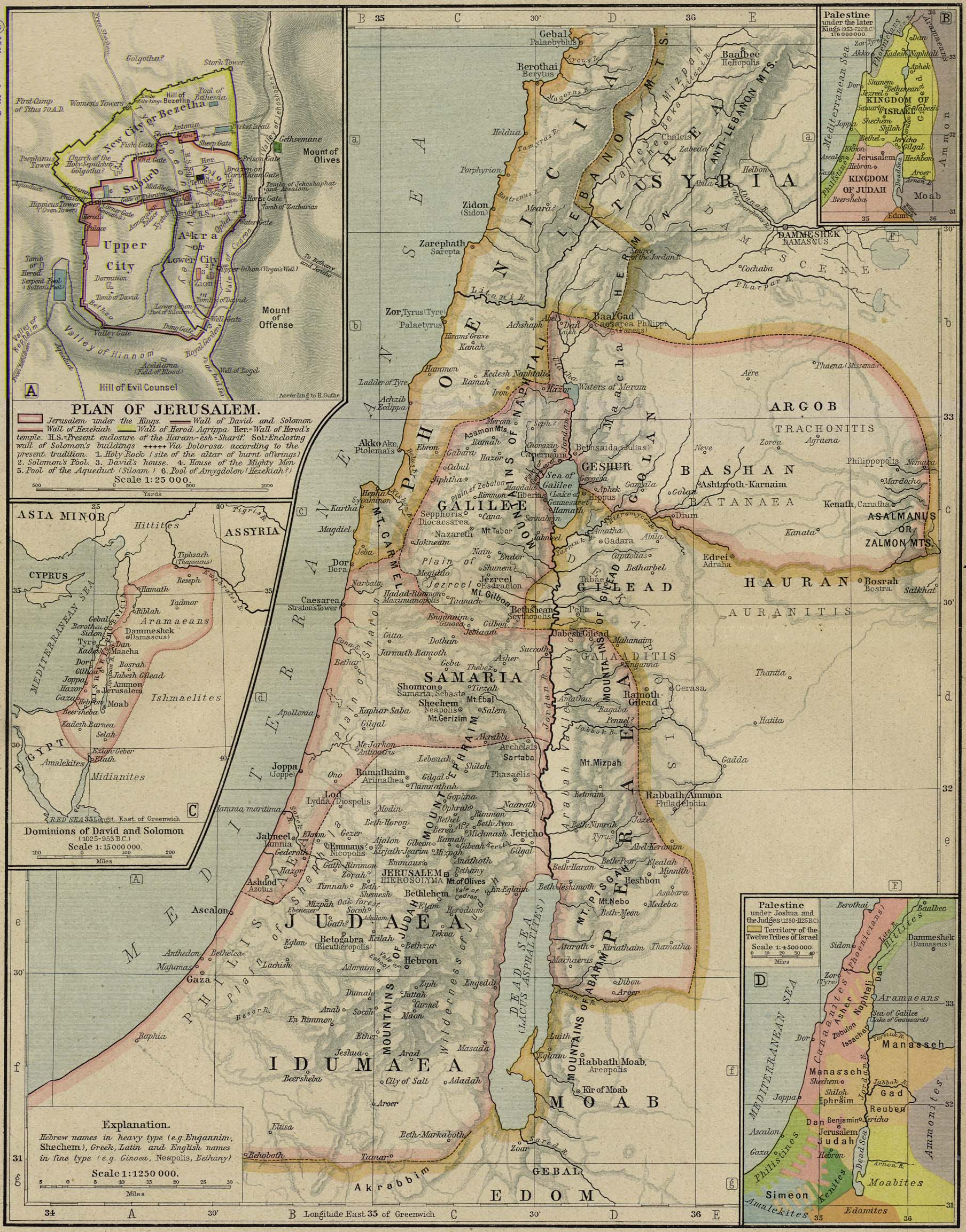
the country around it
- Coordinates
- 32.7067° N, 35.3015° Efind it on the Atlas →
- Region
- Galilee
- Kind of place
- Town
1 place the record names with Nazareth, the farthest 32 km away
- Located: the gazetteer fixes one site
- A dashed line ends at a place the gazetteer does not fix
Why Nazareth matters
What has been found
the evidence, and where it is disputed
The rejection at Nazareth, outlined
Luke 4:16 to 4:30, in the order it happens
Read Luke 4:16 to 4:30, in the order it happens
- He stands up to read in the synagogue that raised HimLuke 4:16Then Jesus came to Nazareth, where He had been brought up. As was His custom, He entered the synagogue on the Sabbath. And when He stood up to read,
- The scroll of Isaiah, and the words He readsLuke 4:18“The Spirit of the Lord is on Me, because He has anointed Me to preach good news to the poor. He has sent Me to proclaim liberty to the captives and recovery of sight to the blind, to release the oppressed,
- Today this Scripture is fulfilledLuke 4:21and He began by saying, “Today this Scripture is fulfilled in your hearing.”
- The town approves, and asks whose son He isLuke 4:22All spoke well of Him and marveled at the gracious words that came from His lips. “Isn’t this the son of Joseph?” they asked.
- Physician, heal yourselfLuke 4:23Jesus said to them, “Surely you will quote this proverb to Me: ‘Physician, heal yourself! Do here in Your hometown what we have heard that You did in Capernaum.’”
- No prophet is accepted in his hometownLuke 4:24Then He added, “Truly I tell you, no prophet is accepted in his hometown.
- Elijah sent past Israel to a widow in SidonLuke 4:26Yet Elijah was not sent to any of them, but to the widow of Zarephath in Sidon.
- The synagogue turnsLuke 4:28On hearing this, all the people in the synagogue were enraged.
- Driven to the brow of the hillLuke 4:29They got up, drove Him out of the town, and led Him to the brow of the hill on which the town was built, in order to throw Him over the cliff.
- He passed through the crowdLuke 4:30But Jesus passed through the crowd and went on His way.
Mark tells the same visit, or a second one, from another angle. There the neighbours name His mother, four brothers and His sisters, Mark says He could do no miracle there except to lay His hands on a few sick people and heal them, and He was amazed at their unbelief (Mark 6:1 to 6:6). Luke's hill is the hill the town was built on. The Mount of Precipice shown to visitors today is a scarp about two kilometres from the old village, and that identification is a later pilgrim tradition rather than a detail from Luke.
Why He Said He Came: the scroll He read in this synagogueWhat happened here, in order
in the order the canon tells it
- The Nazirite of Samson's birth announcement, one reading behind the Nazarene lineJudges 13:5For behold, you will conceive and give birth to a son. And no razor shall come over his head, because the boy will be a Nazirite to God from the womb, and he will begin the deliverance of Israel from the hand of the Philistines.”
- The shoot out of the stump of Jesse, the Hebrew netzerIsaiah 11:1Then a shoot will spring up from the stump of Jesse, and a Branch from his roots will bear fruit.
- The Servant despised and rejected, the reading Wesley takesIsaiah 53:3He was despised and rejected by men, a man of sorrows, acquainted with grief. Like one from whom men hide their faces, He was despised, and we esteemed Him not.
- Joseph settles the family at NazarethMatthew 2:23and he went and lived in a town called Nazareth. So was fulfilled what was spoken through the prophets: “He will be called a Nazarene.”
- Jesus leaves Nazareth and lives at CapernaumMatthew 4:13Leaving Nazareth, He went and lived in Capernaum, which is by the sea in the region of Zebulun and Naphtali,
- The Jerusalem crowds name Him by the townMatthew 21:11The crowds replied, “This is Jesus, the prophet from Nazareth in Galilee.”
- He comes from Nazareth to the JordanMark 1:9In those days Jesus came from Nazareth in Galilee and was baptized by John in the Jordan.
- An unclean spirit names Him Jesus of NazarethMark 1:24“What do You want with us, Jesus of Nazareth? Have You come to destroy us? I know who You are—the Holy One of God!”
- The neighbours name His trade and His familyMark 6:3Isn’t this the carpenter, the son of Mary and the brother of James, Joses, Judas, and Simon? Aren’t His sisters here with us as well?” And they took offense at Him.
- Gabriel is sent to a town in Galilee called NazarethLuke 1:26In the sixth month, God sent the angel Gabriel to a town in Galilee called Nazareth,
- The family returns to their own townLuke 2:39When Jesus’ parents had done everything required by the Law of the Lord, they returned to Galilee, to their own town of Nazareth.
- He goes down to Nazareth and is obedient to themLuke 2:51Then He went down to Nazareth with them and was obedient to them. But His mother treasured up all these things in her heart.
- Thirty hidden years in one sentenceLuke 2:52And Jesus grew in wisdom and stature, and in favor with God and man.
- He stands up to read in the synagogueLuke 4:16Then Jesus came to Nazareth, where He had been brought up. As was His custom, He entered the synagogue on the Sabbath. And when He stood up to read,
- The town drives Him to the brow of the hillLuke 4:29They got up, drove Him out of the town, and led Him to the brow of the hill on which the town was built, in order to throw Him over the cliff.
- Nathanael's question, and Philip's answerJohn 1:46“Can anything good come from Nazareth?” Nathanael asked. “Come and see,” said Philip.
- Pilate writes the town on the crossJohn 19:19Pilate also had a notice posted on the cross. It read: JESUS OF NAZARETH, THE KING OF THE JEWS.
- Peter preaches Jesus of Nazareth in a Roman houseActs 10:38how God anointed Jesus of Nazareth with the Holy Spirit and with power, and how Jesus went around doing good and healing all who were oppressed by the devil, because God was with Him.
- The risen Christ names Himself by the villageActs 22:8‘Who are You, Lord?’ I asked. ‘I am Jesus of Nazareth, whom you are persecuting,’ He replied.
- The movement is called the sect of the NazarenesActs 24:5We have found this man to be a pestilence, stirring up dissension among the Jews all over the world. He is a ringleader of the sect of the Nazarenes,
Where it points
The voices
each quoted from the work named
Thus it appears that our Lord and Master is called a Nazarene and His disciples are styled "the sect of the Nazarenes," while Christian doctrine was called, by the Jews, the heresy of the Nazarenes. Our Savior, though actually born at Bethlehem, was commonly known as Jesus of Nazareth, because Nazareth was the place where He was brought up.
If he had set a fixed example from the Scriptures, he would never have said, what was spoken by the prophets; but simply, what was spoken by the prophet: but now, calling them prophets in the plural, he shows that he did not take words from the Scriptures, but the meaning. Nazarene, interprets as holy. But all Scripture testifies that the Lord would be holy. We can also say in another way, that even in the same words, according to the Hebrew truth, it is written in Isaiah: There shall come forth a rod out of the stem of Jesse, and a Nazarene shall rise out of his roots (Isa. 11:1).
It is difficult to ascertain by what prophets this was spoken. The margin usually refers to Jdg 13:5, where the angel, foretelling the birth of Samson, says, No razor shall come upon his head; for the child shall be a Nazarite (נזיר nezir) unto God from the womb. The second passage usually referred to is Isa 11:1: There shall come forth a rod from the stem of Jesse, and a Branch (נצר netser) shall grow out of his roots. That this refers to Christ, there is no doubt.
4 more teachers on these versesJohn Wesley · Adam Clarke · Charles Spurgeon · J.C. Ryle
He came and dwelt in Nazareth - (where he had dwelt before he went to Bethlehem) a place contemptible to a proverb. So that hereby was fulfilled what has been spoken in effect by several of the prophets, (though by none of them in express words, ) He shall be called a Nazarene - that is, he shall be despised and rejected, shall be a mark of public contempt and reproach.
Can there any good thing come out of Nazareth? - Bp. Pearce supposes that the τι αγαθον of the evangelist has some particular force in it: for, in Jer 33:14, God says, I will perform that good thing which I promised, etc.; and this, in Jer 33:15 is explained to mean, his causing the branch of righteousness (i.e. the Messiah) to grow up unto David, from whom Jesus was descended: in this view, Nathanael’s question seems to imply, that not Nazareth, but Bethlehem, was to be the birth-place of the Messiah
JESUS had spent several years in retirement in the house of His reputed father at Nazareth. He must have been well known—the excellency of His Character and conduct must have attracted notice. In due time He left Nazareth, was baptized by John in Jordan, and began at once His work of preaching and working wonders. The inhabitants of Nazareth, no doubt, often said to one another, "He will be sure to come home and see His parents. When He comes we will all go to hear what the carpenter's son has to say."
We see, in the first place, how apt men are to undervalue things with which they are familiar . The men of Nazareth "were offended" at our Lord. They could not think it possible that one who had lived so many years among themselves, and whose brethren and sisters they knew, could deserve to be followed as a public teacher. Never had any place on earth such privileges as Nazareth. For thirty years the Son of God resided in this town, and went to and fro in its streets.
Nazareth in Scripture
27 verses name it, in 5 books
Open a book to read its mentions here. Text: Berean Standard Bible.
Old TestamentNew Testamentsegment width = share of mentions
New Testament5 books · 27 mentions
Matthew4 mentions
- Matthew 2:23and he went and lived in a town called Nazareth. So was fulfilled what was spoken through the prophets: “He will be called a Nazarene.”
- Matthew 4:13Leaving Nazareth, He went and lived in Capernaum, which is by the sea in the region of Zebulun and Naphtali,
- Matthew 21:11The crowds replied, “This is Jesus, the prophet from Nazareth in Galilee.”
- Matthew 26:71When Peter had gone out to the gateway, another servant girl saw him and said to the people there, “This man was with Jesus of Nazareth.”
Mark3 mentions
- Mark 1:9In those days Jesus came from Nazareth in Galilee and was baptized by John in the Jordan.
- Mark 1:24“What do You want with us, Jesus of Nazareth? Have You come to destroy us? I know who You are—the Holy One of God!”
- Mark 10:47When he heard that it was Jesus of Nazareth, he began to cry out, “Jesus, Son of David, have mercy on me!”
Luke8 mentions
- Luke 1:26In the sixth month, God sent the angel Gabriel to a town in Galilee called Nazareth,
- Luke 2:4So Joseph also went up from Nazareth in Galilee to Judea, to the city of David called Bethlehem, since he was from the house and line of David.
- Luke 2:39When Jesus’ parents had done everything required by the Law of the Lord, they returned to Galilee, to their own town of Nazareth.
- Luke 2:51Then He went down to Nazareth with them and was obedient to them. But His mother treasured up all these things in her heart.
- Luke 4:16Then Jesus came to Nazareth, where He had been brought up. As was His custom, He entered the synagogue on the Sabbath. And when He stood up to read,
- Luke 4:34“Ha! What do You want with us, Jesus of Nazareth? Have You come to destroy us? I know who You are—the Holy One of God!”
- Luke 18:37“Jesus of Nazareth is passing by,” they told him.
- Luke 24:19“What things?” He asked. “The events involving Jesus of Nazareth,” they answered. “This man was a prophet, powerful in speech and action before God and all the people.
John5 mentions
- John 1:45Philip found Nathanael and told him, “We have found the One Moses wrote about in the Law, the One the prophets foretold—Jesus of Nazareth, the son of Joseph.”
- John 1:46“Can anything good come from Nazareth?” Nathanael asked. “Come and see,” said Philip.
- John 18:5“Jesus of Nazareth,” they answered. Jesus said, “I am He.” And Judas His betrayer was standing there with them.
- John 18:7So He asked them again, “Whom are you seeking?” “Jesus of Nazareth,” they answered.
- John 19:19Pilate also had a notice posted on the cross. It read: JESUS OF NAZARETH, THE KING OF THE JEWS.
Acts7 mentions
- Acts 2:22Men of Israel, listen to this message: Jesus of Nazareth was a man certified by God to you by miracles, wonders, and signs, which God did among you through Him, as you yourselves know.
- Acts 3:6But Peter said, “Silver or gold I do not have, but what I have I give you: In the name of Jesus Christ of Nazareth, get up and walk!”
- Acts 4:10then let this be known to all of you and to all the people of Israel: It is by the name of Jesus Christ of Nazareth, whom you crucified but whom God raised from the dead, that this man stands before you healed.
- Acts 6:14For we have heard him say that Jesus of Nazareth will destroy this place and change the customs that Moses handed down to us.”
- Acts 10:38how God anointed Jesus of Nazareth with the Holy Spirit and with power, and how Jesus went around doing good and healing all who were oppressed by the devil, because God was with Him.
- Acts 22:8‘Who are You, Lord?’ I asked. ‘I am Jesus of Nazareth, whom you are persecuting,’ He replied.
- Acts 26:9So then, I too was convinced that I ought to do all I could to oppose the name of Jesus of Nazareth.
The account
Read the account as one telling
Nazareth stands on a hill in lower Galilee, and Luke's line about the brow of the hill on which the town was built is the earliest description of the place in any source. The first century village was small. Jewish practice put burial outside a settlement, so the ring of early Roman rock-cut tombs found around the site marks the limits of the village, and those limits enclose very little ground.
No book of the Old Testament names Nazareth. Joshua's list of the towns of Zebulun passes over it, Josephus never mentions it, and it is absent from the Talmud. What the excavations under and around the town have turned up is a farming hamlet: silos, cisterns, cave storage, olive and wine installations, terraces and a rock-cut winepress.
Luke opens the account of Jesus in this village. In the sixth month of Elizabeth's pregnancy, God sent the angel Gabriel to Nazareth, to a virgin pledged in marriage to Joseph, who was of the house of David. Gabriel told Mary she would conceive and give birth to a son who would be given the throne of His father David and would reign over the house of Jacob forever. Mary answered that she was the Lord's servant.
Matthew and Luke both put the birth at Bethlehem, and Nazareth is never called the birthplace of Jesus anywhere in Scripture. After Egypt, Joseph learned that Archelaus was reigning in Judea in place of his father Herod, was warned in a dream, and withdrew to Galilee. Matthew says he went and lived in a town called Nazareth, and that this fulfilled what was spoken through the prophets, that He will be called a Nazarene. No prophet says those words. The readings offered for the line are set out further down this page.
The years that follow are the least documented stretch of the life of Jesus. Luke gives them four sentences. Mark's neighbours add one detail: they call Him the carpenter, name His mother, name four brothers, James, Joses, Judas and Simon, and say His sisters were living among them.
He left Nazareth for the Jordan and John's baptism, and He came back once to teach. That visit ends with the town driving Him out to the brow of its own hill, and it is the story told above. After it, Matthew says He left Nazareth and lived in Capernaum by the sea. The Galilean ministry ran from the lakeside town from then on, and Nazareth was no longer His base.
The name of the village outlived the visit. Pilate had a notice posted on the cross that read JESUS OF NAZARETH, THE KING OF THE JEWS. Peter preached Jesus of Nazareth at Pentecost and again in the house of Cornelius. On the Damascus road the voice from the light said, I am Jesus of Nazareth, whom you are persecuting. At Paul's trial before Felix, the lawyer Tertullus called him a ringleader of the sect of the Nazarenes, and the name of the town had become the name of the movement.
The town enters the Jewish record after the temple fell. A fragmentary Hebrew inscription found at Caesarea Maritima in 1962 lists the twenty four priestly courses with the Galilean towns each course settled in after the Temple fell, and it assigns the eighteenth course, Happizzez, to Nazareth. That is the earliest known mention of the town outside Christian writing.
Common questions
Why does Matthew say “He will be called a Nazarene” when no Old Testament verse says it?
Readers differ; the positions are named
Matthew writes the prophets, plural, and no prophet says those words. Jerome argued in the fifth century that the plural shows Matthew is giving the sense of the prophets rather than quoting one of them, and he also read the name against Isaiah's branch, the Hebrew netzer, in Isaiah 11:1. Adam Clarke keeps both the branch and the Nazirite of Judges 13:5 open, and John Wesley takes it as the prophets' picture of a despised man, which is Isaiah 53:3.
The netzer reading is the most widely held among commentators, the sense of the prophets reading is the oldest on record, and the Nazirite reading is the one carried in most Bible margins. This page names all three and leaves the question open.
Was Nazareth a real town in the first century? It is not in the Old Testament or in Josephus.
Readers differ; the positions are named
The silence is real. Nazareth appears in no Old Testament book, in none of Josephus' Galilean lists, and in no Talmudic tract. The excavated evidence is also real. A Hebrew inscription from Caesarea Maritima, published by Michael Avi-Yonah in 1962, names Nazareth as the town where the priestly course of Happizzez settled, and excavations under and around the Church of the Annunciation have found first century silos, cisterns, winepresses, chalk vessels and rock-cut tombs.
What that adds up to is a farming hamlet of a few hundred people, which is the kind of place a general writing about a war leaves out. The evidence, the names and the two live disputes are set out further up this page.
Why did Nathanael say “Can anything good come from Nazareth?”
Nazareth was small, poor and unmentioned in the prophets, and Nathanael came from Cana, a few miles away, which is close enough to hold a low opinion. Adam Clarke adds that the expected birthplace of the Messiah was Bethlehem rather than a Galilean village, so the question may be about prophecy as much as about status.
Philip does not argue the point with him. He says, Come and see.
Why did people who had known Jesus all His life try to kill Him?
Their first reaction was approval. They spoke well of Him and marveled at the gracious words that came from His lips. The anger came when He named the widow of Zarephath and Naaman the Syrian, two outsiders God helped while Israelites went without.
They then drove Him to the brow of the hill the town was built on, meaning to throw Him over it. Luke says only that He passed through the crowd and went on His way, and says nothing about how.
What is the difference between a Nazarene and a Nazirite?
A Nazarene is a person from Nazareth, the way a Galilean is a person from Galilee. A Nazirite is someone under the vow of Numbers 6, separated to the LORD, with no razor on the head and no wine.
The two words look alike in English and come from different Hebrew roots. Jesus is called a Nazarene and is never said to have taken the Nazirite vow. He was in fact accused of drinking wine.
If Jesus was born in Bethlehem, why is He called Jesus of Nazareth?
Because Nazareth is where He was raised. Joseph took the family to Galilee after Archelaus took Judea, and they settled there. Spurgeon puts it plainly: though actually born at Bethlehem, was commonly known as Jesus of Nazareth, because Nazareth was the place where He was brought up.
The name follows Him to the cross, where Pilate writes it over His head, and out of the tomb, where the risen Christ uses it of Himself on the Damascus road.
Is the Church of the Annunciation built over the house where Mary lived?
Readers differ; the positions are named
The church stands over caves, cisterns and storage rooms that Franciscan archaeologists excavated from 1955 into the 1960s, and a first century dwelling was exposed nearby in a salvage excavation in 2009. Neither dig produced anything that names the family of Jesus.
Ken Dark's re-study of a different site, under the Sisters of Nazareth convent, identified a first century house later enclosed by a Byzantine cave church, and he said plainly that the identification cannot be proven. These are traditions with a real excavation record underneath them, and the record does not settle whose house any of them was.
Why did Jesus move to Capernaum?
Matthew records the move straight after the rejection: leaving Nazareth, He went and lived in Capernaum by the sea. The Nazareth crowd had already thrown Capernaum in His face, quoting the proverb about a physician healing himself and asking Him to do at home what they had heard He did there.
From that point the Galilean ministry runs from the lakeside town, and Nazareth appears in the Gospels as the place He came from.
Sources cited
- OpenBible.info Bible Geocoding: Nazarethread 2026-08-20The coordinates on this page. Used under CC-BY with attribution to OpenBible.info.
- Michael Avi-Yonah, “A List of Priestly Courses from Caesarea,” Israel Exploration Journal 12 (1962)Publication of the Caesarea Maritima inscription that names Nazareth, the earliest mention outside Christian sources.
- Bellarmino Bagatti, Excavations in Nazareth, volume 1 (Jerusalem: Franciscan Printing Press, 1969)The Franciscan excavations under and around the Church of the Annunciation, 1955 into the 1960s.
- Stephen Pfann, Ross Voss and Yehudah Rapuano, “Surveys and Excavations at the Nazareth Village Farm (1997 to 2002): Final Report,” Bulletin of the Anglo-Israel Archaeological Society 25 (2007), with Ken Dark's critical review in volume 26 (2008)The Village Farm report and the review that disputes the dating of some of its features. Both sides of a live dispute.
- Ken Dark, The Sisters of Nazareth Convent: A Roman-period, Byzantine, and Crusader Site in Central Nazareth (London: Routledge, 2020)The first century courtyard house under the convent, and Dark's own statement that the identification cannot be proven.
- Yardenna Alexandre, Mary's Well, Nazareth: The Late Hellenistic to the Ottoman Periods (Israel Antiquities Authority Reports, 2012)The Israel Antiquities Authority excavation at the spring site, and the background to the 2009 salvage dig near the Church of the Annunciation.
- René Salm, The Myth of Nazareth: The Invented Town of Jesus (American Atheist Press, 2008)Cited as the published form of the objection this page answers, so a reader can check the argument for himself.
- Charles H. Spurgeon, The Metropolitan Tabernacle Pulpit, Sermon No. 1632Public domain, CCEL edition, lightly modernized text.
- Charles H. Spurgeon, The Metropolitan Tabernacle Pulpit, Sermon No. 753Public domain, CCEL edition, lightly modernized text.
- J.C. Ryle, Expository Thoughts on the Gospels: Mark (1857)Public domain, Grace Gems edition, lightly modernized text.
- Jerome, Commentary on Matthew (c. 420)Public domain. The oldest surviving discussion of the Nazarene question.
- Adam Clarke, Commentary on the Bible (1832)Public domain. Cited on Matthew 2:23 and on John 1:46.
- John Wesley, Explanatory Notes upon the New Testament (1755)Public domain, CCEL edition.
- George Adam Smith, Atlas of the Historical Geography of the Holy Land (1915)Public domain. The atlas plate of Palestine in the time of Christ that this page shows for Galilee.
Keep studying
On this page
Studies12
- The rejection at Nazareth, outlined
- The Fulfillment Formula (Matthew's Ten Quotations)
- Type-Scenes: the Stories Scripture Tells Twice
- Unto Us a Child Is Born
- The Lamb: Revelation's Christology
- The Gospels
- The Silent Years
- The Temptation in the Wilderness: Matthew 4
- The Cleansing of the Temple: John 2 · Matthew 21
- Rome
- The 153 Fish
- The Wilderness
Lives that run through it3
Doorway2
Keep this page