
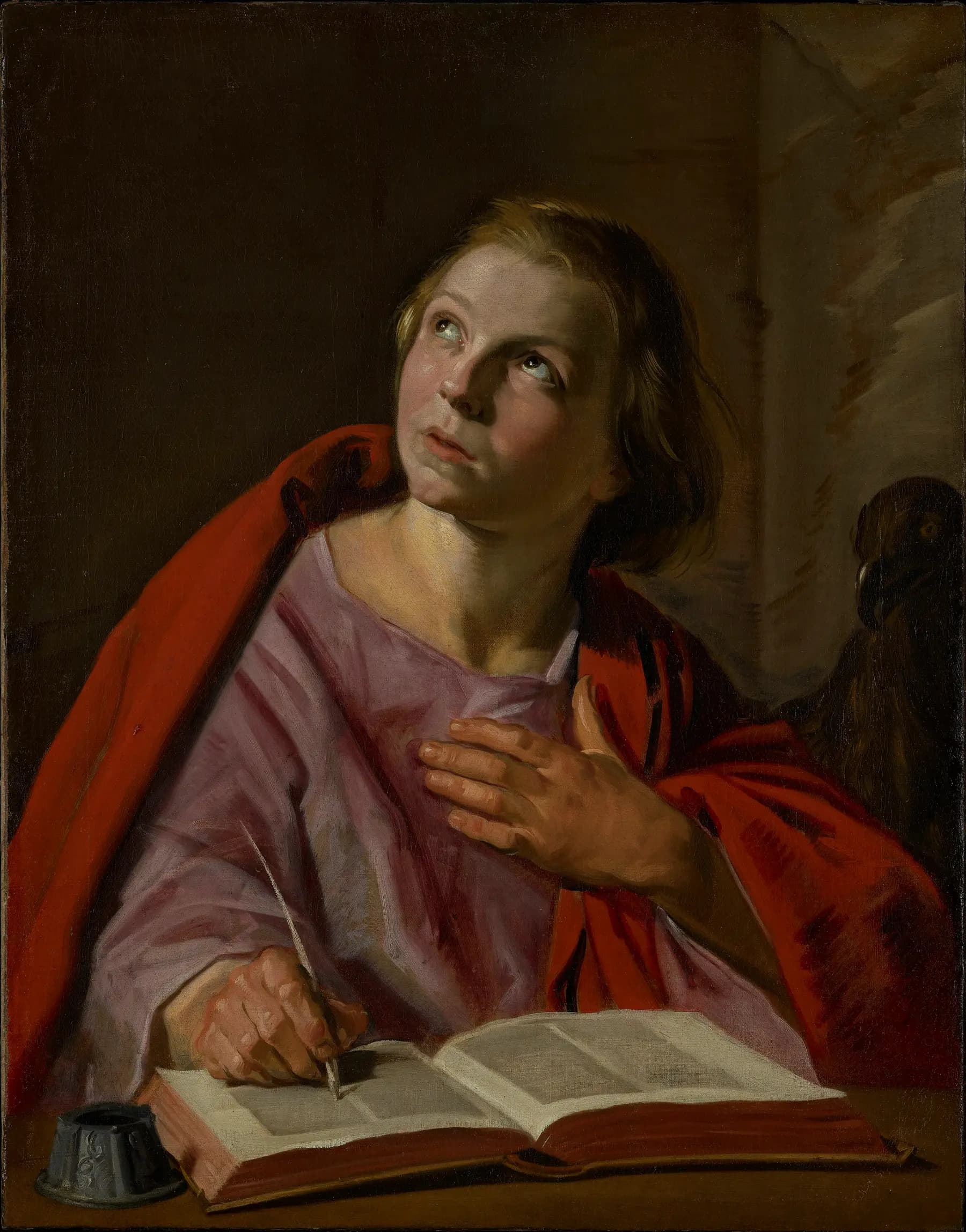
Saint John the Evangelist, Frans Hals, about 1625 to 1628, J. Paul Getty Museum. Public domain.
New Testament · Book 63 of 66
2 John
2 John is a short letter from the elder to the chosen lady and her children. He urges them to walk in truth and love and warns them against welcoming those who deny that Christ came in the flesh.
2 John is a short letter from the elder to the chosen lady and her children. He urges them to walk in truth and love and warns them against welcoming those who deny that Christ came in the flesh.
What is 2 John about?
2 John is a letter of thirteen verses, the shortest book of the Bible by verse count. The elder writes to the chosen lady and her children, whom he loves in the truth. He is glad that some of them walk in the truth, and he asks them to love one another, the commandment they have had from the beginning. Then he warns them that many deceivers have gone out, refusing to confess that Christ came in the flesh. A teacher who brings another teaching is refused the home. The elder closes with the hope to come and “speak with you face to face” (1:12).
All 1 chapters
Every chapter of the book, in one grid. Each cell opens that chapter.
- Truth and love1:1 to 6
- The deceivers1:7 to 11
- Face to face1:12 to 13
The book is one chapter, and its three movements are verse ranges of it. The cell opens the chapter's Study level.
Who wrote it, where, when, for whom, and why?
The writer calls himself the elder (1:1). The letter to Gaius opens with the same title and closes with the same words about ink and a visit face to face (3 John 1:1 and 13 to 14). The confession of Christ come in the flesh and the name antichrist stand also in 1 John (2:22 and 4:2 to 3).
The elder, To the chosen lady and her children, whom I love in the truth—and not I alone, but also all who know the truth—
2 John 1:1, Berean Standard Bible.
The letter goes to the chosen lady and her children (1:1), and it speaks of the home a travelling teacher might be received into (1:10). The deceivers have gone out into the world (1:7). The closing greeting comes from the children of the lady's elect sister (1:13).
The letter gives its time by what has already happened. The readers have had the commandment to love one another from the beginning (1:5 to 6), and many deceivers have already gone out (1:7). 1 John says the readers heard that the antichrist was coming, and that many antichrists have now appeared (1 John 2:18).
The chosen lady and her children, whom the elder loves in the truth, as do all who know the truth (1:1). Some of her children walk in the truth (1:4). From 1:6 the letter speaks to the household together.
The elder writes so that the household keeps the commandment to love one another (1:5), keeps what has been worked for (1:8), and remains in the teaching of Christ (1:9). The teacher who brings another teaching is to be refused the home (1:10). The rest he keeps for a visit, so that their joy may be complete (1:12).
The letter stands with 1 John and 3 John. 3 John commends the brothers who went out on behalf of the Name and asks that they be sent on their way (3 John 1:5 to 8). The commandment to love one another is the one Jesus gave (John 13:34), and 1 John calls it the old commandment the readers had from the beginning (1 John 2:7).
Sources. In 2 John, 1:1, 1:4 to 10 and 1:12 to 13; John 13:34; 1 John 2:7, 2:18, 2:22 and 4:2 to 3; 3 John 1:1, 1:5 to 8 and 1:13 to 14. Every verse is read in the Berean Standard Bible.
How is 2 John arranged, and what is it for?
The three movements of its one chapter, then what it teaches and what it was sent to do.
- Truth and love2 John 1:1 to 6, 6 verses, the turn at 1:6
The elder greets the chosen lady and her children in the truth, rejoices over those walking in it, and asks that they love one another.
- The deceivers2 John 1:7 to 11, 5 verses, the turn at 1:9
Many deceivers have gone out; whoever runs ahead of the teaching of Christ is refused the home and the greeting.
- Face to face2 John 1:12 to 13, 2 verses, the turn at 1:12
The elder sets aside paper and ink, hopes to come and speak face to face, and sends the greeting of the elect sister's children.
The theme
2 John binds love to the truth. The elder loves the household in the truth, rejoices that some of its children walk in the truth, and defines love as walking according to the commandments. Then he names the danger: deceivers who refuse to confess that Christ came in the flesh. The one who remains in the teaching of Christ has the Father and the Son, and the teacher who brings another teaching is refused the home. The letter ends with the hope of a visit and a joy made complete.
The purpose
The letter was sent to keep a household in the truth while deceivers moved among the churches. It told the chosen lady and her children to go on loving one another, to watch themselves so as to keep what had been worked for (2 John 1:8), and to keep their home from the teachers who deny that Christ came in the flesh. It leaves the reader with love and truth held together.
The four words of the opening
The elder, To the chosen lady and her children, whom I love in the truth—and not I alone, but also all who know the truth—
because of the truth that abides in us and will be with us forever:
Grace, mercy, and peace from God the Father and from Jesus Christ, the Son of the Father, will be with us in truth and love.
I was overjoyed to find some of your children walking in the truth, just as the Father has commanded us.
And now I urge you, dear lady—not as a new commandment to you, but one we have had from the beginning—that we love one another.
And this is love, that we walk according to His commandments. This is the very commandment you have heard from the beginning, that you must walk in love.
2 John 1:1–6, Berean Standard Bible.
The key, and the count
truthunderlined5
1:1 (twice), 1:2, 1:3, 1:4
loveboxed5
1:1, 1:3, 1:5, 1:6 (twice)
commandmentdouble underline4
1:4, 1:5, 1:6 (twice)
walkdotted underline3
1:4, 1:6 (twice)
17 marks in all. The next verse turns to the deceivers.
Truth and love
What the text says in these 6 verses, and the pages they open on.
The elder writes to the chosen lady and her children, whom he loves in the truth, and with him all who know the truth (1:1). The truth abides in them and will be with them forever (1:2). Grace, mercy and peace come from God the Father and from the Son of the Father, in truth and love (1:3). The elder is overjoyed to find some of her children walking in the truth, as the Father commanded (1:4). He asks the lady that they love one another, a commandment they have had from the beginning (1:5). Love is to walk according to His commandments, and the commandment is to walk in love (1:6).
And this is love, that we walk according to His commandments. This is the very commandment you have heard from the beginning, that you must walk in love.
- Study
2 John 1one chapter of 13 verses: truth and love, the deceivers, and the close face to faceShow the summary and 5 pagesShow summary, 5 pagesHide the summary
Thirteen verses on a single sheet: 'The elder, To the chosen lady and her children, whom I love in the truth', a church addressed as a household. Truth and love are wound together from the first line and never separated, and John rejoices to find her children walking in truth. The request is nothing new, but that which we had from the beginning, that we love one another. The urgency is the danger: 'many deceivers have gone out into the world, refusing to confess the coming of Jesus Christ in the flesh. Any such person is the deceiver and the antichrist' (v7). Since the itinerant teacher lodges in your house, the order is stark: receive him not, neither give him greeting. John hopes rather to speak face to face, 'so that our joy may be complete.'
On this chapter (5)
- The Incarnation
The Word become flesh, the confession this letter asks for.
- Antichrist
The name John's letters give to the one who denies the Son.
- Who is the chosen lady, a church or a woman?
Answered under Where do readers disagree, lower on this page, with each reading and who holds it.
- Does 2 John 1:10 to 11 forbid every welcome to one who teaches otherwise?
Answered under Where do readers disagree, lower on this page, with each reading and who holds it.
- 2 John 1:6
The turn of the first movement on its own page, with the commentators on it by era.
- The Incarnation
The four words these verses are built on are drawn as the four words of the opening, under The book as a whole.
Characters (4)
Who the text names. A name with a page carries its door.
- The elder
The writer, who gives his title in the first line.
- The chosen lady
The one the letter is sent to, loved in the truth.
- Her children
Some of them found walking in the truth.
- The Son of the Father
With God the Father, the giver of grace, mercy and peace.
Themes (4)
What these verses raise, each on its own page where one stands.
- The truth
What abides in the household and will be with it forever.
- Love one another
The commandment the household has had from the beginning.
- The commandment from the beginning
An old commandment, given again.
- Walking in the truth
The life the elder rejoices to find in her children.
These verses quote no Old Testament passage.
Where these verses meet John's Gospel and 1 John (2)each a cross reference the store holds, with both verses
And now I urge you, dear lady—not as a new commandment to you, but one we have had from the beginning—that we love one another.
2 John 1:5, Berean Standard Bible.
A new commandment I give you: Love one another. As I have loved you, so you also must love one another.
John 13:34, Berean Standard Bible.
Cross reference, 9 votes in the store. The commandment to love one another, given by Jesus on the night before his death.
And this is love, that we walk according to His commandments. This is the very commandment you have heard from the beginning, that you must walk in love.
2 John 1:6, Berean Standard Bible.
For this is the love of God, that we keep His commandments. And His commandments are not burdensome,
1 John 5:3, Berean Standard Bible.
Cross reference, 26 votes in the store. Love set out as keeping His commandments, in the first letter.
The deceivers
What the text says in these 5 verses, and the pages they open on.
The reason for the warning comes next. Many deceivers have gone out into the world, refusing to confess that Christ came in the flesh, and any such person is the deceiver and the antichrist (1:7). The household must watch itself so as to keep what has been worked for and be fully rewarded (1:8). Anyone who runs ahead without remaining in the teaching of Christ does not have God, and whoever remains in it has both the Father and the Son (1:9). A teacher who comes without this teaching is to be refused the home and the greeting (1:10), because whoever greets him shares in his evil deeds (1:11).
Anyone who runs ahead without remaining in the teaching of Christ does not have God. Whoever remains in His teaching has both the Father and the Son.
The confession, in two letters
For many deceivers have gone out into the world, refusing to confess the coming of Jesus Christ in the flesh. Any such person is the deceiver and the antichrist.
Who is the liar, if it is not the one who denies that Jesus is the Christ? This is the antichrist, who denies the Father and the Son.
By this you will know the Spirit of God: Every spirit that confesses that Jesus Christ has come in the flesh is from God, and every spirit that does not confess Jesus is not from God. This is the spirit of the antichrist, which you have heard is coming and which is already in the world at this time.
Two letters, two cases at the door
If anyone comes to you but does not bring this teaching, do not receive him into your home or even greet him. Whoever greets such a person shares in his evil deeds.
Beloved, you are faithful in what you are doing for the brothers, and especially since they are strangers to you. They have testified to the church about your love. You will do well to send them on their way in a manner worthy of God. For they went out on behalf of the Name, accepting nothing from the Gentiles. Therefore we ought to support such men, so that we may be fellow workers for the truth.
Characters (4)
Who the text names. A name with a page carries its door.
- The deceivers
Many who have gone out into the world, refusing the confession of the letter.
- The antichrist
The name the letter gives to any such person.
- Anyone who runs ahead
The one who runs ahead of the teaching of Christ, set against the one who has the Father and the Son (1:9).
- The one who greets him
The host who shares in the teacher's evil deeds.
Places (2)
The places these verses name.
- The world
Where many deceivers have gone out (1:7).
- Your home
The house a teacher who brings another teaching is refused (1:10).
Themes (4)
What these verses raise, each on its own page where one stands.
- The coming in the flesh
The confession the deceivers refuse.
- The teaching of Christ
What a reader remains in, and so has the Father and the Son.
- The welcome and its limit
The home and the greeting kept from the teacher of another teaching.
- A full reward
What the household keeps by watching itself.
These verses quote no Old Testament passage.
Where these verses meet John's Gospel and 1 John (2)each a cross reference the store holds, with both verses
Anyone who runs ahead without remaining in the teaching of Christ does not have God. Whoever remains in His teaching has both the Father and the Son.
2 John 1:9, Berean Standard Bible.
Whoever denies the Son does not have the Father, but whoever confesses the Son has the Father as well. As for you, let what you have heard from the beginning remain in you. If it does, you will also remain in the Son and in the Father.
1 John 2:23–24, Berean Standard Bible.
Cross reference, 13 votes in the store. Having the Father and the Son, and remaining in what was heard from the beginning.
Anyone who runs ahead without remaining in the teaching of Christ does not have God. Whoever remains in His teaching has both the Father and the Son.
2 John 1:9, Berean Standard Bible.
“My teaching is not My own,” Jesus replied. “It comes from Him who sent Me. If anyone desires to do His will, he will know whether My teaching is from God or whether I speak on My own.
John 7:16–17, Berean Standard Bible.
Cross reference, 25 votes in the store. Jesus says his teaching comes from the One who sent him.
Face to face
What the text says in these 2 verses, and the pages they open on.
The elder has many things to write, and he would rather keep them from paper and ink (1:12). He hopes to come and speak with the household face to face, so that their joy may be complete (1:12). The letter ends with a greeting from the children of the lady's elect sister (1:13).
I have many things to write to you, but I would prefer not to do so with paper and ink. Instead, I hope to come and speak with you face to face, so that our joy may be complete.
The two closes
I have many things to write to you, but I would prefer not to do so with paper and ink. Instead, I hope to come and speak with you face to face, so that our joy may be complete. The children of your elect sister send you greetings.
I have many things to write to you, but I would prefer not to do so with pen and ink. Instead, I hope to see you soon and speak with you face to face. Peace to you. The friends here send you greetings. Greet each of our friends there by name.
Characters (2)
Who the text names. A name with a page carries its door.
- The elder
The writer, who hopes to come in person.
- The children of the elect sister
Those who send their greeting at the close.
Themes (2)
What these verses raise, each on its own page where one stands.
- Joy made complete
What the elder hopes the visit will bring.
- Paper and ink
The letter's own materials, set aside for speech.
These verses quote no Old Testament passage.
Where these verses meet John's Gospel and 1 John (1)each a cross reference the store holds, with both verses
I have many things to write to you, but I would prefer not to do so with paper and ink. Instead, I hope to come and speak with you face to face, so that our joy may be complete.
2 John 1:12, Berean Standard Bible.
I have told you these things so that My joy may be in you and your joy may be complete.
John 15:11, Berean Standard Bible.
Cross reference, 4 votes in the store. Joy made complete, the same words Jesus speaks to his disciples.
- Author
- The apostle John (traditional), styling himself ‘The elder’ (1:1)
- Date
- Late 1st century, c. AD 85–95
- Audience
- ‘the chosen lady and her children’ (1:1): either a specific woman and her household or a particular local church
Where do readers disagree?
One list: the readings with their holders, and what the evidence does not settle.
Who is the chosen lady, a church or a woman?
- A church, with its members as her children. Held by Hilary of Arles in his Introductory Commentary on 2 John, on 1:1, and by Robert Jamieson, A. R. Fausset and David Brown, Commentary Critical and Explanatory on the Whole Bible (1871), on 1:1.
- A woman named Kyria. Held by John Wesley, Explanatory Notes upon the New Testament (1755), on 1:1.
- A woman named Electa. Held by Clement of Alexandria in his Adumbrations on 2 John, which survive in the Latin of Cassiodorus, on 1:1.
- A Christian mother and her household. Held by Clarke in his Commentary on the Bible, on 1:5, and by John Gill, Exposition of the New Testament (1746 to 1748), on 1:13.
What the evidence does not settle: The address and 2 John 1:5 speak to one lady and the verses after them speak to many, and each reading gives an account of both.
The argument in full
A church, with its members as her children. The household is spoken to together from 1:6, and the greeting at 1:13 comes from the children of an elect sister, read as a sister church.
A woman named Kyria. The Greek word for lady, kuria, is read as her own name, here and at 1:5.
A woman named Electa. The Greek word for chosen is read as her name, a lady of Babylon whose name also marks the election of the church.
A Christian mother and her household. The lady is spoken to as one person at 1:5, and the elect sister of 1:13 is read as her sister by birth.
Who is the elder?
- John the apostle, old in years. Held by Adam Clarke, Commentary on the Bible (1832), on 1:1, and by Irenaeus, Against Heresies, book 1, who quotes 1:11 as the word of John, the disciple of the Lord.
- John the elder of Ephesus, another man. Held by Eusebius of Caesarea in his Ecclesiastical History, book 3, chapter 39, where he reads Papias as naming a second John, the elder, and by Jerome in his Lives of Illustrious Men, chapter 9.
- A leader in the circle around John. Held by Raymond E. Brown, The Epistles of John, Anchor Bible (1982).
What the evidence does not settle: The letter's one word on its writer is the title the elder, and the same title opens 3 John.
The argument in full
John the apostle, old in years. The title names the writer's great age, and the earliest writer to quote the letter gives it to John.
John the elder of Ephesus, another man. Papias names John the elder beside the apostles, and the title in the first verse is read as that man's own.
A leader in the circle around John. The three letters are read as the work of one teacher in a community formed by John's teaching.
Does 2 John 1:10 to 11 forbid every welcome to one who teaches otherwise?
- The home and the greeting given to a teacher. Held by Albert Barnes in his Notes on the New Testament, on 1:10, and by Clarke in his Commentary on the Bible, on 1:11.
- Separation from the teacher, at home and in the church. Held by Hilary of Arles in his Introductory Commentary on 2 John, on 1:10, and by Didymus the Blind in his Commentary on 2 John, on 1:11.
- The greeting and prayer together both withheld. Held by Clement of Alexandria in his Adumbrations on 2 John, on 1:10.
What the evidence does not settle: The verse names the one who comes bringing a teaching other than the teaching of Christ of 1:7 to 9; how far the rule reaches past a teacher at the door is a judgment of reading.
The argument in full
The home and the greeting given to a teacher. The verses keep a host from supporting a teacher of error as a teacher, and the common offices of kindness to him stand.
Separation from the teacher, at home and in the church. Hilary reads the verses as a case of excommunication from the table at home and in church.
The greeting and prayer together both withheld. Clement adds that the one who holds the truth keeps from praying with such a person, since the greeting follows the prayer.
Does the coming in the flesh at 2 John 1:7 speak of the incarnation or of the return?
- The incarnation. Held by Clarke in his Commentary on the Bible, on 1:7, and by John Wesley in his Explanatory Notes upon the New Testament, on 1:7.
- Both comings, the first and the second. Held by Jamieson, Fausset and Brown in their Commentary Critical and Explanatory on the Whole Bible, on 1:7, and by Theophylact of Ohrid in his Commentary on 2 John, on 1:8.
What the evidence does not settle: The verse uses a present participle where 1 John 4:2 uses a perfect, and both readings rest on that tense.
The argument in full
The incarnation. The deceivers denied that Jesus had come in the flesh, the confession 1 John 4:2 gives in the past tense.
Both comings, the first and the second. The Greek participle is present, coming, and is read as holding both advents; Theophylact warns against those who reject both comings of the Lord.
Why was 2 John slow to be received?
Who Decided the Canon→- Its writer was questioned. Held by Eusebius of Caesarea in his Ecclesiastical History, book 3, chapter 25.
- Some held it genuine and some doubted it. Held by Origen in his Commentary on John, book 5, as Eusebius quotes it.
- It was read as John's from early on. Held by Irenaeus in Against Heresies, book 1; by Clement of Alexandria in his Adumbrations; and by the Seventh Council of Carthage under Cyprian, which cites 1:10 to 11 as the word of John the apostle.
What the evidence does not settle: The record holds both early use and later doubt, and the doubt it names is the question of the writer.
The argument in full
Its writer was questioned. Eusebius places the second and third letters of John among the disputed books, whether they are the evangelist's or another's of the same name.
Some held it genuine and some doubted it. John left one short letter, and perhaps a second and a third, which some held to be genuine and others doubted.
It was read as John's from early on. The letter is quoted by name as John's before Eusebius wrote.
Which of the three letters of John was written first?
- 1 John first, and 2 John looks back to it. Held by Theophylact of Ohrid in his Commentary on 2 John, on 1:5, and by Oecumenius in his Commentary on 2 John, on the same verse.
- 2 John and 3 John written together. Held by Theophylact of Ohrid in his Commentary on 2 John, on 1:12.
- The letter of 3 John 1:9 is a lost letter. Held by Albert Barnes in his Notes on the New Testament, on that verse of 3 John.
What the evidence does not settle: The order is argued from what the letters say: 2 John 1:5 calls the commandment one the readers have had from the beginning, and 3 John 1:9 speaks of a letter the elder wrote to the church.
The argument in full
1 John first, and 2 John looks back to it. The commandment that is not new at 1:5 is read beside 1 John 2:7, which Theophylact calls the first epistle.
2 John and 3 John written together. Both letters are short for one reason: the elder hopes to come and supply in person what is lacking.
The letter of 3 John 1:9 is a lost letter. The letter the elder wrote to the church of Gaius is read as one that was lost, so 2 John is a separate letter.
The Text and the Spade
- The papyrus letters of Oxyrhynchus and the Fayumexcavated from 1896; the letters 3rd century BC to the 7th century AD
Tens of thousands of private letters have been recovered from Egyptian rubbish mounds and settlement sites, and they are the reason we know what an ordinary letter of this period looked like, how long it ran, what it cost and how it was carried. They give the physical setting for 1:12, where the writer has many things to write and keeps them for a visit face to face. Papyrus was made from a reed, ink from soot and gum, and a sheet held a fixed amount, so the closing sentence of 1:12 describes a real limit of the page.
- House churches at Dura-Europos and elsewherethe Dura-Europos house church converted about AD 233 to 256
The best-preserved early Christian meeting place is an ordinary private house on the Euphrates, adapted for worship by knocking two rooms together and adding a baptistery with painted walls. It is later than this letter by well over a century, and it is the clearest physical evidence we have for what a congregation meeting in a house actually looked like. That is the setting the instruction at 1:10 assumes: receiving a teacher into the house was receiving him into the meeting.
The pages 2 John opens on
Studies8
People and groups2
Places1
Words7
Books beside it5
Sources for this page
The movements, the chapter entry, the figures and the Context are read off the text of 2 John. The works behind the readings under Where do readers disagree are Irenaeus, Against Heresies; Clement of Alexandria, Adumbrations, in the Latin of Cassiodorus; the Seventh Council of Carthage under Cyprian; Origen, Commentary on John, as Eusebius quotes it; Eusebius of Caesarea, Ecclesiastical History; Jerome, Lives of Illustrious Men; Didymus the Blind, Commentary on 2 John; Hilary of Arles, Introductory Commentary on 2 John (449); Oecumenius, Commentary on 2 John; Theophylact of Ohrid, Commentary on 2 John; John Gill, Exposition of the New Testament (1746 to 1748); John Wesley, Explanatory Notes upon the New Testament (1755); Adam Clarke, Commentary on the Bible (1832); Albert Barnes, Notes on the New Testament; Robert Jamieson, A. R. Fausset and David Brown, Commentary Critical and Explanatory on the Whole Bible (1871); and Raymond E. Brown, The Epistles of John (1982). The links under each movement are the store's cross references. Every verse quoted on this page is the Berean Standard Bible, read from the store.