

Genesis 8 · Symbol · Featured Study
The Dove
The dove from Noah's window to the temple courts, with the words for the bird and the readings in dispute.
The bird that carried a leaf back to Noah is the form in which the Spirit came down on Jesus.
- The word
- יוֹנָה (yonah), H3123
- First appears
- Genesis 8:8 “Then Noah sent out a dove to see…”
John Everett Millais, The Return of the Dove to the Ark, 1851. Public domain.
Summary
The dove in Scripture is first a real bird, and Noah sent one out from the ark. A poor family could offer a pair at the altar, and traders sold them in the temple courts. From these uses the dove became a picture of rest, of innocence, of love and of mourning. At the Jordan the Spirit of God came down like a dove and rested on Jesus. All four Gospels record it.
- Noah sent the dove out three times, seven days apart. The second time it came back with a fresh olive leaf (Genesis 8:8 to 12).
- A mother too poor for a lamb could bring two turtledoves or two young pigeons. Mary brought that offering when she was purified after the birth of Jesus (Leviticus 12:6 to 8; Luke 2:22 to 24).
- Jesus tells His disciples to be as innocent as doves (Matthew 10:16). Hosea calls Ephraim a silly, senseless dove (Hosea 7:11).
- The Hebrew word yonah stands 31 times in the Old Testament. It is also the name of the prophet Jonah.
The Dove From the Ark
Genesis 8:6 to 12, the first dove in the Bible.
Genesis 8 is the first chapter of the Bible to name the dove, and it shows the bird doing what later passages build on. Noah used it as a messenger. The bird went out over the flood, could not settle while the land lay under water, and came back to the ark carrying evidence from the land. Scripture then uses the dove as an offering the poor can afford, as a picture of innocence and of mourning, and as a name of endearment in the Song of Solomon.
And behold, the dove returned to him in the evening with a freshly plucked olive leaf in her beak. So Noah knew that the waters had receded from the earth.The second flight brings back the evidence Noah was waiting for.
Noah sent the dove three times, seven days apart, after one raven.
- After forty daysA raven flew back and forth until the waters dried up.Genesis 8:6 to 7
- The next sendingThe dove found no place to rest and returned to Noah's hand.Genesis 8:9
- Seven days onShe returned in the evening with a freshly plucked olive leaf.Genesis 8:10 to 11
- Seven days moreShe did not return.Genesis 8:12
Four sendings from the window of the ark, in the order Genesis 8 gives them.
The Dove Comes Home
The scene of Genesis 8:11 as John Everett Millais painted it.
Millais set the dove and the olive leaf at the centre of the dark ark.
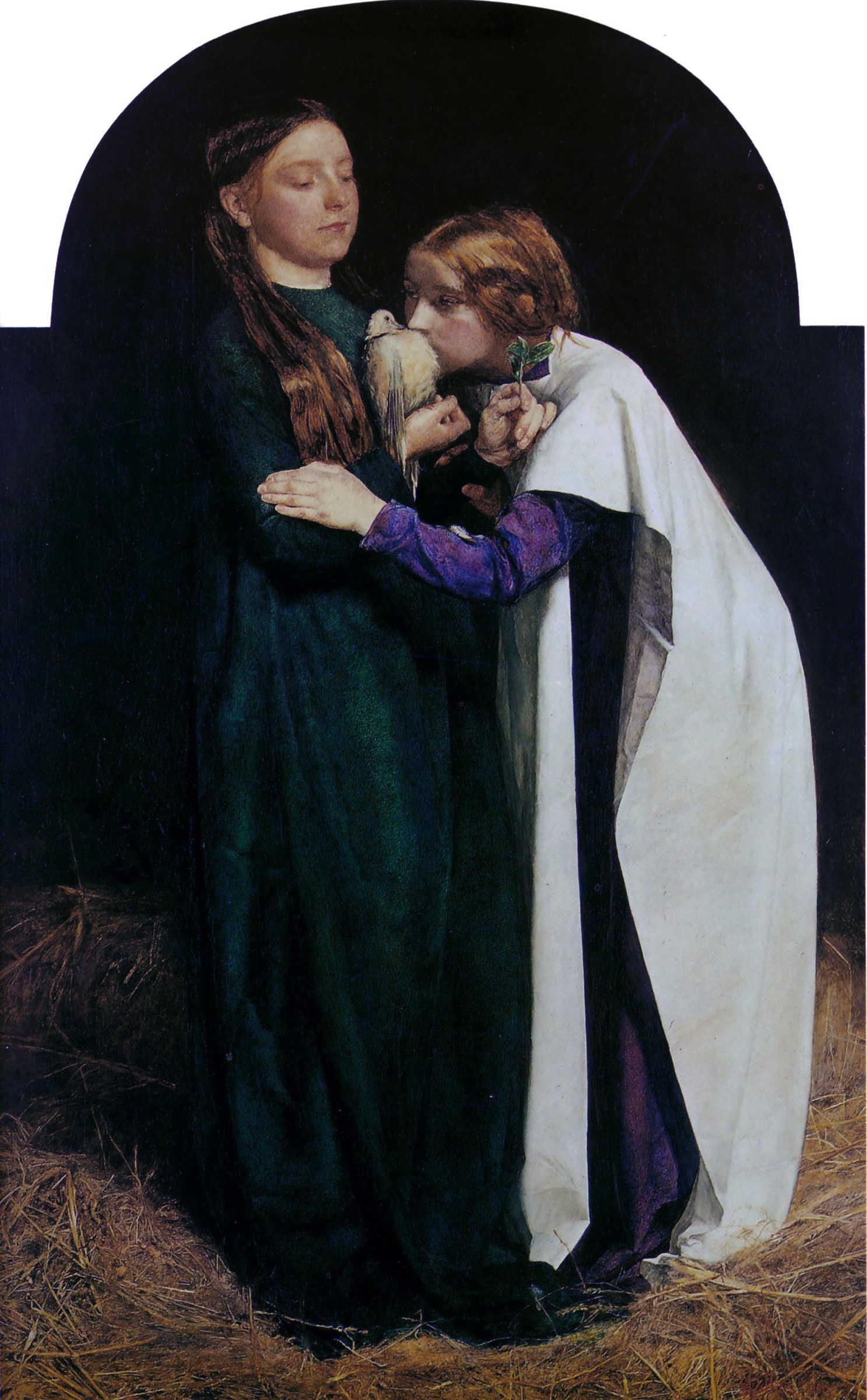
- The doveA pale dove is held close against the green robe.Genesis 8:9
- The olive leafA sprig of fresh green leaves is lifted up in one hand.Genesis 8:11
- The household in the arkTwo young women of the household are gathered around the bird.Genesis 7:13
- The straw of the stallsStraw lies underfoot where the animals were kept and fed.Genesis 6:21
John Everett Millais, The Return of the Dove to the Ark, 1851. Public domain.
Four parts of the painting, each numbered where it stands, with the verse it answers to.
The Dove Through Scripture
Five books of the Old Testament and three of the Gospels name the bird.
The bird is sent, offered, wished for and scolded before it is seen over Jesus.
- Genesis 8:11back to the ark with an olive leaf
- Genesis 15:9a turtledove and a pigeon at Abram's covenant
- Leviticus 12:8the mother's offering after childbirth
- Psalm 55:6wings to fly away and find rest
- Isaiah 60:8the scattered flying home to their shelters
- Hosea 7:11Ephraim flitting between Egypt and Assyria
- Matthew 3:16the Spirit descending on Jesus
- Matthew 10:16the disciples sent out innocent as doves
- Luke 2:24the offering of Mary's purification
- John 2:16the dove sellers driven from the temple
Ten stops in canon order; each opens its verse in the reader.
Doves that fly homeIsaiah 60:8 and Hosea 11:11
Isaiah pictures the returning people as doves flying to their shelters, and Hosea says they will come trembling like doves from the land of Assyria. In both the dove is a bird that knows its way back, as Noah's dove did.
They will come trembling like birds from Egypt and like doves from the land of Assyria. Then I will settle them in their homes, declares the LORD.God promises to settle the returning doves in their homes.
What Scripture Says and What Readers Have Heard
Five verses say what the dove pictures, and two readings come from its teachers.
INNOCENCE
Jesus pairs the dove's innocence with the snake's shrewdness for disciples sent among wolves.
FOOLISHNESS
Hosea uses the same bird for a nation that cannot decide where to fly for help.
ESCAPE AND REST
David wishes for a dove's wings so that he could fly away from his enemies.
MOURNING
Hezekiah compares his prayer in sickness to the moaning of a dove.
THE BELOVED
The bridegroom calls the bride his dove and asks to hear her voice.
Escape and rest, Mourning, The beloved
The olive leaf as a sign of peaceAugustine of Hippo, Christian Instruction
Augustine, in Christian Instruction 2.16.24, reads the olive leaf as everlasting peace, because the olive tree is always in leaf.
The raven set against the doveJohn Chrysostom; Adam Clarke
John Chrysostom, in his Homilies on Genesis 26, suggests that the raven, an unclean bird, found carcasses to feed on and stayed out. Adam Clarke, in his Commentary on the Bible, reads the Hebrew as going forth and returning, so that the raven came back to the ark but was not taken inside. Genesis 8:7 itself leaves the question open.
The Offering of the Poor
Five laws that name turtledoves and young pigeons, and the offering Mary brought.
Three of the five laws give the pair of birds in place of a lamb the worshipper cannot afford.
The five laws and Mary's offeringLeviticus 1, 5, 12 and 14; Numbers 6; Luke 2
Five laws and one Gospel scene name turtledoves and young pigeons at the altar.
| Occasion | What the birds were offered as |
|---|---|
| A burnt offering of birds | one turtledove or one young pigeon |
| A sin when a lamb is too costly | one sin offering and one burnt offering |
| A mother after childbirth | one burnt offering and one sin offering |
| The cleansing of a poor man healed of a skin disease | one sin offering and one burnt offering |
| A Nazirite defiled by a death | two birds brought on the eighth day |
| Mary after the birth of Jesus | the purification offering Luke records |
The dove sellers in the temple courtsMatthew 21:12 and John 2:16
Traders sold doves inside the temple courts, and Matthew 21:12 says Jesus overturned their seats.
To those selling doves He said, “Get these out of here! How dare you turn My Father’s house into a marketplace!”John records the words Jesus addressed to the dove sellers.
Yonah, Tor and Peristera
Two Hebrew words and one Greek word for the bird, and the prophet who bears its name.
יוֹנָה yonah
31 uses in the canon
A dove or pigeon, the bird Noah sent from the ark.
תּוֹר tor
14 uses in the canon
A turtledove, named beside the young pigeon in the offerings.
περιστερά peristera
10 uses in the canon
A dove or pigeon, the word of all four Gospels at the Jordan.
יוֹנָה Yonah
19 uses in the canon
Jonah, the prophet whose name is the same word as the bird.
What the Text Does Not Say
Four questions about the dove that Scripture leaves open.
The dove passages record a leaf, a law, a last flight and a name, and leave their meaning unstated.
| What is not said | What the verse does say |
|---|---|
| Did the olive leaf mean peace? | The verse reports what Noah learned and stops there. |
| Was a turtledove worth more than a pigeon? | The Law accepts either bird for the same offering. |
| Where did the dove go the third time? | She did not return to him. |
| Does Jonah's name carry a message? | The book introduces him as Jonah son of Amittai and nothing more. |
The Spirit Like a Dove
Matthew and John tell what was seen at the Jordan.
Genesis 1:2 sets the Spirit of God over the waters of creation, and Genesis 8 sends a dove over the waters of the flood. Ambrose of Milan, in On the Mysteries 10 to 11, read Noah's dove and the dove at the Jordan together. He took the raven for sin, which goes out and does not return, and the dove for the Holy Spirit. John's Gospel adds that the sight at the Jordan was a sign given in advance to John the Baptist.
As soon as Jesus was baptized, He went up out of the water. Suddenly the heavens were opened, and He saw the Spirit of God descending like a dove and resting on Him.In Matthew it is Jesus who sees the Spirit come down.
I myself did not know Him, but the One who sent me to baptize with water told me, ‘The man on whom you see the Spirit descend and rest is He who will baptize with the Holy Spirit.’The Baptist explains why the sight mattered to him.
Voices on the Dove
Three commentators from the eighteenth century to the nineteenth, each with the work named.
1662 to 1714 · Matthew Henry
“That though Noah by faith expected his enlargement, and by patience waited for it, yet he was inquisitive concerning it, as one that thought it long to be thus confined. Note, Desires of release out of trouble, earnest expectations of it, and enquiries concerning its advances towards us, will very well consist with the sincerity of faith and patience.”
Matthew Henry · Commentary on the Whole Bible · on Genesis 8:6Puritan
1703 to 1791 · John Wesley
“Note here, that Noah set forth the dove the second time, seven days after the first time, and the third time was after seven days too: and probably the first sending of her out was seven days after the sending forth of the raven. The olive branch is an emblem of peace.”
John Wesley · Explanatory Notes upon the Old Testament · on Genesis 8:8Evangelical
1802 to 1910 · Jamieson, Fausset & Brown
“‘My dove, my undefiled is one,’ says the Song of Solomon (So 6:9). Again, ‘Be ye harmless as doves,’ says Christ Himself (Mt 10:16). This is the same thing, in the form of inoffensiveness towards men.”
Jamieson, Fausset & Brown · Commentary Critical and Explanatory on the Whole Bible · on Matthew 3:16Reformed
Where Careful Readers Differ
What was the Spirit's dove form, and why was a dove chosen?
A likeness, with no bird presentAmbrose of Milan, On the Sacraments 1.5
“Christ descended, and John stood who was baptizing, and behold, as if a dove the Holy Spirit descended. It was not a dove that descended, but as if a dove. Remember what I said: Christ took on flesh, not like flesh; but he took on the truth of that flesh, true flesh Christ took on: But the Holy Spirit did not descend in the truth of a dove, but in the likeness of a dove from heaven. Therefore, John saw and believed. Christ descended, the Holy Spirit descended as well.”
Ambrose of Milan · On the Sacraments, Book 1, Chapter 5 · on Mark 1:10Patristic
The objection: Luke says the Spirit descended in a bodily form, which reads as something the eye could see.
A visible bodily formBede, On the Gospel of Luke
Bede, in his commentary on Luke, holds that the Spirit appeared in bodily form because the divine nature cannot be seen by mortal eyes. The objection: Matthew, Mark and John say like a dove, which names a likeness and leaves the substance unsaid.
A dove chosen for its simplicityClement of Alexandria, from the Catena on Luke
“God here assumed the ‘likeness’ not of a man, but ‘of a dove,’ because He wished, by a new apparition of the Spirit in the likeness of a dove, to declare His simplicity and majesty.”
Clement of Alexandria · From the Catena on Luke, Edited by Corderius · on Luke 3:22Patristic
The objection: the Gospels set the dove beside the voice from heaven and draw no lesson from the bird itself.
Books to Read Next
Three works a student reads next, each free to read.
Commentary on the Whole Bible
Matthew Henry · 1708 to 1710
The notes run verse by verse through Genesis 8.
Read his Genesis notesExplanatory Notes upon the Old Testament
John Wesley · 1765
The notes cover every book of the Old Testament in short comments.
Read his Genesis notesOn the Mysteries
Ambrose of Milan · fourth century
It explains the rites of baptism to those who had just been baptized.
Read at New AdventRest for the Dove
Noah reached out his hand and brought the dove back inside the ark when it found no rest, and the Spirit came down like a dove and remained on Jesus. The text asks the reader to come to Him, who promises rest to the weary.
Come to Me, all you who are weary and burdened, and I will give you rest. Take My yoke upon you and learn from Me; for I am gentle and humble in heart, and you will find rest for your souls.Sources
Scripture is the Berean Standard Bible.
- James Strong, Exhaustive Concordance of the Bible, 1890, entries H3123, H8449, G4058 and H3124, with their occurrence counts.
- John Wesley, Explanatory Notes upon the Old Testament, 1765, on Genesis 8:8.
- Matthew Henry, Commentary on the Whole Bible, 1710, on Genesis 8:6.
- Adam Clarke, Commentary on the Bible, 1832, on Genesis 8:7.
- John Chrysostom, Homilies on Genesis 26.12, on Genesis 8:6 to 7.
- Augustine of Hippo, Christian Instruction 2.16.24, on Genesis 8:11.
- Ambrose of Milan, On the Sacraments, Book 1, chapter 5, on Mark 1:10.
- Ambrose of Milan, On the Mysteries 10 to 11 and 25, translated in the Nicene and Post-Nicene Fathers, Second Series, volume 10.
- Bede, On the Gospel of Luke, on Luke 3:22.
- Clement of Alexandria, from the Catena on Luke edited by Corderius, on Luke 3:22.
- Jamieson, Fausset and Brown, Commentary Critical and Explanatory, 1871, on Matthew 3:16.
Keep Studying
People and groups5