
Place
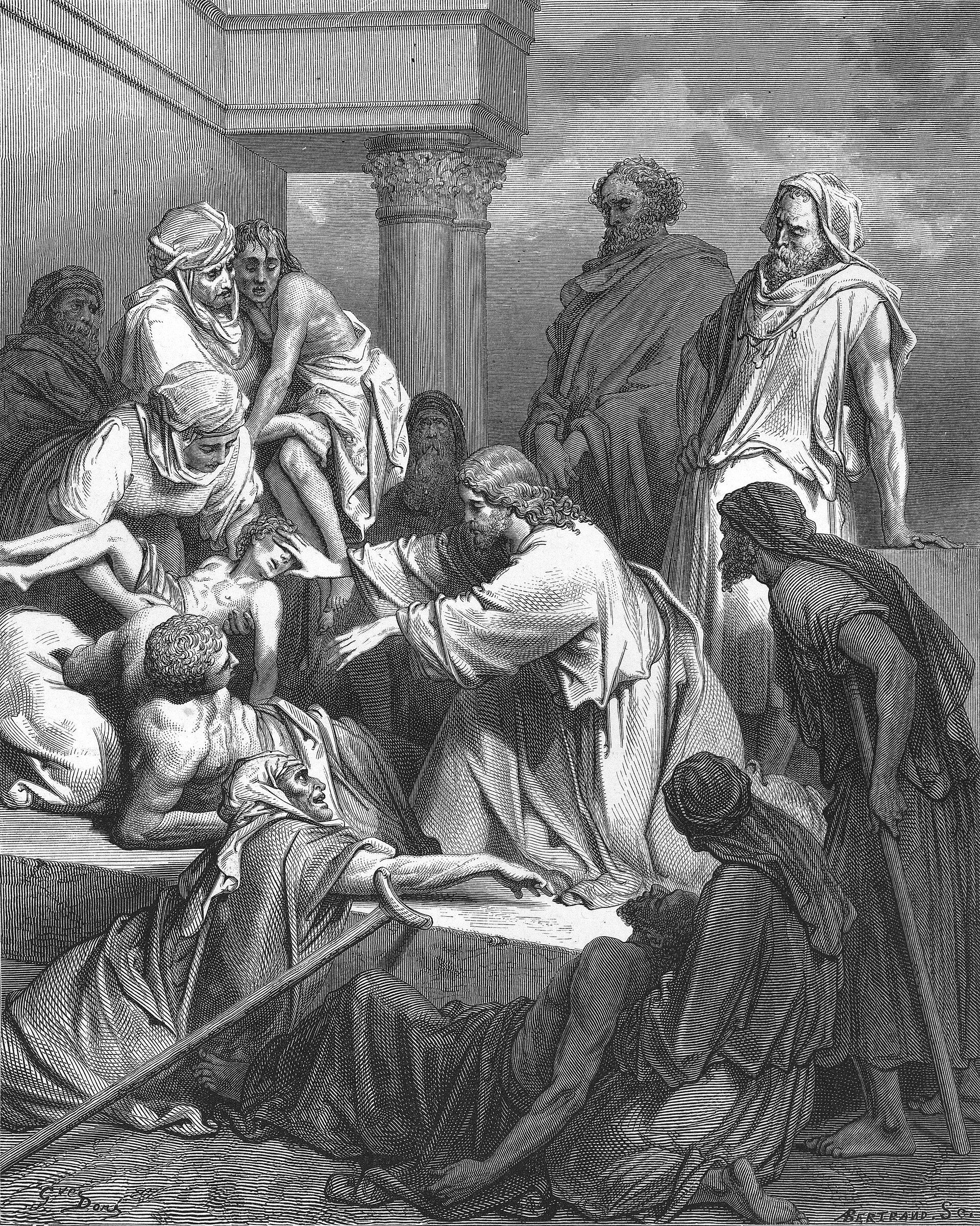
Pool of Bethesda
Gustave Doré, public domain.
Summary
The Jerusalem pool of five porches where Jesus healed the man ill thirty-eight years (John 5:2-9); its remains have been excavated.
- Jesus healed a man who had been sick for thirty-eight years at a pool near Jerusalem's Sheep Gate.
- He asked the man directly, "Do you want to get well?", then told him to pick up his mat and walk.
- The healing happened on the Sabbath, and it grew into a conflict because Jesus called God his own Father.
- The oldest Greek manuscripts of John do not contain the line about an angel stirring the water, and the Berean Standard Bible itself prints nothing at that verse.
- Excavation near Jerusalem's Church of St Anne found twin pools matching John's description of five covered colonnades.
On this page
Where it is
- Region
- Jerusalem
- Kind of place
- Structure
Why Pool of Bethesda matters
The healing at Bethesda, in the order it happens
John 5:1-18
Read John 5:1-18
- The pool with five colonnades, and the man thirty-eight years an invalidJohn 5:5One man there had been an invalid for thirty-eight years.
- Do you want to get well?John 5:6When Jesus saw him lying there and realized that he had spent a long time in this condition, He asked him, “Do you want to get well?”
- No one to help me into the poolJohn 5:7“Sir,” the invalid replied, “I have no one to help me into the pool when the water is stirred. While I am on my way, someone else goes in before me.”
- Get up, pick up your mat, and walkJohn 5:8Then Jesus told him, “Get up, pick up your mat, and walk.”
- Immediately made well, and it was the SabbathJohn 5:9Immediately the man was made well, and he picked up his mat and began to walk. Now this happened on the Sabbath day,
- Stop sinning, or something worse may happen to youJohn 5:14Afterward, Jesus found the man at the temple and said to him, “See, you have been made well. Stop sinning, or something worse may happen to you.”
- Calling God his own Father, equal with GodJohn 5:18Because of this, the Jews tried all the harder to kill Him. Not only was He breaking the Sabbath, but He was even calling God His own Father, making Himself equal with God.
What happened here, in order
in the order the canon tells it
- Jesus goes up to Jerusalem for a feastJohn 5:1Some time later there was a feast of the Jews, and Jesus went up to Jerusalem.
- The pool by the Sheep Gate, called BethesdaJohn 5:2Now there is in Jerusalem near the Sheep Gate a pool with five covered colonnades, which in Hebrew is called Bethesda.
- A great number of the sick lying on the walkwaysJohn 5:3On these walkways lay a great number of the sick, the blind, the lame, and the paralyzed.
- The man picks up his mat and walksJohn 5:9Immediately the man was made well, and he picked up his mat and began to walk. Now this happened on the Sabbath day,
- The Jews object that carrying a mat breaks the SabbathJohn 5:10so the Jews said to the man who had been healed, “This is the Sabbath! It is unlawful for you to carry your mat.”
- The healed man did not know who it wasJohn 5:13But the man who was healed did not know who it was, for Jesus had slipped away while the crowd was there.
- Persecution begins over the Sabbath healingJohn 5:16Now because Jesus was doing these things on the Sabbath, the Jews began to persecute Him.
- My Father is at His work, and I too am workingJohn 5:17But Jesus answered them, “To this very day My Father is at His work, and I too am working.”
Common questions
What happened to John 5:4, the verse about an angel stirring the water?
Readers differ; the positions are named
The traditional line describing an angel who periodically stirred the water is absent from the earliest surviving Greek manuscripts of John's Gospel, and the Berean Standard Bible reflects this directly by printing nothing at verse 4. This is a genuine textual question about which manuscripts preserve the original wording, not a doctrinal one, and the healing that follows does not depend on the answer either way.
Why did Jesus ask a man who had been sick for thirty-eight years, "Do you want to get well?"
The man had spent nearly four decades waiting for a cure that never came, long enough that hope itself could have worn out. Jesus asked him directly rather than assuming, and the man's answer explains his real problem: not a lack of desire but a lack of anyone to help him into the pool in time.
Why did healing this man on the Sabbath cause such a strong reaction?
The objection began small, that carrying a mat on the Sabbath was unlawful, but it grew once Jesus explained his action by saying his Father was still working and he was working too. That claim meant Jesus was calling God his own Father and putting himself on equal standing with God, and from that point the Jewish leaders sought to kill him.
Has archaeology found the pool John describes?
For a long time John's description of five covered colonnades was treated as a mark against the Gospel's reliability, since no pool of that shape was known. Excavation near Jerusalem's Church of St Anne later recovered twin pools with colonnades along four sides and a fifth crossing the divider between them, matching John's count of five exactly. Conrad Schick first uncovered the site in 1888, and further excavation in 1964 brought the twin pools and the dam between them fully to light.
Sources cited
- MannaFest canon study of John (AI-draft)Awaiting the founder's edit.
- Berean Standard Bible, verses table, translation_id 3The Scripture text on this page, including the empty verse 4.
- MannaFest historical anchors research briefRepo file, for the excavation of the twin pools near St Anne's Church.
- MannaFest John expositionRepo file, for the same identification and the Bethesda/Bethzatha manuscript note.
- Wikipedia, "Pool of Bethesda"Conrad Schick's 1888 discovery and the 1964 excavation, added in re-verification session 7. The underlying excavation reports were not fetched this session, so the encyclopedia is cited directly.
Keep studying
On this page
Doorway2
Keep this page