
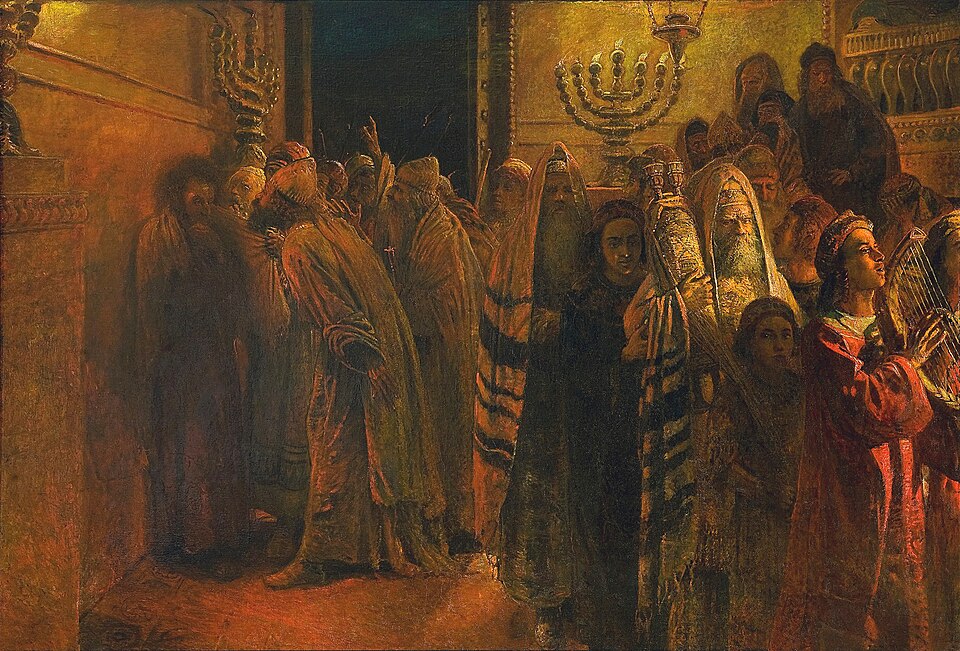
The Sects of Second Temple Judaism · Featured Study
Scribes and the Sanhedrin
One was a profession, the other a court, and the Gospels put both on the page together. The scribes sat “in Moses' seat” as the recognized teachers of the law; the Sanhedrin sat as the recognized court of the nation, under Rome's own limits. This page keeps the two plainly divided, then follows the Sanhedrin through the trials of Jesus, Peter and John, Stephen, and Paul, told from the text itself.
Summary
The scribes were the recognized legal experts of Jesus' day, a profession tracing to Ezra; the Sanhedrin was the nation's court, drawn from chief priests, elders and scribes together. Both appear across the Gospels and Acts, from the seat of Moses to the trials of Jesus, Peter and John, Stephen, and Paul, and this page follows each from the text.
- The scribal office traces to Ezra, 'a scribe of the law of the God of heaven,' who made copying and teaching the Torah a settled profession.
- Jesus tells the crowds to obey the scribes' teaching from Moses' seat while rejecting their example, then names their failures one by one.
- The Sanhedrin was drawn from chief priests, elders and scribes, practically led by the priestly Sadducean leadership, with Pharisees present too.
- John 18:31 has the Jewish leaders tell Pilate they may not put a man to death, consistent with Rome's own reservation of capital sentence.
- Named members are not uniformly hostile to Jesus: Nicodemus questions the council's own procedure, Joseph of Arimathea had not consented to its verdict, and Gamaliel counsels patience toward the apostles.
The Scribes
Ezra's line, and what the profession actually did
The scribal office traces back to Ezra, called “a scribe of the law of the God of heaven” in Ezra 7:12, sent from Babylon to teach Israel's returned exiles the Torah. Over the centuries that followed, copying, preserving and teaching the Scriptures became a settled profession. A scribe's daily work was not primarily what modern readers picture when they hear the word: he was less a secretary than a trained legal and textual expert, qualified to copy Scripture accurately, to interpret the law's application to new questions, and to teach it in the synagogue.
By Jesus' day scribes were often, but not always, aligned with the Pharisees in outlook; the word names a job, a trained legal profession, not a party. Scribes appear throughout the Gospels teaching in synagogues, sitting in judgment alongside priests and elders, and debating Jesus directly over the law's meaning.
- Ezra 7:12the office's own starting point
- H5608sofer, scribe: to count, to write
- G1122grammateus, the Gospels' own Greek word
- 23:2Matthew: the scribes sit in Moses' seat
The Seat of Moses
Matthew 23:2-7, 13, 23: what to obey, and what not to imitate
Matthew 23:2-4
““The scribes and Pharisees sit in Moses’ seat. So practice and observe everything they tell you. But do not do what they do, for they do not practice what they preach. They tie up heavy, burdensome loads and lay them on men’s shoulders, but they themselves are not willing to lift a finger to move them.” Matthew 23:2-4
Obey their teaching; do not follow their example. They preach and do not practice.
Matthew 23:5-7
“All their deeds are done for men to see. They broaden their phylacteries and lengthen their tassels. They love the places of honor at banquets, the chief seats in the synagogues, the greetings in the marketplaces, and the title of ‘Rabbi’ by which they are addressed.” Matthew 23:5-7
Broad phylacteries, long tassels, the chief seats, the title Rabbi: done to be seen.
“By the seat of Moses, we are to understand authority to teach the law. Moses was the great teacher of the Jewish people; and the scribes, etc., are here represented as his successors.”
Adam Clarke · Commentary on the Bible, 1832Methodist
Matthew 23:2
“But all their works they do for to be seen of men--Whatever good they do, or zeal they show, has but one motive--human applause. they make broad their phylacteries--strips of parchment with Scripture-texts on them, worn on the forehead, arm, and side, in time of prayer. and enlarge the borders of their garments--fringes of their upper garments (Nu 15:37-40).”
Jamieson, Fausset & Brown · Commentary Critical and Explanatory on the Whole Bible, 1871Reformed
Matthew 23:5
Matthew 23:13
“Woe to you, scribes and Pharisees, you hypocrites! You shut the kingdom of heaven in men’s faces. You yourselves do not enter, nor will you let in those who wish to enter.” Matthew 23:13
Ye shut up the kingdom of heaven against men: neither entering, nor letting others in.
Matthew 23:23
“Woe to you, scribes and Pharisees, you hypocrites! You pay tithes of mint, dill, and cumin. But you have disregarded the weightier matters of the law: justice, mercy, and faithfulness. You should have practiced the latter, without neglecting the former.” Matthew 23:23
Mint and anise tithed to the letter; judgment, mercy and faith left undone.
“But woe unto you, scribes and Pharisees, hypocrites! for ye shut up the kingdom of heaven against men--Here they are charged with shutting heaven against men: in Lu 11:52 they are charged with what was worse, taking away the key--‘the key of knowledge’--which means, not the key to open knowledge, but knowledge as the only key to open heaven.”
Jamieson, Fausset & Brown · Commentary Critical and Explanatory on the Whole Bible, 1871Reformed
Matthew 23:13
“Ye pay tithe - A tenth part. The law required the Jews to devote a tenth part of all their property to the support of the Levites, Num 18:20-24.”
Albert Barnes · Notes, Explanatory and Practical, on the Old and New Testaments, 1832-1869Evangelical
Matthew 23:23
Jesus' charge holds two things together. The office itself carries real teaching authority, worth obeying: “whatsoever they bid you observe, that observe and do.” The men who held that office, in his charge, tithed the smallest garden herbs to the letter while leaving “the weightier matters of the law, justice, and mercy, and faith” undone. The office is not condemned. The failure of the men in it is.
The Sanhedrin's Composition
the sources' own picture, and the Mishnah's later memory
Acts 4:5-6
“The next day the rulers, elders, and scribes assembled in Jerusalem, along with Annas the high priest, Caiaphas, John, Alexander, and many others from the high priest’s family.” Acts 4:5-6
Rulers, elders, scribes, and the high priest's own kindred, named by name.
Acts 5:21
“At daybreak the apostles entered the temple courts as they had been told and began to teach the people. When the high priest and his associates arrived, they convened the Sanhedrin—the full assembly of the elders of Israel—and sent to the jail for the apostles.” Acts 5:21
The council called together, and all the senate of Israel with it.
“Called the council together - The Sanhedrin, or the Great Council of the nation. This was clearly for the purpose of ‘trying’ the apostles for disregarding their commandments.”
Albert Barnes · Notes, Explanatory and Practical, on the Old and New Testaments, 1832-1869Evangelical
Acts 5:21
The Gospels and Acts consistently describe a council under the high priest, drawn from chief priests, elders and scribes, its leadership dominated by the priestly, largely Sadducean establishment. Pharisees sat in the same body: Acts 23:6-9 shows both parties present and divided against each other in open debate.
The Mishnah's memory of seventy-oneMishnah, Sanhedrin 1:6, compiled c. AD 200
The Mishnah, the first written code of Jewish oral law, compiled roughly a century and a half after the Temple's destruction, remembers a Great Sanhedrin of seventy-one members under a president, seated in a semicircle. Most historians read this as later rabbinic memory idealizing the court's size and procedure, shaped by generations of legal reflection after the fact, rather than a precise description of the body Rome actually dealt with in the first century. This is reception history, the rabbinic tradition's own memory of the institution, presented here as such and not as MannaFest's own historical claim.
Capital Jurisdiction Under Rome
John 18:31: what the Jewish leaders could not do on their own
John 18:31
““You take Him and judge Him by your own law,” Pilate told them. “We are not permitted to execute anyone,” the Jews replied.” John 18:31
It is not lawful for us to put any man to death: the reason Jesus is taken to Pilate at all.
The verse states plainly why Jesus stands before a Roman governor rather than facing a Jewish court's own sentence. Rome reserved capital sentencing to its own provincial governors in territories under direct rule, and John 18:31 puts that limit in the Jewish leaders' own mouths. Stephen's stoning in Acts 7 is the one clear exception in the New Testament record, read either as mob action moving faster than any legal process or as a rare case where Rome did not step in to stop what had already happened.
The Named Members
Nicodemus, Joseph of Arimathea, and Gamaliel
Nicodemus
John 3:1-2
“Now there was a man of the Pharisees named Nicodemus, a leader of the Jews. He came to Jesus at night and said, “Rabbi, we know that You are a teacher who has come from God. For no one could perform the signs You are doing if God were not with him.”” John 3:1-2
A ruler of the Jews comes to Jesus by night, calling him a teacher come from God.
John 7:50-52
“Nicodemus, who had gone to Jesus earlier and who himself was one of them, asked, “Does our law convict a man without first hearing from him to determine what he has done?” “Aren’t you also from Galilee?” they replied. “Look into it, and you will see that no prophet comes out of Galilee.”” John 7:50-52
Nicodemus questions his own council's procedure: does our law judge a man unheard?
Nicodemus returns a third time, after the crucifixion, bringing a hundred pounds of myrrh and aloes to bury Jesus alongside Joseph of Arimathea.
John 19:38-39
“Afterward, Joseph of Arimathea, who was a disciple of Jesus (but secretly for fear of the Jews), asked Pilate to let him remove the body of Jesus. Pilate gave him permission, so he came and removed His body. Nicodemus, who had previously come to Jesus at night, also brought a mixture of myrrh and aloes, about seventy-five pounds.” John 19:38-39
Nicodemus and Joseph of Arimathea together take Jesus' body down and bury it.
Joseph of Arimathea
Luke 23:50-51
“Now there was a Council member named Joseph, a good and righteous man, who had not consented to their decision or action. He was from the Judean town of Arimathea, and was waiting for the kingdom of God.” Luke 23:50-51
A councillor, good and righteous, who had not consented to the council's own deed.
Gamaliel
Acts 5:34-35
“But a Pharisee named Gamaliel, a teacher of the law who was honored by all the people, stood up in the Sanhedrin and ordered that the men be put outside for a short time. “Men of Israel,” he said, “consider carefully what you are about to do to these men.” Acts 5:34-35
A Pharisee, a doctor of the law, in honor of all the people, stands up in the council.
Acts 22:3
““I am a Jew, born in Tarsus of Cilicia, but raised in this city. I was educated at the feet of Gamaliel in strict conformity to the law of our fathers. I am just as zealous for God as any of you here today.” Acts 22:3
Paul himself names Gamaliel as his own teacher in the law.
“But a certain Pharisee - And as such believing the resurrection of the dead; a doctor, or teacher of the law - That is, a scribe, and indeed one of the highest rank; had in honour by all the people - Except the Sadducees; rising up in the council - So God can raise defenders of his servants, whensoever and wheresoever he pleases.”
John Wesley · Explanatory Notes upon the New Testament, 1755Wesleyan
Acts 5:34
The Trials
Jesus, Peter and John, Stephen, and Paul before the council
Jesus
Mark 14:53
“They led Jesus away to the high priest, and all the chief priests, elders, and scribes assembled.” Mark 14:53
Chief priests, elders and scribes gather with the high priest against him.
Mark 14:64
“You have heard the blasphemy. What is your verdict?” And they all condemned Him as deserving of death.” Mark 14:64
All condemn him worthy of death, on a charge the court frames as blasphemy.
Peter and John
Acts 5:40-41
“At this, they yielded to Gamaliel. They called the apostles in and had them flogged. Then they ordered them not to speak in the name of Jesus, and released them. The apostles left the Sanhedrin, rejoicing that they had been counted worthy of suffering disgrace for the Name.” Acts 5:40-41
Beaten and charged to silence, they leave rejoicing to suffer for the Name.
Stephen
Acts 6:12
“So they stirred up the people, elders, and scribes and confronted Stephen. They seized him and brought him before the Sanhedrin,” Acts 6:12
The people, elders and scribes stir up the crowd and seize him before the council.
Acts 7:54-60
“On hearing this, the members of the Sanhedrin were enraged, and they gnashed their teeth at him. But Stephen, full of the Holy Spirit, looked intently into heaven and saw the glory of God and Jesus standing at the right hand of God. “Look,” he said, “I see heaven open and the Son of Man standing at the right hand of God.” At this they covered their ears, cried out in a loud voice, and rushed together at him. They dragged him out of the city and began to stone him. Meanwhile the witnesses laid their garments at the feet of a young man named Saul. While they were stoning him, Stephen appealed, “Lord Jesus, receive my spirit.” Falling on his knees, he cried out in a loud voice, “Lord, do not hold this sin against them.” And when he had said this, he fell asleep.” Acts 7:54-60
The one trial before this court that ends in death by stoning, without Roman sentence.
Paul
Acts 23:1
“Paul looked directly at the Sanhedrin and said, “Brothers, I have conducted myself before God in all good conscience to this day.”” Acts 23:1
Paul opens by declaring a clean conscience before God to this day.
Acts 23:6-9
“Then Paul, knowing that some of them were Sadducees and others Pharisees, called out in the Sanhedrin, “Brothers, I am a Pharisee, the son of a Pharisee. It is because of my hope in the resurrection of the dead that I am on trial.” As soon as he had said this, a dispute broke out between the Pharisees and Sadducees, and the assembly was divided. For the Sadducees say that there is neither a resurrection, nor angels, nor spirits, but the Pharisees acknowledge them all. A great clamor arose, and some scribes from the party of the Pharisees got up and contended sharply, “We find nothing wrong with this man. What if a spirit or an angel has spoken to him?”” Acts 23:6-9
Paul names himself a Pharisee, and the court splits Pharisee against Sadducee on the spot.
The same court appears at four turning points in the New Testament's own story, and its own internal division, Pharisee against Sadducee, shows plainly in Paul's own trial: a single body, not a single mind. A dedicated page on Jesus' own trial, its charges and its stages, is planned and is not built out here.
The Words Underneath
the Hebrew and Greek behind both institutions
The words underneath
saphar: to recount
Hebrew · H5608Strong's entry: properly, to score with a mark as a tally or record, i.e. (by implication) to inscribe, and also to enumerate; intensively, to recount, i.e. celebrate
sofer, "scribe," from a root meaning to count or to write. Used of Ezra himself (Ezra 7:6) and of the office generally (2 Samuel 8:17).
159 times in the Old Testament · saphar, in full →
grammateus: scribe
Greek · G1122Strong's entry: from . a writer, i.e. (professionally) scribe or secretary
grammateus, the Gospels' own Greek word for the office (Matthew 23:2), literally one who works with letters or writing.
62 times in the New Testament · grammateus, in full →
synedrion: council
Greek · G4892Strong's entry: a joint session, i.e. (specially), the Jewish Sanhedrin; by analogy, a subordinate tribunal
synedrion, "council," the Greek word behind "Sanhedrin," literally a sitting together (Matthew 26:59; Acts 5:21).
22 times in the New Testament · synedrion, in full →
The Voices
with the work named
Commentary on the Bible (1832) · public domain
Reads the seat of Moses as teaching authority, and the scribes as Moses' own successors in that office.
Commentary Critical and Explanatory on the Whole Bible (1871) · public domain
Draws the line between shutting the kingdom against men and taking away the key of knowledge in Luke's parallel account.
Notes, Explanatory and Practical (1832-1869) · public domain
Distinguishes the Sanhedrin proper from the wider senate of elders called together in Acts 5:21.
Explanatory Notes upon the New Testament (1755) · public domain
Names Gamaliel's standing among the people, and reads his rising up in the council as God raising a defender for his own.
Marcus Brown's own commentary leads above all; within a tier, all voices are equal. The Mishnah is cited as reception history, the rabbinic tradition's own later memory of the court, not as MannaFest's historical claim about the first-century Sanhedrin.
Where to Go Next
The other schools and courts
- The Sects of Second Temple Judaism the survey this page belongs to.
- The Pharisees many scribes belonged to this party.
- The Sadducees the priestly party that led the court.
The trials, read in full
- Mark 14:53 where Jesus' own trial before the council begins.
- Read Acts 7 Stephen's own trial and death, in full.
Keep Studying
Read it1
On this page
Studies7
People and groups5
Places1
Symbols1