

Eduard Hildebrandt, Landschaft mit Hirten vor Bethlehem, after 1851. Public domain.
Genesis 35:16 to 20 · Place · Featured Study
Bethlehem
Bethlehem is a hill town of Judah, about ten kilometres south of Jerusalem, that Genesis first names as Ephrath.
Rachel was buried on the road to it, Ruth gleaned in its fields, and Samuel anointed David in it.
So Rachel died and was buried on the way to Ephrath (that is, Bethlehem).
- Today
- Bethlehem, in the West Bank
- Region
- The hill country of Judah
- Site
- 31.705, 35.202
- First named
- Genesis 35:19 “…way to Ephrath (that is, Bethlehem).”
- Last named
- John 7:42 “…line of David and from Bethlehem, the village…”
Rachel was buried on the road to it, Ruth gleaned in its fields, and Samuel anointed David in it.
Summary
Bethlehem is a small town of Judah that Scripture keeps returning to from Genesis to the Gospels.
- Two names, Bethlehem and Ephrath, stand for the one town.
- A second town of the name stood in Zebulun, near Nazareth.
- The town stands about 775 metres above sea level, 30 metres higher than Jerusalem.
The Town Genesis Calls Ephrath
Genesis gives the town its older name, Ephrath, and twice adds that it is Bethlehem.
Later, they set out from Bethel, and while they were still some distance from Ephrath, Rachel began to give birth, and her labor was difficult.Rachel's death near the town begins with this labour.
Now as for me, when I was returning from Paddan, to my sorrow Rachel died along the way in the land of Canaan, some distance from Ephrath. So I buried her there beside the road to Ephrath” (that is, Bethlehem).Jacob, near his own death in Egypt, repeats the gloss that ties the old name to the new.
The Hebrew name is Bêyth Lechem, and Strong's dictionary glosses Ephrath as another name for Bethlehem.
Bethlehem on the Rand McNally Plate
The plate of 1926 shows Galilee and the hill country of Judah on one sheet.
Bethlehem of Judea lies about 110 kilometres south of Nazareth in a straight line.
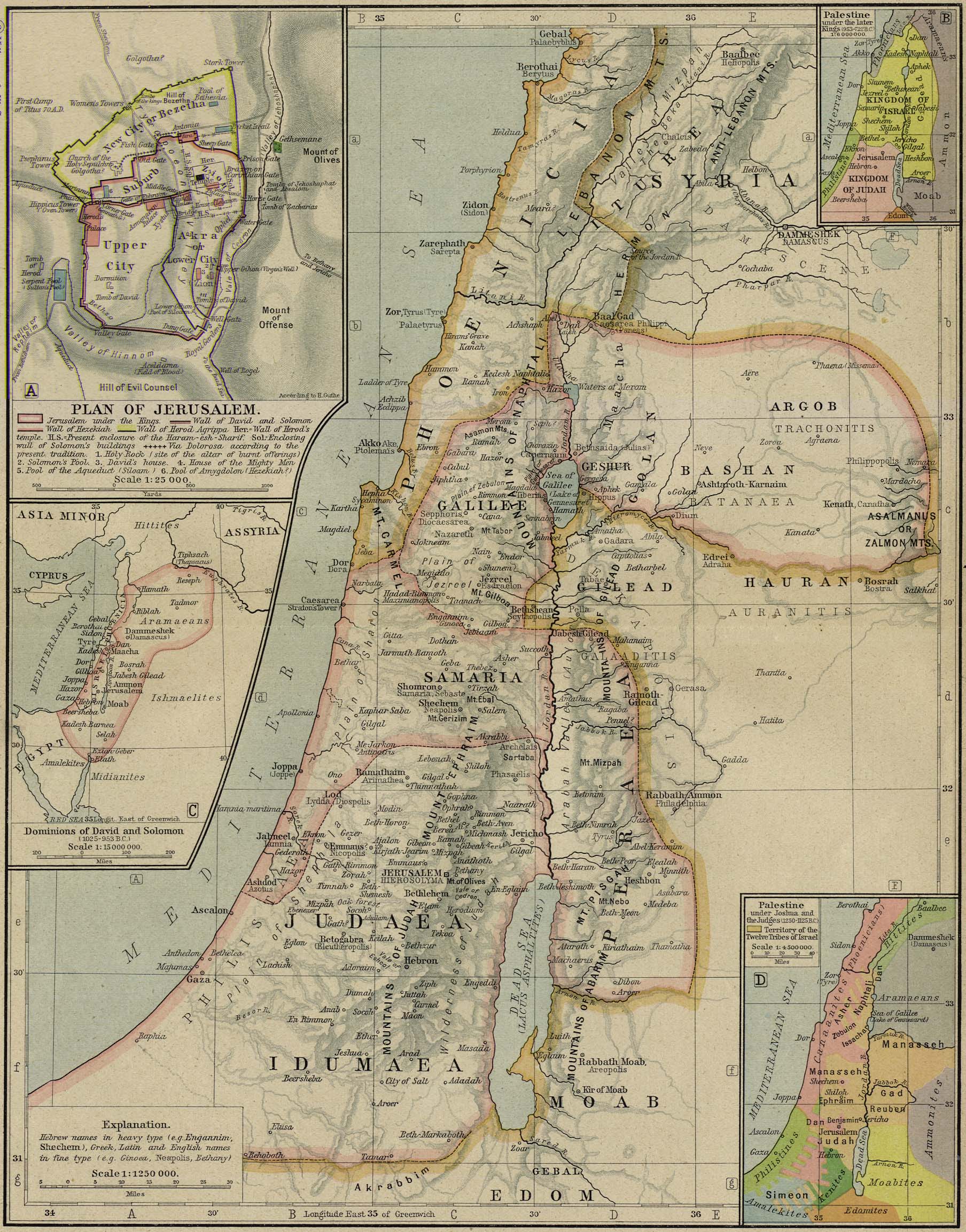
- Located: the site is known
- The route, in the order the text gives
- 1Nazareth, Joseph set out from his town in Galilee Luke 2:4
- 2Bethlehem, The city of David, where Joseph was registered Luke 2:4
- 3Jerusalem, Where the Magi asked for the newborn king Matthew 2:2
- 4Bethlehem of Zebulun, The town of the same name in Galilee Joshua 19:15
Base map: Reference map of ancient Palestine, Rand McNally reference map (1926), public domain. Places with a place page stand at its coordinates and the others at the point cited for each, set on the plate by Jerusalem and Damascus, as the plate prints them.
Four places; the line joins the two towns of Luke 2:4, and Scripture does not give the road between them.
Bethlehem in Scripture
Twelve moments tied to the town, in the order of the books that tell them.
Bethlehem's part in Scripture runs from Genesis to the Gospels.
- Jacob's returnRachel is buried on the way to EphrathGenesis 35:19
- The judgesIbzan of Bethlehem judges IsraelJudges 12:8
- No king in IsraelA young Levite of Bethlehem goes looking for a place to liveJudges 17:7
- A famineElimelech's family leaves for MoabRuth 1:1
- The returnThe whole town is stirred when Naomi comes back with RuthRuth 1:19
- At the gateThe elders witness Boaz's marriage to RuthRuth 4:11
- Saul's reignThe Spirit of the LORD comes on Jesse's youngest son1 Samuel 16:13
- David at AdullamDavid longs for water from the well by the gate2 Samuel 23:15
- Rehoboam's reignRehoboam fortifies the town2 Chronicles 11:6
- The return from exile123 men of Bethlehem come homeEzra 2:21
- Herod's reignJesus is born in Bethlehem in JudeaMatthew 2:1
- After the MagiHerod orders the boys of the town killedMatthew 2:16
Each row gives the moment and the verse that tells it.
Saul's reign, David at Adullam, Rehoboam's reign, The return from exile, Herod's reign, After the Magi
Three Things the Text Says Plainly
Three facts about the town that retellings often pass over, each with its verse.
DAVID'S CLAN KEPT A YEARLY SACRIFICE THERE
David asked Jonathan to tell Saul that he had hurried home to Bethlehem for the annual sacrifice of his whole clan.
EPHRATHITE WAS THE FAMILY NAME OF THE TOWN
First Samuel calls Jesse an Ephrathite from Bethlehem of Judah, as Ruth calls Elimelech's household Ephrathites.
BOAZ'S FIELD LAY OUTSIDE THE TOWN
Boaz arrived from Bethlehem to greet his harvesters.
The House of Bread
The town stood among grain fields, and the book of Ruth turns on its harvest.
So Naomi returned from the land of Moab with her daughter-in-law Ruth the Moabitess. And they arrived in Bethlehem at the beginning of the barley harvest.The barley harvest was beginning, which is why a widow could glean there at once.
In Hebrew the name means house of bread or house of food, and the Arabic name of the town means house of meat.
Bethlehem in the Record
The town's record outside Scripture runs from Egypt's archive to Constantine's church.
Bit-Lahmi in the Amarna lettersWikipedia, the article Bethlehem
Among the Amarna letters of about 1350 to 1330 BC, Abdi-Heba, the governor of Jerusalem, asks Pharaoh for help to retake a town near Jerusalem called Bit-Lahmi. The reading of the name is uncertain.
The seal of 2012Wikipedia, the article Bethlehem
In 2012 excavators in the City of David found a clay seal impression in ancient Hebrew script that reads From the town of Bethlehem to the King.
The Church of the NativityWikipedia, the article Bethlehem
Hadrian destroyed the town, and Constantine rebuilt it and commissioned the Church of the Nativity in AD 327. Samaritan rebels damaged the church in 529, and Justinian rebuilt it.
What the Text Leaves Unsaid
The record leaves the distance and the building unstated.
Genesis does not say how far from Ephrath Rachel died. Adam Clarke, in his Commentary on the Bible, notes that the Hebrew word kibrath was a measure of land whose size cannot now be known. Luke 2:7 names a manger and an inn, and it names no stable, cave or innkeeper.
The Town and the Promised Ruler
Micah ties the coming ruler to the clan town, and the crowd in John still knew his words.
But you, Bethlehem Ephrathah, who are small among the clans of Judah, out of you will come forth for Me One to be ruler over Israel—One whose origins are of old, from the days of eternity.Matthew 2:6 quotes this verse from Micah.
Doesn’t the Scripture say that the Christ will come from the line of David and from Bethlehem, the village where David lived?”Some in the Jerusalem crowd used the prophecy to argue that a man from Galilee could not be the Christ.
The Voices on Bethlehem
Gregory the Dialogist, Matthew Henry and Albert Barnes each wrote on David and his town.
died 604 · Gregory the Dialogist
Gregory the Dialogist, the pope known as Gregory the Great, reads David's refusal to drink as a lesson in self-reproach.
“When long afterward David sat against the battle lines of enemies, he wished from desire to drink water from the cistern of Bethlehem. His chosen soldiers, breaking through the midst of the opposing forces, brought back unharmed the water the king had desired. But the man instructed by scourges immediately reproached himself for having desired water at the peril of his soldiers, and pouring it out, he offered it to the Lord, as it is written there: He poured it out to the Lord.”
Gregory the Dialogist · Forty Gospel Homilies, Homily 34 · on 2 Samuel 23:16Patristic
1662 to 1714 · Matthew Henry
Matthew Henry asks why God chose a shepherd boy from the fields of Bethlehem for a king.
“We should think a military life, but God saw a pastoral life (which gives advantage for contemplation and communion with heaven), the best preparative for kingly power, at least for those graces of the Spirit which are necessary to the due discharge of that trust which attends it. David was keeping sheep, though it was a time of sacrifice; for there is mercy that takes precedence of sacrifice.”
Matthew Henry · Commentary on the Whole Bible · on 1 Samuel 16:11Puritan
1798 to 1870 · Albert Barnes
Albert Barnes records where the monks of his day placed David's well.
“A cistern of deep, clear, cool water, is called by the monks, David’s Well, about three-quarters of a mile to the north of Bethlehem. Possibly the old well has been filled up since the town was supplied with water by the aqueduct.”
Albert Barnes · Notes, Explanatory and Practical, on the Old and New Testaments (1832-1869) · on 2 Samuel 23:15Evangelical
Which Bethlehem?
Readers place the birth at Bethlehem of Judah or, in one modern proposal, at Bethlehem of Galilee.
It also included Kattath, Nahalal, Shimron, Idalah, and Bethlehem. There were twelve cities, along with their villages.The northern town appears here in the allotment of the tribe of Zebulun.
Bethlehem of JudahJerome, about AD 420; Adam Clarke, 1832
Jerome, as the Catena Aurea gives him, held that Matthew wrote of Judah because there is another Bethlehem in Galilee. Adam Clarke, on Matthew 2:6, reads the words the same way and points to Joshua 19:15.
The objection, as Wikipedia's article on Bethlehem of Galilee reports it: the northern town lies about ten kilometres from Nazareth, and that nearness is the case for it.
Bethlehem of GalileeAviram Oshri, 2005
Aviram Oshri of the Israel Antiquities Authority argued in Archaeology magazine in 2005, in the article Where Was Jesus Born?, that the birth took place at Bethlehem of Galilee.
The objection: Matthew 2:5 to 6 and Luke 2:4 place the birth in Judea, in the city of David.
The City of David
God chose a small clan town of Judah for the house of David and for the birth of the Christ.
When the angels had left them and gone into heaven, the shepherds said to one another, “Let us go to Bethlehem and see this thing that has happened, which the Lord has made known to us.”The first visitors to the newborn came in from the fields around the town.
Sources
Scripture is the Berean Standard Bible.
- James Strong, Exhaustive Concordance of the Bible (1890), Hebrew dictionary, entries 1035, 672 and 673.
- Adam Clarke, Commentary on the Bible (1832), on Genesis 35:16.
- Adam Clarke, Commentary on the Bible (1832), on Matthew 2:6.
- Jerome, in Thomas Aquinas, Catena Aurea, on Matthew 2:1.
- Gregory the Dialogist (Gregory the Great), Forty Gospel Homilies, Homily 34, on 2 Samuel 23:16.
- Matthew Henry, Commentary on the Whole Bible (1710), on 1 Samuel 16:11.
- Albert Barnes, Notes, Explanatory and Practical, on the Old and New Testaments, on 2 Samuel 23:15.
- Rand McNally atlas reference map, 1926, public domain.
Keep Studying
Read it5
Studies3
People and groups6
Symbols1
Doctrines2