
Johnchapter 1
51 verses · John, by tradition · AD 85 to 95 · The Gospels
In the beginning was the Word, and the Word was with God, and the Word was God.
Introduction
John, by tradition, The Gospels, John Overview.
This Gospel was written late in the first century by the disciple the church has long named as John, son of Zebedee, a fisherman who became one of the Twelve. He wrote for believers who already knew the story and needed to know who Jesus is. The opening chapter reaches back before creation and then comes down to a river crossing and a handful of men from Galilee. Listen for the titles, since almost every paragraph adds a new name for Jesus. Notice also how often one person brings another. Read it as the door to the whole book.
Context
- Who
- Readers in a world where Jewish synagogue and Greek city sat side by side
- What
- The Gospel's prologue on the eternal Word made flesh, followed by the witness of John the Baptist and the calling of the first disciples.
- Where
- Before creation in its opening lines, then Bethany beyond the Jordan and the road into Galilee.
- When
- The opening lines stand before time; the events fall at the start of the ministry, about AD 27 to 28, and the Gospel was written late in the first century.
- Why
- To state at the outset who Jesus is, so that every sign and saying after it is read in that light.
Historical context
The opening word, translated Word, worked in two directions at once for first-century readers. To Jews it echoed the way God's word created and acted, and the reverent way synagogue Aramaic paraphrases spoke of God's Word doing what God did; to Greeks it named the rational principle they believed held the universe together. John uses a term both audiences already owned and then says it became flesh, which neither of them expected.
Show the rest of the historical context, 3 more paragraphs
The verb behind dwelt among us means pitched a tent, and it is the language of the wilderness tabernacle. Readers who knew the story of God's glory settling on that tent would have caught what was being claimed about a man they could touch.
The delegation from Jerusalem was official business. Priests and Levites sent by the authorities to interrogate a popular preacher at a river crossing is exactly the kind of inquiry a religious establishment ran, and the questions they ask, are you the Messiah, Elijah, the Prophet, are the three figures Jewish expectation was watching for.
The call scenes are full of small local facts. Untying a sandal strap was the one task so degrading that a Jewish master could not require it of a Jewish slave, which is what makes John's disclaimer so extreme. Nathanael sitting under a fig tree fits a common picture of a man studying Scripture in the shade. And the crack about Nazareth is fair: it was a village of perhaps a few hundred, never named in the Old Testament and never mentioned by Josephus.
Significance
The Baptist's title for Jesus, the Lamb of God who takes away the sin of the world, put together two things a Jewish hearer kept separate: the Passover lamb, whose blood shielded a household, and the sacrifices that dealt with sin at the altar.
Show the rest of the significance, 1 more paragraph
For readers pushed out of synagogues by the time this Gospel circulated, the prologue answered the deepest question they had. He came to his own and his own did not receive him, but to all who did receive him he gave the right to become children of God. Their rejection was written into the story from the first page.
The heads below are this chapter's scenes. The numbered points under each are its verses.
In the Beginning Was the Word
John 1:1-2
In the beginning was the Word: Three clauses stand in verse 1: the Word already was, He was with God, and He was God. In the last clause theos stands without the article in Greek and states what the Word is.
John 1:1
“In the beginning - This expression is used also in Gen 1:1. John evidently has allusion here to that place, and he means to apply to “the Word” an expression which is there applied “to God.” In both places it clearly means before creation, before the world was made, when as yet there was nothing. The meaning is: that the “Word” had an existence before the world was created. This is not spoken of the man Jesus, but of that which “became” a man, or was incarnate, Joh 1:14. The Hebrews, by expressions like this, commonly denoted eternity.”
1 more voice on this verseWhat preachers and commentators have said about this verse, in their own words.
John 1:1
“Yet some think that Christ is meant by the Word in Acts xx. The Chaldee paraphrase very frequently calls the Messiah Memra--the Word of Jehovah, and speaks of many things in the Old Testament, said to be done by the Lord, as done by that Word of the Lord. Even the vulgar Jews were taught that the Word of God was the same with God.”
Matthew Henry · Commentary on the Whole Bible (1707-1721)puritan
ConnectionsGenesis 1:1, John 1:18, John 20:28
with God in the beginning: Origen asks why John writes the Word and never the Word of God. He answers that the fuller phrase would imply many words, of God, of angels and of men. The bare title names one Word alone.
John 1:2
“Now some one might ask, and not unreasonably, why it is not said, "In the beginning was the Word of God, and the Word of God was with God, and the Word of God was God." But he who asked such a question could be shown to be taking for granted that there are a plurality of logoi, differing perhaps from each other in kind, one being the word of God, another perhaps the word of angels, a third of men, and so on with the other logoi.”
John 1:3-5
Through Him all things were made: , and every created thing stands inside His work. Life is in Him, and that life is the light of men; the Greek katelaben in verse 5 carries both grasped and mastered. Verse 5 turns to the present tense: the Light shines.
John 1:3
“All things - The universe. The expression cannot be limited to any part of the universe. It appropriately expresses everything which exists - all the vast masses of material worlds, and all the animals and things, great or small, that compose those worlds. See Rev 4:11; Heb 1:2; Col 1:16. Were made - The original word is from the verb “to be,” and signifies “were” by him; but it expresses the idea of creation here.”
1 more voice on this verse
John 1:3
“All things beside God were made, and all things which were made, were made by the Word. In the first and second verse is described the state of things before the creation: verse 3, In the creation: verse 4, In the time of man's innocency: verse 5, In the time of man's corruption.”
John Wesley · Explanatory Notes upon the New Testament (1755)evangelical
ConnectionsJohn 1:17
In Him was life: Where verse 3 ends is an old question. Jerome closes the sentence at nothing was made that has been made. Adam Clarke reports manuscripts and fathers that join those words to In Him was life.
John 1:4
“Many read this inaccurately because they add without any punctuation, "that which has been made in him was life." The correct statement is "All things were made through him, and without him was made nothing that has been made," meaning that that which has been made without him has not been made. … Now, if all things were made through him, is the Father, on that account, excluded from creation, or Holy Spirit, and has the Son alone worked?”
Jerome · written before 420 · Homily 87, on John 1.1-14patristic
1 more voice on this verse
John 1:4
“In him was life,.... The Persic version reads in the plural number, "lives". There was life in the word with respect to himself; a divine life, the same with the life of the Father and of the Spirit; and is in him, not by gift, nor by derivation or communication; but originally, and independently, and from all eternity: indeed he lived before his incarnation as Mediator, and Redeemer.”
The Light shines in the darkness: Albert Barnes reads the darkness as ignorance, guilt and misery. It is a world the Light came to teach through the prophets, through His own ministry and in every age since.
John 1:5
“The person who supposes that he is protected by the darkness is vain, since he cannot escape the light that shines in the darkness, and the darkness grasped it not. Accordingly, he is discovered like a fugitive and a wicked hireling and is recognized before he can conceal himself. For all things are known to the Lord before he seeks them out, not only past events but also those that are to come.”
Ambrose of Milan · written before 397 · Interrogation of Job and David 1.3.6patristic
1 more voice on this verse
John 1:5
“The light shineth in darkness - Darkness, in the Bible, commonly denotes ignorance, guilt, or misery. See Isa 9:1-2; Mat 4:16; Act 26:18; Eph 5:8, Eph 5:11; Rom 13:12. It refers here to a wicked and ignorant people. When it is said that “the light shineth in darkness,” it is meant that the Lord Jesus came to teach an ignorant, benighted, and wicked world. This has always been the case. It was so when he sent his prophets; so during his own ministry; and so in every age since.”
The Light Comes to His Own
John 1:6-8
a man who was sent from God: The eternal clauses stop and a man arrives with a name and a commission from God. His work is witness, martyria in Greek, the word for evidence given by a man who saw the thing himself. Verse 8 sets the record straight: John witnessed to the Light.
John 1:6
“And that we may not have to ask, Of what God was the Word made flesh? he does himself previously teach us, saying, "There was a man sent from God, whose name was John. The same came as a witness, that he might bear witness of that Light. He was not that Light, but [came] that he might testify of the Light." By what God, then, was John, the forerunner, who testifies of the Light, sent [into the world]?”
Irenaeus · written before 202 · Against Heresies 3.11.4patristic
1 more voice on this verse
John 1:6
“John, after beginning his gospel with a statement of our Lord's nature as God, proceeds to speak of His forerunner, John the Baptist. The contrast between the language used about the Savior, and that used about His forerunner, ought not to be overlooked. Of Christ we are told that He was the eternal God—the Creator of all things—the source of life and light. Of John the Baptist we are told simply, that "there was a man sent from God, whose name was John." We see, firstly, in these verses, the true nature of a Christian minister's office.”
so that through him everyone might believe: Cyril of Alexandria cites the law of witnesses. The evangelist sets the Baptist beside himself as a second voice, so that his own account of things above understanding does not stand alone.
John 1:7
“For a witness - To give testimony. He came to prepare the minds of the people to receive him Matt. 3; Luke 3; to lead them by repentance to God; and to point out the Messiah to Israel when he came, Joh 1:31. Of the Light - That is, of the Messiah. Compare Isa 60:1. That all men ... - It was the object of John’s testimony that all people might believe.”
1 more voice on this verse
John 1:7
“And since (according to what was said by God through Moses), At the mouth of two and three witnesses shall every word be established, wisely does he bring in addition to himself the blessed Baptist, and introduces him along with himself a most noteworthy witness. For he did not suppose that he ought, even if of gravest weight, to demand of the readers in his book concerning our Saviour credence above that of the law, and that they should believe him by himself when declaring things above our understanding and sense.”
Cyril of Alexandria · written before 444 · Commentary on the Gospel of John, Book 1patristic
He himself was not the Light: Matthew Henry reasons that a John who claimed to be the Light would have lost the standing of a faithful witness. For him, those who take Christ's honour forfeit the honour of serving Him. John was useful because he pointed away from himself.
John 1:8
“Had John pretended to be that light he had not been so much as a faithful witness of that light. Those who usurp the honour of Christ forfeit the honour of being the servants of Christ; yet John was very serviceable as a witness to the light, though he was not that light.”
Matthew Henry · Commentary on the Whole Bible (1707-1721)puritan
John 1:9-11
The true Light: gives light to every man, yet the world He had made did not recognize Him. Israel was His own, ta idia in Greek, His own home and land, and His own people did not receive Him. The sorrow is stated before the story begins.
John 1:9
“Who lighteth every man - By what is vulgarly termed natural conscience, pointing out at least the general lines of good and evil. And this light, if man did not hinder, would shine more and more to the perfect day.”
John Wesley · Explanatory Notes upon the New Testament (1755)evangelical
1 more voice on this verse
John 1:9
“That was the true Light - Not John, but the Messiah. He was not a false, uncertain, dangerous guide, but was one that was true, real, steady, and worthy of confidence. A false light is one that leads to danger or error, as a false beacon on the shores of the ocean may lead ships to quicksands or rocks; or an “ignis fatuus” to fens, and precipices, and death. A true light is one that does not deceive us, as the true beacon may guide us into port or warn us of danger. Christ does not lead astray.”
He was in the world: The world stands three times in the verse, and Jamieson, Fausset and Brown find an enigma in it: Christ unknown in His own world. The world made through Him did not recognize Him.
John 1:10
“And to these things does John also, the disciple of the Lord, bear witness, when he speaks thus in the Gospel: "In the beginning was the Word, and the Word was with God, and the Word was God. This was in the beginning with God. All things were made by Him, and without Him was nothing made." And then he said of the Word Himself: "He was in the world, and the world was made by Him, and the world knew Him not. To His own things He came, and His own people received Him not.”
Irenaeus · written before 202 · Irenaeus Against Heresies Book 5patristic
2 more voices on this verse
John 1:10
“He was in the world - From its very commencement - he governed the universe - regulated his Church - spake by his prophets - and often, as the angel or messenger of Jehovah, appeared to them, and to the patriarchs.”
Adam Clarke · Commentary on the Bible (1810-1826)evangelical
John 1:10
“He was in the world, &c.--The language here is nearly as wonderful as the thought. Observe its compact simplicity, its sonorousness--"the world" resounding in each of its three members--and the enigmatic form in which it is couched, startling the reader and setting his ingenuity a-working to solve the stupendous enigma of Christ ignored in His own world.”
Jamieson, Fausset & Brown · Commentary Critical and Explanatory on the Whole Bible (1871)reformed
His own did not receive Him: Charles Spurgeon traces why His own did not receive Him. They looked for a king with an earthly kingdom, and so passed over the Messiah the prophets foretold.
John 1:11
“He came unto his own - His own “land” or “country.” It was called his land because it was the place of his birth, and also because it was the chosen land where God delighted to dwell and to manifest his favor. See Isa 5:1-7. Over that land the laws of God had been extended, and that land had been regarded as especially his, Psa 147:19-20. His own - His own “people.” There is a distinction here in the original words which is not preserved in the translation.”
3 more voices on this verse
John 1:11
“The Evangelist pursues his plea that the world knew not its Illuminer, that is the Only-Begotten, and from the worse sin of the children of Israel, he hastens to clench the charges against the Gentiles and shews the disease of ignorance alike and unbelief which lay upon the whole world.”
Cyril of Alexandria · written before 444 · Commentary on the Gospel of John 1.9patristic
John 1:11
“The Jews were at this time a mean despicable people; the crown was fallen from their head; yet, in remembrance of the ancient covenant, bad as they were, and poor as they were, Christ was not ashamed to look upon them as his own. Ta idia --his own things; not tous idious --his own persons, as true believers are called, ch. xiii.”
Matthew Henry · Commentary on the Whole Bible (1707-1721)puritan
John 1:11
“I WOULD very frankly confess at the outset that I am not about to preach from the words of this text and that I have selected it solely because it contains an epitome of man's behavior towards the Savior. He came unto His own people, the Jews, and answered in every particular to the descriptions which their Prophets had given. But as they were looking for a temporal leader who should dazzle them with an earthly kingdom, they would not acknowledge the true Messiah.”
John 1:12-13
the right to become children of God—: renders exousia, a standing granted by one who has the authority to grant it. John defines receiving Him as believing in His name, and verse 13 sets aside blood, human desire and a man's will. The new birth is left with God.
John 1:12
“But this is God's kindness to man, that of whom He is Maker, of them according to grace He afterwards becomes Father also; becomes, that is, when men, His creatures, receive into their hearts, as the Apostle says, "the Spirit of His Son, crying, Abba, Father." And these are they who, having received the Word, gained power from Him to become sons of God; for they could not become sons, being by nature creatures, otherwise than by receiving the Spirit of the natural and true Son.”
Athanasius of Alexandria · written before 373 · Four Discourses Against the Arians, Discourse 2, Chapter 59patristic
2 more voices on this verse
John 1:12
“Gave he power - Εξουσιαν, Privilege, honor, dignity, or right. He who is made a child of God enjoys the greatest privilege which the Divine Being can confer on this side eternity. Those who accept Jesus Christ, as he is offered to them in the Gospel, have, through his blood, a right to this sonship; for by that sacrifice this blessing was purchased; and the fullest promises of God confirm it to all who believe.”
Adam Clarke · Commentary on the Bible (1810-1826)evangelical
John 1:12
“Observe here, [1.] The true Christian's description and property; and that is, that he receives Christ, and believes on his name; the latter explains the former. Note, First, To be a Christian indeed is to believe on Christ's name; it is to assent to the gospel discovery, and consent to the gospel proposal, concerning him.”
Matthew Henry · Commentary on the Whole Bible (1707-1721)puritan
born not of blood: Blood is plural in the Greek, as John Gill observes. John Wesley reads blood and the desire or will of man as descent from Abraham, ordinary birth and adoption. Matthew Henry puts it shortly: grace does not run in the blood.
John 1:13
“Who were born - Who became the sons of God, not of blood - Not by descent from Abraham, nor by the will of the flesh - By natural generation, nor by the will of man - Adopting them, but of God - By his Spirit.”
John Wesley · Explanatory Notes upon the New Testament (1755)evangelical
4 more voices on this verse
John 1:13
“Which were born - This doubtless refers to the “new birth,” or to the great change in the sinner’s mind called regeneration or conversion. It means that they did not become the children of God in virtue of their natural birth, or because they were the children of “Jews,” or because they were descended from pious parents. The term “to be born” is often used to denote this change. Compare Joh 3:3-8; 1Jn 2:29. It illustrates clearly and beautifully this great change. The natural birth introduces us to life. The new birth is the beginning of spiritual life.”
John 1:13
“Vain also are the Ebionites, who do not receive by faith into their soul the union of God and man, but who remain in the old leaven of [the natural] birth, and who do not choose to understand that the Holy Ghost came upon Mary, and the power of the Most High did overshadow her: wherefore also what was generated is a holy thing, and the Son of the Most High God the Father of all, who effected the incarnation of this being, and showed forth a new [kind of] generation; that as by the former generation we inherited death,…”
Irenaeus · written before 202 · Against Heresies Book Vpatristic
John 1:13
“It is not of blood, nor of the will of the flesh, nor of corruptible seed, 1 Pet. i. Man is called flesh and blood, because thence he has his original: but we do not become the children of God as we become the children of our natural parents. Note, Grace does not run in the blood, as corruption does.”
Matthew Henry · Commentary on the Whole Bible (1707-1721)puritan
John 1:13
“Which were born not of blood,.... Or bloods, in the plural number.”
The Word Became Flesh and Dwelt Among Us
The Word became flesh: Made His dwelling renders eskenosen, pitched a tent, so the glory that filled the tabernacle at Exodus 40:34 now fills a human life. It is full of grace and truth, as the LORD described Himself at Exodus 34:6.
John 1:14
“For the Word perceived that death was the only way that the corruption of people could be undone. However, it was impossible for the Word to suffer death, being immortal and Son of the Father. Therefore, he takes to himself a body capable of death, so that such a body, by partaking of the Word who is above all, might be worthy to die in the stead of all, and might, because of the Word that had come to dwell in it, remain incorruptible. In this way, the corruption of all might be checked by the grace of the resurrection.”
Athanasius of Alexandria · written before 373 · On the Incarnation of the Word 9.1-4patristic
2 more voices on this verse
John 1:14
“And the Word was made flesh - That very person who was in the beginning - who was with God - and who was God, Joh 1:1, in the fullness of time became flesh - became incarnated by the power of the Holy Ghost, in the womb of the virgin. Allowing this apostle to have written by Divine inspiration, is not this verse, taken in connection with Joh 1:1, an absolute and incontestable proof of the proper and eternal Godhead of Christ Jesus?”
Adam Clarke · Commentary on the Bible (1810-1826)evangelical
John 1:14
“Flesh sometimes signifies corrupt nature; sometimes the body; sometimes, as here, the whole man. We beheld his glory - We his apostles, particularly Peter, James, and John, Luke ix, 32. Grace and truth - We are all by nature liars and children of wrath, to whom both grace and truth are unknown.”
John Wesley · Explanatory Notes upon the New Testament (1755)evangelical
ConnectionsExodus 33:22, Exodus 34:6, Exodus 40:34
John 1:15-17
The Baptist puts the order plainly: the One who comes after him ranks before him. He is later in ministry and earlier in being.
John 1:15
“John cried - With joy and confidence; This is he of whom I said - John had said this before our Lord's baptism, although he then knew him not in person: he knew him first at his baptism, and afterward cried, This is he of whom I said. &c. He is preferred before me - in his office: for he was before me - in his nature.”
John Wesley · Explanatory Notes upon the New Testament (1755)evangelical
1 more voice on this verse
John 1:15
“This was He of Whom I spake, He that cometh after me is preferred [has become] before me, for He was before me. Having named the witness same-minded and same-named with himself, and having shown that he used a great voice for the service of his preaching, he profitably adds the mode too of his testimony: for it is in this in particular that the whole question lies. What then do we find the great John crying regarding the Only-Begotten? He that cometh after me has become before me for He was before me.”
Cyril of Alexandria · written before 444 · Commentary on the Gospel of John, Book 1patristic
From His fullness we have all received: Verse 15 breaks in, and readers ask who speaks here. Charles Spurgeon joins this verse to verse 14 as the words of John the writer. John Wesley hears the apostle confirm the testimony of the Baptist.
John 1:16
THESE are not words spoken by John the Baptist, as a cursory reader might imagine, but they were written by John the Evangelist. The verse preceding is a paragraph cast into the midst of the Gospel, causing a temporary break. Omitting that verse, we read as follows: "The Word was made flesh and dwelt among us, (and we beheld His glory, the glory as of the only-begotten of the Father), full of Grace and truth; and of His fullness have we all received and Grace for Grace."
4 more voices on this verse
John 1:16
“And - Here the apostle confirms the Baptist's words: as if he had said, He is indeed preferred before thee: so we have experienced: We all - That believe: have received - All that we enjoy out of his fulness: and in the particular, grace upon grace - One blessing upon another, immeasurable grace and love.”
John Wesley · Explanatory Notes upon the New Testament (1755)evangelical
John 1:16
“The passage before us contains three great declarations about our Lord Jesus Christ. Each of the three is among the foundation-principles of Christianity. We are taught, firstly, that it is Christ alone who supplies all the spiritual needs of all believers . It is written that "of his fullness have we all received, and grace for grace." There is an infinite fullness in Jesus Christ. As Paul says, "It pleased the Father that in him should all fullness dwell." "In Him are hidden all the treasures of wisdom and knowledge." (Coloss. 1:19; 2:3.)”
John 1:16
“He has a fountain of fulness overflowing: We all have received. All we apostles; so some. We have received the favour of this apostleship, that is grace; and a fitness for it, that is truth.”
Matthew Henry · Commentary on the Whole Bible (1707-1721)puritan
John 1:16
“This verse should be put in place of the fifteenth, and the 15th inserted between the 18th and 19th, which appears to be its proper place: thus John’s testimony is properly connected.”
Adam Clarke · Commentary on the Bible (1810-1826)evangelical
the law was given through Moses: The verbs differ, and John Wesley reads the difference. The law was given through Moses and was never his own, while grace and truth came through Christ as His. Wesley sets grace against wrath and truth against the shadows of the ceremonies.
John 1:17
“The law, saith he, was given by Moses: grace was by Jesus Christ. Observe the reason for placing each word thus: The law of Moses was not his own. His grace was opposite to the wrath, his truth to the shadowy ceremonies of the law.”
John Wesley · Explanatory Notes upon the New Testament (1755)evangelical
3 more voices on this verse
John 1:17
“The law was given - The Old Testament economy. The institutions under which the Jews lived. By Moses - By Moses, as the servant of God. He was the great legislator of the Jews, by whom, under God, their polity was formed. The law worketh wrath Rom 4:15; it was attended with many burdensome rites and ceremonies Act 15:10; it was preparatory to another state of things. The gospel succeeded that and took its place, and thus showed the greatness of the gospel economy, as well as its grace and truth.”
John 1:17
I pardon willingly, [says the Lord,] I quickly forgive: "I will have mercy rather than sacrifice," because by sacrifice the just is rendered more acceptable, by mercy the sinner is redeemed. "I come not to call the righteous but sinners." Sacrifice was under the law; in the gospel is mercy. "The law was given by Moses, grace by me."
Ambrose of Milan · written before 397 · Concerning Repentance 1.12.54patristic
John 1:17
“For, &c.--The Law elicits the consciousness of sin and the need of redemption; it only typifies the reality. The Gospel, on the contrary, actually communicates reality and power from above (compare Ro 6:14). Hence Paul terms the Old Testament "shadow," while he calls the New Testament "substance" (Col 2:17) [OLSHAUSEN].”
Jamieson, Fausset & Brown · Commentary Critical and Explanatory on the Whole Bible (1871)reformed
No one has ever seen God: , and the Son at the Father's side is the exception the verse names. Has made Him known renders exegesato, the verb behind exegesis, to lead a meaning out where it can be seen. Only God can set God forth.
John 1:18
“For "no man," he says, "hath seen God at any time," unless "the only-begotten Son of God, which is in the bosom of the Father, He hath declared [Him]." For He, the Son who is in His bosom, declares to all the Father who is invisible. Wherefore they know Him to whom the Son reveals Him; and again, the Father, by means of the Son, gives knowledge of His Son to those who love Him.”
Irenaeus · written before 202 · Against Heresies Book IIIpatristic
2 more voices on this verse
John 1:18
“No man hath seen God - With bodily eyes: yet believers see him with the eye of faith. Who is in the bosom of the Father - The expression denotes the highest unity, and the most intimate knowledge.”
John Wesley · Explanatory Notes upon the New Testament (1755)evangelical
John 1:18
“No man hath seen God at any time - Moses and others heard his voice, and saw the cloud and the fire, which were the symbols of his presence; but such a manifestation of God as had now taken place, in the person of Jesus Christ, had never before been exhibited to the world.”
Adam Clarke · Commentary on the Bible (1810-1826)evangelical
John the Baptist: A Voice in the Wilderness
John 1:19-23
this was John’s testimony: Priests and Levites come from Jerusalem to question John, and the trial shape of this Gospel begins with a witness under oath. He refuses the three titles they offer, the Christ, Elijah and the Prophet. He answers from Isaiah, a voice and nothing more.
John 1:19
“Now, therefore, let us consider John's second testimony. Jews from Jerusalem send priests and Levites to inquire who John might be, since they are kinsmen of the Baptist who happens to be from the priestly race. … Note that two embassies come to the Baptist. One consists of "priests and Levites" sent from Jerusalem by the Jews "to ask him, 'Who are you?' " The other comes from the Pharisees, who send also because they are in doubt about the answer that had been given to the priests and Levites.”
Origen of Alexandria · written before 253 · Commentary on the Gospel of John 6.43, 50-51, 54patristic
1 more voice on this verse
John 1:19
“This is the record - The word “record” here means “testimony,” in whatever way given. The word “record” now commonly refers to “written” evidence. This is not its meaning here. John’s testimony was given without writing. When the Jews sent - John’s fame was great. See Mat 3:5. It spread from the region of Galilee to Jerusalem, and the nation seemed to suppose, from the character of his preaching, that he was the Messiah, Luk 3:15. The great council of the nation, or the Sanhedrin, had, among other things, the charge of religion.”
The doubled statement, did not refuse to confess and openly declared, is a common Jewish form of speech according to Adam Clarke. The priests had not yet named the Christ. John answers the question beneath theirs and, in Clarke's words, renounces himself so that Jesus may be all in all.
John 1:20
“He confessed, and denied not; but confessed - A common mode of Jewish phraseology. John renounces himself, that Jesus may be all in all. Though God had highly honored him, and favored him with peculiar influence in the discharge of his work, yet he considered he had nothing but what he had received, and therefore, giving all praise to his benefactor, takes care to direct the attention of the people to him alone from whom he had received his mercies.”
Adam Clarke · Commentary on the Bible (1810-1826)evangelical
Origen explains the denial by the question asked. The priests wanted to know whether John was the very Elijah who had been taken up, returned without a birth.
John 1:21
“Art thou the prophet - Of whom Moses speaks, Deut. xviii, 15. He said - I am that forerunner of Christ of whom Isaiah speaks. I am the voice - As if he had said, Far from being Christ, or even Elijah, I am nothing but a voice: a sound that so soon as it has expressed the thought of which it is the sign, dies into air, and is known no more.”
John Wesley · Explanatory Notes upon the New Testament (1755)evangelical
1 more voice on this verse
John 1:21
“Elias--in His own proper person. that prophet--announced in De 18:15, &c., about whom they seem not to have been agreed whether he were the same with the Messiah or no.”
Jamieson, Fausset & Brown · Commentary Critical and Explanatory on the Whole Bible (1871)reformed
We need an answer for those who sent us: We need an answer shows men acting under orders. Adam Clarke thinks they were probably a deputation from the Sanhedrin, whose members had heard of the Baptist's success and wanted his account of himself. Asked for his claim, John gives Isaiah's words instead.
John 1:22
“That we may give an answer to them that sent us - These Pharisees were probably a deputation from the grand Sanhedrin; the members of which, hearing of the success of the Baptist’s preaching, were puzzled to know what to make of him, and seriously desired to hear from himself what he professed to be.”
Adam Clarke · Commentary on the Bible (1810-1826)evangelical
Matthew, Mark and Luke apply Isaiah's words to John, and John Gill notes that here John takes them on his own lips. John Wesley reads the voice as a sound that dies into the air once its thought is spoken. Cyril hears word that the Lord is at the doors.
John 1:23
“He accuses them sharply as knowing nothing, and accredits the design or purpose entrusted to him by Prophetic testimony. For I come, he says, to say nothing else than that He, The Looked for, is at length at the doors, yea rather the Lord within the doors. Be ye ready to go whatsoever way He bids you, ye have gone the way given you through Moses, take up that by Christ: for this the choir of the holy Prophets foretold you. A setting forth of sayings concerning the way that is after Christ. Isaiah.”
Cyril of Alexandria · written before 444 · Commentary on the Gospel of John, Book 1patristic
1 more voice on this verse
John 1:23
“And he said, I am the voice of one crying in the wilderness,.... These words are cited by the other evangelists, and applied to John the Baptist; but then they are only to be considered as their citation, and as an application of them to him by them: but here they are used by John himself, who both expresses them, and interprets them of himself; and in which he was undoubtedly under the infallible direction of the blessed Spirit; and which confirms the sense of the evangelists, who apply the words to him.”
Cross references
John 1:23
- QuotingIsaiah 40:3“A voice of one calling: “Prepare the way for the LORD in the wilderness; make a straight highway for our God in the desert.”
John the Baptist self-identifies: 'I am the voice of one crying in the wilderness'
John 1:24-28
the Pharisees who had been sent: The Pharisees asked John why he baptizes with water when he holds none of the three offices. Lightfoot gathered Talmud parallels where immersion is used on Gentiles entering Israel, so applying it to Israel itself carried a charge.
Their question assumes that to baptize requires an office. Albert Barnes explains that John was the first to baptize Jews as well as proselytes from paganism. The people took it as a claim to be the Christ, Elijah or the Prophet.
John 1:25
“But still those who were sent inquire further: "Why then do you baptize, if you are not the Christ, nor Elijah, nor the prophet?" Because this was said not from a desire to learn the truth, but from the malice of pursuing rivalry, the Evangelist silently made known when he added, saying: "And those who had been sent were from the Pharisees." As if he openly said: Those men inquire of John about his actions who do not know how to seek teaching, but only how to envy.”
Gregory the Dialogist · written before 604 · Forty Gospel Homilies, Homily 7patristic
2 more voices on this verse
John 1:25
“Why baptizest thou then ... - Baptism on receiving a proselyte from “paganism” was common before the time of John, but it was not customary to baptize a “Jew.” John had changed the custom. He baptized “all,” and they were desirous of knowing by what authority he made such a change in the religious customs of the nation. They presumed, from the fact that he introduced that change, that he claimed to be a prophet or the Christ. They supposed that no one would attempt it without “pretending,” at least, authority from heaven.”
John 1:25
“Why baptizest thou, if not, &c.--Thinking he disclaimed any special connection with Messiah's kingdom, they demand his right to gather disciples by baptism.”
Jamieson, Fausset & Brown · Commentary Critical and Explanatory on the Whole Bible (1871)reformed
among you stands One you do not know: Adam Clarke reads among you stands One as present in Judea, since Jesus appears only the next day at verse 29. Cyril calls John's washing an introductory baptism. John Wesley adds that it showed Jews, as well as Gentiles, needed washing from their sins before the Messiah came.
John 1:26
“I baptize with water - See on Mar 1:8 (note). I use the common form, though I direct the baptized to a different end, viz. that they shall repent of their sins, and believe in the Messiah. There standeth one among you - That is, the person whose forerunner I am is now dwelling in the land of Judea, and will shortly make his appearance among you. Christ was not present when John spoke thus, as may be seen from Joh 1:29.”
Adam Clarke · Commentary on the Bible (1810-1826)evangelical
3 more voices on this verse
John 1:26
“John answered them, saying, I baptize with water,.... Or in water, so the Vulgate Latin, and all the Oriental versions render it.”
John 1:26
“Much enduringly does the blessed Baptist bear with the fault finders: and very seasonably does he make the declaration regarding himself a basis of saving preaching: and teaches those who were sent from the Pharisees now even against their will that Christ was within the doors. For I, he says, am bringing in an introductory Baptism, washing those defiled by sin with water for a beginning of penitence and teaching them to go up from the lower unto the more perfect.”
Cyril of Alexandria · written before 444 · Commentary on the Gospel of John, Book 1patristic
John 1:26
“John answered, I baptize - To prepare for the Messiah; and indeed to show that Jews, as well as Gentiles, must be proselytes to Christ, and that these as well as those stand in need of being washed from their sins.”
John Wesley · Explanatory Notes upon the New Testament (1755)evangelical
Albert Barnes sets the contrast: John was known and honoured by thousands, while Jesus was still unknown, and John ranks himself below a servant's task. Ambrose reads the sandal through the loosed shoes of Moses and Joshua. Christ alone is the bridegroom.
John 1:27
Moses was not the bridegroom, for to him comes the word, "Loose your shoe from off your foot," that he might give place to his Lord. Nor was Joshua, the son of Nun, the bridegroom, for to him also it was told, saying, "Loose your shoe from off your foot," lest, by reason of the likeness of his name, he should be thought the spouse of the church. None other is the bridegroom but Christ alone, of whom John said, "He who has the bride is the bridegroom."
Ambrose of Milan · written before 397 · Exposition of the Christian Faith 3.10.71-74patristic
1 more voice on this verse
John 1:27
“Whose shoe’s latchet - See the notes at Mat 3:11. The “latchet” of sandals was the string or thong by which they were fastened to the feet. To unloose them was the office of a servant, and John means, therefore, that he was unworthy to perform the lowest office for the Messiah. This was remarkable humility. John was well known; he was highly honored; thousands came to hear him. Jesus was at that time unknown; but John says that he was unworthy to perform the humblest office for Jesus.”
Bethany beyond the Jordan: Some copies read Bethabara here. Adam Clarke judges Bethany beyond the Jordan the true reading, with most Greek manuscripts, the old versions and the fathers before Origen behind it. Clarke supposes Origen first changed the name of the place where John was baptizing.
John 1:28
“These things were done in Bethabara - It is very probable that the word Bethany should be inserted here, instead of Bethabara. This reading, in the judgment of the best critics, is the genuine one. The following are the authorities by which it is supported: ABCEGHLMSX, BV, of Matthai, upwards of a hundred others, Syriac, Armenian, Persic, Coptic, Slavonic, Vulgate, Saxon, and all the Itala, with some of the most eminent of the primitive fathers, before the time of Origen, who is supposed to have first changed the reading.”
Adam Clarke · Commentary on the Bible (1810-1826)evangelical
Behold, the Lamb of God
John 1:29-31
the Lamb of God, who takes away the sin of the world!: The Lamb of God gathers the Passover lamb of Exodus 12 and the lamb offered morning and evening at the temple. It also gathers the lamb led to slaughter at Isaiah 53:7.
John 1:29
“He seeth Jesus coming and saith, Behold the Lamb - Innocent; to be offered up; prophesied of by Isaiah, Isaiah liii, 7, typified by the paschal lamb, and by the daily sacrifice: The Lamb of God - Whom God gave, approves, accepts of; who taketh away - Atoneth for; the sin - That is, all the sins: of the world - Of all mankind. Sin and the world are of equal extent.”
John Wesley · Explanatory Notes upon the New Testament (1755)evangelical
2 more voices on this verse
John 1:29
“Abel knew how to divide when he offered a sacrifice from "the firstlings of his flock," teaching that the gifts of the earth, which had degenerated in the sinner, will not please God. But those in which the grace of the divine mystery shone forth will please him. And so he prophesied that we were to be redeemed from fault through the passion of the Lord, of whom it is written: "Here is the lamb of God who takes away the sin of the world." Thus, too, he made an offering from the firstlings, that he might signify the firstborn.”
Ambrose of Milan · written before 397 · On the Sacrament of the Incarnation of the Lord 1.4patristic
John 1:29
“The next day John seeth Jesus coming unto him,.... Not to be baptized, for he had been baptized before by him.”
ConnectionsExodus 29:38, Genesis 22:14, Genesis 22:8, Revelation 5:6
This is He of whom I said: Of whom I said points back, and John Gill finds two possible occasions. They are the day before at verse 27, or earlier at verse 15, when John first began to baptize. On the second reading John spoke of this man before he knew Him by sight.
I myself did not know Him: John and Jesus were kinsmen, and Albert Barnes explains the words by their upbringing, John in the hill country of Judea and Jesus at Nazareth. John Wesley sees providence in the distance. It kept John's testimony free of suspicion, since he knew the Messiah by the sign God gave.
John 1:31
“And I knew Him not, but that He should be made manifest to Israel, therefore am I come baptizing with water. He that leaped in the depth of the womb of his mother at the voice of the Holy Virgin while yet bearing the Lord, prophet before the travail-pang, disciple in the womb, says of the Saviour, I knew Him not, and says truly, for he does not lie. For God knows all things of Himself and untaught, but the creature, by being taught.”
Cyril of Alexandria · written before 444 · Commentary on the Gospel of John, Book 2patristic
2 more voices on this verse
John 1:31
“I knew him not - John was not personally acquainted with Jesus. Though they were remotely related to each other, yet it seems that they had had heretofore no personal acquaintance. John had lived chiefly in the hill country of Judea. Jesus had been employed with Joseph at Nazareth. Until Jesus came to be baptized Mat 3:13-14, it seems that John had no acquaintance with him. He understood that he was to announce that the Messiah was about to appear.”
John 1:31
“But there was a peculiar providence visible in our saviour's living, from his infancy to his baptism, at Nazareth: John all the time living the life of a hermit in the deserts of Judea, Luke i, 80, ninety or more miles from Nazareth: hereby that acquaintance was prevented which might have made John's testimony of Christ suspected.”
John Wesley · Explanatory Notes upon the New Testament (1755)evangelical
John 1:32-34
the Spirit descending from heaven: John was told to watch for the Spirit coming down from heaven like a dove, and the mark was the resting. Menon, the Greek word here, is the one John later uses for abiding in Christ.
The verse sets two baptisms side by side. Tertullian calls John's divine in its command and human in its nature, a baptism of repentance that served the heavenly one to come.
John 1:33
“The same said ... - This was the sign by which he was to know the Messiah. He was to see the Spirit descending like a dove and abiding on him. It does not follow, however, that he had no intimation before this that Jesus was the Christ, but it means that by this he should know it infallibly.”
2 more voices on this verse
John 1:33
“Christ had a human experience from God to show what the perfect human experience should be. He was the first of multitudes. He was the first Holy Spirit-baptized man on earth.”
Reinhard Bonnke · Holy Spirit: Are We Flammable or Fireproof? (7-day study, YouVersion)Pentecostal-evangelical
John 1:33
“But we, with but as poor a measure of understanding as of faith, are able to determine that that baptism was divine indeed, (yet in respect of the command, not in respect of efficacy too, in that we read that John was sent by the lord to perform this duty, ) but human in its nature: for it conveyed nothing celestial, but it fore-ministered to things celestial; being, to wit, appointed over repentance, which is in man's power.”
Tertullian · written before 220 · On Baptismpatristic
I have seen and testified: joins sight to witness, and Cyril of Alexandria calls it a sure witness because John speaks what he actually saw. For Cyril the Son of God named here is the One the law of Moses proclaimed and the prophets announced.
John 1:34
“Sure is the witness; who, what he hath actually seen, that he also speaketh. For haply he was not ignorant of that which is written, That which thine eyes have seen, tell. I saw then, says he, the sign, and understood That Which was signified by it. I bear record that this is the Son of God, Who was proclaimed by the Law that is through Moses, and heralded by the voice of the holy Prophets.”
Cyril of Alexandria · written before 444 · Commentary on the Gospel of John, Book 2patristic
The First Disciples: Come and See
John 1:35-39
two of his disciples: John points his own two disciples to Jesus, and they leave him and follow. What do you want are the first words Jesus speaks in this Gospel. Come and see sets the method: they went, they saw, they stayed the day.
John 1:35
“Again, the next day after,.... The third day from the priests and Levites having been with John, to know who he was. The Syriac, Arabic, and Persic versions, leave out the word "again": stood, and two of his disciples; one of these was Andrew, Simon Peter's brother, as appears from Joh 1:40 and very likely the other was the Evangelist John, the writer of this Gospel, who always chooses to conceal himself. John the Baptist stood, and these disciples by him, in some certain place near Jordan, where he was preaching and baptizing.”
1 more voice on this verse
John 1:35
“These verses ought always to be interesting to every true Christian. They describe the first beginnings of the Christian Church. Vast as that church is now, there was a time when it consisted of only two weak members. The calling of those two members is described in the passage which is now before our eyes. We see, for one thing, in these verses, what good is done by continually testifying of Christ. The first time that John the Baptist cried, "Behold the Lamb of God," no result appears to have followed.”
ConnectionsJohn 21:24
John says Look, the Lamb of God again from verse 29, shorter now. Adam Clarke dwells on the verb for saw, a steady and attentive look. A close look at Jesus finds more than a man.
John 1:36
“And looking upon Jesus as he walked,.... Either by them; or as he was going from them to his lodgings; it being toward the close of the day, when John had finished his work for that day, and the people were departing home: John fixed his eyes intently on Christ, with great pleasure and delight, and pointing at him, he saith, behold the Lamb of God; as in Joh 1:29, where it is added, "which taketh away the sin of the world"; and which the Ethiopic version subjoins here.”
1 more voice on this verse
John 1:36
“And looking upon Jesus - Attentively beholding, εμβλεψας, from εν, into, and βλεπω, to look - to view with steadfastness and attention. He who desires to discover the glories and excellencies of this Lamb of God, must thus look on him. At first sight, he appears only as a man among men, and as dying in testimony to the truth, as many others have died. But, on a more attentive consideration, he appears to be no less than God manifest in the flesh, and, by his death, making an atonement for the sin of the world.”
Adam Clarke · Commentary on the Bible (1810-1826)evangelical
they followed Jesus: The two leave their teacher on his own word, and John lets them go. Albert Barnes reads this as proof of John's sincerity: he formed no party and built no sect, and was content that his hearers follow Christ. The first disciples of Jesus came from John.
John 1:37
“They followed Jesus - They had been the disciples of John. his office was to point out the Messiah. When that was done, they left at once their master and teacher, John. and followed the long-expected Messiah. This shows that John was sincere; that he was not desirous of forming a party or of building up a sect; that he was willing that all those whom he had attracted to himself by his ministry should become followers of Christ. The object of ministers should not be to build up their own interests or to extend their own fame.”
For Cyril of Alexandria, calling Him Rabbi shows they came to learn, and asking where He stays seeks an unhurried hour. Jamieson, Fausset and Brown read it the same way. Their need was too large for the road.
John 1:38
“They said unto Him, Rabbi, where dwellest Thou? Like people well instructed do they that are asked reply. For already do they call Him, Master, thereby clearly signifying their readiness to learn. Then they beg to know His home, as about therein to tell Him at a fit season of their need. For probably they did not think it right to make talk on needful subjects the companion of a journey. Be what is said again to us for a useful pattern.”
Cyril of Alexandria · written before 444 · Commentary on the Gospel of John, Book 2patristic
1 more voice on this verse
John 1:38
What seek ye--gentle, winning question, remarkable as the Redeemer's first public utterance. (See on Mt 12:18-20.) where dwellest thou--that is, "That is a question we cannot answer in a moment; but had we Thy company for a calm hour in private, gladly should we open our burden."
Jamieson, Fausset & Brown · Commentary Critical and Explanatory on the Whole Bible (1871)reformed
It was about the tenth hour: The tenth hour is reckoned two ways. Jamieson, Fausset and Brown count from sunrise to four in the afternoon, which explains why the two stayed the rest of the day. They note that some take it as ten in the morning.
John 1:39
“Come and see--His second utterance, more winning still. tenth hour--not ten A.M. (as some), according to Roman, but four P.M., according to Jewish reckoning, which John follows. The hour is mentioned to show why they stayed out the day with him--because little of it remained.”
Jamieson, Fausset & Brown · Commentary Critical and Explanatory on the Whole Bible (1871)reformed
2 more voices on this verse
John 1:39
“Come and see - This was a kind and gracious answer. He did not put them off to some future period. Then, as now, he was willing that they should come at once and enjoy the full opportunity which they desired of his conversation. Jesus is ever ready to admit those who seek him to his presence and favor. Abode with him - Remained with him. This was probably the dwelling of some friend of Jesus. His usual home was at Nazareth. The tenth hour - The Jews divided their day into twelve equal parts, beginning at sunrise.”
John 1:39
“THE one text is in the beginning and the other at the end of John's Gospel. There is a mystery here. Here is typified a growth which it were well for us to understand. "Come and see," is for babes in Grace—"Come and dine," is for strong men in Christ Jesus. We must notice the order. "Come and see," is the beginning of spiritual life as it is the beginning of this Gospel. "Come and dine," is a high after-privilege of the spiritual life and a blessed result of it.”
John 1:40-42
Simon Peter’s brother: Andrew hears John, follows Jesus, and goes for his brother. We have found the Messiah is the claim this book was written to prove, and John translates the title for Greek readers as Christ. Jesus looks at Simon and names him Cephas, the Aramaic for rock, which John renders Peter.
John 1:40
“His great sensitiveness is touchingly shown in his representation of this first contact with the Lord; the circumstances are present to him in the minutest details; he still remembers the very hour. But "he reports no particulars of those discourses of the Lord by which he was bound to Him for the whole of His life; he allows everything personal to retire" [OLSHAUSEN].”
Jamieson, Fausset & Brown · Commentary Critical and Explanatory on the Whole Bible (1871)reformed
He first found his brother Simon: Andrew's first act as a disciple is to find his brother. Albert Barnes infers that religion by its nature wants others to possess it. Both the Hebrew Messiah and the Greek Christ mean anointed.
John 1:41
“He first findeth - He found him and “told him about Jesus” before he brought him to Jesus. We have found the Messias - They had learned from the testimony of John, and now had been more fully convinced from conversation with Jesus, that he was the Messiah. The word “Messiah,” or “Messias,” is Hebrew, and means the same as the Greek word “Christ,” “anointed.” See the notes at Mat 1:1. From the conduct of Andrew we may learn that it is the nature of religion to desire that others may possess it.”
1 more voice on this verse
John 1:41
“They who even now received the talent, straightway make traffic of their talent, and bring it to the Lord. For such are in truth obedient and docile souls, not needing many words for profit, nor bearing the fruit of their instruction, after revolutions of years or months, but attaining the goal of wisdom along with the commencement of their instruction. For give, it says, instruction to a wise man, and he will be yet wiser: teach a just man, and he will increase in learning.”
Cyril of Alexandria · written before 444 · Commentary on the Gospel of John, Book 2patristic
Jesus names Simon and his father before anyone has told Him, and John Wesley thinks this must have struck Peter. Cyril of Alexandria says the look saw the man Peter would become and how far he would go in faith. Adam Clarke renders Petros a stone.
John 1:42
“Jesus said, Thou art Simon, the son of Jonah - As none had told our Lord these names, this could not but strike Peter. Cephas, which is Peter - Moaning the same in Syriac which Peter does in Greek, namely, a rock.”
John Wesley · Explanatory Notes upon the New Testament (1755)evangelical
2 more voices on this verse
John 1:42
“Cephas, which is by interpretation, A stone - Πετρος signifies a stone, or fragment of a rock. The reason why this name was given to Simon, who was ever afterwards called Peter, may be seen in the notes on Mat 16:18, Mat 16:19, and particularly in Luke, at the end of chap. 9.”
Adam Clarke · Commentary on the Bible (1810-1826)evangelical
John 1:42
“He after a Divine sort looketh upon him, Who seeth the hearts and reins; and seeth to how great piety the disciple will attain, of how great virtue he will be possessed, and at what consummation he will leave off. For He Who knoweth all things before they be is not ignorant of ought. And herein does He specially instruct him that is called, that being Very God, He hath knowledge untaught.”
Cyril of Alexandria · written before 444 · Commentary on the Gospel of John, Book 2patristic
John 1:43-46
Finding Philip, He told him: Jesus calls Philip in two words, and Philip finds Nathanael. Philip's claim is that Moses wrote about this man and the prophets foretold Him, Jesus of Nazareth, Joseph's son. Nathanael's question about Nazareth is the plainest objection in the chapter, and Philip answers by taking him to look.
John 1:43
“Likeminded with those preceding was Philip, and very ready to follow Christ. For Christ knew that he would be good. Therefore also He says Follow Me, making the word a token of the grace that was upon him, and wherein he bid him follow, testifying to him that most excellent was his conversation. For He would not have chosen him, if he had not been altogether good.”
Cyril of Alexandria · written before 444 · Commentary on the Gospel of John, Book 2patristic
2 more voices on this verse
John 1:43
“Would go forth - Was about to go. Into Galilee - He was now in Judea, where he went to be baptized by John. He was now about to return to his native country. Findeth Philip - This does not refer to his calling these disciples to be “apostles,” for that took place at the Sea of Tiberias Mat 4:18, but it refers to their being. convinced that he was the Christ. This is the object of this evangelist, to show how and when they were convinced of this.”
John 1:43
“Let us observe, as we read these verses, how various are the paths by which souls are led into the narrow way of life. We are told of a man, named Philip, being added to the little company of Christ's disciples. He does not appear to have been moved, like Andrew and his companions, by the testimony of John the Baptist. He was not drawn, like Simon Peter, by the out-spoken declaration of a brother. He seems to have been called directly by Christ Himself, and the agency of man seems not to have been used in his calling.”
Philip was from Bethsaida: The shared town ties the calls together, since Andrew, Peter and Philip came from one place. Thomas Aquinas notes that Bethsaida means house of hunters, and he finds the name fitting for these first disciples and their state of mind. Philip then seeks out Nathanael.
the One Moses wrote about in the Law: Philip names Jesus as people commonly knew Him, Jesus of Nazareth, the son of Joseph. John Wesley thinks Philip did not know of the birth at Bethlehem, and Albert Barnes allows that he may have known it. Wesley and John Gill take Nathanael to be Bartholomew.
John 1:45
“Moses, in the law - Moses, in that part of the Old Testament which he wrote, called by the Jews “the law.” See Deu 18:15, Deu 18:18; Gen 49:10; Gen 3:15. And the prophets - Isa 53:1-12; Isa 9:6-7; Dan 9:24-27; Jer 23:5-6; etc. Jesus of Nazareth ... - They spoke according to common apprehension. They spoke of him as the son of Joseph because he was commonly supposed to be. They spoke of him as dwelling at Nazareth, though they might not have been ignorant that he was born at Bethlehem.”
2 more voices on this verse
John 1:45
“Jesus of Nazareth - So Philip thought, not knowing he was born in Bethlehem. Nathanael was probably the same with Bartholomew, that is, the son of Tholomew.”
John Wesley · Explanatory Notes upon the New Testament (1755)evangelical
John 1:45
“Exceeding swift was the disciple unto the bearing fruit, that hereby he might shew himself akin in disposition to them that had preceded. For he findeth Nathanael, not simply meeting him coming along, but making diligent search for him. For he knew that he was most painstaking and fond of learning. Then he says that he had found the Christ Who was heralded through all the Divine Scripture, addressing himself not as to one ignorant, but as to one exceedingly well instructed in the learning both of all-wise Moses and of the prophets.”
Cyril of Alexandria · written before 444 · Commentary on the Gospel of John, Book 2patristic
John Gill hears contempt in Can anything good come from Nazareth, a town despised by its Galilean neighbours, when the Messiah was expected from Bethlehem. Cyril of Alexandria reads eager agreement instead.
John 1:46
“And Nathanael said unto him,.... Taking notice of, and laying hold on what Philip said, that he was of Nazareth, which at once stumbled, and prejudiced him against Jesus being the Messiah; knowing very well that Bethlehem was to be the place of his birth: can there any good thing come out of Nazareth? The whole country of Galilee was had in contempt with the Jews; but Nazareth was so mean a place, that it seems it was even despised by its neighbours, by the Galilaeans themselves; for Nathanael was a Galilean, that said these words.”
1 more voice on this verse
John 1:46
“Nathanael readily agrees that something great and most fair is that which is expected to appear out of Nazareth. It is, I suppose, perfectly clear, that not only did he take Nazareth as a pledge of that which he sought, but bringing together knowledge from the law and Prophets, as one fond of learning he gained swift understanding. Come and see. Sight will suffice for faith, says he, and having only conversed with Him you will confess more readily, and will unhesitatingly say that He is indeed the Expected One.”
Cyril of Alexandria · written before 444 · Commentary on the Gospel of John, Book 2patristic
John 1:47-49
a true Israelite: with no deceit in him sets Nathanael beside Jacob. Jacob took the blessing by deceit at Genesis 27:35 and was renamed Israel.
John 1:47
“An Israelite indeed - One who is really an Israelite - not by birth only, but one worthy of the name. One who possesses the spirit, the piety, and the integrity which become a man who is really a Jew, who fears God and obeys his law. Compare Rom 9:6; Rom 2:28-29. No guile - No deceit, no fraud, no hypocrisy. He is really what he professes to be - a Jew, a descendant of the patriarch Jacob, fearing and serving God. He makes no profession which he does not live up to.”
Nathanael asks how Jesus knows him, and Jamieson, Fausset and Brown take him to be aware that his heart had been read. Jesus knew what passed under the fig tree before Philip called. Adam Clarke draws comfort for the sincere from it, and a warning for the deceitful.
John 1:48
“Whence knowest thou me--conscious that his very heart had been read, and at this critical moment more than ever before. Before Philip called thee--showing He knew all that passed between Philip and him at a distance. when . . . under the fig tree, &c.--where retirement for meditation and prayer was not uncommon [LIGHTFOOT].”
Jamieson, Fausset & Brown · Commentary Critical and Explanatory on the Whole Bible (1871)reformed
2 more voices on this verse
John 1:48
“Would that Jesus would cast a glance on me still lying under that barren fig tree, and that my fig tree might also after three years bear fruit. But how can sinners have that kind of hope?”
Ambrose of Milan · written before 397 · Concerning Virginity 1.1.3-4patristic
John 1:48
“Whence knowest thou me? - He was not yet acquainted with the divinity of Christ, could not conceive that he could search his heart, and therefore asks how he could acquire this knowledge of him, or who had given him that character. It is the comfort of the sincere and upright, that God knows their hearts; and it should be the terror of the deceitful and of the hypocrite, that their false dealing is ever noticed by the all-seeing eye of God.”
Adam Clarke · Commentary on the Bible (1810-1826)evangelical
Nathanael confesses more than Philip told him. John Wesley reads the two titles as the person and the office of Christ. Albert Barnes takes Son of God here as a title of the Messiah.
John 1:49
For He, the Son who is in His bosom, declares to all the Father who is invisible. Wherefore they know Him to whom the Son reveals Him; and again, the Father, by means of the Son, gives knowledge of His Son to those who love Him. By whom also Nathanael, being taught, recognised [Him], he to whom also the Lord bare witness, that he was "an Israelite indeed, in whom was no guile." The Israelite recognised his King, therefore did he cry out to Him, "Rabbi, Thou art the Son of God, Thou art the King of Israel."
Irenaeus · written before 202 · Against Heresies Book IIIpatristic
2 more voices on this verse
John 1:49
“Nathanael answered - Happy are they that are ready to believe, swift to receive the truth and grace of God. Thou art the Son of God - So he acknowledges now more than he had heard from Philip: The Son of God, the king of Israel - A confession both of the person and office of Christ.”
John Wesley · Explanatory Notes upon the New Testament (1755)evangelical
John 1:49
“How much loftier this than anything Philip had said to him! But just as the earth's vital powers, the longer they are frost-bound, take the greater spring when at length set free, so souls, like Nathanael and Thomas (see on Joh 20:28), the outgoings of whose faith are hindered for a time, take the start of their more easy-going brethren when loosed and let go.”
Jamieson, Fausset & Brown · Commentary Critical and Explanatory on the Whole Bible (1871)reformed
John 1:50-51
Greater things than these opens on Jacob at Bethel, where angels went up and down a stairway between earth and heaven at Genesis 28:12. Here the angels of God ascend and descend on the Son of Man, and He is the stairway.
John 1:50
“Because I said - I saw thee, etc. - As thou hast credited my Divine mission on this simple proof, that I saw thee when and where no human eye, placed where mine was, could see thee, thy faith shall not rest merely upon this, for thou shalt see greater things than these - more numerous and express proofs of my eternal power and Godhead.”
Adam Clarke · Commentary on the Bible (1810-1826)evangelical
1 more voice on this verse
John 1:50
“WE cannot help making a few remarks upon the narrative before we proceed to the distinct subject of discourse. Certain catch words are exceedingly worthy of notice since they are abundantly full of instruction. When Nathanael had doubts as to whether the Messiah could come from Nazareth, Philip answered Him, "Come and see." Now, those were the precise words which the Lord Jesus had Himself used to His earliest disciples when they began to follow Him—He said to them, "Come and see." It is always safe for us to use over again words which God has blessed.”
you will all see heaven open: Truly, truly renders a doubled amen, which Albert Barnes reads as a mark of weight and certainty. John Wesley places the sight at Christ's return in glory. Cyril of Alexandria sees the angels serving Him through His ministry, which reveals Him as Son of God by nature.
John 1:51
“And Jacob went on, and slept, which is a sign of a peaceful soul: and he saw the angels of God ascending and descending, that is, he foresaw Christ on earth, to whom a host of angels descended and ascended, offering service to their own pious Lord.”
Ambrose of Milan · written before 397 · On Jacob and the Blessed Life 2.4.16patristic
3 more voices on this verse
John 1:51
“Hereafter ye shall see - All of these, as well as thou, who believe on me now in my state of humiliation, shall hereafter see me come in my glory, and all the angels of God with me.”
John Wesley · Explanatory Notes upon the New Testament (1755)evangelical
John 1:51
“Verily, verily - In the Greek, “Amen, amen.” The word “amen” means “truly, certainly, so be it” - from the Hebrew verb to confirm, to establish, to be true. It is often used in this gospel. When repeated it expresses the speaker’s sense of the importance of what he is saying, and the “certainty” that it is as he affirms. Ye shall see - Not, perhaps, with the bodily eyes, but you shall have “evidence” that it is so. The thing shall take place, and you shall be a witness of it.”
John 1:51
“Common now to all is the word which seals the faith of Nathanael. But in saying that angels shall be seen speeding up and down upon the Son of Man, that is, ministering and serving His commands, for the salvation of such as shall believe, He says that then especially shall He be revealed as being by Nature Son of God. For it is not one another that the rational powers serve but surely God. And this does not take away subjection among the angels (for this will not be reasonably called bondage).”
Cyril of Alexandria · written before 444 · Commentary on the Gospel of John, Book 2patristic
ConnectionsGenesis 28:12
Keep studying
Studies48
- The Tabernacle
- Creation to New Creation
- The God Who Sings: Zephaniah 3:17
- Lamb of God
- The Scarlet Thread
- The Lamb: Revelation's Christology
Show the next 6 titles
- The Binding of Isaac (Genesis 22)
- Wisdom Seen on Earth
- Christophany
- The Deity of Christ
- Elijah the Tishbite
- Ezekiel's Temple, Ezekiel 40-48
Show the next 6 titles
- Follow Me
- Gematria and Its Limits
- How Greek Works
- Irony in Scripture: More Than the Speaker Knows
- Jacob Wrestles the Angel: Genesis 32
- Jesus on Discipleship
Show the next 6 titles
- Jesus: Titles & Roles
- John the Baptist
- Theological Words
- Mary of Nazareth
- Miracles of Jesus
- Nicodemus at Night. John 3
Show the next 6 titles
- Reading Rabbinic Sources as a Christian
- Born Again
- The Sacrificial System
- The Feast of Tabernacles
- The Baptism of Jesus: Matthew 3
- The Exodus, Redemption's Master-Type
Show the next 6 titles
Words12
Trails1
Sources for this chapter
The summary
Jamieson, Fausset & Brown, Commentary Critical and Explanatory; John Calvin, Commentaries; John Wesley, Explanatory Notes Upon the New Testament and Matthew Henry, Complete Commentary.
The context
Albert Barnes, Notes on the Bible and Matthew Henry, Commentary on the Whole Bible.
The exposition
Adam Clarke, Commentary on the Bible; Albert Barnes, Notes, Explanatory and Practical, on the Old and New Testaments (1832-1869); Alexander Maclaren, Expositions of Holy Scripture, John; Ambrose of Milan; Augustine, Tractates on the Gospel of John; Brooke Foss Westcott, The Gospel according to St. John; Charles Spurgeon; Cyril of Alexandria; Gregory the Dialogist, Forty Gospel Homilies, Homily 7; J. C. Ryle, Expository Thoughts on the Gospels, John; Jamieson, Fausset & Brown, Commentary Critical and Explanatory on the Whole Bible; Jerome, HOMILY 87, ON JOHN 1.1-14; John Calvin, Commentary on the Gospel according to John; John Gill; John Lightfoot, Horae Hebraicae et Talmudicae on John; John Wesley, Explanatory Notes upon the New Testament; Matthew Henry, Commentary on the Whole Bible; Origen of Alexandria; Tertullian, On Baptism and Thomas Aquinas, Commentary on John.
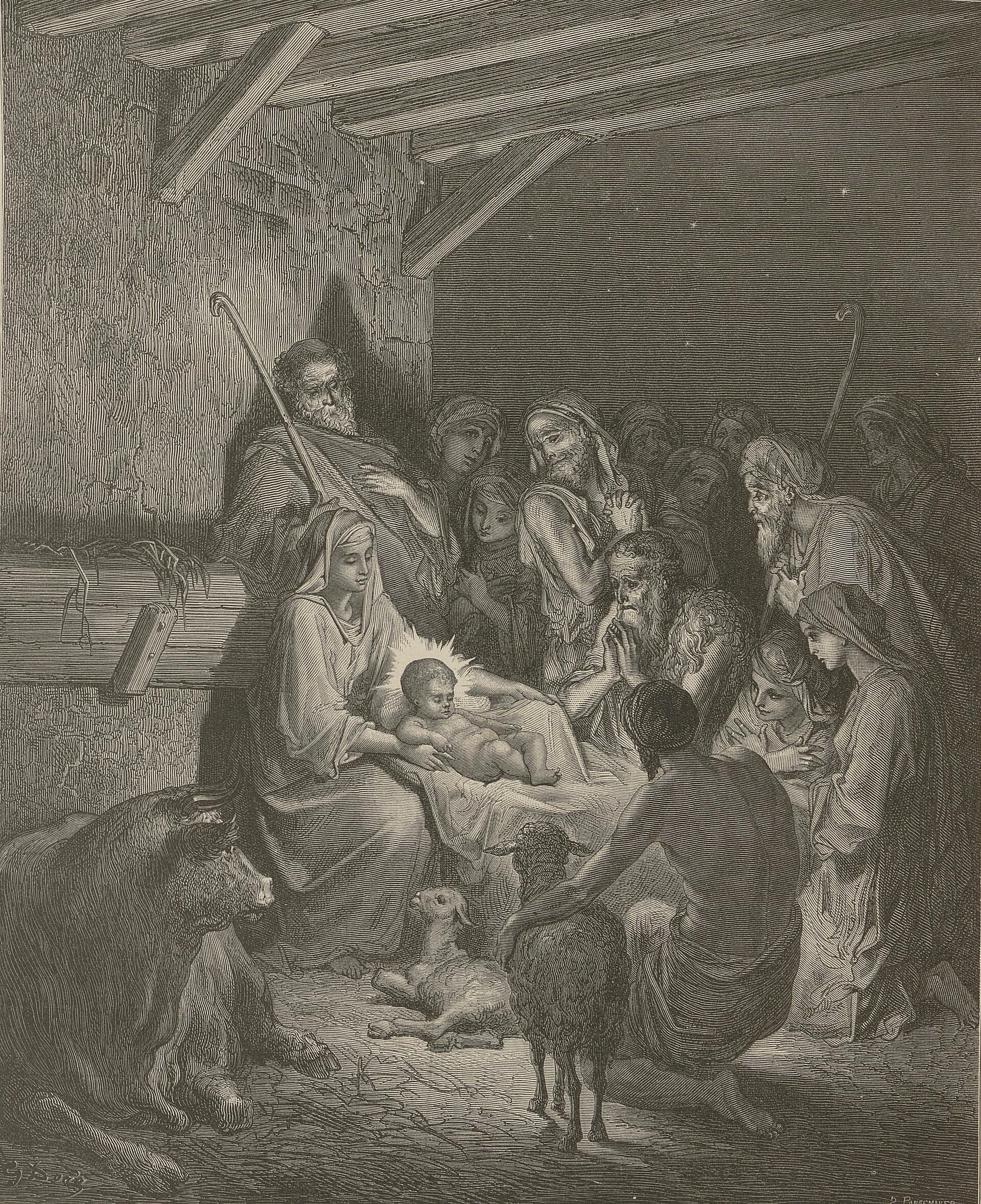
The painting
The Word Made Flesh, Gustave Doré (engraving), public domain