
Psalm 23 · The trade under the psalm
The Shepherd's Life
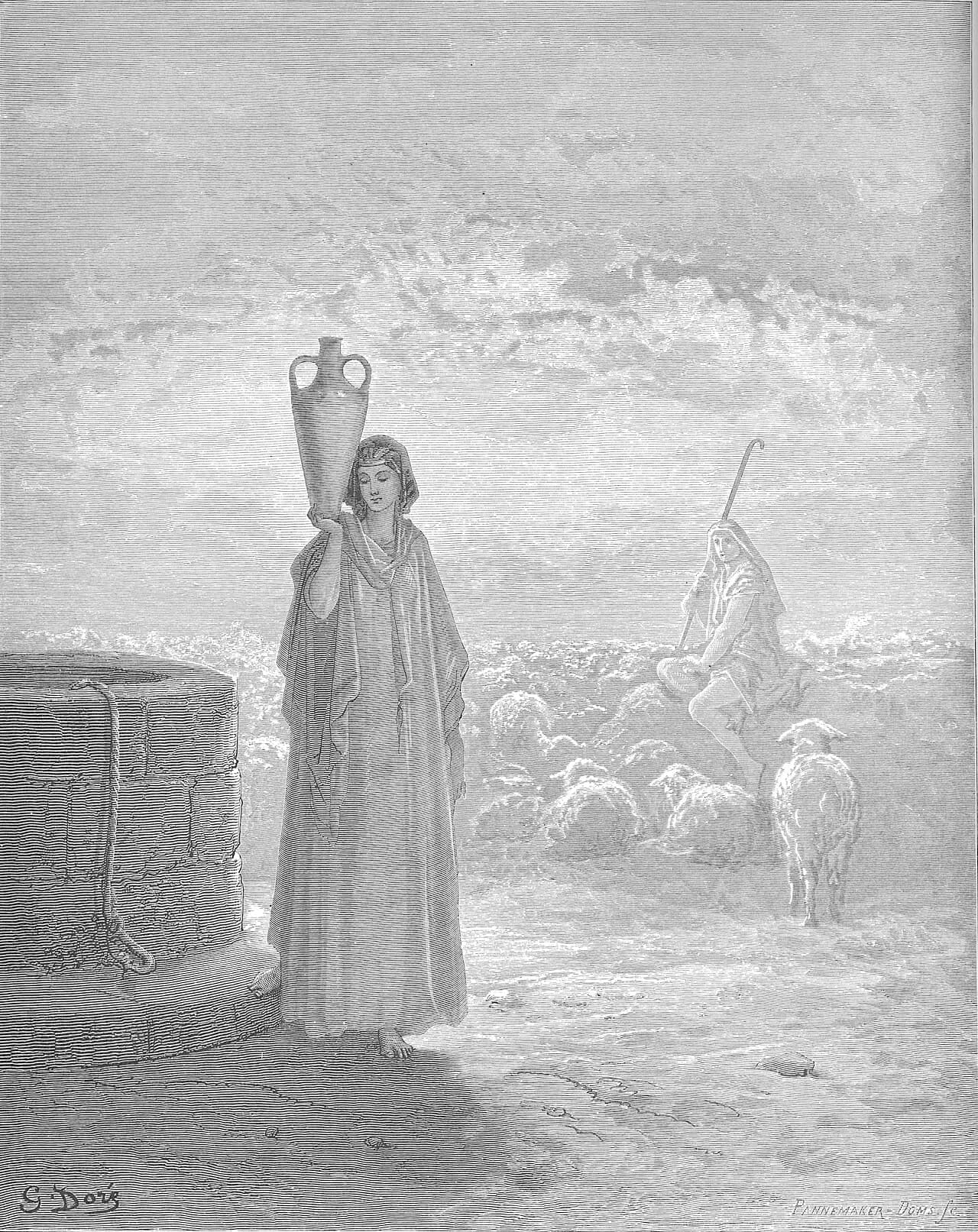
Gustave Doré, Jacob Tends Laban's Flocks and Meets Rachel, from La Grande Bible de Tours, 1866. Public domain.
THE ARTWORKDoré draws the work rather than the idea: a flock at a water source, a staff in the hand, the ground open and dry behind. Genesis 29 is four centuries before David, and the trade is the same one Psalm 23 is speaking out of. The plate is shown whole.
Summary
Summary
Six verses, six practices of a working trade. The pasture and the water a shepherd had to find, the tracks he chose, and the rod and the staff he carried. At verse 5 the psalm changes from a shepherd to a host.
- David had worked the trade, and 1 Samuel records him going after a lion and a bear for one lamb.
- The rod is a club and the staff is a crook, and the psalm calls both of them a comfort.
- At verse 5 the figure changes from shepherd and sheep to host and guest, and the enemies stay in the room.
- What this page will not claim is listed in its research file, because the sources for it could not be reached.
Psalm 23, Whole
6 verses, Berean Standard Bible, from the store
- 1The LORD is my shepherd; I shall not want.
- 2He makes me lie down in green pastures; He leads me beside quiet waters.
- 3He restores my soul; He guides me in the paths of righteousness for the sake of His name.
- 4Even though I walk through the valley of the shadow of death, I will fear no evil, for You are with me; Your rod and Your staff, they comfort me.
- 5You prepare a table before me in the presence of my enemies. You anoint my head with oil; my cup overflows.
- 6Surely goodness and mercy will follow me all the days of my life, and I will dwell in the house of the LORD forever.
The Man Who Wrote It Had the Job
two places Samuel records the trade
And Samuel asked him, “Are these all the sons you have?” “There is still the youngest,” Jesse replied, “but he is tending the sheep.” “Send for him,” Samuel replied. “For we will not sit down to eat until he arrives.”When the household is called to meet the prophet, the son out with the sheep is the one nobody sent for.
David replied, “Your servant has been tending his father’s sheep, and whenever a lion or a bear came and carried off a lamb from the flock, I went after it, struck it down, and delivered the lamb from its mouth. If it reared up against me, I would grab it by its fur, strike it down, and kill it.David's own account of the work: he went after the animal, struck it, and took the lamb back.
These two passages set the terms for the psalm. The shepherd is the youngest in the house, the work is done alone and out of sight, and the defence of one animal is expected to be physical. A reader who has both in view will hear the fourth verse of the psalm differently.
Six Verses, Six Practices
each verse beside the working practice it names
Shepherding in Judah was the work of the household, and often of its youngest member. When Samuel came to Jesse's house to anoint a king, the son who was not at the table was the one out with the sheep. David's own account to Saul is of a shepherd who went after a lion and a bear and took the lamb back out of the mouth.
Held by: 1 Samuel 16:11 and 1 Samuel 17:34-35, both from the store.
The country east of the Bethlehem ridge falls away into the wilderness of Judah, so the same shepherd worked grain-country slopes and open wilderness in one season. The psalm names two things a flock needs daily and a shepherd has to find: grass it can lie down in, and water it will drink. The Hebrew behind the still waters is waters of rest.
Held by: The site's Psalm 23 exposition record, and its place records for Bethlehem and En-gedi.
A flock moved along paths the shepherd chose, and in that country the choice mattered. The tracks run along ridges and down ravines, and the wrong one ends in ground a sheep cannot climb out of. The psalm's phrase carries the plain sense of the right paths, alongside the moral sense the older commentators heard in it.
Held by: The site's Psalm 23 exposition record, on verse 3.
The rod is the club, carried against animals and against men. The staff is the crook, used to turn a sheep back and to pull one out of a place it should not be. The psalm names both, and then calls them a comfort, which is a strange word for a weapon and a hook until you have watched what they are for.
Held by: The site's Psalm 23 exposition record, on verse 4, and the page below.
At verse 5 the psalm stops describing a shepherd and starts describing a host. A table is set, a head is anointed with oil and a cup is filled past its measure. Those three are the marks of welcome a man gave a guest under his roof. The enemies are still in the room. The table is set in plain sight of them rather than after they are gone.
Held by: The site's Psalm 23 exposition record, on verse 5.
The last verse leaves both pictures behind for a house. The shepherd's year is a circuit that returns, and the psalm ends by making the return permanent.
Held by: The site's Psalm 23 exposition record, chapter summary.
The Night, and the Fold
the one working detail this site holds byte for byte from a public-domain source
The flock spent the night penned. Adam Clarke writes on the shepherds of Luke 2 and describes the arrangement. A pen stood in the open field with the men under tents or booths beside it. The night was divided into watches, so one man was awake while the others slept.
dwelt in the fields where they had their sheep penned up; but they undoubtedly had tents or booths under which they dwelt
Adam Clarke· Commentary on the Bible, on Luke 2:8
the watches of the night, i.e. each one keeping a watch (which ordinarily consisted of three hours) in his turn
Adam Clarke· Commentary on the Bible, on Luke 2:8
And there were shepherds residing in the fields nearby, keeping watch over their flocks by night.The verse Clarke is writing on, and the same trade a thousand years after David.
How the Psalm Has Been Read
4 readings from the store's public-domain commentaries
Under a metaphor borrowed from scenes of pastoral life, with which David was familiar, he describes God's providential care in providing refreshment, guidance, protection, and abundance
Jamieson, Fausset & Brown· Commentary Critical and Explanatory, on Psalm 23:1-6
The reading this page is built on. The psalm's figures are taken from a trade David had worked, so the way to read them is to learn the trade.
Lie down - To repose myself at noon, as the manner was in those hot countries. Green - Where there is both delight and plenty of provisions.
John Wesley· Notes on the Old Testament, on Psalm 23:2
Wesley reads the lying down as the noon rest rather than the night, which puts the second verse in the middle of a working day rather than at its end.
Thy rod and thy staff - Two words denoting the same thing, and both designing God's pastoral
John Wesley· Notes on the Old Testament, on Psalm 23:4
A dissent worth printing. Wesley takes the rod and the staff as one implement named twice, against the reading that they are two with two jobs. The site's own exposition holds the two-implement reading, and both are given here.
Restoreth - Hebrew. He bringeth it back; from its errors and wandering. For - Not for any worth in me, but for the glory of his justice, and faithfulness, and goodness.
John Wesley· Notes on the Old Testament, on Psalm 23:3
The restoring is a shepherd's act on a sheep that has walked off, and the reason given is the shepherd's character rather than the sheep's value.
The third of these is a live disagreement about the trade itself, and it is printed rather than settled. Wesley takes the rod and the staff as one thing named twice; the site's own exposition of the psalm takes them as two implements with two uses. The text supports the question being asked, and neither reading changes what the verse says the implements do.
Where the Shepherd Leads
the psalm's own last word, and the one the Gospel gives it
Surely goodness and mercy will follow me all the days of my life, and I will dwell in the house of the LORD forever.The circuit ends in a house, and the psalm makes the stay permanent.
I am the good shepherd. The good shepherd lays down His life for the sheep.Jesus takes the trade's own title and names the one duty Psalm 23 never has to mention.
Psalm 23 describes a shepherd who keeps the sheep alive through everything the country can do to them. John 10 adds the one thing a working shepherd would avoid at any cost, and makes it the definition.
Keep studying
Read it1
On this page
Studies7
Places1
Symbols1
Doctrines1
Go further2