
Genesis 29 to Revelation 19 · Subject · Featured Study
The Seven Days of a Jewish Wedding
The wedding week of Genesis 29 and Judges 14, the parts of a wedding that Scripture records, and the bridegroom of the prophets and the Gospels.
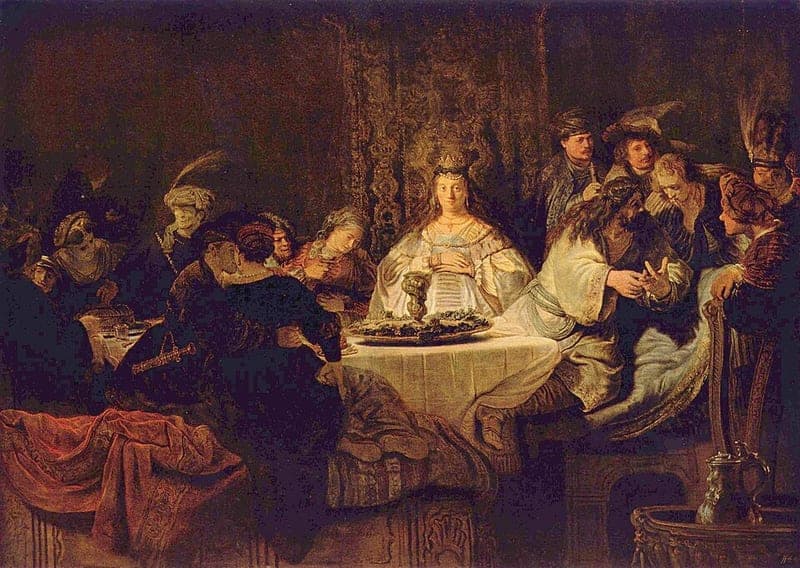
Rembrandt van Rijn, The Wedding of Samson, 1638, Gemäldegalerie Alte Meister, Dresden. Public domain, via Wikimedia Commons.
THE ARTWORKRembrandt painted Samson's wedding feast of Judges 14. The bride sits at the centre of the table in a pale gown and a crown. Samson leans back at the right with his long hair loose and speaks with raised hands to the men behind him. It stands here because Judges 14 names the seven days of that feast twice and tells what happened on the fourth day and the seventh.
Samson's wife wept the whole seven days of the feast until he told her the answer to his riddle.
Summary
Genesis and Judges keep a wedding with a feast that lasts seven days, and later Scripture makes the bridegroom and his feast a picture of God and his people.
- Jacob served seven years for Rachel, and Laban gave him Leah in her place on the night of the wedding feast.
- Judges 14 gives Samson thirty companions at his feast, and his wife was afterwards given to one of them.
- The prophets use the voices of the bride and the bridegroom for the joy God takes away from Judah and gives back.
- Jesus calls his disciples the guests of the bridegroom, and Revelation 19 ends the line with the marriage supper of the Lamb.
The Wedding Week in Scripture
Four passages give the first word on marriage and the wedding week at Haran and at Timnah.
For this reason a man will leave his father and mother and be united to his wife, and they will become one flesh.Scripture gives this word on marriage in the account of the woman's making, before it tells any wedding.
Finish this week’s celebration, and we will give you the younger one in return for another seven years of work.”Laban's words are the first place in Scripture where a wedding's celebration is given a length, and the length is a week.
Then his father went to visit the woman, and Samson prepared a feast there, as was customary for the bridegroom.The verse shows that the wedding feast was still a custom in the days of the judges, long after Laban's feast at Haran.
“Let me tell you a riddle,” Samson said to them. “If you can solve it for me within the seven days of the feast, I will give you thirty linen garments and thirty sets of clothes.Samson's wager is set by the feast's seven days, which makes Timnah a second witness to the wedding week after Haran.
Jacob's Two Weddings
Ten steps, from Jacob's offer for Rachel to the twenty years he names to Laban.
- The offerSeven years of service for Rachel, the younger daughter, Genesis 29:18, Genesis 29:18
- The first seven yearsYears that seemed but a few days to Jacob, for love of Rachel, Genesis 29:20, Genesis 29:20
- The requestJacob's time complete, and his wife asked of Laban, Genesis 29:21, Genesis 29:21
- The feastAll the men of that place invited by Laban, Genesis 29:22, Genesis 29:22
- The eveningLeah brought to Jacob, with Zilpah as her maidservant, Genesis 29:23 to 24, Genesis 29:23 to 24
- The morningLeah found, and Laban charged with deceit, Genesis 29:25, Genesis 29:25
- The customThe younger daughter not given in marriage before the older, by Laban's answer, Genesis 29:26, Genesis 29:26
- Rachel givenRachel given as wife, with Bilhah as her maidservant, Genesis 29:28 to 29, Genesis 29:28 to 29
- The second seven yearsAnother seven years of work for Laban, Genesis 29:30, Genesis 29:30
- Twenty years in allFourteen years for the two daughters and six for the flocks, Genesis 31:41, Genesis 31:41
A timeline of Jacob's two weddings in ten steps, each with what the text gives and its verse.
Leah at the Feast and Rachel after the Week
Genesis 29 tells of the night Leah was brought to Jacob, the maidservant given with her, the week before Rachel was given, and the price Jacob paid.
Genesis does not say how Leah passed for Rachel through the night. Adam Clarke explains it from the custom of the time, because the bride was always veiled and the bride chamber was dark or nearly so.
Radak, on Genesis 29:24, places the gift of Zilpah at the moment Leah was led under the wedding canopy.
Matthew Henry set the night beside Jacob's deceit of his own father in Genesis 27, and he judged that the Lord was righteous in it, however unrighteous Laban was.
When Rachel was givenGenesis 29:28 to 30
Genesis 29:28 to 30 has Jacob finish the week's celebration and receive Rachel before it names the further seven years of work. Adam Clarke calls this order perfectly plain. Jerome, in his Hebrew Questions on Genesis, reads it the same way against those who thought Rachel came to Jacob only after another seven years.
The price Jacob paidGenesis 29:18 to 20
Jamieson, Fausset and Brown write that a suitor won his bride by costly presents to her family, by cattle to the value her father set, or by service for a fixed time.
Adam Clarke counts the service as Jacob's dowry and sets it beside Shechem's offer of a dowry and a gift for Dinah.
The Parts of a Wedding
Seven parts of a wedding that Scripture records, from the bride price to the chamber.
| Part | What the text gives | Verse |
|---|---|---|
| The bride price | Seven years of service | Genesis 29:18 |
| Gifts | Silver, gold and clothing for Rebekah, and precious gifts for her brother and mother | Genesis 24:53 |
| Consent | Rebekah asked by her family, and her answer that she will go | Genesis 24:58 |
| The veil | Rebekah covered with her veil at the sight of Isaac | Genesis 24:65 |
| The feast | Given by Laban at Haran and by Samson at Timnah | Genesis 29:22 and Judges 14:10 |
| The companions | Thirty men chosen by the Philistines to accompany the bridegroom | Judges 14:11 |
| The chamber | The bridegroom coming out of his chamber, and the bride leaving hers | Psalm 19:5 and Joel 2:16 |
- Part
- The bride price
- What the text gives
- Seven years of service
- Verse
- Genesis 29:18
- Part
- Gifts
- What the text gives
- Silver, gold and clothing for Rebekah, and precious gifts for her brother and mother
- Verse
- Genesis 24:53
- Part
- Consent
- What the text gives
- Rebekah asked by her family, and her answer that she will go
- Verse
- Genesis 24:58
- Part
- The veil
- What the text gives
- Rebekah covered with her veil at the sight of Isaac
- Verse
- Genesis 24:65
- Part
- The feast
- What the text gives
- Given by Laban at Haran and by Samson at Timnah
- Verse
- Genesis 29:22 and Judges 14:10
- Part
- The companions
- What the text gives
- Thirty men chosen by the Philistines to accompany the bridegroom
- Verse
- Judges 14:11
- Part
- The chamber
- What the text gives
- The bridegroom coming out of his chamber, and the bride leaving hers
- Verse
- Psalm 19:5 and Joel 2:16
How long the feast lastedAlbert Barnes, Radak
Albert Barnes, on Judges 14:10, calls Samson's feast the wedding feast and an essential part of the marriage. He notes that it lasted seven days here and fourteen at the wedding of Tobias in the book of Tobit.
Radak, Rabbi David Kimhi, in his commentary on Genesis, takes Laban's feast as a custom that still stood in his own day, given by the groom or by the father of the bride or groom. He writes that the Sages set the wedding meal and the seven days of celebration after a wedding from Laban's words in Genesis 29:27.
Scripture gives the same number of days to mourning, when Joseph mourned his father seven days at the threshing floor of Atad (Genesis 50:10).
The thirty companionsJudges 14:11 and Judges 14:20
Albert Barnes takes the thirty to be the bridegroom's guests whom Jesus names in Matthew 9:15, and he infers from their number that Samson's family had wealth and standing. Rashi, in his commentary on Judges, calls them the retinue of wedding attendants.
Adam Clarke takes the man who was given Samson's wife in Judges 14:20 to be the one called the friend of the bridegroom in John 3:29. Jamieson, Fausset and Brown add that the bride's kin furnished the thirty, in name to honour the wedding and in truth to spy on Samson.
The riddle and the days of the feastJudges 14:12 to 18
Adam Clarke thought riddles were one of the amusements of a marriage feast, each guest proposing one in turn on a forfeit.
The Berean text has the Philistines press Samson's wife on the fourth day. John Wesley's notes read the seventh day there, and Rashi reads that seventh day as the seventh of the week, which fell on the fourth day of the feast.
Rebekah's answer and her veilGenesis 24:57 to 65
Adam Clarke concludes from Genesis 24:58 that the choice was finally left to Rebekah. He notes that the Hebrew word for her veil appears there for the first time in Scripture, and that women in the East wore it as a sign of modesty.
Hebrew Words of the Wedding
Seven Hebrew words behind the English feast, week, bride price, veil, chamber, bride and bridegroom.
MISHTEH (HEBREW, H4960)
A feast, named from the act of drinking. Genesis 29:22 is its first use for a wedding, after Lot's feast in Genesis 19:3, Abraham's feast at Isaac's weaning in Genesis 21:8 and Isaac's feast for Abimelech in Genesis 26:30.
SHAVUA (HEBREW, H7620)
A week, literally a period of seven. Genesis uses it of the wedding week twice, in Genesis 29:27 and Genesis 29:28.
MOHAR (HEBREW, H4119)
The price paid for a wife. It stands three times, in Genesis 34:12, Exodus 22:16 and 1 Samuel 18:25.
TSA'IPH (HEBREW, H6809)
A veil or shawl. It stands three times, for Rebekah's veil and twice for Tamar's in Genesis 38.
CHUPPAH (HEBREW, H2646)
A canopy or chamber. It stands three times, for the bridegroom's chamber in Psalm 19:5, the canopy over Zion in Isaiah 4:5 and the bride's chamber in Joel 2:16.
KALLAH (HEBREW, H3618)
A bride, and from that a son's wife. Ruth 1:8 uses it of Naomi's two daughters-in-law.
CHATAN (HEBREW, H2860)
A relative by marriage through the bride, used of the bridegroom and of a son-in-law. Judges 15:6 uses it of Samson as the Timnite's son-in-law.
What the Text Leaves Unsaid
Three things the text leaves open.
The Bridegroom and His Feast
The prophets and the Gospels take up the bride, the bridegroom and the wedding feast.
I will remove from the cities of Judah and the streets of Jerusalem the sounds of joy and gladness and the voices of the bride and bridegroom, for the land will become a wasteland.”Jeremiah stands first here because he makes the voices of a wedding the measure of a city's joy, which judgment takes away.
the sounds of joy and gladness, the voices of the bride and bridegroom, and the voices of those bringing thank offerings into the house of the LORD, saying: ‘Give thanks to the LORD of Hosts, for the LORD is good; His loving devotion endures forever.’ For I will restore the land from captivity as in former times, says the LORD.The same prophet makes the return of those voices a sign that the land is restored, so the wedding marks the restoration as it marked the ruin.
For as a young man marries a young woman, so your sons will marry you; and as a bridegroom rejoices over his bride, so your God will rejoice over you.Isaiah stands here because he gives the bridegroom's joy to God himself, where Jeremiah heard it in the streets.
The bridegroom in the Gospels and RevelationMatthew 9:15 to Revelation 19:9
Jesus replied, “How can the guests of the bridegroom mourn while He is with them? But the time will come when the bridegroom will be taken from them; then they will fast.Jesus speaks of himself as the bridegroom in answer to John's disciples, who asked why his disciples did not fast.
The bride belongs to the bridegroom. The friend of the bridegroom stands and listens for him, and is overjoyed to hear the bridegroom’s voice. That joy is mine, and it is now complete.John the Baptist calls himself the bridegroom's friend in answer to his own disciples, who complained that everyone was going to Jesus.
“The kingdom of heaven is like a king who prepared a wedding banquet for his son.Jesus' parable moves the wedding feast from a household like Laban's to a royal court.
But while they were on their way to buy it, the bridegroom arrived. Those who were ready went in with him to the wedding banquet, and the door was shut.The parable of the ten virgins turns on who is ready when the bridegroom arrives.
Then the angel told me to write, “Blessed are those who are invited to the marriage supper of the Lamb.” And he said to me, “These are the true words of God.”The angel calls the invited guests blessed, the place Jesus gave his disciples in Matthew 9:15 as guests of the bridegroom.
The wedding at CanaJohn 2:1 to 11
On the third day a wedding took place at Cana in Galilee. Jesus’ mother was there, and Jesus and His disciples had also been invited to the wedding.John sets the first of Jesus' signs at a wedding in Galilee.
and the master of the banquet tasted the water that had been turned into wine. He did not know where it was from, but the servants who had drawn the water knew. Then he called the bridegroom aside and said, “Everyone serves the fine wine first, and then the cheap wine after the guests are drunk. But you have saved the fine wine until now!”The master of the banquet speaks to the bridegroom as the one who supplied the wine, so the sign meets a need of the bridegroom's own feast.
Voices on the Wedding
Five quotations on marriage and the weddings of Genesis and Judges, earliest first.
Origen of Alexandria, preaching on Genesis, read the meeting at the well as a figure of the church.
“Rebekah followed the servant and comes to Isaac. The church followed the prophetic word, to be sure, and comes to Christ. Where does she find him? ‘Walking,’ the text says, ‘at the well of the oath.’ On no occasion is one withdrawn from wells; on no occasion does one stand apart from waters. Rebekah is found ‘at a well.’ Rebekah in turn finds Isaac ‘at a well.’ There she gazed upon his countenance for the first time. There ‘she dismounted from the camels.’”
Origen of Alexandria · Homilies on Genesis 10.5 · on Genesis 24:64Patristic
Ephrem the Syrian counted the years between Sarah's death and Rebekah's coming.
“By the joy [which he received] from Rebekah, who came three years later, Isaac was comforted from the mourning of his mother with which he had been shrouded for three years.”
Ephrem the Syrian · Commentary on Genesis 21:4 · on Genesis 24:67Patristic
Ambrose of Milan saw more than strength in the lion Samson met on the way to his marriage.
“And perhaps this was not only a prodigy of valour, but also a mystery of wisdom, an utterance of prophecy. For it does not seem to have been without a purpose that, as he was going to his marriage, a roaring lion met him, which he tore asunder with his hands, in whose body, when about to enjoy the wished-for wedlock, he found a swarm of bees, and took honey from its mouth, which he gave to his father and mother to eat.”
Ambrose of Milan · On the Holy Spirit 2, Introduction, 6-9 · on Judges 14:14Patristic
Matthew Henry looked for a reason behind Rebekah's ready answer.
“We may hope that the notice she had taken of the servant's piety and devotion gave her such an idea of the prevalence of religion and godliness in the family she was to go to made her desirous to hasten thither, and willing to forget her own people and her father's house, where religion had not so much the ascendant.”
Matthew Henry · Commentary on the Whole Bible · on Genesis 24:58Puritan
John Wesley asked who first spoke the words of Genesis 2:24.
“It appears by Matt. xix, 4, 5, that it was God himself who said here, a man must leave all his relations to cleave to his wife; but whether he spake it by Moses or by Adam who spake, ver. 23 is uncertain: It should seem they are the words of Adam in God's name, laying down this law to all his posterity.”
John Wesley · Explanatory Notes upon the Old Testament · on Genesis 2:24Evangelical
Laban's Custom
Genesis gives the custom of Genesis 29:26 only in Laban's own words and does not say whether it was real.
An early custom of the EastAdam Clarke
Adam Clarke, in his Commentary on the Bible, takes Laban's words as an early custom of giving daughters in marriage by order of age. He adds that the Hindus of his own day kept it as a law and held it criminal to marry a younger daughter while an elder remained unmarried.
A custom Laban inventedMatthew Henry
Matthew Henry, in his Commentary on the Whole Bible, judges that no such custom stood in Laban's country and that Laban made it up to laugh at Jacob's mistake. He warns that those who do wickedly and turn it off with a jest will find that God is not mocked.
Reading Further
Five older commentaries and homilies, earliest first.
Homilies on Genesis
Origen of Alexandria · about 240
The tenth homily reads the meeting of Rebekah and Isaac at the well.
Hebrew Questions on Genesis
Jerome · about 391
Jerome reads the Hebrew of Genesis beside the Greek versions, Aquila's among them.
Commentary on the Whole Bible
Matthew Henry · 1706 to 1710
Henry comments in turn on Rebekah's consent and her veil, and on Laban's deceit and his custom.
Commentary on the Bible
Adam Clarke · 1810 to 1826
Clarke's notes on Genesis 29 and Judges 14 compare the text's customs with the Hindu and Arab customs of his own day.
Notes, Explanatory and Practical, on Judges
Albert Barnes · 1832 to 1869
Barnes sets Samson's feast beside the other wedding feasts of Scripture, from Genesis 29 to Revelation 19.
Ready for the Feast
Scripture opens with a man and his wife made one flesh in Genesis 2:24 and closes with a wedding in which Christ is the bridegroom.
These texts ask the reader to be found ready when the bridegroom comes, as the bride of Revelation 19:7 has made herself ready.
Keep studying
Read it4
Studies3