

Joachim Patinir, The Baptism of Christ, about 1515. Public domain.
Genesis 13 · Place · Featured Study
The Jordan
Genesis names the river five times, from Lot's choice of its plain to the mourning for Jacob on its far side.
Scripture names the Jordan in 185 verses, more than three times as often as the Euphrates.
And Lot looked out and saw that the whole plain of the Jordan, all the way to Zoar, was well watered like the garden of the LORD, like the land of Egypt. (This was before the LORD destroyed Sodom and Gomorrah.)
- Today
- the Jordan River, between Israel and the West Bank on the west and the kingdom of Jordan on the east
- Region
- the rift valley from Mount Hermon to the Dead Sea
- Site
- 32.309, 35.560
- First named
- Genesis 13:10 “…the whole plain of the Jordan, all the…”
- Last named
- John 10:40 “…Jesus went back across the Jordan to the…”
Scripture names the Jordan in 185 verses, more than three times as often as the Euphrates.
Summary
The Jordan is the river of the rift valley and the eastern edge of the land of Canaan.
- Israel crossed it on dry ground while the priests stood in its bed with the ark.
- Reuben, Gad and half the tribe of Manasseh settled on its east side.
- Jesus came from Galilee and was baptized in it by John.
Where the Jordan Stands in Scripture
Genesis 13 and John 10.
Joshua names the river in 59 verses and Deuteronomy in 29. The four Gospels name it in 15, most of them in the accounts of John the Baptist.
And Lot looked out and saw that the whole plain of the Jordan, all the way to Zoar, was well watered like the garden of the LORD, like the land of Egypt. (This was before the LORD destroyed Sodom and Gomorrah.)The river's plain enters Scripture as the well-watered land Lot chose for himself.
Then Jesus went back across the Jordan to the place where John had first been baptizing, and He stayed there.The verse finds Jesus withdrawing beyond the river when His enemies tried to seize Him.
Joshua names the river in 59 verses and Deuteronomy in 29. The four Gospels name it in 15, most of them in the accounts of John the Baptist.
Then Jesus went back across the Jordan to the place where John had first been baptizing, and He stayed there.The verse finds Jesus withdrawing beyond the river when His enemies tried to seize Him.
The Jordan on the Map
Six places along its course, each with its verse.
Most of the places Scripture ties to the river lie on its lower course, below the Sea of Galilee.
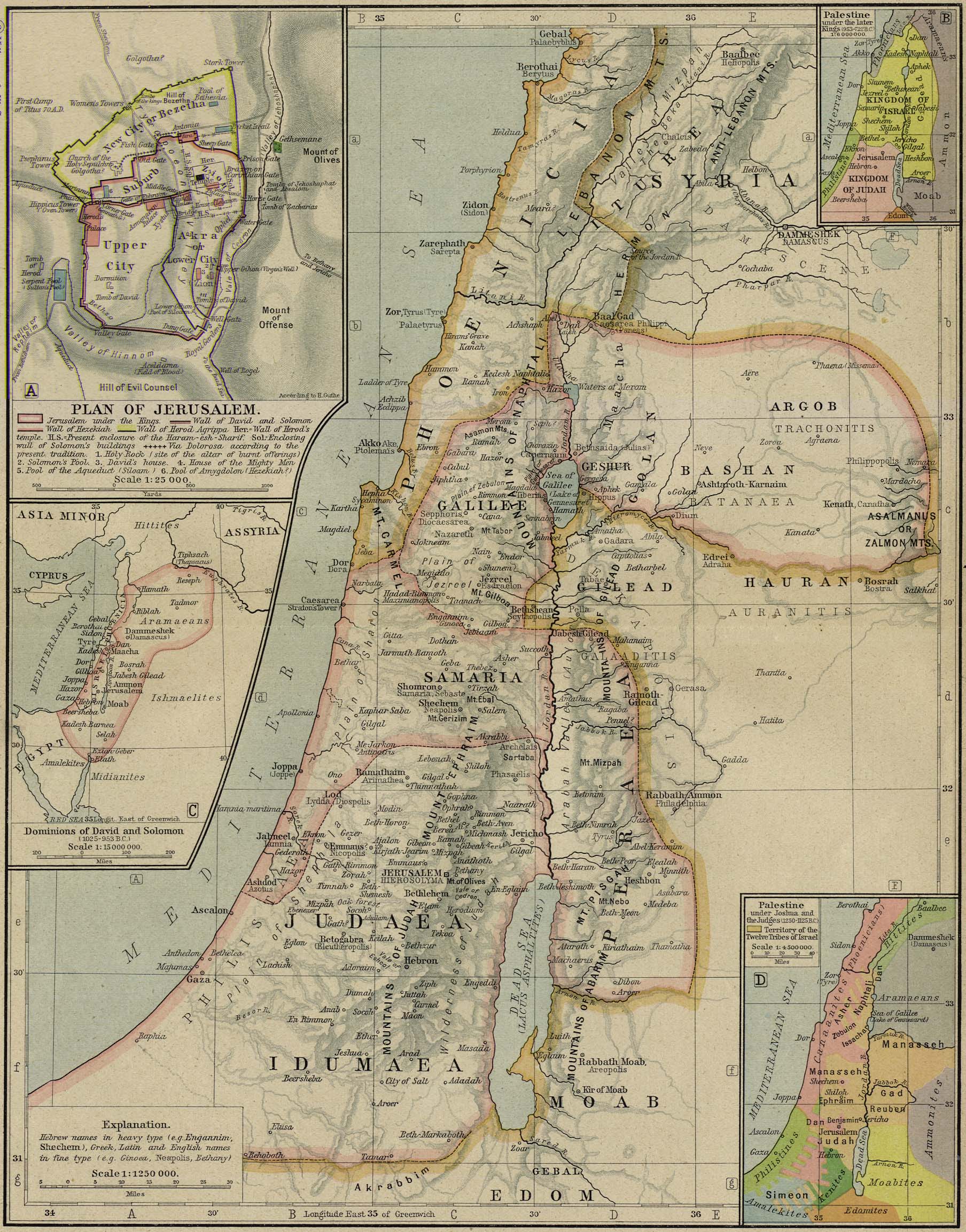
- Located: the site is known
- Probable: OpenBible scores 500 to 799
- 1Dan, The northern bound of Israel, beside the largest spring of the river. Judges 20:1
- 2Sea of Galilee, Numbers calls the lake the Sea of Chinnereth. Numbers 34:11
- 3Adam, The town upstream where the waters stood up in a heap. Joshua 3:16
- 4Jericho, The city opposite the place where Israel crossed. Joshua 4:13
- 5Bethany beyond the Jordan, The place in Perea that John 1:28 names. John 1:28
- 6Salt Sea, Joshua also calls it the Sea of the Arabah. Joshua 3:16
Base map: Reference map of ancient Palestine, Rand McNally reference map (1926), public domain. Places with a place page stand at its coordinates and the others at the point cited for each, set on the plate by Jerusalem and Damascus, as the plate prints them.
The Rand McNally plate of 1926 prints the source of the Jordan below Hermon, the Waters of Merom and the Dead Sea. A mark with no gazetteer point is graded by its OpenBible score.
Crossings and Events at the River
The patriarch, the lawgiver, the judges, the king and the prophets.
Scripture tells of the river crossed and its fords held in every age of Israel's history.
- Jacob's flight to HaranJacob crosses with nothing but his staffGenesis 32:10
- The end of the wildernessMoses sees the land from Pisgah and is told he will not crossDeuteronomy 3:27
- The days of JephthahThe men of Gilead hold the fords and test each fugitive with the word ShibbolethJudges 12:6
- David's flight from AbsalomDavid and all his people cross before daybreak2 Samuel 17:22
- The last day of ElijahElijah strikes the water with his cloak, and Elisha does the same after him2 Kings 2:14
- The days of ElishaNaaman dips seven times and his flesh is restored2 Kings 5:14
Six events, from Genesis 32 to 2 Kings 5.
The River Itself
Its springs, its length and its flood.
The Dan, the Hasbani and the Banias rise at the foot of Mount Hermon and join to form the river. It flows through the Sea of Galilee and runs 251 kilometres, or 156 miles, to the Dead Sea, which has no outlet. In its lower course it winds within its own flood plain.
Now the Jordan overflows its banks throughout the harvest season. But as soon as the priests carrying the ark reached the Jordan and their feet touched the water’s edge,The flood of the harvest season is the condition the crossing turns on.
The name of the riverYarden, from yarad
The name is commonly taken from the Hebrew root yarad, to go down, after the river's steep fall. Its first recorded use is the form Yārdon in the Egyptian papyrus Anastasi I, which probably dates from the reign of Rameses II.
What Scripture Leaves Unsaid
Two things the text does not record.
How long did the waters stand?Joshua 4:18
Joshua says the water returned when the priests' feet left the riverbed and gives no count of the hours.
Where It Points
Joshua gives the crossing a purpose, and the Father speaks at the baptism.
He did this so that all the peoples of the earth may know that the hand of the LORD is mighty, and so that you may always fear the LORD your God.”Joshua gives the dried river a purpose for every people of the earth.
And a voice came from heaven: “You are My beloved Son; in You I am well pleased.”The Father's word from heaven names the one John has just baptized.
Voices on the Jordan
Three teachers on Lot's choice, Jacob's staff and the baptism of Jesus, from Aphrahat to J. C. Ryle.
died 345 · Aphrahat the Persian Sage
ON PRAYER 6
Jacob's staff read as a sign of the cross
The quotation1 quotation
“‘With only his staff he crossed the Jordan.’ It was a wondrous symbol Jacob held in his hand in anticipation—the sign of the cross of the great prophet. He lifted up his feet on to the land of the people of the east, because it was from there that ‘a light shone out to the peoples.’”
Aphrahat the Persian Sage · On Prayer 6 · on Genesis 32:10Patristic
died 397 · Ambrose of Milan
ON ABRAHAM 2.6.33
The humility of Abram and the boldness of Lot
The quotation1 quotation
“Haughtiness is the companion of those who deviate from the truth. In fact, as Abraham was quite humble in that he offered the choice, so Lot was rather insolent in presuming to choose. Virtue humbles itself, whereas wickedness becomes arrogant. Lot should rather have relied on one more wise than he, to be on the safe side. Indeed, he did not have the knowledge to make a choice.”
Ambrose of Milan · On Abraham 2.6.33 · on Genesis 13:10Patristic
1816 to 1900 · J.C. Ryle
Expository Thoughts on the Gospels: Matthew
The High Priest washed for His office
The quotation1 quotation
“We have here the account of our Lord Jesus Christ’s baptism. This was his first step when he entered on his ministry. When the Jewish priests took up their office they were washed with water ( Exodus 29:4 ), and when our great High Priest begins the great work he came into the world to accomplish he is publicly baptized. We should notice firstly in these verses the honour placed upon the sacrament of baptism . An ordinance of which the Lord Jesus himself partook is not to be lightly esteemed.”
J.C. Ryle · Expository Thoughts on the Gospels: Matthew · on Matthew 3:13 to 17Reformed Evangelical
Where Was John Baptizing?
Two traditions of the place, each with its early witnesses.
All this happened at Bethany beyond the Jordan, where John was baptizing.The Gospel names the place and the side of the river, and nothing more.
Bethany, on the east bankthe Greek manuscripts; the church of Anastasius
Nearly all the ancient manuscripts read Bethany beyond the Jordan. A church to John the Baptist was built on the east bank in the reign of the emperor Anastasius (491 to 518). The excavated site at al-Maghtas in the Wadi al-Kharrar was inscribed by UNESCO in 2015.
The objection: the Madaba map of the sixth century labels Bethabara on the west side.
Bethabara, by the west bankOrigen of Alexandria; the pilgrims of Qasr el-Yahud
Origen, in his Commentary on John of the mid third century, found no Bethany east of the river and proposed the reading Bethabara, a place then shown as the site of the baptism. A long pilgrimage tradition keeps the western bank at Qasr el-Yahud as the place.
The objection: Adam Clarke, in his Commentary of 1832, judges Bethany the genuine reading and says Origen is supposed to have first changed it.
Books to Read Next
Two works, each free to read online.
The Historical Geography of the Holy Land, chapter 22
George Adam Smith · 1894
Smith describes the fall of the Jordan valley below the level of the sea and the terraces of its floor.
Read at archive.orgCommentary on the Whole Bible
Matthew Henry · 1710
Henry reads the banks of the Jordan as the place where God began to magnify Joshua.
Read at CCELThe River of Crossing
Joshua's twelve stones were set up so that children would ask what they meant and hear what the LORD did at the river (Joshua 4:6 to 7).
Jesus came up out of this river into His ministry, and in Galilee He called all who heard Him to repent and believe in the gospel (Mark 1:14 to 15).
Sources
Scripture is the Berean Standard Bible.
- Strong's Hebrew dictionary, h3383.
- Wikipedia, Jordan River, revision 1371651759, read on 20 October 2026.
- Origen of Alexandria, Commentary on the Gospel of John, book 6, on John 1:28.
- Matthew Henry, Commentary on the Whole Bible, 1710, on Joshua 3:7 to 8.
- The Madaba mosaic map, sixth century, Saint George's church, Madaba.
- UNESCO World Heritage List, Baptism Site Bethany Beyond the Jordan (Al-Maghtas), inscribed 2015.
- OpenBible.info, Bible Geocoding Data, ancient.jsonl, CC BY.
- George Adam Smith, The Historical Geography of the Holy Land, 1894, chapter 22, The Jordan Valley (the archive.org copy printed 1897), public domain.
- Adam Clarke, Commentary on the Bible, 1832, on John 1:28.
- Aphrahat the Persian Sage, On Prayer 6, on Genesis 32:10.
- Ambrose of Milan, On Abraham 2.6.33, on Genesis 13:10.
- J. C. Ryle, Expository Thoughts on the Gospels: Matthew, 1856, on Matthew 3:13 to 17.
Keep Studying
Read it5